
How to Write a Research Paper Outline in 5 Steps
Learn how to write a research paper outline in 5 clear steps - from choosing a topic and doing preliminary research to organizing sections, structuring body paragraphs, and finding supporting evidence.



A recent study about the effects of outlining on the writing process found that outlining before writing reduces conflict between cognitive processes. This allows your brain to more fully engage in planning and then writing without distraction.
Turn your fully-engaged brain toward planning so you can organize your ideas and simplify your writing process. With this guide, you will:
- Review the purpose of a research essay outline
- Learn the steps to complete an outline
- Analyze a strong example of a research paper outline
- Try out free templates
- Find answers to frequently asked questions.
What is a Research Paper Outline?
A research paper outline is a planning document that organizes key components of your paper. It helps define the boundaries of your essay so you can present a clear and coherent message. It also facilitates the writing process, providing a roadmap to consult as you craft sentences into paragraphs.
Outlining your research paper helps create logical ordering to the information you present. Research papers often involve finding, organizing, and presenting a large amount of information – an outline is crucial for keeping track of all your data and analysis.
Types of Research Paper Outlines
Consider two main formats for essay outlines: decimal outlines vs. full-sentence outlines.
A decimal outline presents points in a numerically ordered list. It shows the organization of essay topics clearly and in a logical order.

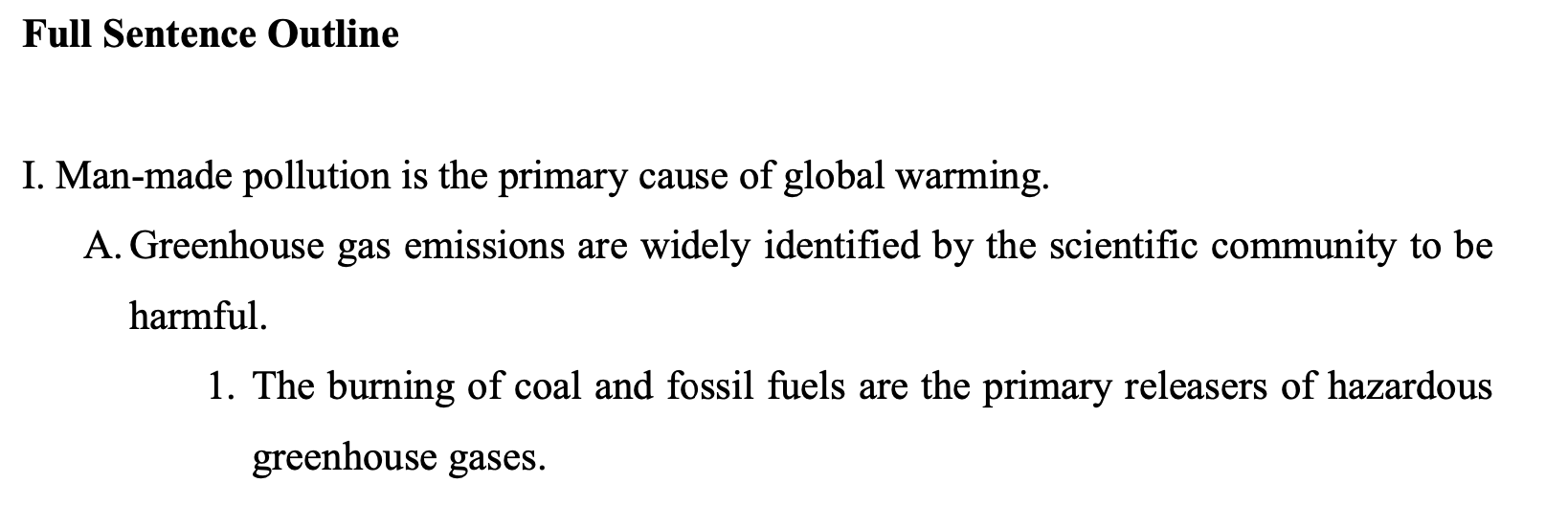
A full-sentence outline also presents a logically ordered structure of points, but brings in more detail and expresses points more fully using sentences.
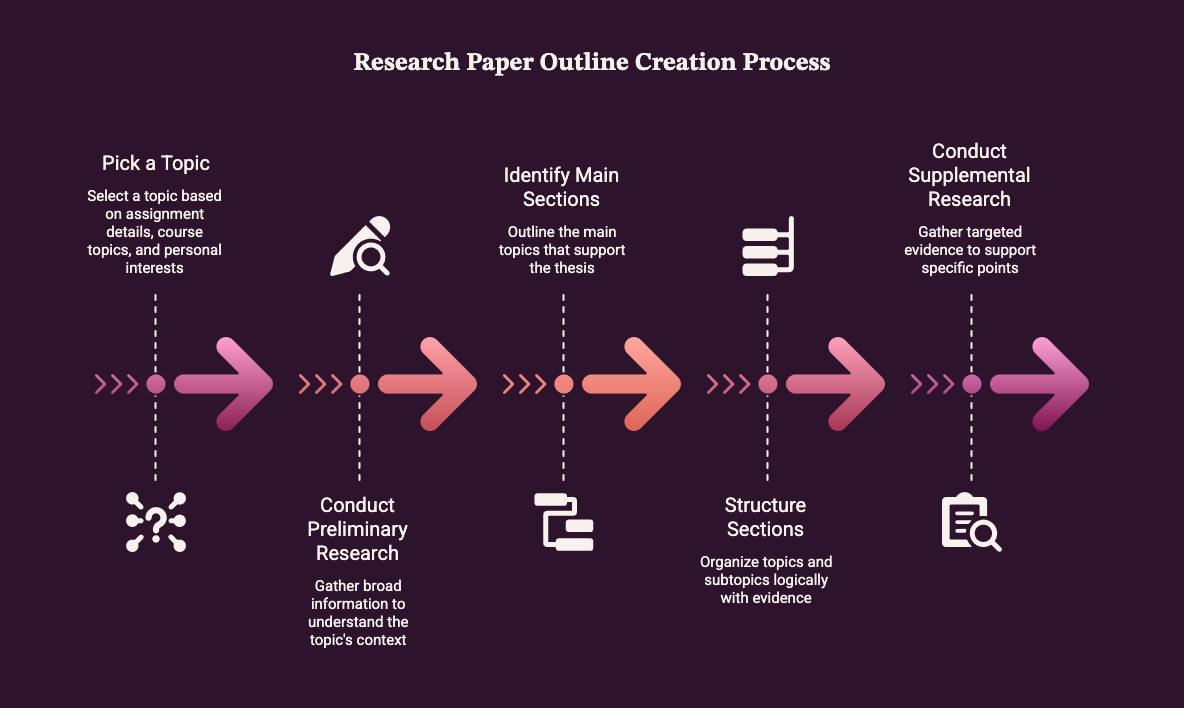
How to Write a Research Paper Outline in 5 Steps
Pick a topic
The main considerations for selecting a research essay topic are:
- The assignment details
- Pay close attention to instruction details
- Note requirements and build them into the essay structure
- The course topics
- Address topics, themes, and debates addressed in course lectures and readings
- Your personal interests
- What are you interested in researching?
- Genuine curiosity helps engage your reader and yourself
Conduct preliminary research
The goal of preliminary research is to get a sense of the context of your topic. Cast a wide net and pull in a large amount of information so that you can read about the topic to understand it broadly. Once you have a solid understanding of the topic, you can make informed decisions to narrow in on a specific thesis.
Identify main sections
This early stage of outlining is free-form and requires few details. In broad strokes, lay out the main topics that support your thesis and group related subtopics under them.
Watch the University of North Carolina Chapel Hill’s short video on essay outlining for a quick overview of how to list and group related ideas into the main sections of an outline.
Structure sections
Essay outlines create a hierarchy of topics, subtopics, and their related evidence. Group topics and information together under the essay’s key points and organize them so your reader can follow a coherent logic.
Body paragraphs need these components:
- Main Point: The topic sentence of the paragraph. It should be one of the main supporting points for the thesis.
- Evidence: The data and quotations that prove your point.
- Analysis: Your interpretation of the evidence and how it supports your thesis.
Conduct supplemental research for supporting evidence
Unlike your initial research, supplemental research should be highly targeted. Consider the sections and subsections that you structured in the previous step: which points have the most evidence and which points are lacking support?
Research Paper Outline Templates
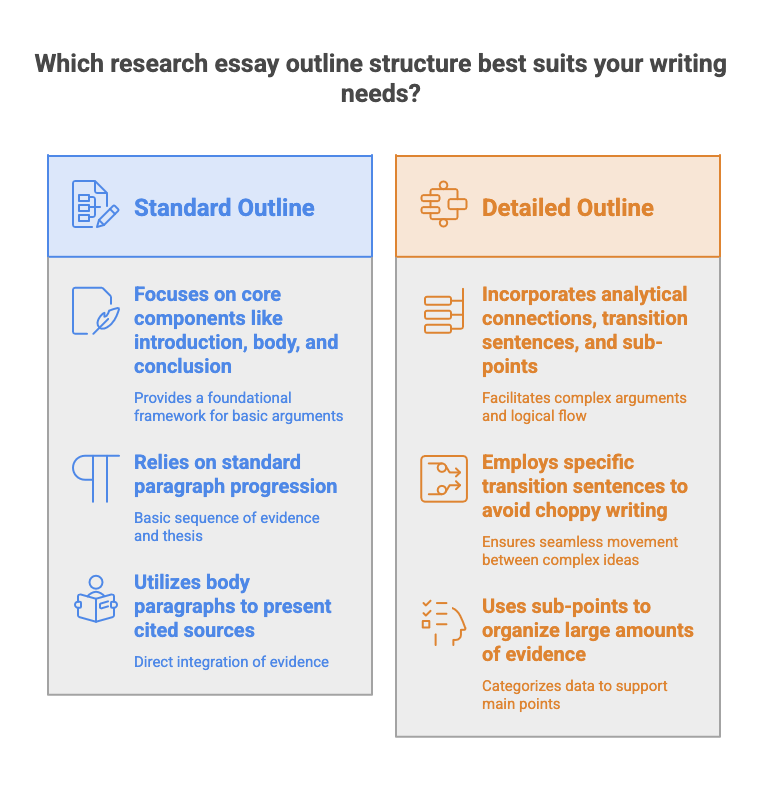
Standard Outline
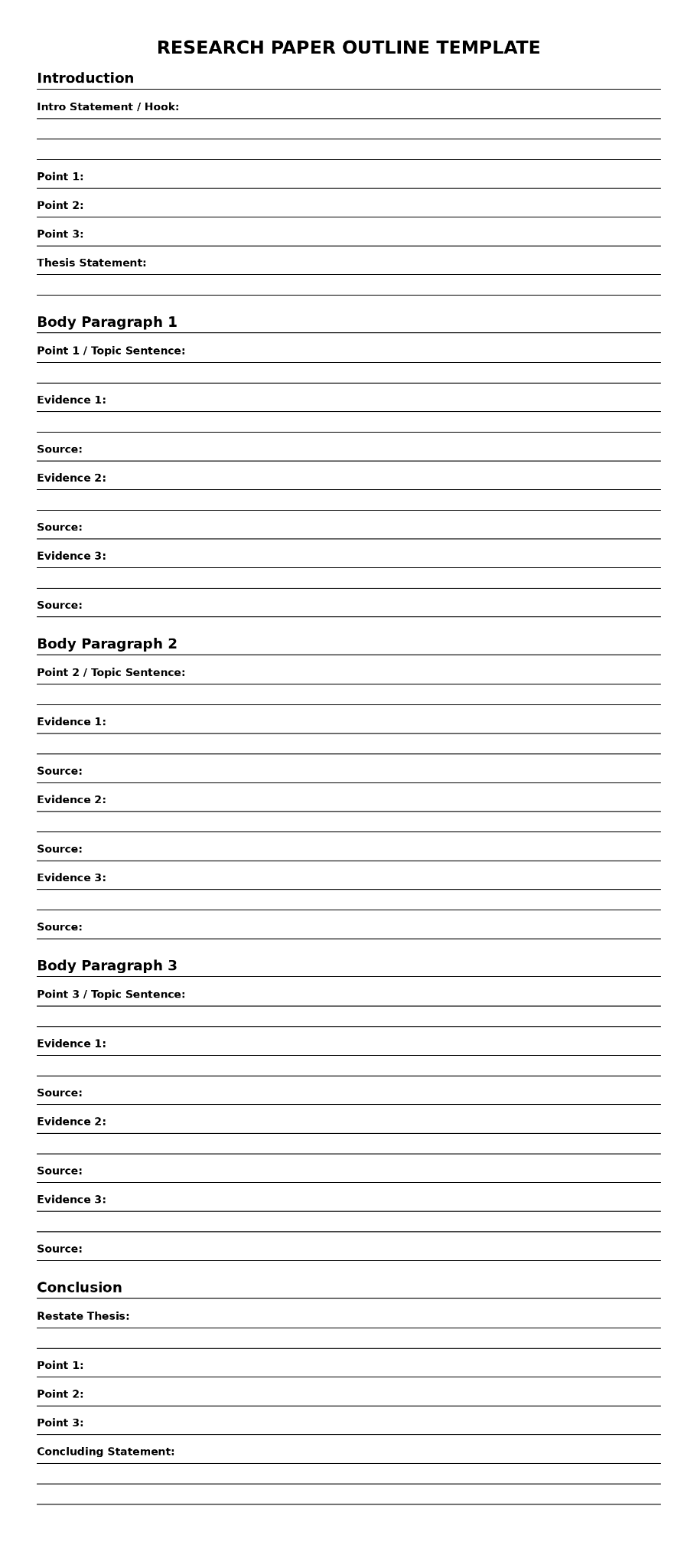
This basic research essay outline template is recommended by the University of Northern British Columbia. Here is their fillable version. As you can see below, there is space for:
- An introduction starting with a hook and ending in a thesis statement;
- Several body paragraphs with evidence from cited sources;
- And a conclusion that restates the thesis and offers a concluding statement.
Detailed Outline
Once you have the basic framework for your research essay—an introduction with a thesis, subtopics supporting the thesis, and a conclusion—you can add details to your outline that help structure body paragraphs.
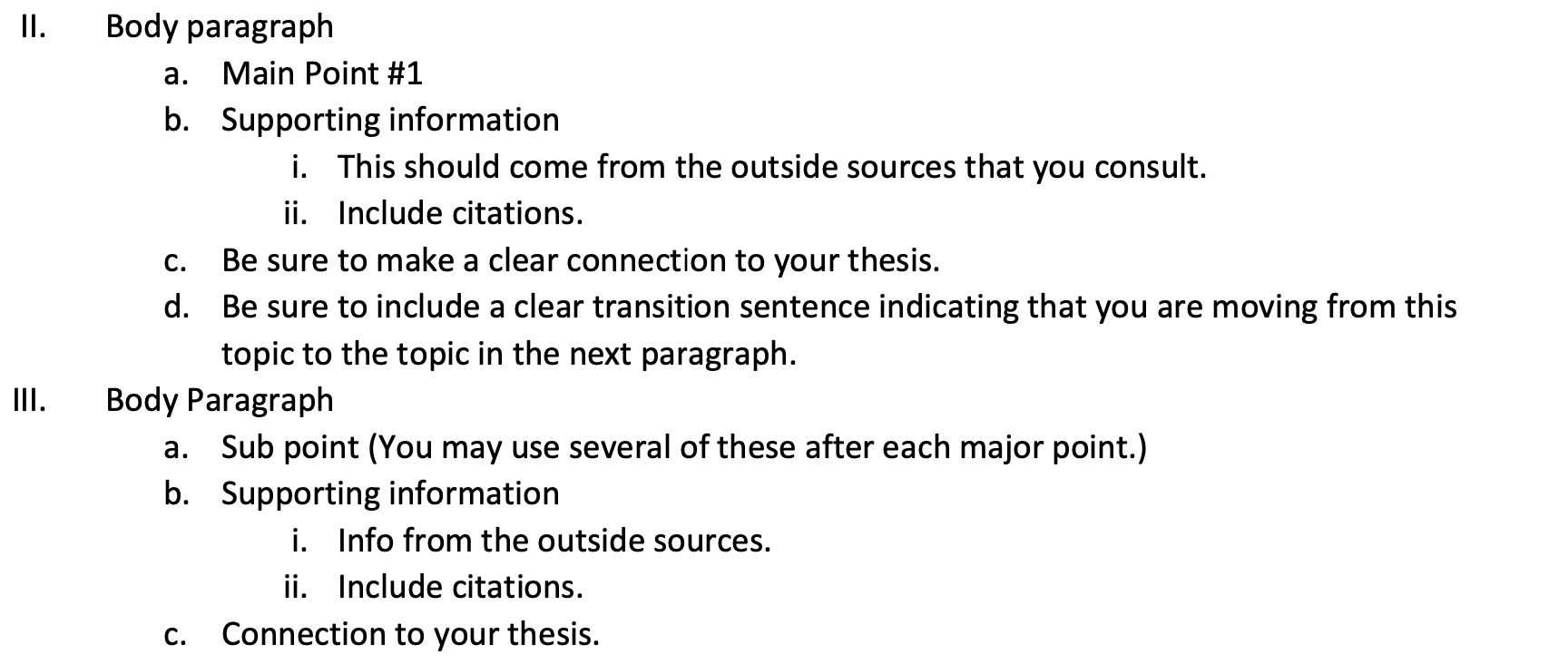
Here is a PDF template of a research paper outline from San Diego State University that breaks down the introduction, conclusion, and body paragraphs into the finer details.
Similar to the standard outline above, the outline for body paragraphs asks for a topic sentence/main point and evidence/supporting information. This template, however, creates space for additional components:
- “A clear connection to the thesis” is key to bringing your analysis and perspective to the evidence and linking it strongly to your main argument.
- “A clear transition sentence” creates flow to avoid choppy and incoherent writing.
- “Subpoint” – this is important! Unless you’re writing a 5-paragraph essay, your main points will likely involve multiple aspects and groupings of evidence, making subpoints crucial to how you present your argument.
FAQ
How do you format a research paper outline?
When you’re ready to finalize your essay draft, check this helpful guide on how to format your research paper. Check your assignment instructions to see if you’re supposed to use APA, Chicago, MLA, or another common format.
How do I write an alphanumeric outline?
An alphanumeric outline is very similar to a decimal outline but instead of decimal points it uses Roman (I, II, III…), capital letters (A, B, C…), arabic (1, 2, 3…), and lowercase (a, b, c…) numerals. Here’s an example of an alphanumeric outline:

Can AI help create a research paper outline?
Having AI write your outline often produces a recognizably generic writing style and may fabricate citations, but there are key tasks in outlining an essay where tools can boost your efficiency:
- Use a grammar checker to polish your draft.
- Run your citations through a hallucination detector to make sure they’re credible, academic sources.
- Review your writing for natural language and document your writing process with a student-centered AI detector.
How do I start writing now that I’ve outlined?
Once you’ve completed your research paper outline, pick up some handy tricks on how to write the research paper. If it’s the first paragraph that’s tripping you up, learn more about research paper introductions. Struggling to start writing may indicate that your outline is lacking in detail, so consider turning your decimal outline into a full-sentence outline, or your standard outline into a detailed outline.