How to Write a Research Paper (Step-by-Step Guide)
A research paper is a type of academic writing that presents a systematic and in-depth investigation of a topic supported by credible evidence.


The research paper is one of the most rigorous types of academic writing and, as Purdue OWL puts it, “an essential aspect of academics”. Pulling off a successful research paper can be a very rewarding experience, precisely because of how challenging it can be.
The reason students struggle with this classic format is the scale. A research paper is more in-depth than other essay formats, such as the argumentative or informative essay. There can be many sources and arguments to track, and the information has to be presented coherently.
We understand why the research paper can be a daunting task. In this guide, you will learn:
- What a research paper is and how it differs from other academic papers
- How to structure a research paper
- The 8-step process for writing a research paper
TL;DR
- A research paper presents an original, in-depth analysis supported by systematic research.
- It is structured this way: introduction, thesis, methodology, results or discussion, conclusion, and references.
- The most common mistakes when assembling a research paper are insufficient
What Is a Research Paper?
A research paper is one of the most structured pieces of academic writing. It develops an original argument and supports the argument with rigorous research and evidence. The argument has to be original (yours), and the evidence must be compiled from credible sources like peer-reviewed studies, primary documents, data sets, expert interviews, and even your own original experiments.
Research papers are a very common form of assessment in undergraduate and graduate studies, and their use extends beyond into professional journals. The goal of the research paper is to contribute to the existing body of work through new ways of interpreting or presenting evidence.
Academic vs. Non-Academic Research Papers
An academic research paper written for coursework, graduate research, or submission to journals follows a familiar essay structure and adheres to strict citation rules. This is the type of research paper we will be guiding you through in this guide.
A non-academic research paper, sometimes known as a white paper or a report, follows the same principles as the academic research paper, but the format is more flexible. This type of research paper still presents detailed research, but doesn’t have to adhere to strict citation rules.
Research Paper Structure
Even if you have never written a research paper before, its structure will be familiar to you because it is similar to other essay formats. The underlying logical flow follows the introduction-body paragraph-conclusion cadence.
Introduction
Your introduction sets up the topic and leads up to a clear and strong thesis statement. A good introduction gives an overview of what’s to come in the research paper and, most importantly, answers the question “why does this matter?”
Thesis statement
The thesis statement can be a sentence or sometimes two that articulates the main argument or finding of your research paper. A strong thesis has three key elements: it is specific, defensible, and not immediately obvious. Oftentimes, the thesis will emerge as you do your preliminary research on a topic. If you're using AI as a thesis thought partner, scanning your work with an advanced AI detector can ensure you are keeping your thinking yours.
Main body
The main paragraphs in your essay (or body paragraphs) will demonstrate the depth and quality of your research. Body sections vary by discipline, but regardless of whether you are writing a science research paper or a humanities one, the same principles apply- each paragraph develops a specific argument or point.
Conclusion
Your conclusion restates the point you made in your thesis in light of the evidence you presented. It summarizes the key findings and sometimes broadens the conversation by talking about the implications of the findings. Try not to introduce new topics or tangents in this section.
References
Your assignment brief should have specific information on which citation style you should use. If you used AI to surface research, it's a good idea to scan for hallucinations before you finalize your paper.
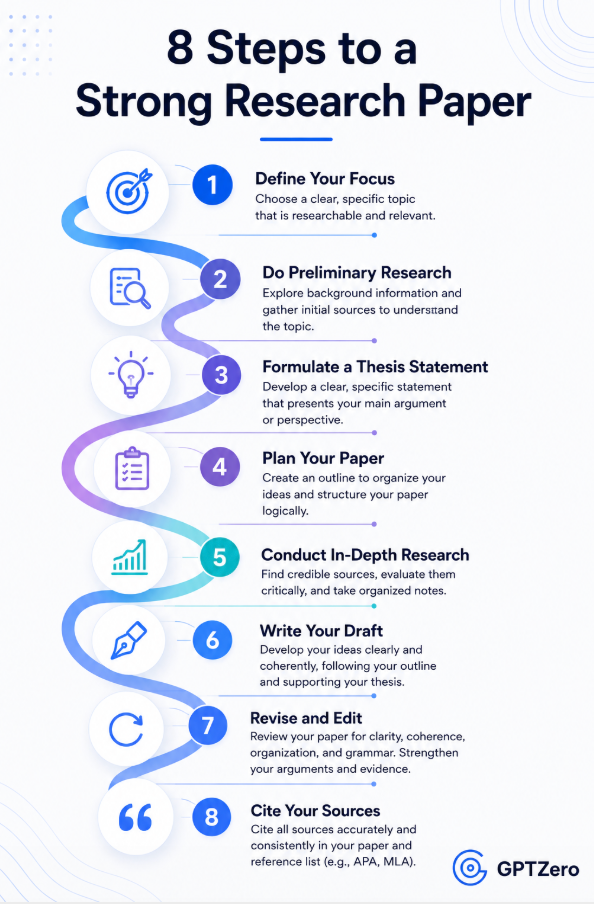
How to Write a Good Research Paper — 8-Step Process
Step 1: Pick a Focused Topic
Your topic has to be narrow enough for you to meaningfully cover in your research paper. Something as broad as “climate change,” for example, has too many nuances and is not suitable for a research paper. Go a layer or two deeper and find more specificity.
Step 2: Conduct Background Research
Your research is at the core of a successful research paper. We recommend that you do the readings before you go much further into the assignment. Read widely and begin to notice patterns, undeveloped angles, or discrepancies. Surfacing these insights will lead you to your thesis. Choose credible sources and use AI to unearth resources you may have missed in traditional searches.
Step 3: Develop a Research Question and Thesis
After all that reading, a question should be emerging in your mind. Something that hasn’t fully been answered- a point of tension. Your thesis will be the proposed answer to these questions. Make sure your thesis is specific enough and that it can be disagreed with.
Step 4: Build an Outline
Map out your paper in detail before you begin drafting. You can use point form at this stage in the process. Start by writing out your thesis and move to the body sections, including all the evidence you plan to use. Don’t forget to save a section for addressing the counterargument.
Step 5: Gather and Organize Evidence
After you have created a skeleton structure for your essay and listed your supporting evidence, it's time to go back to the books and dig a little deeper. A research paper is research-heavy, so you must track your sources carefully as you go. Decide on specific quotes and passages and note down the author, title, publication, page numbers, URL, and date.
Step 6: Write the First Draft
Your first draft’s job is to tie all your ideas together. Begin drafting without looking back to edit. No first draft is perfect, and you shouldn’t aim for perfection. Focus on the clarity of ideas and getting them down on paper. We recommend writing the body paragraphs first and the introduction and conclusion later.
Step 7: Revise for Argument, Then for Language
Your first round of revisions should focus on structural issues. Does each section support the thesis? Is the evidence solid? Are counterarguments addressed? The second pass is for surface-level polish, including formatting and grammar checks.
Step 8: Verify Your Voice and Sources
These days, most writing is hybrid. More and more students are using AI technology to assemble drafts. In your final edits before submission, you should make sure your work is your own and that any hallucinations, AI language and poor grammar have been resolved.
Research Paper Format
Formatting standards differ by citation style, but most academic papers share these basics:
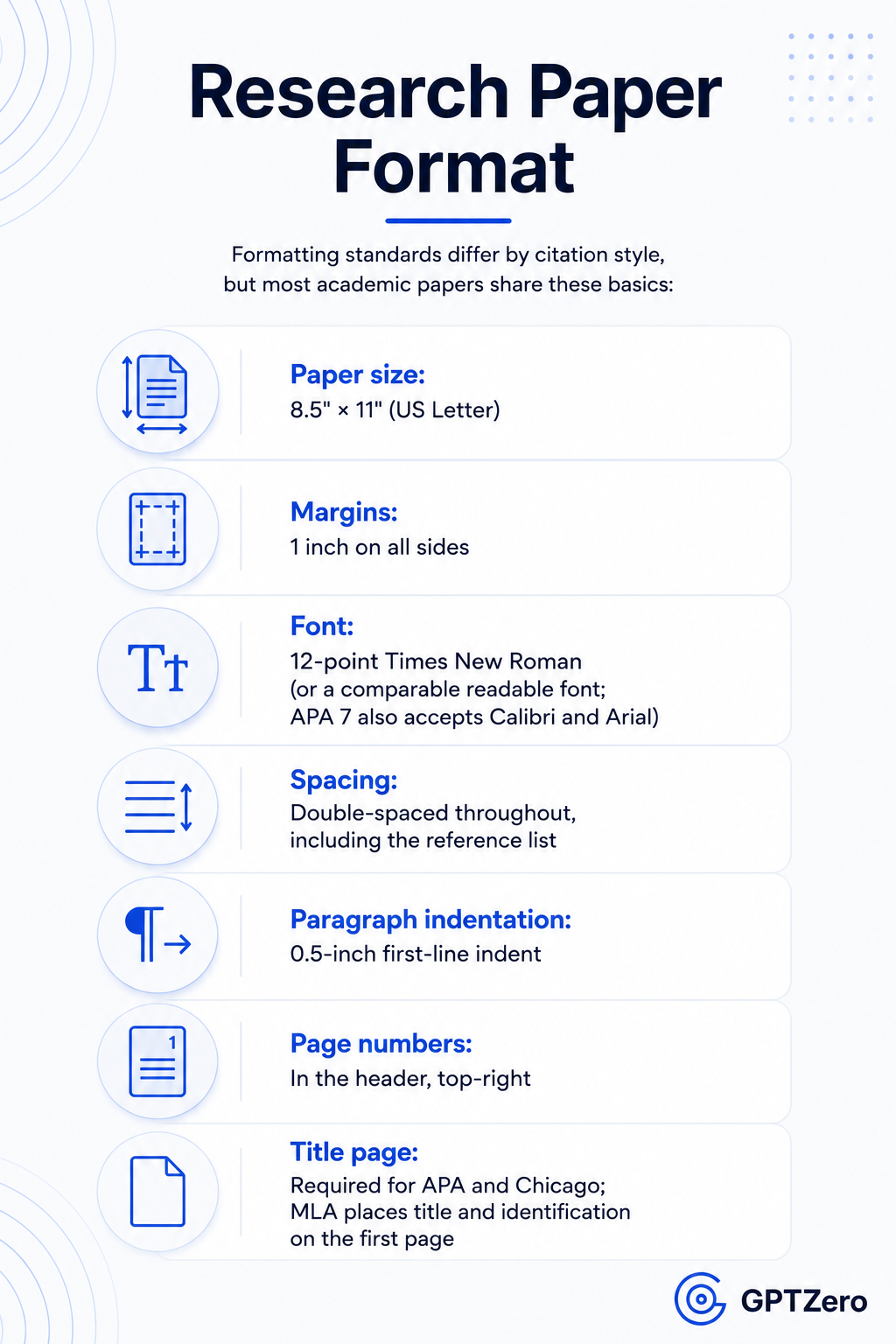
Infographic showing research paper format, including paper size, margins, font, spacing, paragraph indentations, pagination and title page.
Citation style depends on the discipline. APA is standard in psychology, education, and the social sciences. MLA is used in literature and the humanities. Chicago covers history, philosophy, and the arts. Most undergraduate research papers run between 2,000 and 6,000 words; graduate work and journal submissions can be longer.
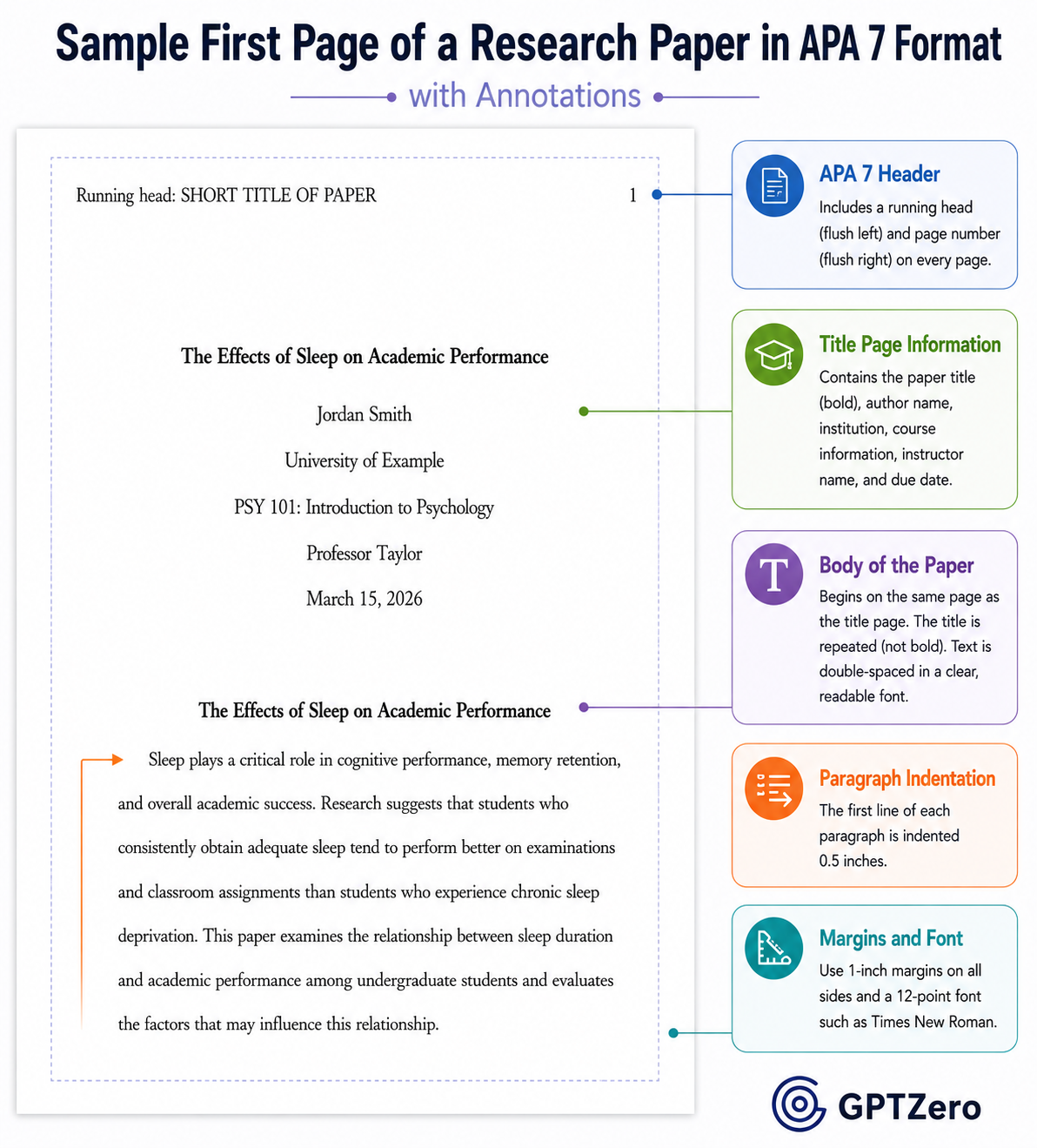
Tips for Writing an Effective Research Paper
- Read widely on your topic and more than you think you need to. Seeing your topic from multiple angles will make your paper stand out.
- Once you’ve gathered your research, don’t get stuck there- begin writing before you feel ready. You can always go back and fill in research gaps later.
- Careful when paraphrasing. The line between taking an idea that isn’t yours and properly integrating an idea into your paper can be blurry.
- Let your thesis shift if the reading supports it. Don’t be attached to what you started with.
- Give yourself plenty of time to revise. Multiple revisions are necessary, so plan.
FAQs
How long should a research paper be?
As with all essays, research papers range in size widely. For undergraduate work, they can land anywhere from 2000 to 6000 words. More in-depth graduate work can be as long as 8000 words. Always check your assignment brief or speak to your instructor.
How do you structure a research paper?
A research paper is structured in the same way as most essay formats and follows this cadence: introduction with thesis, main body paragraphs that cover methodology, results and a structured discussion of evidence and a conclusion. Lastly, a reference section which follows one of the three citation styles.
How do you write a thesis for a research paper?
A strong thesis is specific and defensible. More importantly, it leaves plenty of room for the counterargument. Allow your thesis to shift as you acquire more knowledge and read more on a topic.