How to Write an Essay Outline (With Examples, Templates & Tips)
Learn how to write an essay outline with step-by-step instructions, templates, and examples. Avoid common mistakes and structure your essay with confidence.


Students who skip outlining make significantly more errors in their essay structure. One study by Udayana University found over 4x as many errors in the essays of students who skipped outlining compared to students who used an essay outline.
An essay outline is a writing tool. It helps you make organizational decisions and provides a roadmap to follow as you draft your essay so that you stay firmly on topic and write with intention.
This guide will take you through a step-by-step process for essay outline writing and provide you with foundational facts about essay outlines, some useful templates and examples, and a few key tips to take with you.
What Is an Essay Outline? Formal and Informal
Essays must clearly organize a variety of ideas and supporting details into a coherent whole. This may seem like such a daunting task that all you can do is ask strangers on the internet to “Pray for me guys,” like this Redditor. But luckily, there is a solution: an essay outline can help you choose, organize, and connect your ideas.
Depending on your stage in the essay writing process and your own personal preferences, you may prefer an informal or a formal style of essay outline.
An informal outline is suited to early stages of essay writing, and can help you overcome the staring-at-a-blank-page paralysis by allowing creative ideas to flow without expectations for order or precision.
Formal outlines perform their best when you’ve already determined your thesis and are now looking to sort and order the many elements of your subarguments so that you can begin drafting with a clear and detailed plan to follow.
Tip: If you’re a visual or tactile learner, try mind mapping or flow charting with coloured post-it notes or cue cards.
Key Components of a Formal Essay Outline
Introduction
Hook the reader with a strong first sentence, give them necessary background information on the essay’s main topic, and state your thesis.
Body Paragraphs
Present the main points of the essay, and support those points with details, examples, explanations, and analysis.
Conclusion
State how you have proven your thesis, emphasize its importance, and end with a closing statement.
Essay Outline Formats (With Examples)
Alpha-numeric
This format follows a recognized set of characters that always observe the following order:
- Roman numerals
- Capitalised letters
- Arabic numerals
- Lowercase letters
- Arabic numerals inside parentheses
- Lowercase numerals inside parentheses
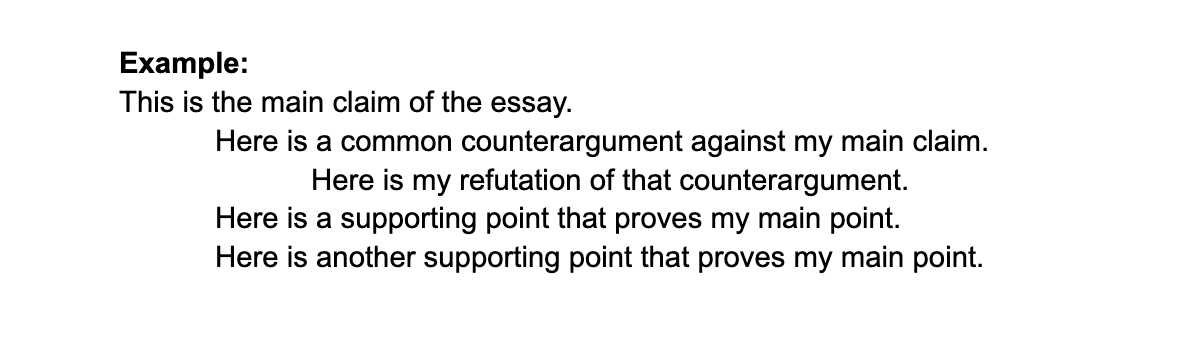
Example:

Decimal
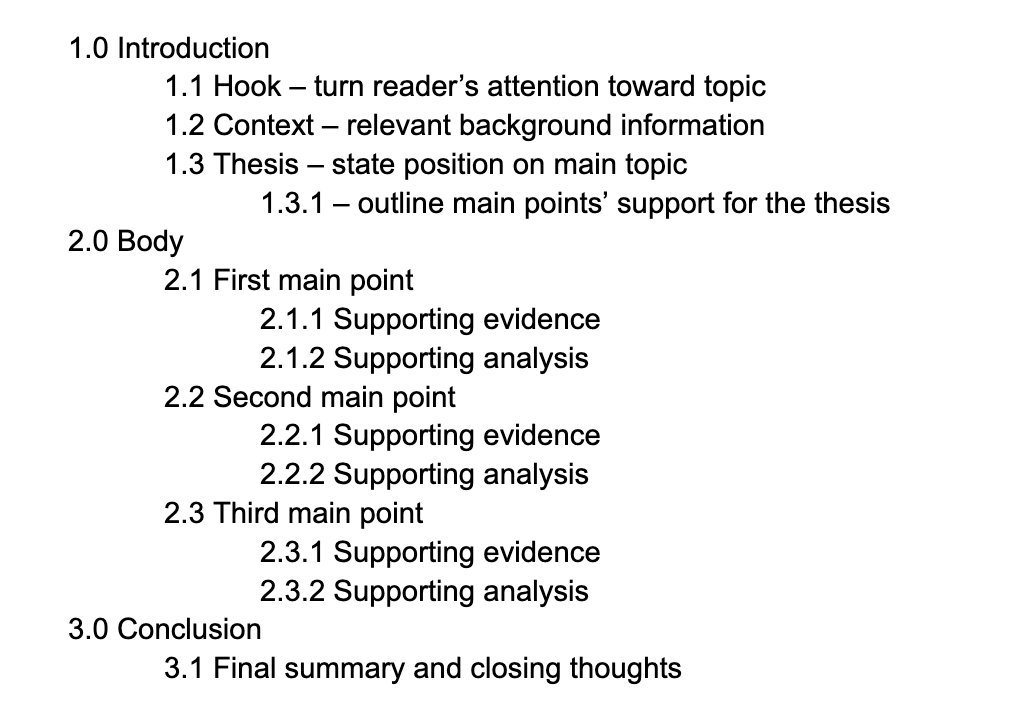
This format uses decimal notation to clearly show the subordinate levels in the outline.

Full-sentence
As the name suggests, this format uses full sentences at every level of the outline. The OWL at Purdue University notes that a full-sentence outline “is most often used when preparing a traditional essay.”
How to Create an Essay Outline (Step-by-Step)
Understand the assignment
Start with your assignment instructions. Is it a research essay? A comparative essay? What is the length of the essay? What kinds of sources are required, and how many?
Choose a topic
Select a topic that’s interesting to you and relevant to the course. Ensure your essay is connected to the course by engaging with key debates and issues raised in lectures or course readings.
Brainstorm main ideas
An informal outline is perfect for the early stages of brainstorming. Cast a wide net for ideas that relate to your main topic.
Write a strong thesis statement
Choose the main point of your essay and write a sentence that summarizes this central idea. It should strongly relate to all components in your essay.
Organize supporting points
Sift through your brainstormed ideas for themes and connections, and collect information that best supports your thesis.
Structure into outline format
A formal outline is your best friend. Put your main points into a logical order, and lay out the supporting evidence and analysis that corroborate your points.
Check for originality
Make sure your ideas are entirely your own. Run your essay outline through GPTZero, the world’s leading AI detection platform for education.
Essay Outline Templates
The Writing Centre at San José State University offers this detailed, alpha-numeric essay outline template. If you’re looking for a shorter option or want a starting point to scale up your outline, here is a more streamlined, decimal template:
Check out these essay outlines from Monash University for more examples.
Common Mistakes to Avoid
Ignoring the outline completely
Don’t neglect the useful work of outlining in advance. Writing from an outline will dramatically reduce the errors in your essay and the time you need to spend making major edits.
Overly detailed outline
Know when to change gears and start drafting. If your outline has a thesis and the main points, it’s likely time to take the plunge and start crafting sentences into paragraphs, and paragraphs into pages.
Lack of clarity
Confusing sentence structure, unclear word choice, and small errors in spelling and grammar can reduce the effectiveness of an essay outline. Run your outline through a grammar checker to boost its quality.
Conclusion
Essay outlining can save a lot of time, effort, and frustration by laying down the foundations for clarity, structure, and an efficient writing process. It can help you ease into the writing process and allow you to see gaps or connections in information that you might otherwise miss. Do yourself a solid, and spend a moment outlining your next essay before writing.