How to Write a Body Paragraph (Guide and FAQ)
Learn how to write effective body paragraphs with clear topic sentences, strong evidence, insightful analysis, and smooth transitions. This guide covers paragraph structure, popular formats, and common FAQs.

Paragraphs make reading easier and more enjoyable. Essays and news articles obviously need them, but even Redditors hate to see “a wall of text longer than the bible.” So how do you write a paragraph? What are the parts of a paragraph? And why does it matter?
Paragraphs profoundly affect readability. A study in The Journal of Verbal Learning and Verbal Behaviour found that badly structured paragraphs produce longer reading times and lower recall of passage content.
Help your readers understand and remember your points by mastering how to write good body paragraphs. This guide explains what a body paragraph is, how to structure one, and answers common questions about writing paragraphs to make your essays clearer and more organized.
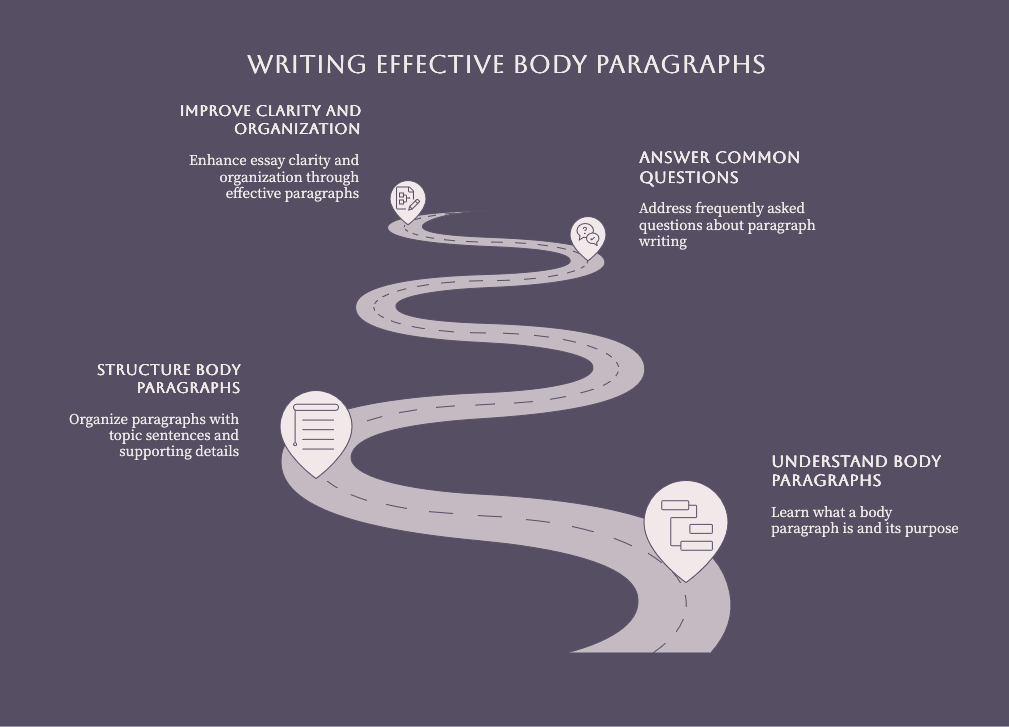
What Is a Body Paragraph?
A body paragraph is a grouping of sentences around one main idea in the essay. More specifically, “body paragraphs present the evidence you have gathered to confirm your thesis.”
An essay introduction establishes a thesis statement and gives a roadmap of the main points that will support that thesis — your body paragraphs must follow that map. These paragraphs are where you gather, organize, and present the evidence and analysis that support your main claim.
4 Key Parts of a Body Paragraph
Let’s review how to start a body paragraph, how to end a body paragraph, and everything that comes in between.
Topic Sentence
A topic sentence states the main idea that is developed in the rest of the paragraph. Secondly, Harvard University suggests that a strong topic sentence will also indicate to the reader how the paragraph is connected to the larger argument of the paper.
Tip: Train yourself to look for topic sentences as you read to understand complex and lengthy academic texts with greater speed and clarity.
Evidence
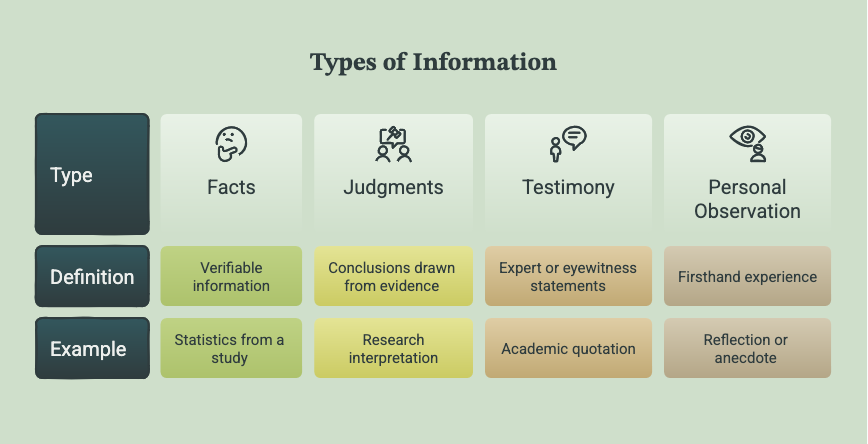
Evidence is the information you give to support your position. There are 4 main kinds of evidence:
- Facts: the strongest form of evidence, as they are usually not disputed and provide a foundation for your perspective.
- Judgements: conclusions drawn from facts. Distinct from opinions because they are based on reasoning and examination.
- Testimony: direct quotations from an eyewitness or an expert witness.
- Personal observations: your own testimony. Things you know to be true based on your own experience.
Analysis
Analysis explains the significance of your evidence and uses it to support your point. Different disciplines take different approaches (rhetorical, discourse, close reading, etc) but generally, analysis looks closely at evidence to explain how its parts work and how it relates to the paper’s main argument.
The University of Waterloo reminds us that nuanced writing will often navigate back and forth between evidence and analysis.
Transition
A transition “helps you move fluidly from the last paragraph” by bridging what’s been said to what’s about to be said. Without them, new paragraphs can be a jarring shift in topic.
If you’re struggling to create a transition, the APA Style Guide provides this great list of transitional words and phrases.
See how your body paragraphs perform against this checklist from Royal Roads University.
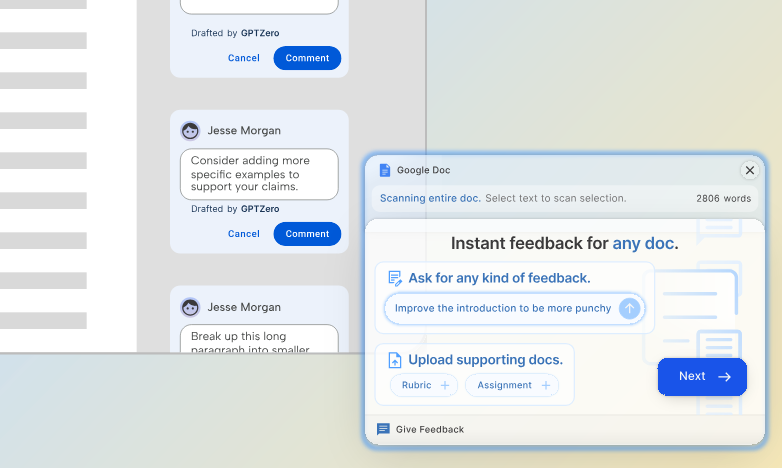
Tip: If you write your essays in Google Docs, try GPTZero’s Chrome extension and receive writing feedback generated directly into the document’s comments.
Popular Body Paragraph Structures
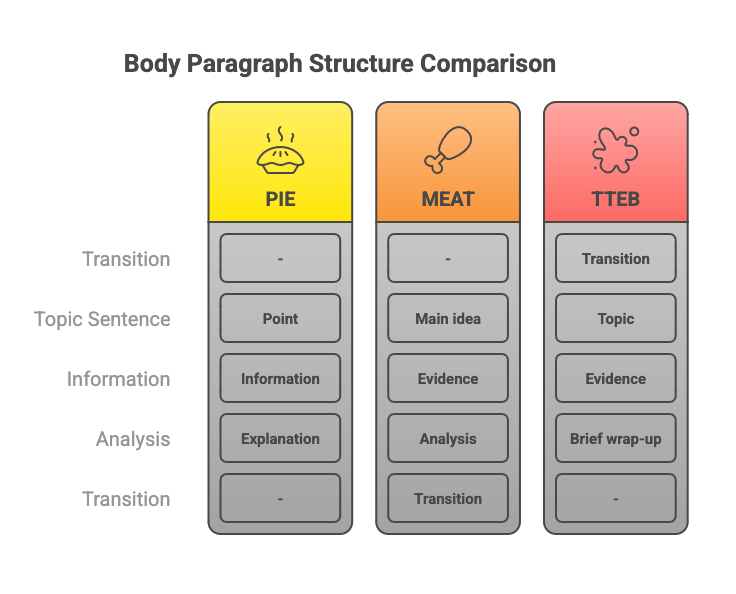
Grab a snack for this section, because we’re talking about PIE, MEAT, and … TTEB.
PIE
- Point
- Information
- Explanation
The PIE structure is simple, requiring only the main topic, the discussion that describes that topic, and an explanation of its significance.
The advantage here is that the simple format allows you to dive straight into writing about the topic. The drawback is that this format may lead to “choppy” writing that lacks flow between sections and ideas.
MEAT
- Main idea
- Evidence
- Analysis
- Transition
The MEAT format is highly recommended and contains all the key sections of a paragraph, including a transition at the end.
In reality, your body paragraph may follow a more complex structure that weaves together evidence and analysis with more nuance and transitions in and out of the paragraph to produce a pattern like TMEAEEAAT, for example.
TTEB
- Transition
- Topic
- Evidence
- Brief wrap-up
The TTEB structure is similar to the MEAT format, containing a topic, evidence, and a brief wrap-up; however, the transition comes at the beginning of the paragraph instead of the end. Transitioning into the paragraph at the beginning can be just as effective as transitioning out of the paragraph at the end.
FAQ
How long should a body paragraph be?
According to Trent University, “about one or two hundred words.” However, this will vary a lot depending on the length and structure of your paper. In academic writing, a paragraph with only 1 or 2 sentences is very likely underdeveloped. However, if your paragraph is a page or longer, look for a logical spot to break it up.
How many paragraphs are in an essay?
In a classic 5-paragraph essay, 3 of those paragraphs will be body paragraphs. However, if your essay is longer than around 1000 words, it’s likely that you will need to break apart your subarguments into more than 3 body paragraphs.
How to start a body paragraph?
A body paragraph should begin by transitioning into the main topic of the paragraph. You don’t need a hook or attention-grabbing sentence; assume the reader is already with you. If your topic follows naturally from the last sentence of the preceding paragraph, dive right in with a topic sentence.
When should you use a topic sentence?
Topic sentences are expected and often required in academic writing. You won’t usually find them in common forms of writing like novels, newspapers or this page you’re reading now.