
How to Format a Research Paper: APA, MLA & Chicago Step-by-Step Guide
Learn how to format a research paper in APA, MLA, and Chicago style. Includes rules, examples, and a step-by-step guide.


A research paper is a structured piece of writing commonly used in higher education to present in-depth research, critical thinking, and an original contribution to a field of study. It presents an academic argument backed by rigorous evidence.
As a diligent student, there is nothing more frustrating than getting your research paper back and realizing that you lost marks, not on the argument or your research, but on formatting.
Formatting may seem like an afterthought, but it is one of the most important pieces of the puzzle when it comes to presenting your research. In fact, according to a 2024 survey by Inside Higher Ed, over 60% of faculty reported that clarity and correctness in student writing still matter more than ever, even as AI tools change how papers get drafted and edited.
In this guide, we will walk you through how to format a research paper using the three most common styles- APA (American Psychological Association), MLA (Modern Language Association), and Chicago. We have included rules, examples, and a step-by-step process you can follow.
Quick Research Paper Format Cheat Sheet
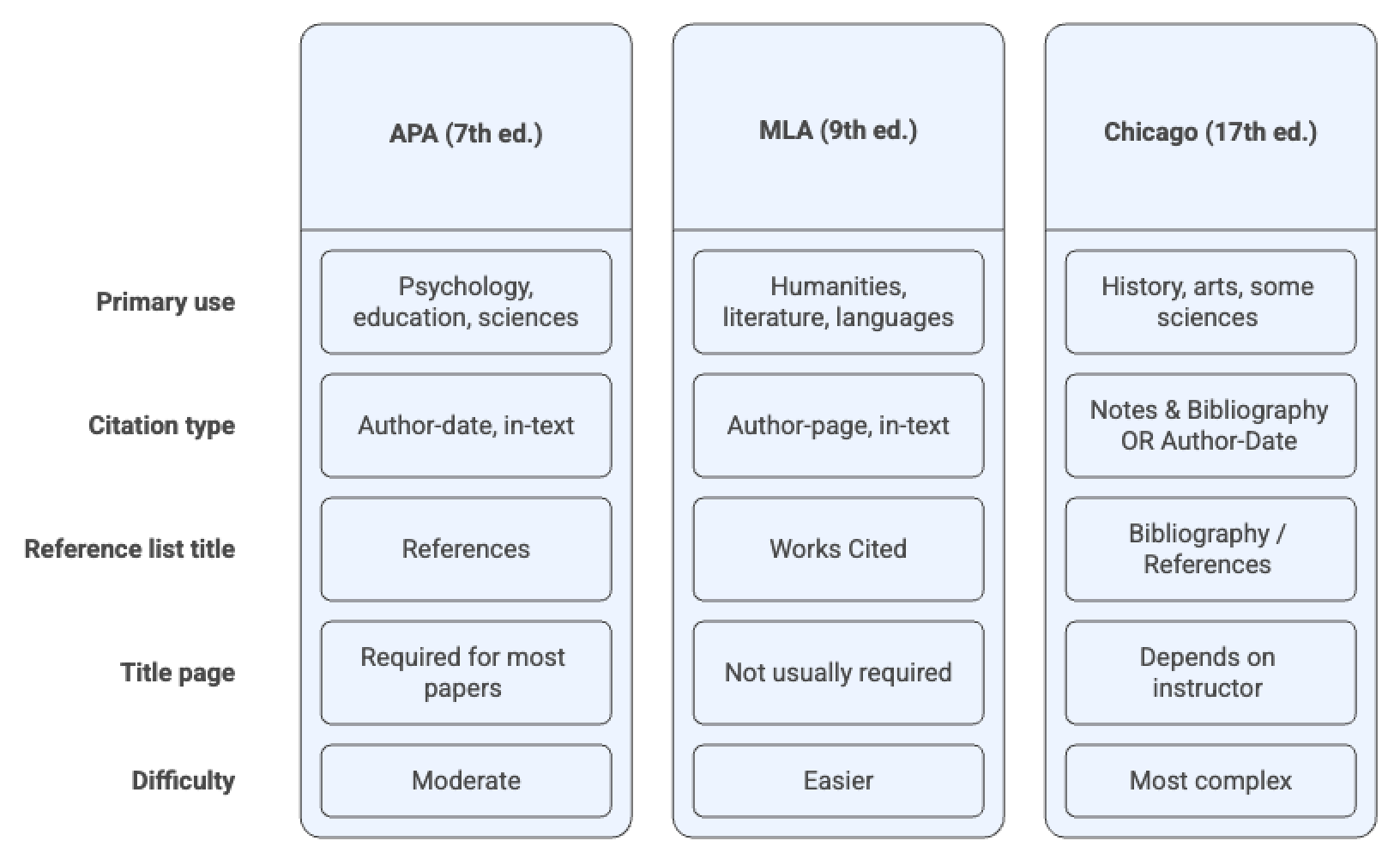
Which Format Should You Use?
Your instructor will, in most cases, determine the format you use for your research paper. If unspecified, the discipline you are writing for will be the determining factor. If you are writing within the field of psychology, education, or social sciences, APA is almost always used. English and the humanities tend to use MLA, while history, philosophy and the fine arts use Chicago.
What Is a Research Paper Format?
A research paper format is a set of rules that will determine how your final paper looks. It includes elements like margins, font, spacing, headings, how sources are cited, and how references are displayed.
Common Research Paper Formatting Rules (All Styles)
Below you will find common research paper formatting rules that overlap across all three styles:
- 8.5 x 11" paper with 1-inch margins on all sides
- Double-space the entire paper, including the reference list
- Use a readable font (Times New Roman 12pt is the safe default; Calibri and Arial are also accepted in APA 7)
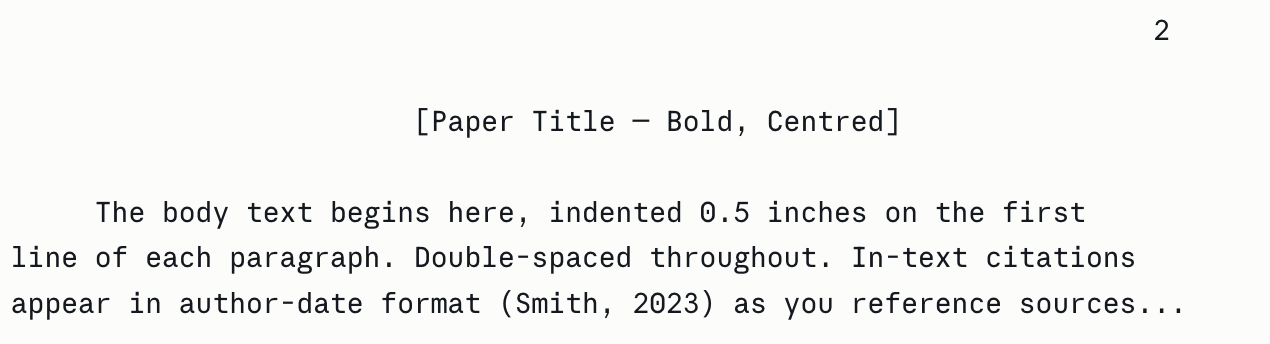
- Indent the first line of each paragraph by 0.5 inches
- Include page numbers in the header
- Align text to the left (ragged right margin)
Tip: Once you’ve drafted your paper, make sure you run it through a Grammar checker to catch the small mistakes that tend to sneak in.
Key Components of a Research Paper
No matter which style you use, all research papers follow the same architecture.
Title Page: Paper title, your name, institution, course, and date
Abstract: A short summary of your paper (APA only)
Introduction: States your thesis and sets up the argument
Body: Develops your argument with rigorous evidence and analysis
Conclusion: Summarises findings and suggests implications
References / Works Cited / Bibliography: includes a full list of sources
APA Research Paper Format (7th Edition)
How to Format Papers in APA (7th Edition)
APA Title Page Format
- Title (bold, centred, in the upper half of the page)
- Your name
- Institution
- Course number
- Instructor
- Due date
According to the APA Style website, student papers don't need a running head unless your instructor asks for one.
APA Body Paragraphs
- Double-spaced
- 12pt Times New Roman (or equivalent)
- 1-inch margins
- Level 1 headings are centred and bold
- Level 2 is flush left and bold.
APA Citations
In-text citations use the author-date format — for example, (Smith, 2023). For direct quotes, include the page number: (Smith, 2023, p. 45).
APA References
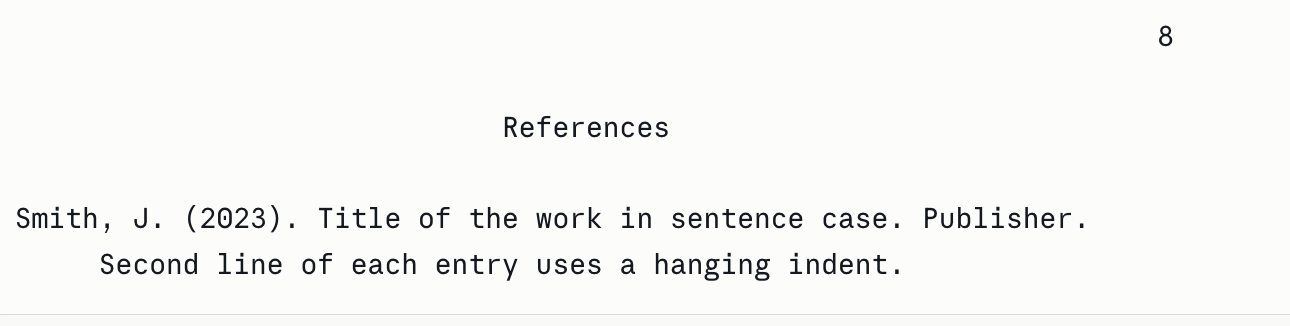
Start on a new page titled "References" (centred and bold). Entries are alphabetical with a hanging indent.
MLA Research Paper Format
MLA Title Page Format
There is no separate title page in MLA. On the first page, include:
- name
- instructor
- course and date (day-month-year, e.g., 17 April 2026) in the top-left corner
The title of your paper is centred below, with no bold, italics, or underlining. Your last name and page number should be inserted in the top-right header of every page.
MLA Body Paragraphs
- Double spaced
- Use a 12pt Times New Roman font
- 1-inch margins
- 0.5-inch paragraph indents
MLA Citation Style
Use the author-page format for in-text citations. For example: (Smith 45).
MLA Works Cited
The reference list is titled "Works Cited". The title of this section is centred in plain text on a new page. Entries follow and are alphabetical with a hanging indent. As the MLA Style Center notes, every entry must correspond to an in-text citation in the body.
Chicago Style Research Paper Format
Chicago style is the most flexible and the most complicated of the three.
Two systems of formatting. Which one you use depends on your field.
- Notes and Bibliography (NB) option: Commonly used in history, literature, philosophy, and the arts. Sources are cited using numbered footnotes or endnotes, with a full bibliography at the end.
- Author-Date (AD) option: mostly used in the sciences and social sciences. Sources are cited in parentheses (Smith 2023, 45). A list of references is included at the end.
Chicago Style Title Page
- Separate title page
- The title should be centred and located about a third of the way down
- Your name, course, and date on separate lines below the title
- Page numbers begin on the first page of the body, not the title page
Chicago Style Body Paragraphs
- Double-spaced
- 12pt Times New Roman font
- 1-inch margins
- 0.5-inch paragraph indents
- Block quotes of five or more lines are single-spaced and indented
Chicago Style Citation
- Use a superscript number in the text to point to a footnote (or endnote)
- Bibliography or reference list appears at the end, alphabetized with hanging indents
Step-by-Step: How to Format a Research Paper
- Set up your blank document. Choose your format, set margins to 1 inch, pick your font, and turn on double-spacing.
- Create your title page. Double-check your assigned style specifications.
- Outline your body text. Get the big ideas down on the page and organize them.
- Add citations. Add your citations, paying close attention to your assigned style guide.
- Create your reference list. Using your style guidelines, compile your references and triple-check the formatting.
- Proofread your draft. Use a grammar checker to clean up any mistakes.
- Do a final check for plagiarism and originality. Many students run their writing through a Plagiarism Checker as a final safeguard, especially when they've cited a lot of sources.
Tip: If you regularly use AI to aid you in your work, an AI detector extension lets you check originality directly in your browser and across multiple tabs.
Research Paper Format Example (APA, 7th edition)
APA Title Page Example (7th edition):

APA Body Paragraph Example:
APA References Example:
Common Mistakes to Avoid
- Mixing up style rules: Ex. Using (Smith, 2023) in one section and (Smith 45) in another.
- Messy or wrong indentation: The most common areas to check are first-line indents on body paragraphs and hanging indents on references.
- Wrong reference formatting: Look for missing italics on book titles and inconsistent punctuation between elements.
- Inconsistent fonts or spacing: Careful not to accidentally use more than one font, a common occurrence when copying and pasting text.
- Forgetting page numbers: Especially on the title page, as most styles still require them.
Tip: If you are a grad student, researcher, or even a freelance writer, an AI detector for writers can help you keep your voice consistent across drafts, especially when you're working with multiple sources.
Conclusion
Getting the formatting right for your research paper is not just an annoying formality. It signals to your reader that you take your work seriously and present your work in the best possible light.
The good news is that once you understand how each style works, the process becomes much more straightforward with each research paper you write.
If you want confidence that your essay is truly original, run it through GPTZero’s AI checker for students . Widely used in education and trusted by over 380,000 educators, it analyses writing at the sentence level to highlight potential AI-generated content.
FAQs
How do I format a paper in APA Style?
The core rules of APA are 1-inch margins, double-spacing, and 12pt Times New Roman (or another approved font). Also include a title page, and use in-text author-date citations. Always include a References page at the end.
Can I use more than one citation style in my research paper?
It is not a good idea to mix citation styles. Pick one style and use it consistently.
How do I choose among Chicago, APA, and MLA?
Most of the time, your instructor will specify the formatting you need to use. If it's not specified, use the default for your discipline: APA for social sciences and psychology, MLA for humanities and literature, and Chicago for history and the arts.
What's the difference between Works Cited, References, and Bibliography?
Works Cited (MLA) and References (APA and Chicago Author-Date) include only the sources you actually cited in the body of your paper. If it's not referenced in the text, it doesn't appear here.
Bibliography (Chicago Notes and Bibliography) is broader. It includes every source you cited, plus any additional reading that shaped your paper and thinking. Think of it as a full paper trail on your process.
How do I edit my research paper before submitting?
Run a final review that covers three things: originality, grammar, and formatting. Many students combine an AI checker for students with a grammar checker to fix both surface-level errors and maintain academic integrity.