
How to Write a Research Paper Introduction (Step-by-Step Guide)
Struggling to start your research paper? Learn how to write an introduction with a strong hook, clear research gap, and thesis that earns top marks.



Crafting an airtight research paper introduction can be a nightmare. Most students struggle to clearly define their research gap and thesis statement in the first paragraph, even though studies show “a strong positive relationship” between good introductions and good grades.
If you’re an undergraduate student struggling to start your research paper, this guide will show you how to write an introduction that clearly presents your argument and earns higher grades.
You’ll understand what a research paper introduction is and what it needs to accomplish by following a step-by-step guide, learning about common mistakes, and reviewing a checklist and FAQ on best practices for writing your research essay introduction.
What Is a Research Paper Introduction (and Why It Matters)
An introduction paragraph engages the reader’s attention and prepares them to understand and anticipate the arguments and analysis you’re going to present in the body of the paper.
A research paper introduction is distinguished from the introductory paragraph of other essay formats by its emphasis on research findings and their significance. You must highlight why your research was needed.
Why It Matters
An introductory paragraph grabs the reader’s attention, signals why they should care about your topic, and prepares them to follow you through the various subtopics and supporting arguments of your paper. It sparks curiosity and provides a roadmap into the paper.
From your perspective as the writer, an introductory paragraph sets your house in order so you can welcome the reader into a well organized paper. If you’re able to lay out a clear introduction, then you understand the composition and focus of your own paper.
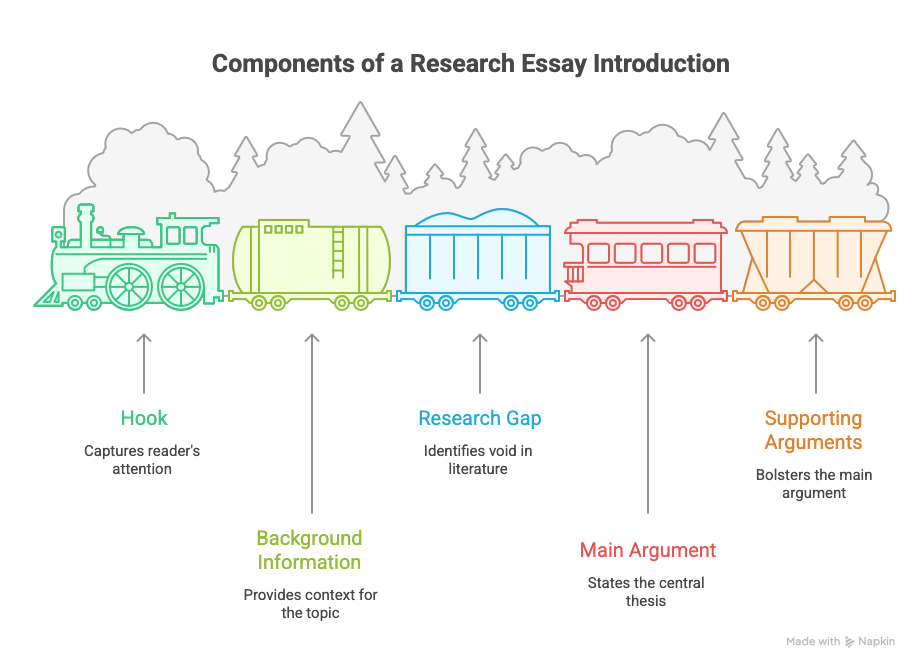
Anatomy of a Perfect Research Paper Introduction
Hook
A hook is an attention-grabbing first sentence. It snares the reader’s curiosity, usually with a bold statement or an intriguing fact. For a research paper, a hook will frequently highlight an underresearched area of knowledge.
Background information
This is the background context to your main topic that a reader requires to understand:
- What your paper is about
- Why that topic is important
- What is unknown about the topic (the gap that your research will address)
Thesis
For an undergraduate paper, the thesis will be 1-3 sentences that tell the reader clearly what the paper’s main point is, and how it will mobilize key supporting arguments.
The University of Waterloo illustrates the two components of a thesis as interlocking puzzle pieces:

For a postgraduate level introduction paragraph, consider the University of Southern California’s C.A.R.S. Model.
How to Write a Research Paper Introduction (Step-by-Step)
Introduce the topic and grab the reader’s attention
Craft an engaging hook. Have fun with it! This is a chance to be creative. Take a peek at these literary examples of hooks to get inspired and check out Dr. Caitlin Tucker’s strategies for writing hooks.
Tip: As you review research materials and literature sources, note compelling statistics and quotes that relate strongly to the core point of your paper and turn one into your hook.
Provide context
Give background information on your topic and introduce key concepts. Be highly selective about what you include. Include only the information the reader requires to understand your thesis and its relevance.
Identify the research gap and its significance
Describe the importance of your topic and highlight what knowledge is missing on the topic. Ask yourself: “So what?” Tell the reader your research objectives and the stakes of your research.
State the thesis
Declare the main argument of your paper and how it is supported by subarguments. You may rework your thesis statement after writing the subarguments, but start with a working thesis.
Try out the University of Arizona’s Thesis Generator. Then consider the University of North Carolina’s list of questions to strengthen your thesis.
Good vs Bad Introduction Examples
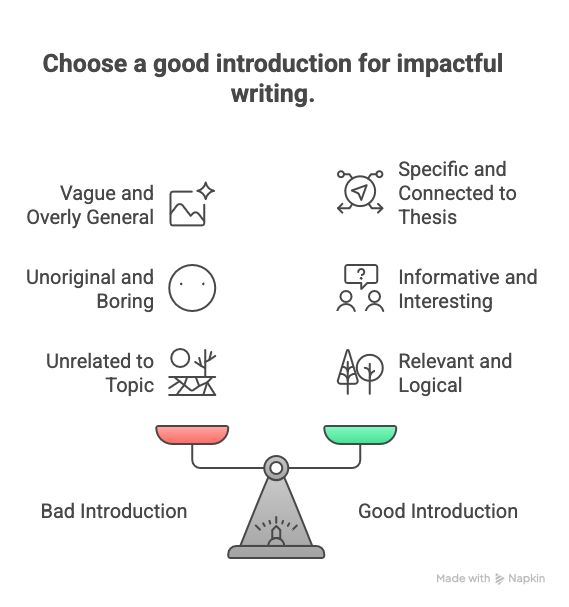
Consider these examples of weak introductions. Some key distinctions between a bad introduction and good introduction are:
Common Mistakes to Avoid
General first sentences
You may have heard this dubious advice in high school: “Start with a broad statement.” While your thesis shouldn’t be the first sentence, a bland truism or a sweeping generalization will not only bore your reader, it may also make them more sceptical of the truth or quality of what you’re going to say next.
Missing the research gap
Identifying the research gap signals that your research is necessary and original. Clearly indicate what’s new about your research or what problem it seeks to address.
Tip: Verify the uniqueness of your introduction and avoid unintentional plagiarism with a plagiarism checker.
Burying the lead
Don’t hide your thesis statement. Use this familiar phrase to flag your thesis to the reader: “This paper argues that…”
Under or overshooting the length
As a general rule, an introduction should be no more than 10% of the paper. Condense your writing and use the space efficiently, but be sure to include the features in the following checklist.
Research Paper Introduction Checklist
- Hook included
- Background clear
- Research gap defined
- Thesis strong
- Length appropriate
FAQ
Do research paper introductions vary by degree/discipline?
- Yes, but the core features of academic writing remain the same. Research papers require an introduction with a hook, a context, and a complete thesis. For discipline-specific features, consider Harvard University’s examples of introductions in Biology, Literature, and the Social Sciences.
Should I include citations in the introduction for a research paper?
- Not always, but it can be a good idea. As part of the background information to the paper, you may have fact claims that require citations.
When should I write the introduction?
- Before writing: the rough version. You need to outline your main topic and how it connects your subtopics before writing, so some elements of your introduction should be in place from the start.
- After writing: the final version. After you’ve done the heavy lifting of writing your body paragraphs, you’re ready to polish up your introduction.
How should I revise my introduction after completing the rest of the paper?
- Reverse outlining is a great idea at this stage. The OWL at Purdue offers a two-step process to help clarify the introduction’s overview of claims.
- Introductions are short and interesting–show yours off to a friend or family member and have them proofread for clarity.
- Use a grammar checker to clarify arguments and eliminate errors.