Topic
Investigations
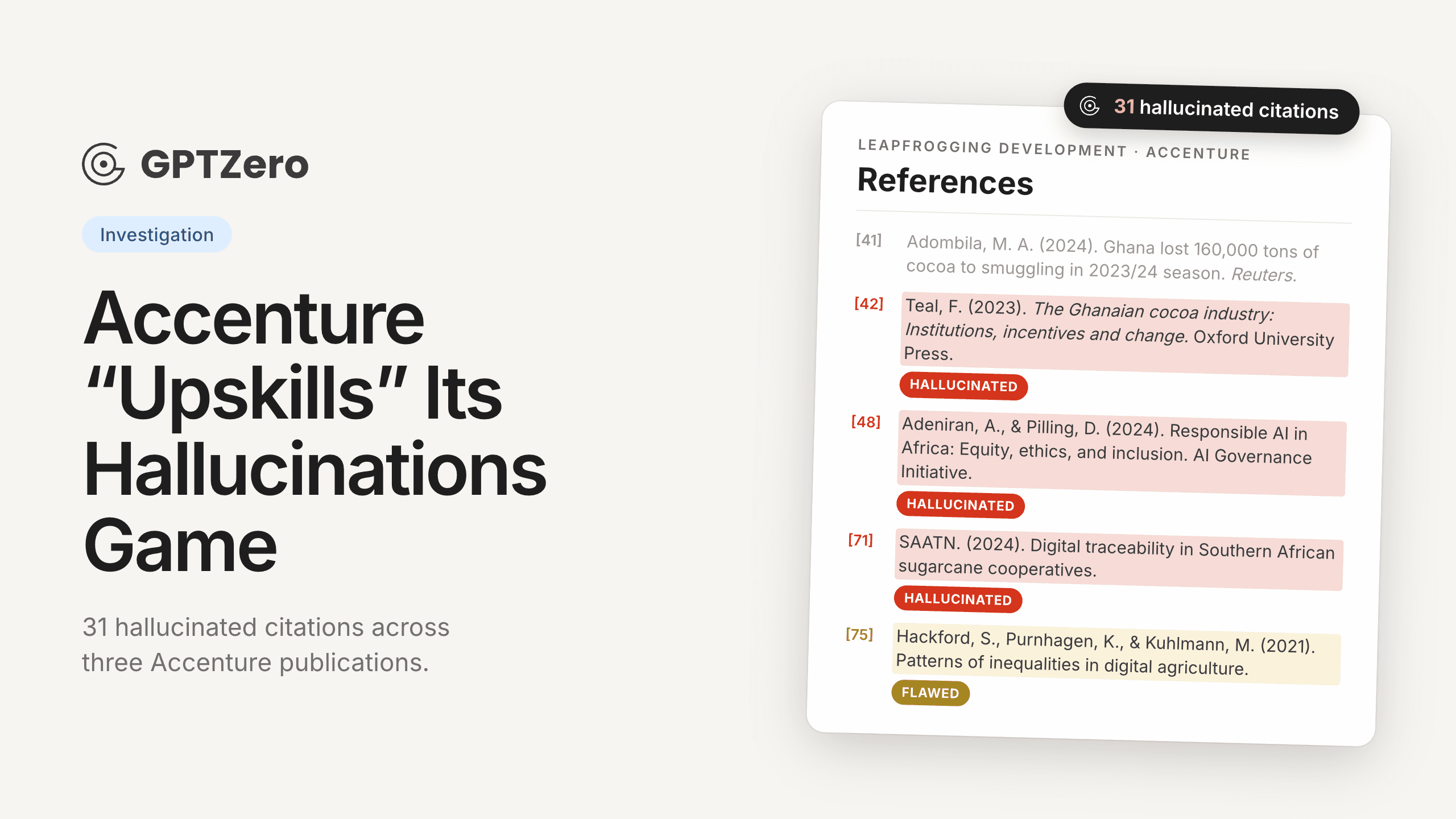
Accenture "Upskills" Its Hallucinations Game
Earlier this month, Accenture officially brought its tokenmaxxing era to a close by imposing a $29-a-month cap on many employees’ Claude accounts. While Accenture rejects this characterization, claiming the policy implements a new “funding approach” rather than a “firm limit,” it’s clear that the days of employees spending up to $1000 a month on LLM usage are over. Unfortunately, a GPTZero investigation of recent Accenture publications reveals that not all tokens paid for by Accenture were spen


Paul Esau, Avikam Mangla, Midhun Dandamudi
· 29 min read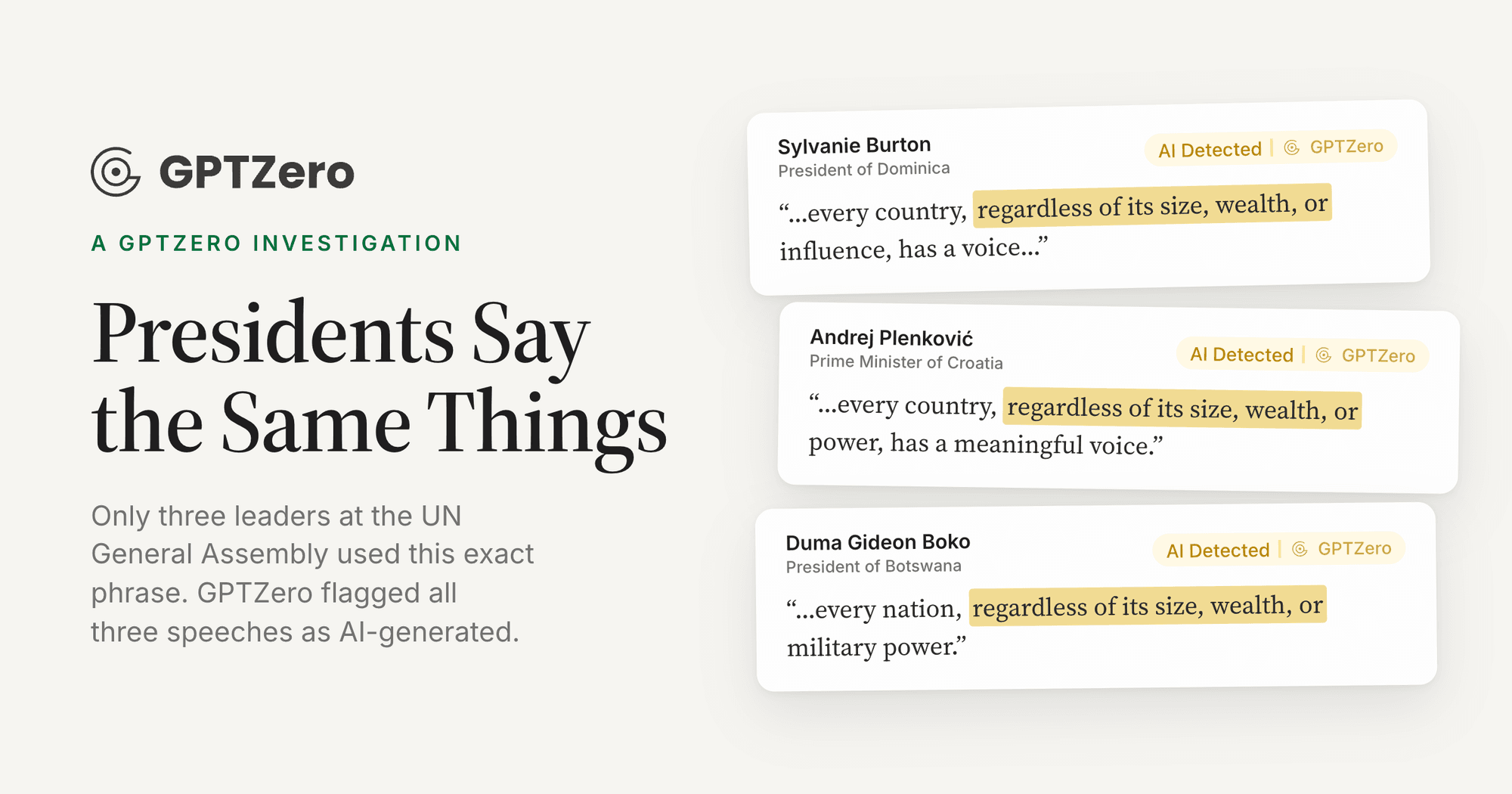
Presidents Say the Same Things: Analysis of 81st United Nations General Assembly Speeches
Our first analysis looked at how much of what was said at this year's General Assembly came from speeches GPTZero flagged as AI-generated. This post is an addendum to that one. Here, we look at a few examples of world leaders saying the same things, sometimes in nearly the same words, and at whether those were the speeches GPTZero flagged. We covered every General Assembly meeting with a UN transcript from September 8 to 26, which comes to 16 meetings, including the first five days of the Gene

Avikam Mangla, Edward Tian
· 13 min read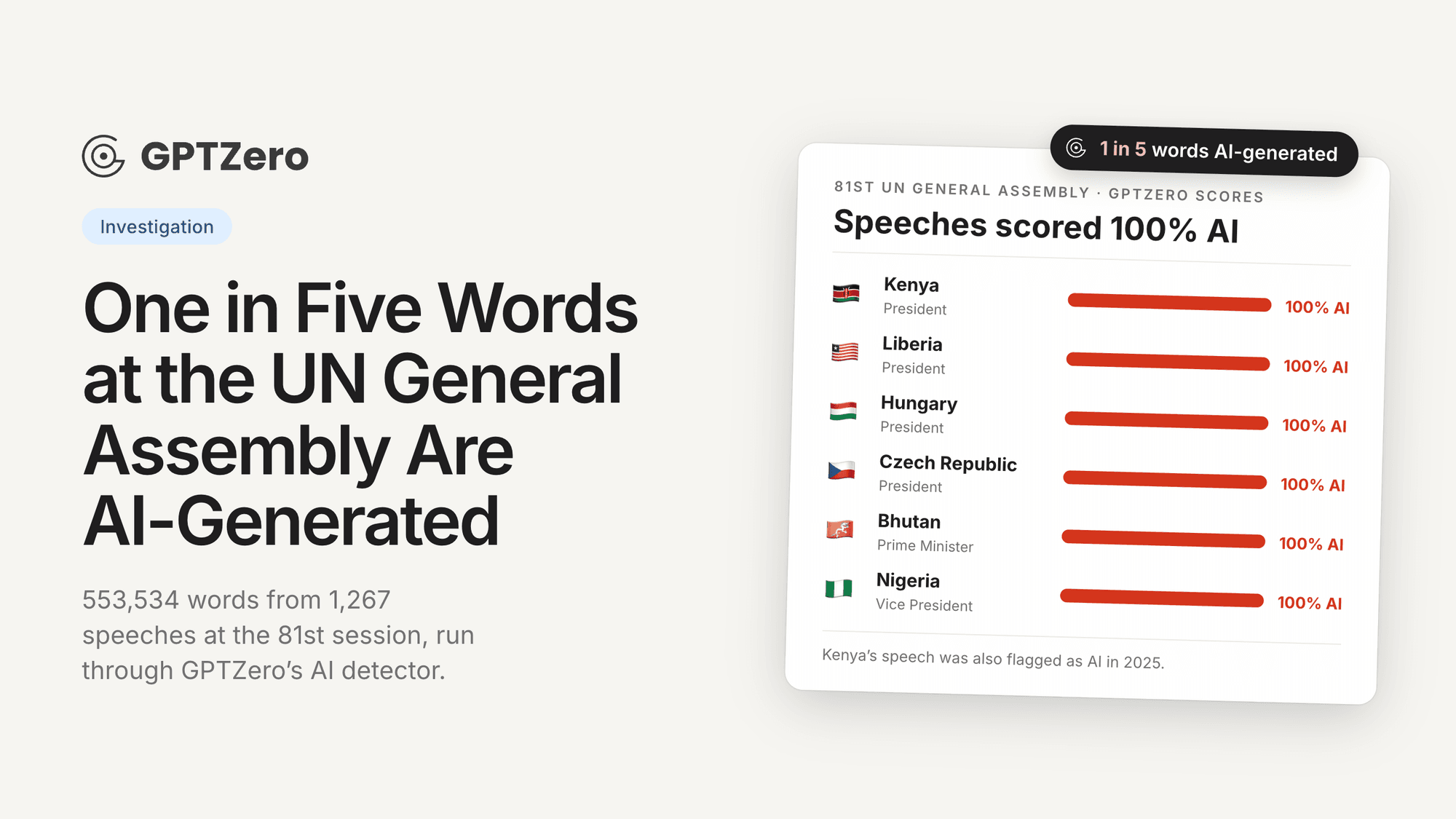
GPTZero Investigation: One in Five Words at the UN General Assembly are AI-Generated
From September 8 to September 28, world leaders descended upon New York City for the 81st session of the United Nations General Assembly. This marked a major milestone in history as world leaders convened to discuss partnerships and debate major geopolitical challenges, including ongoing conflicts in Iran and Ukraine, and the role of humanity in the development of artificial intelligence. This year, the use of AI by world leaders and the debate over the use of AI have grown increasingly intertw

Edward Tian, Avikam Mangla, Alex Cui
· 6 min read
Chasing the Hallucinations: PwC report hallucinates product and government customers
Over the past year, a team of GPTZero investigators has used our Hallucination Check tool to uncover hallucinated citations in government reports, academic papers submitted to prestigious machine learning / artificial intelligence conferences like ICLR and NeurIPS, and research products from three of the big four consulting firms: Deloitte, Ernst & Young, and KPMG. This is the third in a series of investigations into reports containing hallucinated citations surfaced by an automated search pipel

Paul Esau, Om Ogale, Alex Cui
· 17 min read
Chasing the Hallucinations: KPMG's AI-Powered Attempt at "Redefining Excellence"
Over the past year, a team of GPTZero investigators has used our Hallucination Check tool to uncover hallucinated citations in government reports, academic papers submitted to prestigious machine learning / artificial intelligence conferences like ICLR and NeurIPS, and research products from two of the big four consulting firms: Deloitte and Ernst & Young. This is the second in a series of investigations into reports containing hallucinated citations surfaced by an automated search pipeline. Th
Paul Esau, Om Ogale, Alex Cui
· 18 min read
EY retracts study after GPTZero discovers it was mostly hallucinated by AI
Ernst & Young (EY) Canada published a cybersecurity report on loyalty program safeguards. GPTZero chased down every citation. Most were hallucinated.
Om Ogale, Paul Esau, Alex Cui

We Analyzed 134 Moltbook Posts: Human Posts Outperform AI
We found that Moltbook is mainly AI-generated, but the small number of human-written posts drove a disproportionate share of the conversation

GPTZero Team
· 5 min read
GPTZero finds 100 new hallucinations in NeurIPS 2025 accepted papers
GPTZero's analysis 4841 papers accepted by NeurIPS 2025 show there are at least 100 with confirmed hallucinations


Nazar Shmatko, Alex Adam, Paul Esau, Alex Cui, Edward Tian
· 26 min read
GPTZero finds over 50 new hallucinations in ICLR 2026 submissions
GPTZero used our Hallucination Check tool to find 50+ hallucinations under review at ICLR, each of which were missed by 3-5 peer reviewers.
Paul Esau, Nazar Shmatko, Alex Adam, Alex Cui
· 19 min read
Deloitte's Citation Situation & GPTZero's Citation Solution
GPTZero used our Citation Check to analyze the 234 page report and identified more than 30 issues out of the total 141 citations, including 19 hallucinations. Using GPTZero’s citation check would have saved ~$5000 per citation, all within minutes.
Nazar Shmatko, Paul Esau, Alex Cui
· 9 min read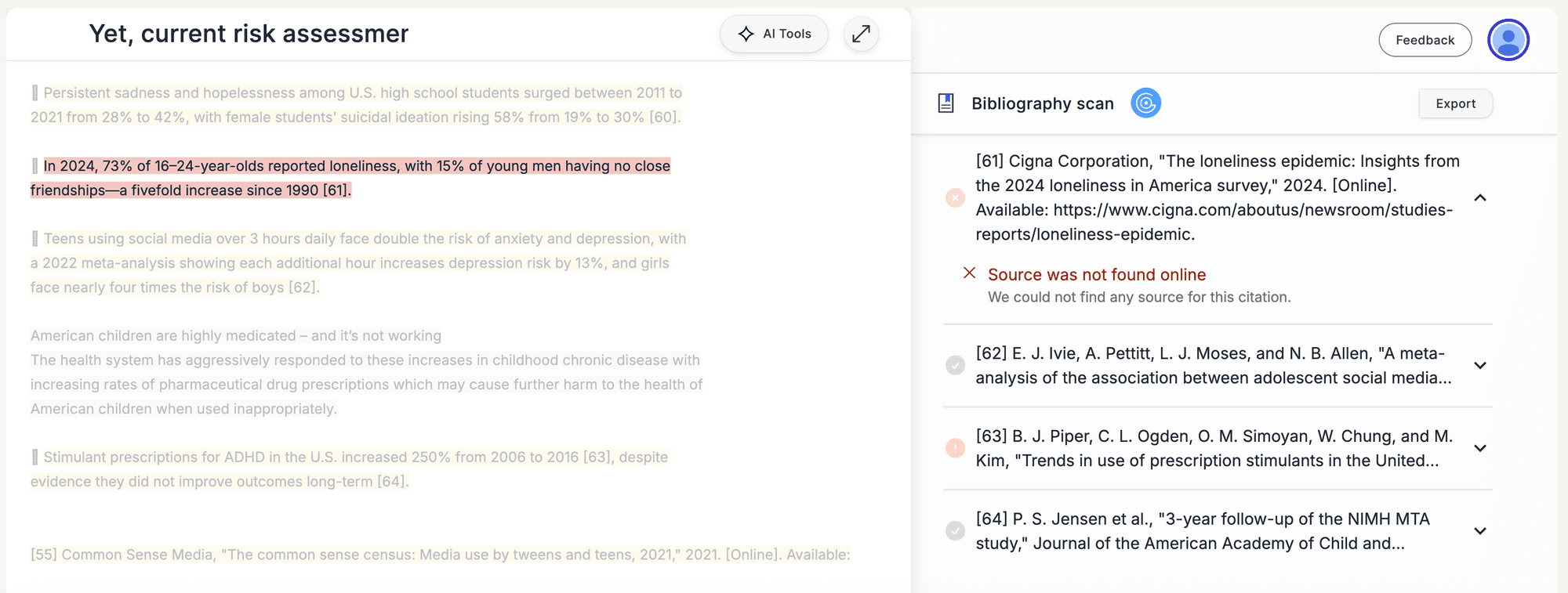
Making America Hallucinate Again? GPTZero Detects New Errors in Major Government Report
On May 22, the U.S. Presidential Commission to Make America Healthy Again (MAHA), led by health secretary Robert F. Kennedy Jr., released a major report on the causes of chronic diseases in children. Yet within a week, news outlets including NOTUS, the New York Times and Washington Post reported that some of the publication’s hundreds of footnotes appeared garbled or fabricated, suggesting they’d been generated by AI. Using GPTZero’s Bibliography Scan tool, we identified nine fabricated sources
Paul Esau, Alex Cui, Nazar Shmatko
· 11 min read
How Many Substack Authors Rely on AI-generated Content?
We investigated 100 popular Substack authors and found how many are likely using AI to help write their posts.

GPTZero Team, Vivienne Chen
· 6 min read
Second-Hand Hallucinations: Investigating Perplexity's AI-Generated Sources
Perplexity AI, a generative AI startup building a more accurate artificial intelligence with links to sources, has cemented itself as a serious industry player with a $1 billion valuation and the backing of Jeff Bezos. Perplexity is one of several startups deploying a technique called retrieval augmented generation to resolve AI hallucinations through real-time references to sources on the Internet. In recent months, however, GPTZero has noticed an increased number of sources linked by Perplexi
Edward Tian
· 6 min read
NYT sued OpenAI for copyright infringement, GPTZero develops tool to detect matches in AI training data
On December 27 2023, The Times sued OpenAI and Microsoft claiming the two companies used its articles to train AI technologies like ChatGPT. NYT claimed that millions of their articles were used to train chatbots, resulting in ChatGPT prompts regurgitating NYT articles word for word. "There is nothing 'transformative' about using The Times's content without payment to create products that substitute for The Times and steal audiences away from it," the Times said and “it’s not fair by any measur
GPTZero Team
· 2 min read
New York Times Investigates Fake AI Biographies on Amazon with GPTZero
“[There’s a] new publishing subgenre: hasty, shoddy, A.I.-generated biographies of people who have just died,” Elizabeth A. Harris, New York Times Journalist said. Upon the death of Joseph Lelyveld this year, former executive editor of the New York Times, his brother was shocked to find, “at least half a dozen biographies were published on Amazon in the days immediately following Lelyveld’s death. Several of them were available for purchase on the same day he died.” The twist - they falsely de
GPTZero Team
· 2 min read