
How to Write an Analytical Essay (with Examples)
An analytical essay is a type of academic writing exercise that meticulously and systematically examines a topic or piece of literature in support of a hypothesis.



Analytical essays are a great way to deep dive into a topic and gain expertise in it. Instructors love to assign analytical essays because they can provide the student with deep context in the subjects covered in the course. As the Harvard Writing Center puts it, analytical essays force the writer to “go through a process of thinking more deeply about a question or problem.”
Analytical essays consist of more than just a summary of facts. A successful analytical essay is “about breaking down a subject through close reading, interpreting its elements, and using textual evidence to show how those parts create meaning.”
In this guide, we will walk you through the step-by-step process of writing an analytical essay. Complete with examples, outlines, and tips to help you succeed.
TL;DR
- An analytical essay presents an in-depth examination of a topic, text, event, or work of art by breaking it apart and explaining how the pieces fit.
- The basic structure is an introduction ending in a thesis, two to four body paragraphs each dedicated to one point or angle, and a conclusion.
- The most common mistake students make is focusing on summarizing rather than analyzing.
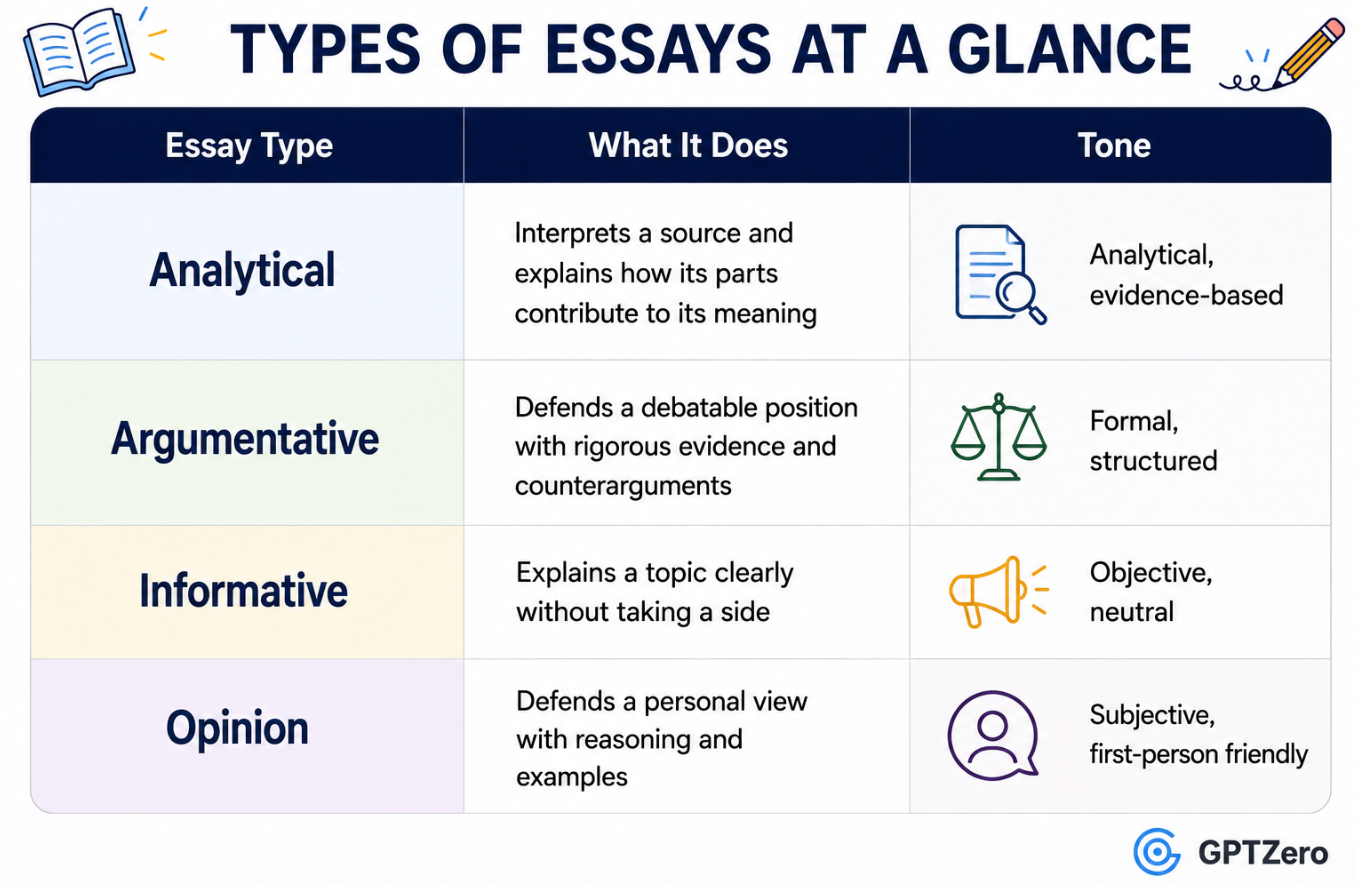
What Is an Analytical Essay?
An analytical essay presents an in-depth examination of a topic, text, event, or work of art by breaking it apart and explaining how the pieces fit. The analysis explains how its parts contribute to a larger meaning, effect, or outcome. Where an informative essay summarizes, and an argumentative essay attempts to prove a point, the analytical essay interprets.
In an analytical essay, students are asked to use their critical thinking skills beyond summarizing their findings and towards making meaning. Analytical essays are common in literature, history, philosophy, film studies, psychology, art history, and any course that engages critically with a body of work.
How to Structure an Analytical Essay Outline
Introduction
Begin by introducing your topic or the source you are going to be discussing. To engage the reader, consider starting with a hook – something like a compelling fact, statistic, or bold statement. The next two to three sentences will provide the context to your reader. Your introduction should end with a strong thesis statement. Your thesis statement should clearly state your analytical claim.
More tips on writing a great introduction, as well as some examples, can be found in this guide.

Body paragraphs
Your analytical essay will have three to four body paragraphs. Each paragraph will develop one analytical claim that supports your thesis. A useful pattern to remember is:
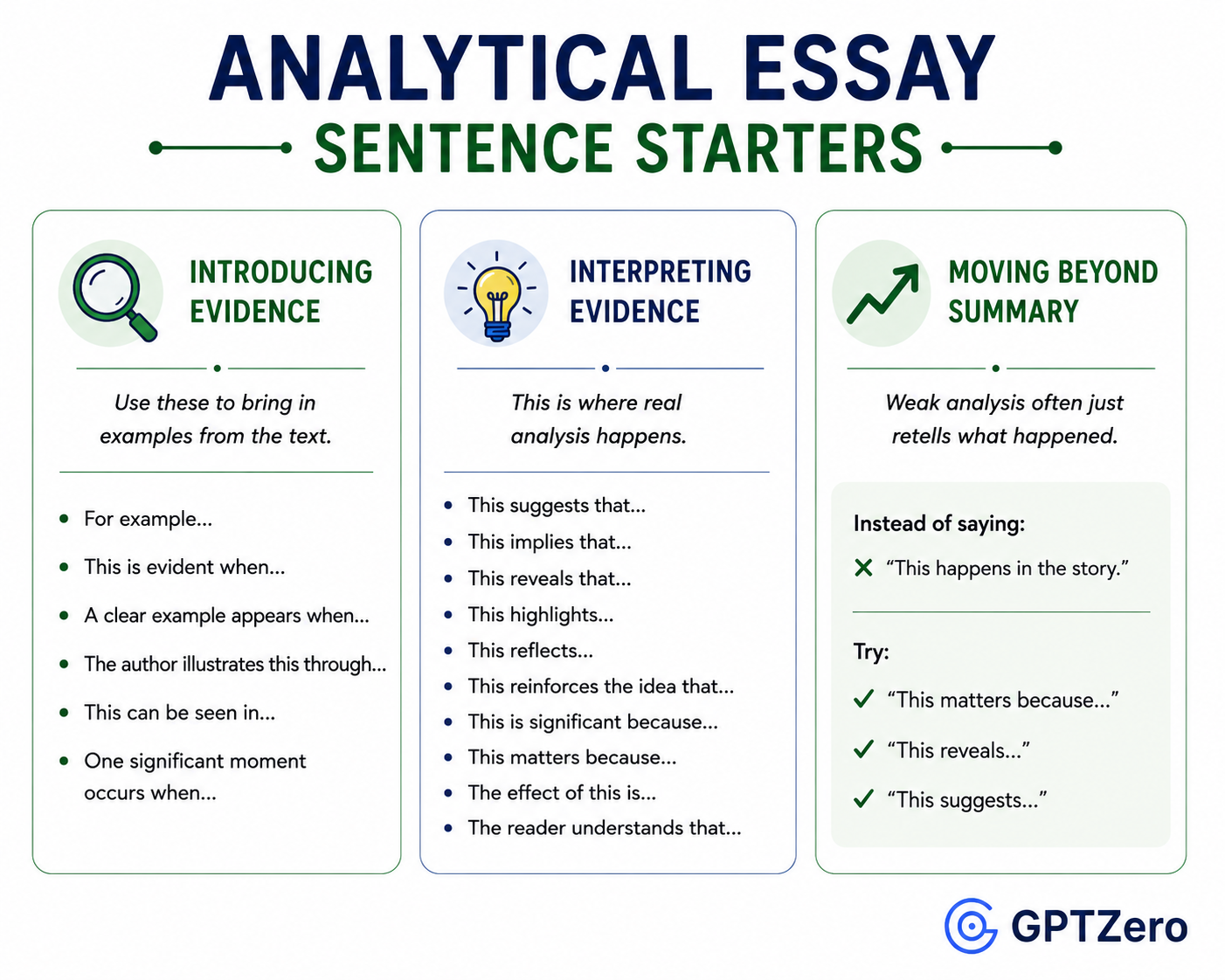
Topic sentence→ specific evidence from the source (quote, scene, data point, image)→ analysis explaining how the evidence supports the claim→ transition sentence to the next paragraph. You can follow this flow for all body paragraphs, no matter the essay style you have been assigned.
Conclusion
Restate your thesis in light of the new evidence you’ve presented to the reader. You can summarize the main analytical arguments and end with broader implications. Think of the conclusion as the mirror image of the introduction.
How to Write an Analytical Essay in 6 Steps
Step 1: Choose a Source and Read It Closely
Whatever you are analyzing, a poem, a historical document, or a work of art it's important to spend some time with it. Read it over and over, notice anything interesting that emerges from multiple passes. Look for patterns, contradictions, and areas of curiosity.
Tip: Try not to outsource your thinking to AI. By engaging with the original text or artifact and seeing what you notice, you are warming up your brain to analytical thinking. If you do use AI tools as brainstorming partners, check your work for accidental plagiarism.
Step 2: Identify a Point of Tension
Hopefully, during your close reading step, you were able to identify a point of tension that will focus your thesis. A point of tension can look like a contradiction, a question left unanswered, or a pattern you spotted. Your thesis will be the answer to this tension.
Step 3: Develop Your Thesis
A strong thesis for an analytical essay meets three criteria: specific, debatable, and not obvious. Your thesis needs to include your interpretation and be defensible with evidence. Aim to move away from descriptive and
Step 4: Build an Outline
A solid outline will save you hours of editing later. Spend some time creating a skeleton for your argument. Make sure you are clear on what each analytical claim is going to be, per paragraph.
To help you with the blank page, check out our step-by-step essay outline guide.
Step 5: Write Your First Draft
With a strong outline in hand, you are ready to draft your analytical essay. Draft straight through and don’t worry about editing as you go. You can catch spelling and grammar errors with your favorite grammar checker later. The important thing at this stage is to get your ideas on paper and have them flow together.
Step 6: Revise and Run Quality Checks
It is a good idea to revise in two separate passes. On the first pass, focus on your ideas and how they flow together. Look at your transition sentences between paragraphs and ensure your argument builds with enough evidence and credibility.
Used AI in your writing process? Take time to check that the finished paper still feels authentic to your voice.

Analytical Essay Example
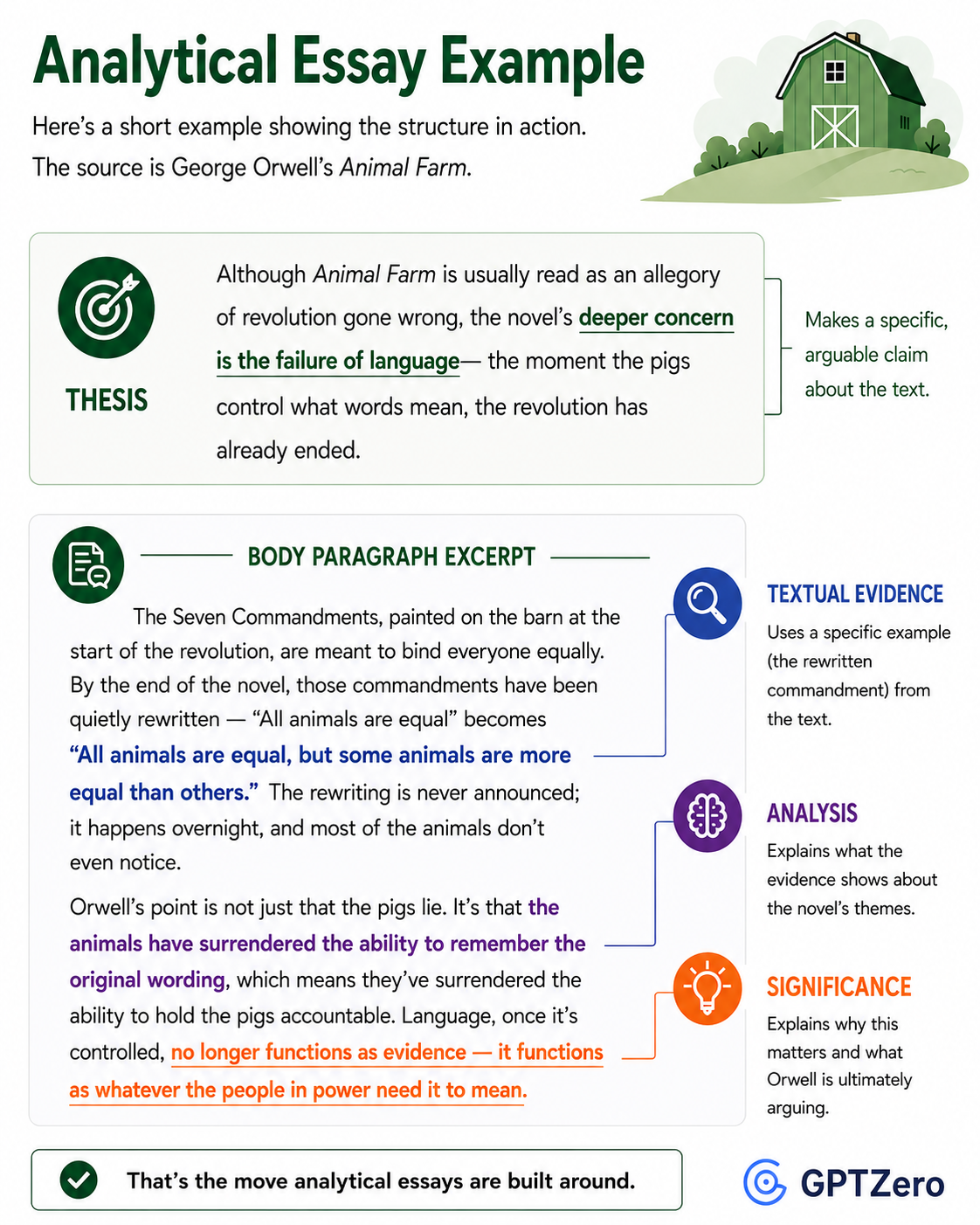
Here's a short example showing the structure in action. The source is George Orwell's Animal Farm.
Tips for Writing an Effective Analytical Essay
- Focus on analysis, not summary. You can assume the reader is familiar with the source or topic, and your job is to make them see something they haven’t before.
- Be as specific as possible. Avoid vague claims like “the author uses symbolism” and actually name the symbol, where it appears,s and why it matters.
- Use the present tense for literary analysis. “Wolf argues” not “Wolf argued”.
- Each quote should be followed by an interpretation or analysis.
FAQs
How long should an analytical essay be?
Most undergraduate analytical essays fall between 800 and 2000 words. Literary analysis essays tend to be on the longer side of this range. Graduate work can be much longer. Instructors are usually specific about word count, so always check your assignment brief.
How do you write an introduction for an analytical essay?
Begin by introducing your topic or the source you are going to be discussing. To engage the reader, consider starting with a hook. Something like a compelling fact, statistic, or bold statement. The next two to three sentences will provide the context to your reader. Your introduction should end with a strong thesis statement. Your thesis statement should clearly state your analytical claim.
More tips on writing a great introduction, as well as some examples, can be found in this guide.
Can I use "I" in an analytical essay?
Most academic analytical essays prefer the third person, but some instructors allow the first person. Check your assignment guidelines. Even when "I" is allowed, lean on the interpretation rather than the pronoun. You want to keep your tone objective and somewhat formal for this type of essay.
What types of evidence are best for analytical essays?
The best pieces of evidence for analytical essays are direct quotes, specific scenes or moments, data points, and images. Secondary scholarship, like literary criticism, for example, is also welcome, but the primary source should remain the focus.