
How to Write an Informative Essay: 7-Step Guide with Examples
An informative essay is an academic paper that explains a specific topic objectively.


According to the National Assessment of Educational Progress (NAEP), “many students struggle with organizing evidence and developing clear written explanations.” An informative essay tests the student on their ability to present information coherently and without bias.
Writing an informative essay can sound deceptively simple, but like all essay types, it comes with its own unique challenges. Behind all successful informative essays is a writer who has done their research, gained expertise on the topic, organized the information, and presented it to the reader in an engaging way.
In this guide, we have distilled everything you need to know to write a successful informative essay, even if you’ve never written one before. By the end of this blog, you will have all the info you need to complete your informational essay from start to finish.
TL;DR
- An informative essay presents information on a topic in an objective manner, leaving the reader to make up their own mind.
- An informational essay has a basic three-part structure: introduction, body paragraphs, conclusion, and bibliography.
- Strong informative essays use credible sources like academic research, government data, and reputable journalism.
- The most common mistake is letting bias sneak into your essay.
What Is an Informative Essay?
An informative essay presents objective, well-structured information about a specific topic so that the reader can understand it. According to Purdue University, informative essays “seek to enlighten and educate readers, so they can make their own educated opinions and decisions about what to think and how to act."
A defining characteristic of informative essays is their objective tone. An informative essay doesn’t try to persuade or change the reader’s mind about a topic; it simply provides all the information they need to make the decision.
Here are some common characteristics of a strong informative essay:
- Objective tone that avoids personal opinions or loaded language;
- A simple thesis that states what the essay will cover or explain;
- Well-organized body paragraphs that focus on one idea or concept each;
- Credible evidence that includes peer-reviewed articles, primary sources, and data;
- An educational takeaway that is useful to the reader.
Informative Essay vs. Other Essay Types
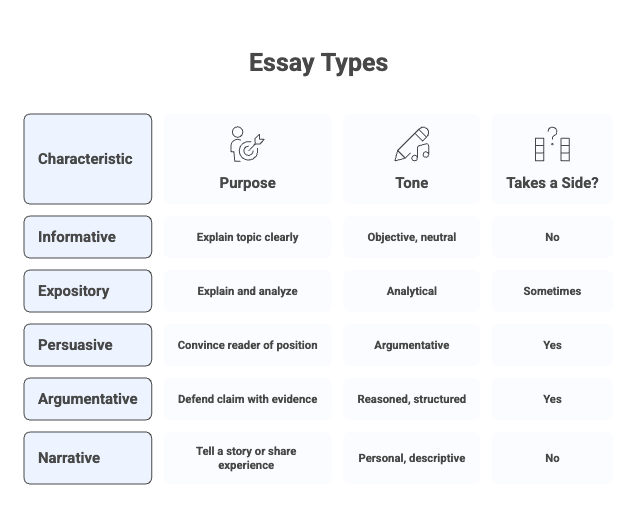
Informative essays can be easy to confuse with other essay types, like expository essays and reflective essays. Here’s a simple breakdown to make sure you stay on track:
Essential Components of an Informative Essay
Informative essays follow the same four-part structure as other essays. Here’s how to approach each section:
Introduction
Your introduction should set up the topic, hook the reader, and end with a clear thesis statement. The hook can be a relevant or striking statistic or a question that invites curiosity in the reader. As the Harvard Writing Center puts it, “your introduction is also your opportunity to explain to your readers what your essay is about and why they should be interested in reading it.”
Once you’ve earned their attention, you can add a few sentences providing the context for what you are going to cover and then end with the thesis statement.
Body Paragraphs
Each body paragraph in your informative essay should focus on one subtopic. Present the supporting idea by opening with a topic sentence, then develop that idea with evidence. Make sure it always connects back to your thesis, and your reader understands that connection. Aim for three to five body paragraphs. Remember to use transitions as you connect your ideas in the paragraphs. More ideas on transitional words and devices can be found here.
Conclusion
Your conclusion is the mirror image of your introduction. You want to start your conclusion by restating the thesis in light of the information you have provided. Follow that up with a few sentences summarizing the main sections of your essay, and end with an open, thought-provoking statement. This is a section where your own opinions might slide in unexpectedly- remember to keep the tone objective.
Bibliography
Like other essays, you will need to provide a thorough account of all your references. You will either use APA, MLA, or Chicago style. Which you end up following will depend on your instructor or field – just make sure you don’t mix more than one style together.
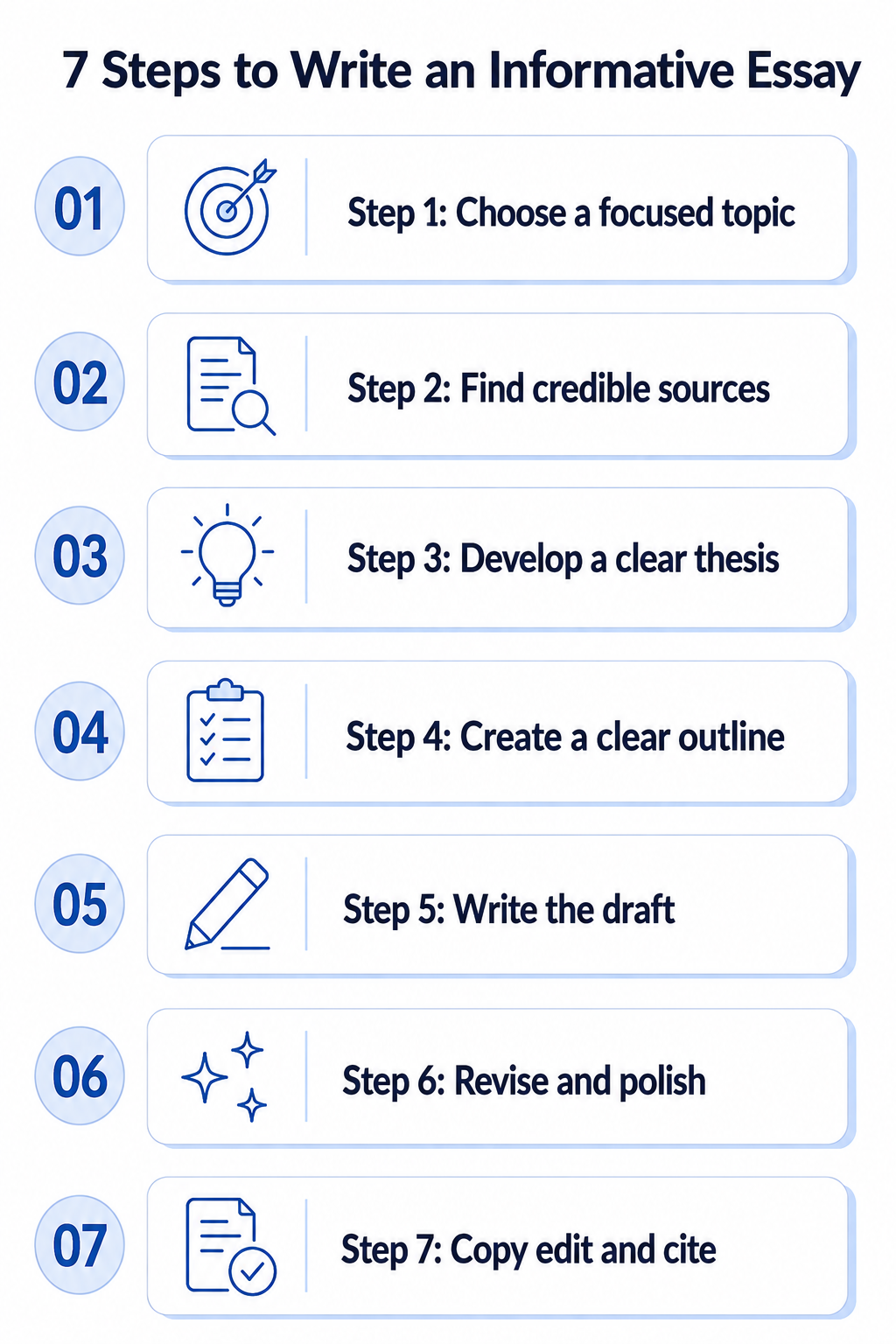
7 Steps to Write an Informative Essay
Step 1: Choose a focused topic
The narrower the topic, the easier it will be for you to cover the necessary information. Brainstorm a topic that makes it realistic to cover in the specified word count. For example, “a history of medicine” is too broad, but something like “how antibiotic resistance has shaped modern hospital protocols" can be tackled in a few paragraphs.
Step 2: Find credible sources
There’s no shortage of information available on any topic today, but when it comes to informative essays, it's best to stick to academic or official sources. When using AI to surface your research material, you should consider using an AI source finder to help you determine whether a citation is real.
Step 3: Develop a clear thesis
Your thesis tells the reader what they are going to learn from your informative essay. A strong thesis is clear and specific.
A weak thesis: "This essay is about climate change."
A strong thesis: "Rising ocean temperatures have measurably altered marine ecosystems in three specific ways over the past two decades."
Step 4: Outline
Don’t start writing your essay before you have sketched out its structure. You want to have a clear idea of what is going to go in each paragraph. At this stage it's better to stick to point-form notes.
Tip: If you’ve used AI to surface your references, take the time to double-check their veracity yourself. Double-check links and confirm that the citation exists and is credible. A hallucination detector can do this work for you.
Step 5: Draft
This is where your point-form notes turn into full sentences and coherent paragraphs. Begin writing and try not to stop and correct too often. If you are toggling between source material and your own writing, including copying and pasting, a good writing assistant can ensure you are staying human throughout your draft by keeping AI vocabulary out of your draft.
Step 6: Polish
Now that you have the raw first draft, you can start editing for clarity, transitions, sources, and choice of language. This pass is about how effectively you have presented your thinking and shows how well you understand your chosen topic.
Step 7: Copy editing
An often overlooked step of the process, this is where you resolve any issues your grammar checker flagged for you. Your bibliography is an important part of your essay and should be formatted according to the correct annotation style (APA, MLA, or Chicago). References should be checked for unintentional plagiarism, and since many instructors now use AI detectors to grade work, doing the due diligence here will pay off.
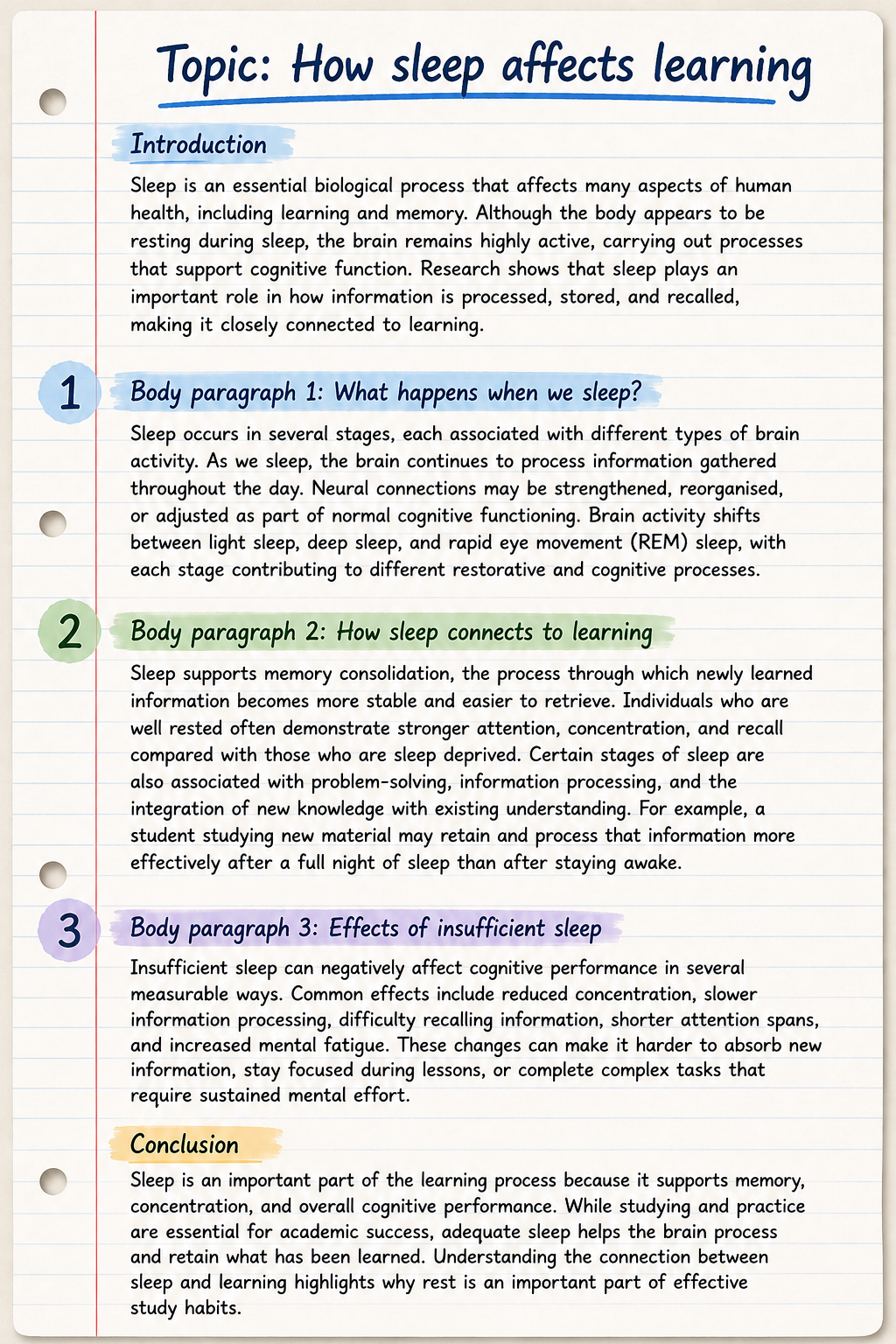
Abridged Informative Essay Example
Tips for Writing an Informative Essay Effectively
- Pique the reader’s curiosity instead of focusing on an opinion. Think of it like inviting the reader into an objective conversation on a topic.
- Write naturally and without too much flourish. Aim to express your ideas with the simplest possible language, avoiding unnecessarily large words.
- Group your information purposefully. Really think about which pieces of the puzzle need to be presented together and which form separate clusters of information.
- Cite immediately after using a source. Leaving this step for later will make it more difficult to find the exact source.
- Read your informative essay aloud to get a sense of the rhythm and catch any awkward sentences.
FAQs
How do you create an effective informative essay outline?
The most important part of creating an outline is making sure you have read enough on the subject to have a clear idea of the topic. Once you’ve grasped it, you can ask yourself, “What does the reader need to know to understand this?” Begin with your thesis or topic sentence. Break down the topic into three to five sections you’d need to cover, and underneath each one, list as many ideas, points, and references as come to mind. Don’t worry about polish here- just get the big ideas in first.
What is the purpose of an informative essay?
The purpose of an informative essay is to educate the reader on a specific topic without trying to sway their opinion. The informative essay has to remain objective as its goal is to inform and not to persuade.
How long should an informative essay be?
In most cases, informative essays will fall between the 1000- 3000-word range. Most assignments are clear on word counts, so always check there first.
What is the best structure for an informative essay?
The best structure for an informative essay is the classic three- part essay structure that other essay formats use. Introduction with a thesis, three to five body paragraphs with one big idea each, a conclusion that summarizes and restates the thesis, and a bibliography.