How to Write an Argumentative Essay (Structure, Steps & Examples)
An argumentative essay takes a clear position on a debatable topic and defends that position with evidence, reasoning, and fair treatment of the opposing side.

Argumentative essays are one of the most challenging essay formats you will encounter in your academic career. They ask you to weave a careful case, staying grounded in evidence – all while acknowledging and engaging honestly with the opposing side. The arguments have to be structured in a specific way. Simply listing for and against arguments will not get you the standout results you want. As the Purdue Writing Lab points out: “Without logical progression of thought, the reader is unable to follow the essay’s argument.”
In this guide, we show you a real example of what an argumentative essay looks like, the step-by-step process to writing one, argument structures, and more. By the time you have finished reading this guide, you will have a clear understanding of how to handle an argumentative essay with confidence.
Key Takeaways
- An argumentative essay takes a strong position on a topic and defends it using evidence and reasoning.
- There are four steps to writing an argumentative essay: pick a position, conduct research, outline arguments, and draft.
- Argumentative essays use three main logical structures to present the argument: Classical, Rogerian, and Toulmin.
- Standout essays engage with the opposing argument directly and honestly.
What Is an Argumentative Essay?
An argumentative essay defends a debatable position on a chosen or assigned topic. Unlike a descriptive or informative essay, the argumentative essay takes a strong and definitive stand and defends that position with well-chosen evidence.
The goal of an argumentative essay is to persuade the reader through the use of compelling evidence. To do this effectively, both sides of the argument must be included in the essay. This shows that you understand the context around your topic and are aware of the different perspectives and implications surrounding it. Standout argumentative essays also look at an issue from different lenses, for example, cultural, political, and socio-economic, and paint a detailed picture for the reader.
Most argumentative essay assignments run between 1,000 and 2,500 words and are common capstone projects.

Classroom debate scene featuring teenage students participating in a formal debate, with two student speakers at podiums
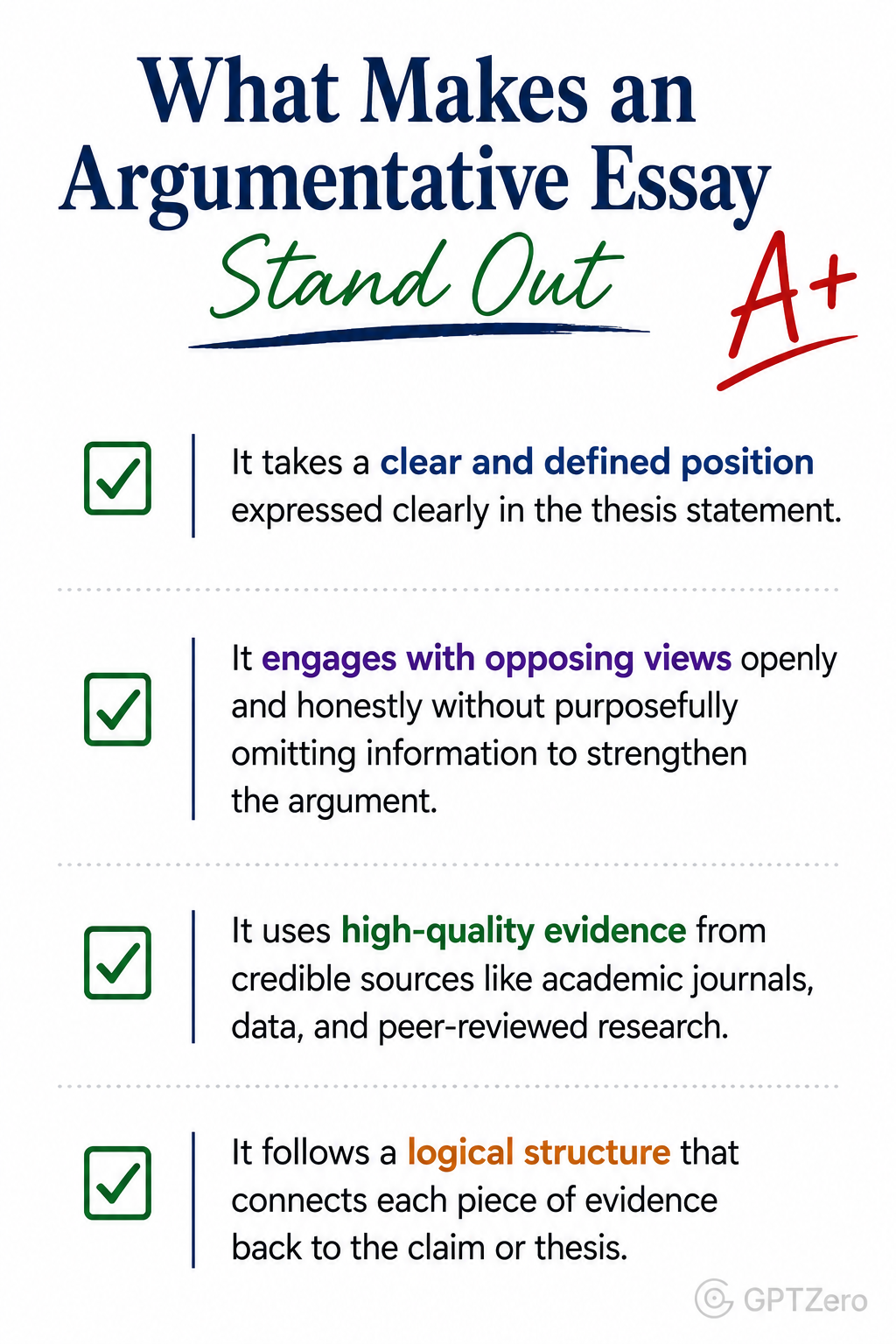
What Makes an Argumentative Essay Stand Out
- It takes a clear and defined position expressed clearly in the thesis statement.
- It engages with opposing views openly and honestly without purposefully omitting information to strengthen the argument.
- It uses high-quality evidence from credible sources like academic journals, data, and peer-reviewed research.
- It follows a logical structure that connects each piece of evidence back to the claim or thesis.
Step-by-Step Process for Writing an Argumentative Essay
Step 1: Pick a Defensible Position
It is important to pick a topic that causes a natural disagreement among people. For example, choosing a thesis statement like “climate change is bad for our future” will encounter some disagreement, but most people will easily agree with the statement. Choose something more specific within the topic you are researching. An example of a suitable position could be “Carbon pricing is a more effective tool than emissions caps for reducing industrial emissions.”
Step 2: Research From Credible Sources
The quality of your evidence is particularly crucial when writing an argumentative essay. Because your topic might cause some polarity, you will find a lot of blogs, threads, and ‘hot takes’ online. Steer clear of lower-quality sources by focusing your research on peer-reviewed academic articles, government data, primary documents, and reputable journalism. An AI source finder can help you at this stage of the writing process by confirming your sources are legitimate.
Step 3: Build an Outline
Building a clear outline before you start drafting is a crucial step. Your outline should map your arguments and list the points for and against that you want to include. If you’ve dog-eared some references, now is the time to organize your citations. Your outline structure will vary depending on the type of argumentative essay structure you choose (more on this coming up).
Step 4: Draft
Now that you have your outline, it's time to connect the dots by drafting your essay in full. During this step, it’s important not to over-edit as you write. Leave the copy edits to your grammar checker and focus on getting the first draft done in full, including any references, citations, and pull quotes you have decided to incorporate into your argument. A Hallucination detector can help you spot any AI.
Tip: A common struggle for many students is properly incorporating citations into their body paragraphs and giving appropriate credit to ideas. To avoid unintended plagiarism, run your work through a plagiarism checker once you’ve drafted.
Step 5: Revise and Run Quality Checks
Before submitting your work, go over it for final checks. Take care of any grammar issues first. If you’ve used AI to write your argumentative essay, you’d benefit from scanning your work with a reputable AI detector to help you see where the draft can use more of your own voice. AI language tools can help you identify specific AI vocabulary and replace it with more human phrasing.
3 Advanced Argumentative Essay Structures
Most of you will be familiar with the standard essay structure we were taught throughout our time in school. Introduction, followed by three body paragraphs, and capped with a concluding paragraph. Argumentative essays, on the other hand, typically use one of these three structures when presenting their argument.
1. Classical (Aristotelian)
When to use it
When you have a clear position, and your audience is neutral or already leaning toward agreement.
Basic structure
Copy and paste this paragraph structure to get you started with the Aristotelian structure.
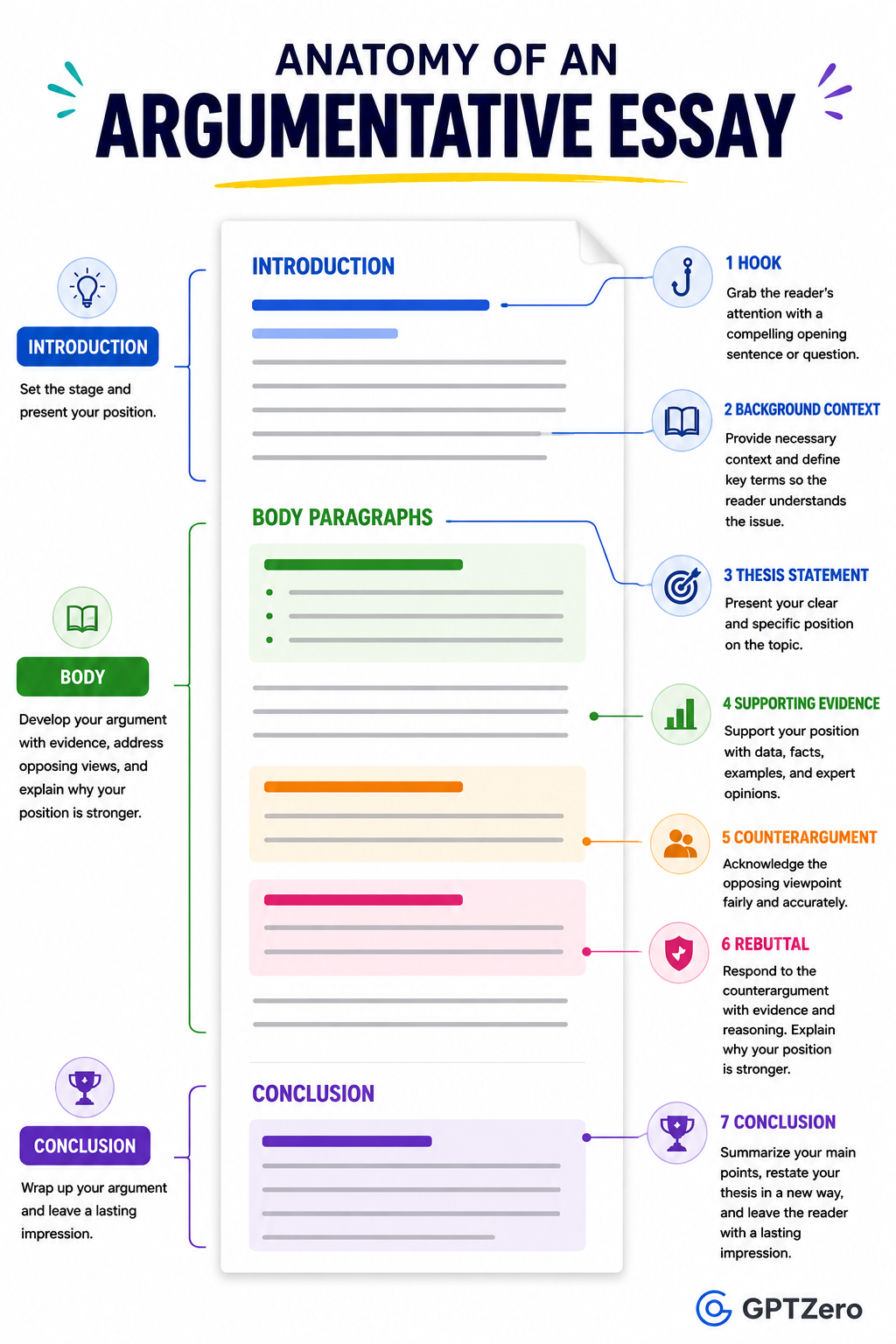
Introduction with thesis: [State your position clearly]
Background context: [Provide key context or define the issue]
Main argument + evidence: [Present your strongest point with supporting evidence]
Counterargument: [Acknowledge the opposing viewpoint]
Rebuttal: [Refute the opposing argument with reasoning or evidence]
Conclusion: [Reinforce your thesis and summarize your position]
2. Rogerian
When to use it
When you are tackling a more controversial topic and your audience is skeptical, divided, or emotionally invested in the opposing view. Rogerian arguments are designed to find common ground.
Basic structure
Copy and paste this paragraph structure to get you started with the Aristotelian structure.
Introduce the issue: [Present the topic and explain the debate]
Opposing view: [Fairly explain the alternative perspective]
Your position: [State your own argument clearly]
Shared values: [Identify common ground between both perspectives]
Compromise/resolution: [Propose a balanced solution or middle ground]
3. Toulmin
When to use it
Use when your argument rests on complex logic or assumptions the reader might not share. The Toulmin structure is the most rigorous of the three.
Basic Structure
Copy and paste this paragraph structure to get you started with the Toulmin structure.
Claim: [State your main argument or position]
Grounds (evidence): [Provide facts, data, examples, or expert support]
Warrant: [Explain why the evidence supports your claim]
Backing: [Add further support to strengthen the warrant]
Qualifier: [Acknowledge limits, conditions, or nuance in your argument]
Rebuttal: [Address potential objections or opposing arguments]
Argumentative Essay Example
Here's a mini example of an argumentative essay that shows the Classical structure in action.
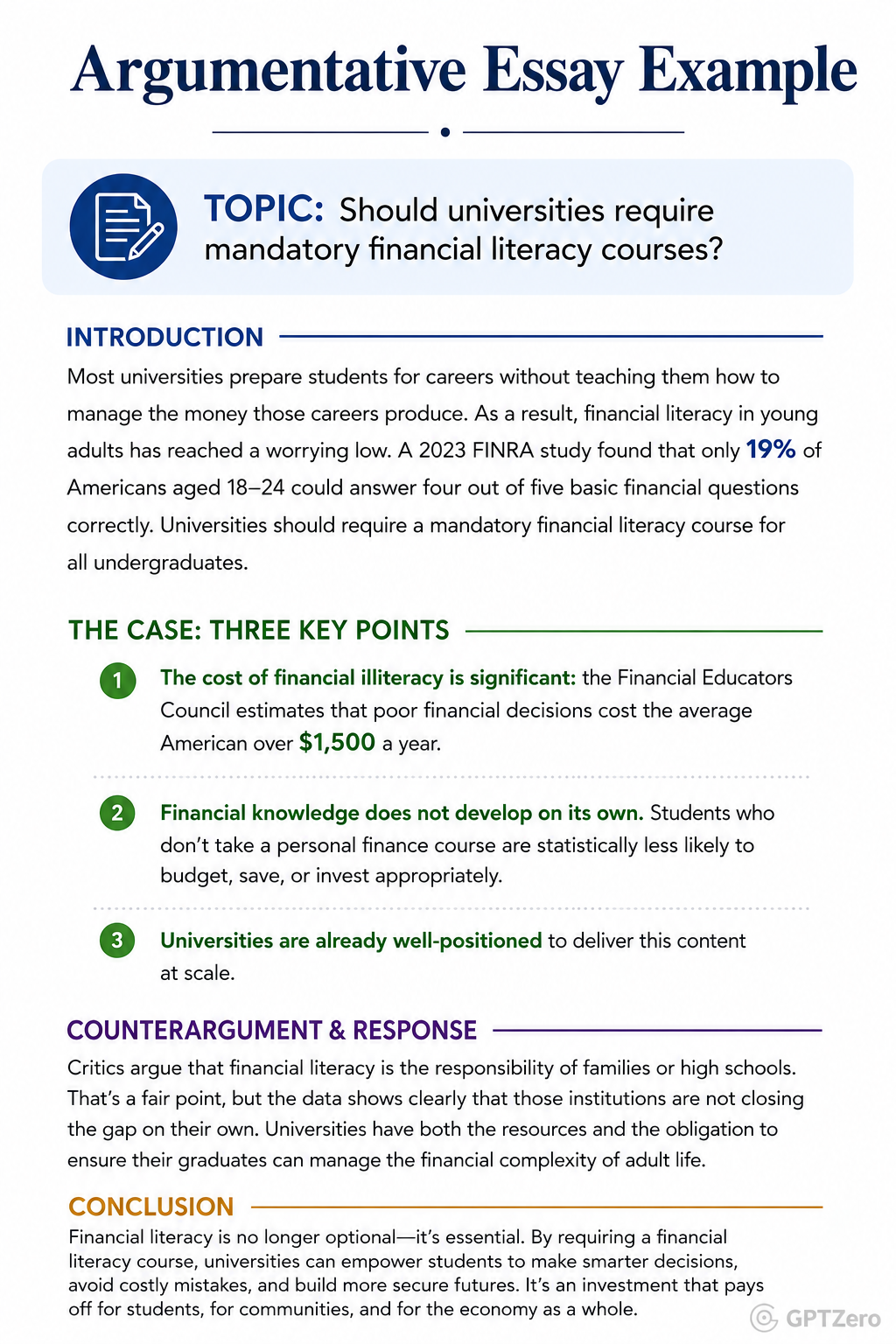
Quick analysis of the example:
- The introductory paragraph clearly states the topic and opens with a hook. It provides a brief background and closes with a strong thesis statement.
- The body paragraph provides evidence for the argument and leads the reader through a logical progression that ties back to the thesis.
- The conclusion addresses critics and forms a rebuttal.
Best Practices for Writing an Effective Argumentative Essay
Lead With the Strongest Evidence
Your best evidence should appear early in your essay. Don’t bury your most powerful sources. The goal is to have your reader convinced of your point before they reach the counterargument section of your paper.
Engage With the Other Side Honestly
The most powerful argumentative essays don’t dismiss or skim over the opposing view. They address the other side’s argument openly and honestly. Doing this builds trust with the reader and shows that you’ve read widely on your topic.
Use an Academic Tone
Argumentative essays have to stay neutral in their tone even when tackling issues that might spark an emotional response. Stick to academic language and avoid colloquialisms.
Verify Your Voice Before Submitting
If you’ve used AI to brainstorm ideas or draft small sections, take a few minutes to make sure the final draft is fully your own. You can do this with a reputable AI detector or add an AI checker extension to your browser for a more seamless experience.
Tip: A common struggle for many students is properly incorporating citations into their body paragraphs and giving appropriate credit to ideas. To avoid unintended plagiarism, run your work through a plagiarism checker once you’ve drafted.
FAQs
What makes an argumentative essay stand out?
A standout argumentative essay takes a clear, narrow position; uses high-quality evidence; engages honestly with opposing views; and connects every piece of evidence back to the thesis.
What is the basic argumentative essay structure?
An argumentative essay can be structured like the standard essay with an introduction, a thesis, three body paragraphs each developing one supporting point, and a conclusion that restates the thesis in light of the evidence. More advanced structures for presenting an argument include the Classical, Rogerian, and Toulmin models.
How do you write an argumentative essay introduction?
The introduction of an argumentative essay is structured in the same way as a standard introduction to any essay. Begin with the hook, like a striking statistic. Follow with a couple of sentences that give the context, and always close with a strong thesis statement.
How long should an argumentative essay be?
An argumentative essay usually falls between 1,000 and 2,500 words for undergraduate work and can run as high as 5,000 words or more for longer, graduate-level studies. Most assignments will have specified word limits, so always check there first. If unspecified, speak to your instructor.