How to Become a Top 1% Student: 7 Proven Strategies
While it might seem like top 1% students have more hours in the day, the truth is that they tend to build better systems for learning.



College admissions can feel more competitive than ever, because they are: the 2024-2025 Common App season showed a total of 1,498,199 distinct first-year applicants submitting over 10 million applications, an 8% increase from the previous year.
Competition may be increasing, but studying for longer is not the only way to improve your results. In this guide, you’ll learn seven practical strategies for remembering more, staying focused, learning from mistakes, and using AI without letting it replace your own thinking, and becoming a "top 1% student" who consistently outperforms their peers.
By the end, you’ll have a practical framework for studying more effectively, protecting your concentration, and using AI in ways that support rather than replace learning.
TL;DR
Becoming a top 1% student is often mistaken for being smarter than your peers, when in reality, it’s about taking the time to come up with a sustainable and effective learning system that works for you. These students go beyond simply studying to optimize how they study, including managing their time, using active recall and spaced practice, learning from mistakes, teaching others, protecting their concentration and taking care of their wellbeing.
What Does Being a 1% Student Mean?
A "1% student" is someone who performs in the top tier of their class or cohort, often because of the high level of intentionality they bring to their learning journey. While some might see it as a fixed identity, it is better understood as a set of behaviours: how someone plans their study time, responds to difficulty and improves the way they learn.
Being a 1% student has some overlap with being a straight-A student, but while a straight-A student is more about achieving high grades through memorization or cramming, a 1% student is about creating deep learning and a sustainable study process. While high grades come as a consequence of being a 1% student, they are just the tip of the iceberg of a well-developed learning system.
Debunking Common Myths
Before looking at the habits of high-performing students, it helps to address several common misconceptions about how they succeed.
- “Top students are just naturally gifted.” Research on expertise suggests that deliberate practice and effective learning strategies play an important role in developing high performance, meaning that 1% students have spent more time developing how they learn, and not focusing only on what they learn.
- “They never struggle.” Struggle is often inevitable and also a sign of real learning happening. Top students run into difficulty as well but they intentionally develop habits (such as active recall) that help them along the way.
- “They study for hours longer than everyone else.” Instead of measuring the quality of a study session in hours, the real differentiator is actually the level of focus and the chosen method. As in, a deeply focused 90-minute session with certain techniques can beat six hours of passive, semi-distracted re-reading.
- “They don't need help.” 1% students are actually often the most proactive about seeking help, and are not afraid to ask for assistance. This can include tutoring, feedback, and AI tools, which they treat as part of their learning system.
These myths matter because they can make academic success feel out of reach – but as you’ll see below, the strategies we’re about to outline treat learning as a process that anyone can improve through practice and feedback.
Top 7 Strategies Used by 1% Students
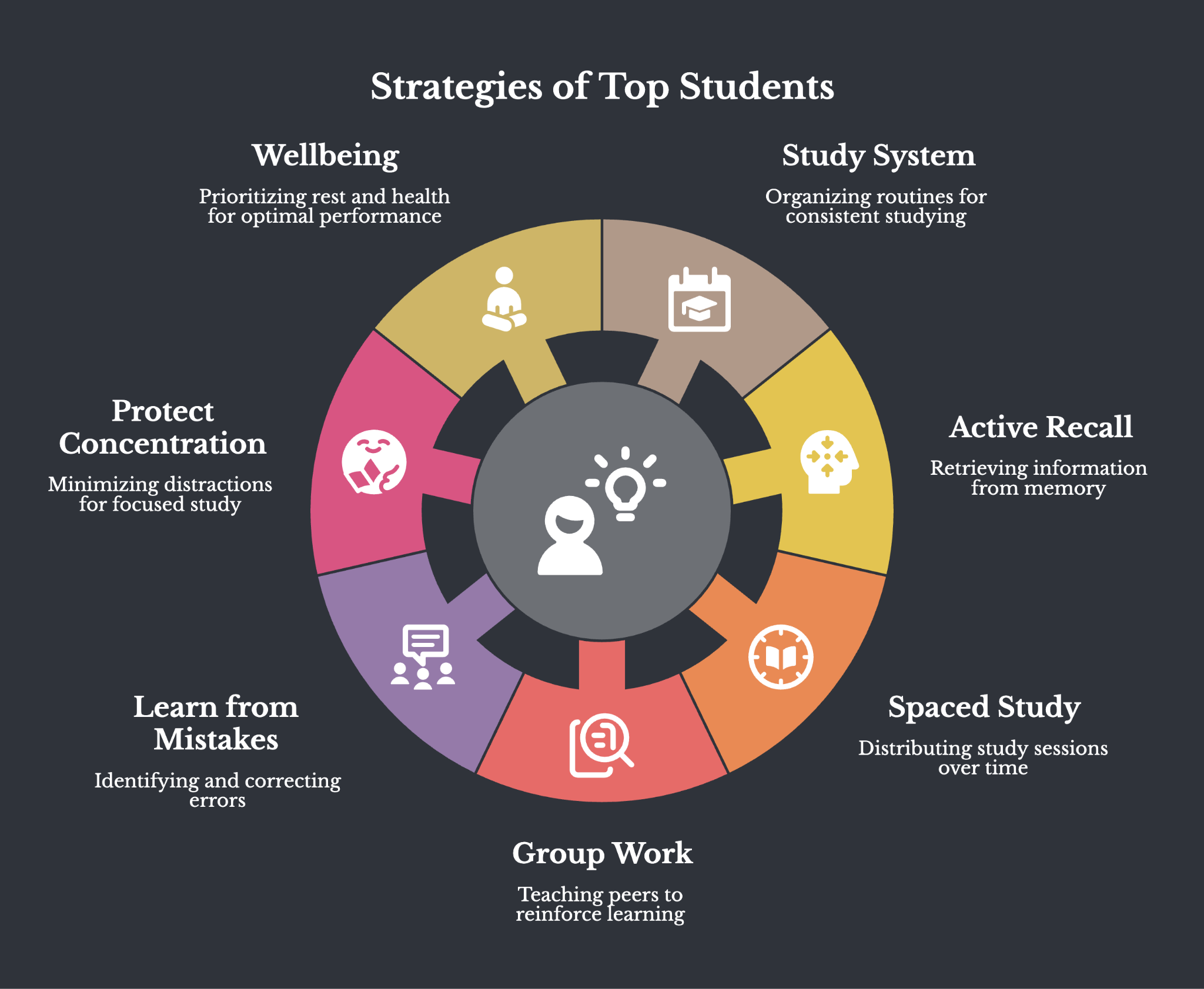
1. Build a study system, which starts with getting organised
1% students know that motivation can be there one day and then gone the next, which is why it’s so critical to build a study system around routines, which make studying easier to both start and also maintain.
Teen expert Daniel Wong, the bestselling author of The Happy Student: 5 Steps to Academic Fulfillment and Success, talks about how it starts with being organised: “Getting straight A’s every time requires a good amount of organisation and planning on your part, so that you’re always prepared to do your best.”
While being organised can seem like an overwhelming task, he shares tips on breaking it down into a couple of manageable tasks: using a calendar to manage important dates, and on getting on top of your filing system and creating a homework list. “This is a simple system that takes 15 minutes a week to implement, but it’ll save you many hours in the long run.”
2. Use active recall
Erin Meryl, a University of Cambridge student, shares: “The top 1% of students do not have more discipline than you do. They do not have more hours in the day than you do. They possess no inherent skills, really, that are above the skills that you possess. What they do is build systems. They build systems across three areas that are super important: clarity, methods and environment.”
One of the most effective methods in that system is active recall, which refers to deliberately retrieving information from memory rather than repeatedly looking at it.
“Active recall is when you take information out of your brain and transform it into a different form,” Meryl shares. “So, you’re not looking at a textbook and then writing notes. You’re not watching a video and then making a mind map, because that is not taking knowledge out of your brain.”
In practice, active recall could mean closing your textbook and writing down everything you remember, answering practice questions without checking your notes or explaining a concept aloud from memory. The sheer effort is what makes the method effective.
3. Space out study sessions
Active recall works even better when you apply it over time. Instead of last-minute cramming, find a study rhythm that works well for you. While cramming can jam in the information before an assessment, the information is likely to disappear quickly afterwards. As this video from German education coach shribe! explains:
“What if you spread your study hours more evenly throughout the semester? You don’t need to study more, just distribute your study time more evenly… One of the main advantages of this approach is that the number of study hours you invest throughout the semester remains consistent.”
The video goes on to say: “By the way, the spaced-repetition technique has been around for a while. It was described as early as 1932 in the book The Psychology of Study, which has since been found to be highly effective in countless scientific studies. This approach is a fundamental part of learning how to learn, as it allows for a better distribution of study time and supports long-term memory.”
4. Learn from mistakes
As you study more deliberately and intentionally, this will inevitably reveal gaps in your knowledge, which are useful. While it can be tempting to look only at your final grade, 1% students also take time to identify their mistakes and ask why they happened.
Elaine Loh from Manhattan Prep advises: “Create an ‘error log.’ When you get an answer wrong on a practice test or homework assignment, write down the question, the correct answer, and why you made the mistake. This prevents you from repeating the same errors on high-stakes exams.”
In time, you might spot patterns: perhaps it often comes down to misreading the question or making a careless mistake, or running out of time to respond. Taking a bit of time to get to the root cause of an error will pay off in the long run.
5. Work in a group
Dr Andrew Huberman shares several strategies intended to help students excel academically and optimise their learning, including teaching material to their peers.
“[Top students] make an effort to then teach their peers, to teach other students in the class,” he shares. “Now, some of you may be thinking that if you spend all this time learning the information and you are in a competitive scenario with the other students, teaching them the information is kind of a freebie for them, and it’s harder for you, meaning you’re putting yourself at a competitive disadvantage or you’re giving them an unfair advantage for not having done the work.”
He continues, “But it’s very clear that students who make it a point to learn material in isolation, then bring that material to other students in the same course and teach them, perform exceedingly well in comparison to the other students. So don’t be afraid to be a teacher of your peers in order to test and develop mastery of the material.”
6. Protect your concentration
Effective methods still depend on having enough concentration, and just setting time aside to study doesn’t matter as much as creating conditions that make it easier to focus. If you’re spending three hours studying but you’re flicking between social media and videos and different tabs, that’s not as effective as a single hour of concentrated work.
As Cal Newport puts it in How to Become a Straight A Student:
“Jason, a straight-A student from the University of Pennsylvania, uses the term “pseudo-working” to describe this common approach to studying. The pseudo-worker looks and feels like someone who is working hard – he or she spends a long time in the library and is not afraid to push on late into the night – but, because of a lack of focus and concentration, doesn’t actually accomplish much. This bad habit doesn’t actually accomplish much.”
So before starting work, try to put your phone in another room, shut down tabs you don’t need, choose a single task to finish. Some students find it helpful to work in timed sessions, like 30 minutes, then a short break, although the precise length matters less than giving your full focus to one task.
7. Take care of your well-being
Concentration goes beyond willpower and also depends on how well your brain and body are functioning. 1% students know that they need rest in order to perform their best, and that sleep plays a critical function in memory, mood and decision-making. This means their routines include regular sleep, proper meals, breaks and social time.
Another tip from Daniel Wong is: “Physical health is the foundation of academic excellence. To be a straight-A student, you don’t need to have the physique of an Olympic-level athlete. But you do need to take excellent care of your body.”
How Straight-A Students Use AI Without Hurting Their Learning
Before using AI for schoolwork, you need to check the policy for your institution as well as for your specific assignment. Once you’ve done that, you might find AI tools can help with your learning.
One department head in the GPTZero community told us that rather than grading students against an AI standard of clinical perfection, she emphasizes that her goal is to cultivate their individual voice: "We would rather have them be interesting than perfect."
Use AI for concept clarity
AI can explain tricky ideas in simpler language or present the same concept in several ways. For example, you might ask, “Explain photosynthesis as if I am 12, then explain it again at high-school level.”
Saying that, AI-generated answers can contain errors, and an AI hallucination occurs when a tool gives fake information that sounds convincing. A hallucination detector can help flag questionable content, but ideally you should still check any facts against textbooks, academic sources, or teacher guidance.
Use AI for self-testing
AI can act as a quiz partner by generating practice questions and responding to your answers. For example, you could ask it to test you on the causes of World War 2, or you could ask it to help you come up with multiple-choice questions, run a mock exam, or make questions progressively harder.
Use AI for feedback
Students can use AI to identify unclear wording or possible grammar issues. A free grammar checker can help identify potential language errors after you have written a draft, or you could compare your work with an assignment rubric and ask which criteria need more attention.
Definitely avoid asking AI to rewrite an entire assignment, which can remove the original voice, make room for factual errors, and make it harder to demonstrate genuine understanding. The strongest approach is to do your own thinking independently, then use AI selectively during review.
Use of AI Detection Tools
One college professor from the GPTZero community told us how AI has fundamentally ruined his ability to appreciate outstanding student work . He reflects on how he used to react to excellent writers: "Ten years ago, if I had a student, they wrote something, I was like, oh my gosh, this makes me so happy... This is an amazing student. I'm going to recognize them for an award. I'm going to read their essay out loud." Now, his immediate reaction to seeing a stellar essay is suspicion: "Did they write it? Like that's my first reaction."
Tools such as GPTZero analyze writing for patterns associated with AI-generated and human-written text. Students can use GPTZero’s AI detector to review their work and explore sections that may require closer attention. Students can also use an online plagiarism checker to check text that may be too close to an existing source.
When you use AI, keep your own thinking at the center, and review your work with tools like GPTZero before submitting. GPTZero’s writing tools can support review, fact-checking, and transparency without replacing the work that helps you learn.
Frequently Asked Questions
How many hours do top students study?
There is no single number of hours that works for every student, as the quality and focus of a study session usually matter more than its length. One hour of focused active recall may be more useful than several hours of distracted rereading.
Do top students study every day?
Many high-performing students study regularly, but this does not mean completing long or intense sessions every day. Instead, consistency may involve a short review, completing homework, revisiting flashcards, or planning the next task. Students also need rest days and time away from schoolwork.
What is the most important habit of a 1% student?
The most important habit is taking responsibility for your learning: identifying what you do not understand, asking for help when necessary, reviewing feedback, and adjusting your approach over time. There’s no single “hack” to becoming a 1% student – it’s about building a reliable system that helps you keep improving over time.