
How to Write a Synthesis Essay (Steps, Examples, and AP Lang Guidance)
Learn how to write a synthesis essay step by step, connect multiple sources into one argument, and tackle the AP Lang synthesis essay with confidence, examples, and practical tips.



“The synthesis essay kills people because they get overwhelmed by the sources,” explains one Redditor. This statement is backed by a study that found the main challenge for students writing a synthesis essay is organizing and connecting information from more than one source.
Synthesis essays are popular assignments because they highlight important skills like close and critical reading, the use of textual evidence, and organized argument formation. These are all learnable skills, and a clear writing process will help you develop and apply them.
This guide explains how to write a successful synthesis essay and offers practical advice on tackling the synthesis essay portion of the AP Lang exam. Follow the step-by-step guide, master the features of a high-scoring AP Lang essay, and answer your questions about how to write a strong synthesis essay.
What is a Synthesis Essay?
The OWL at Purdue sums up synthesis writing succinctly: “looking for relationships between sources and drawing conclusions.” A synthesis essay calls on you to read connections between multiple sources and use those connections to draw a conclusion that forms the essay’s thesis.
To write a successful synthesis essay, you need to gather information on a topic, discover meaningful connections between sources, and form a distinctive position or argument on the topic.
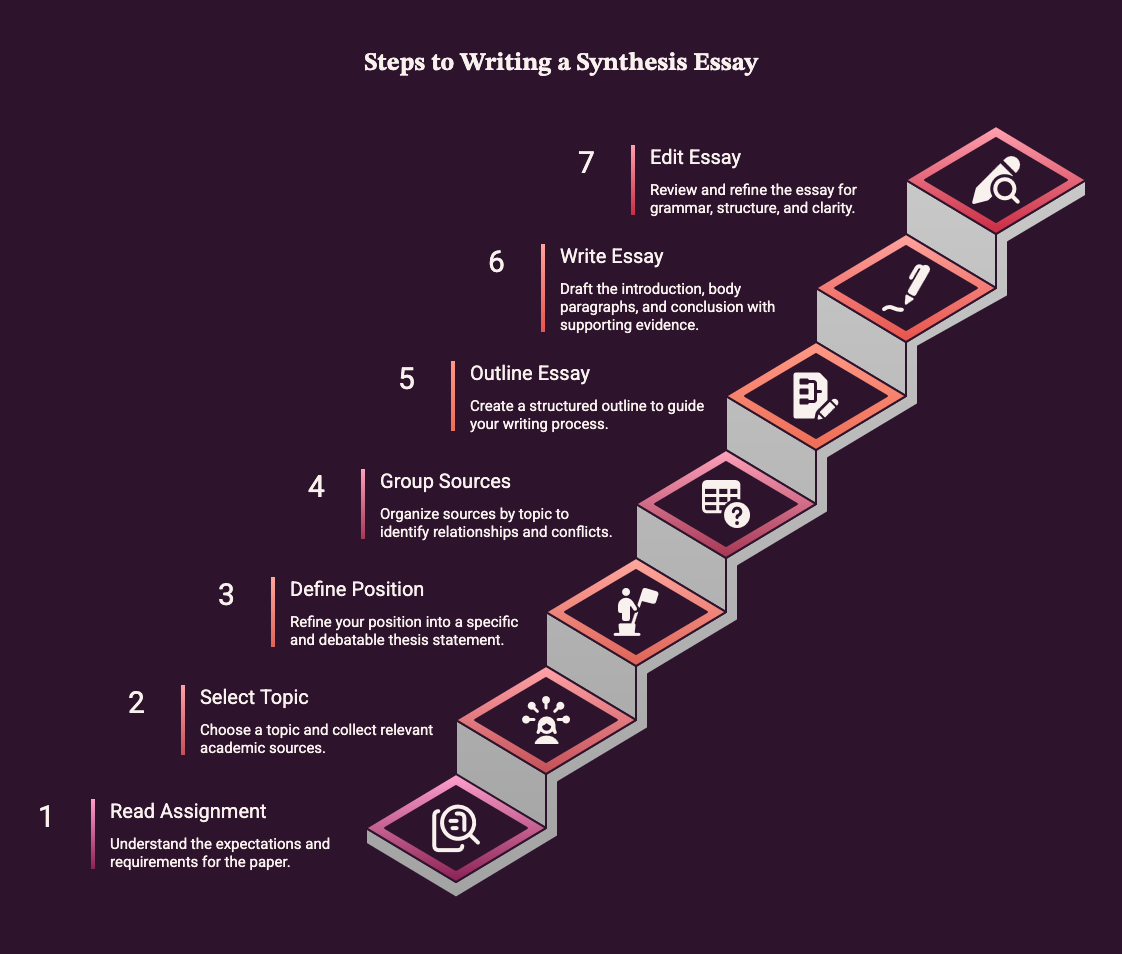
How to Write a Synthesis Essay in 7 Steps
Read the assignment
Carefully read your assignment guidelines. The University of Nevada, Las Vegas advises that you “ensure that you understand the expectations and requirements for the paper,” and critically, “look for specific questions that you need to answer in your essay.”
Select and research a topic
If you’re working from a prompt that provides a topic and sources, as with an AP Lang synthesis essay, you can skip this step. Otherwise, choose a topic to research and collect sources that are academic and relevant.
As you review the sources you found, UNLV recommends you take notes to “identify differences and similarities” and “ideas that are related to your interests or relevant to the questions or requirements of the assignment.”
An AI source finder is a useful complement to your own research practices; use it to verify your sources and get suggestions for academic sources to strengthen unsupported claims.
Define your position
After reading and annotating your sources, decide what position you hold on your topic. Refine this position into a thesis statement that is specific and debatable.
Consider how your thesis statement relates to your sources as you review them, and look for evidence that supports your claim.
Group sources by topic
Ask, how are these sources in conversation with one another? Look for complementarity where sources are making similar or supporting claims, or conflict and contrast where sources oppose one another or arrive at very different conclusions.
North Carolina State University recommends using a “synthesis matrix” to group sources by topic. The matrix can be expanded for greater numbers of topics or sources, but looks like this:
Insert authors’ names at the top, list your main ideas in the left-hand column, and fill in the rest with evidence from your sources. Try using NCSU’s blank matrix template.
Outline your essay
A good essay outline contains:
- A thesis - make it specific and debatable
- A roadmap in the introduction - identify the main points that support your thesis
- Body paragraphs - one topic per paragraph with supporting evidence and analysis
- A conclusion - restate the thesis in new words and give closing thoughts
Write
Follow the outline and draft your introduction, body paragraphs, and conclusion. Paraphrase and quote information from your sources to directly support your thesis with textual evidence.
Be sure to use topic sentences to organize your body paragraphs, consider writing an attention-grabbing hook at the beginning, and wrap it up with a memorable conclusion.
Edit
Review the grammar, structure, and clarity of your writing. Make sure that all of your points relate back to your thesis and each paragraph only addresses one point.
Some powerful tools are available to help with this final stage, including a free grammar checker to polish your writing, an AI source finder to strengthen unsupported sections, and an AI checker for students to refine your authentic voice.
AP Lang Specific Synthesis Essay Guide
Three key factors distinguish the AP Lang (Advanced Placement English Language and Composition) synthesis essay from a regular synthesis essay: the pre-selected sources and topic, the time crunch, and the scoring rubric.
Sources and Topic
No research or topic selection is required, but you must become very familiar with the sources and the essay question provided. Identify the question you’re meant to answer or the issue you’re meant to take a position on. The final few sentences of the prompt are usually where to find this information.
As you’re reading sources, consider them critically. Identify the author’s position, look for how they’re supporting that position, and assess whether they’ve considered multiple sides to the issue or not.
Time Crunch
Here are the official exam components for Section 2 (after Section 1 multiple choice questions). You will have 2 hours and 15 minutes to complete a synthesis essay, a rhetorical analysis essay, and an argumentative essay:
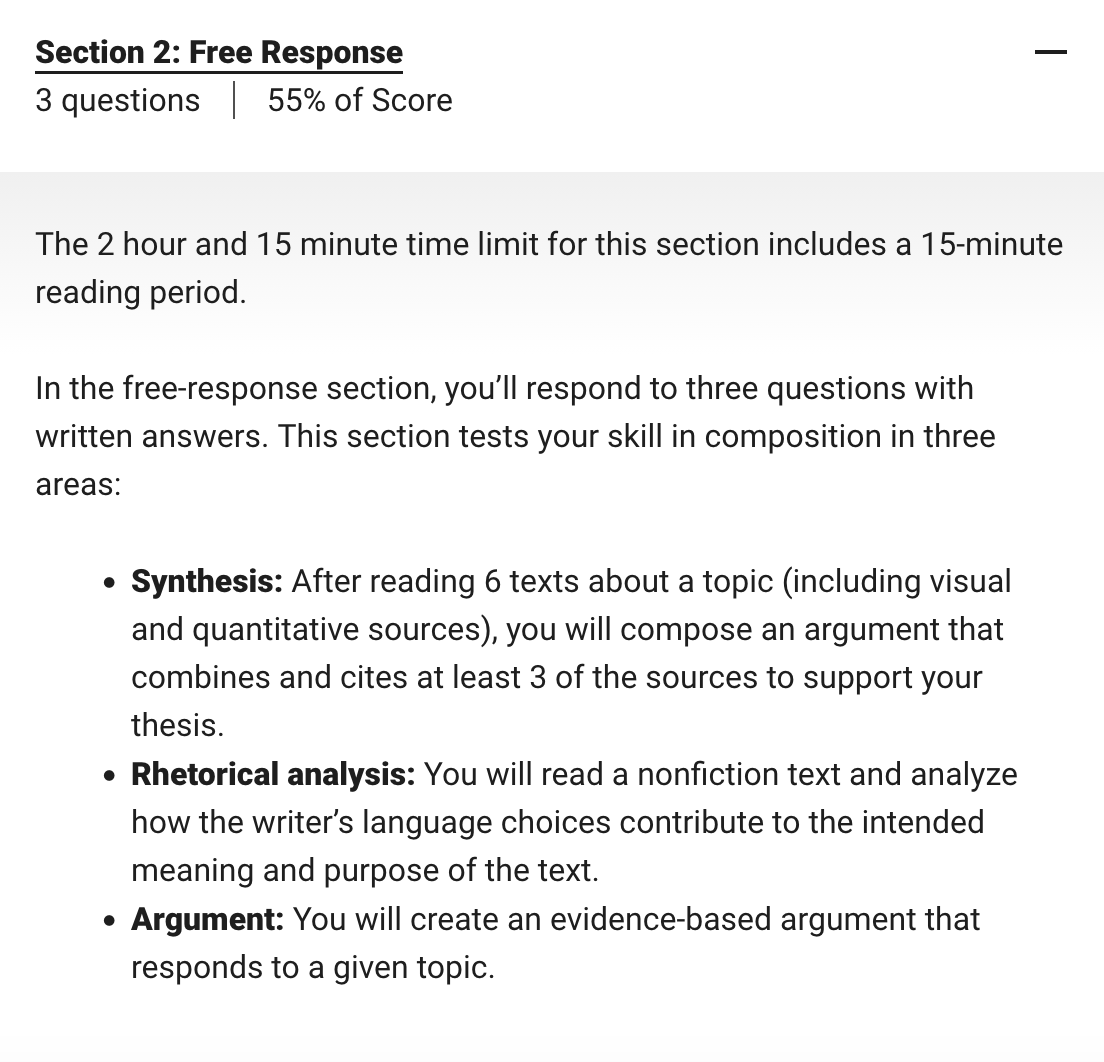
After 15 minutes of reading, you will need to write 3 essays in 2 hours, leaving you roughly 40 minutes to complete your synthesis essay.
Here is a simple breakdown of how to spend that time efficiently:
- 5 minutes planning – brainstorm, outline your essay, and make sure the main components of your argument are in place.
- 30 minutes writing – follow your outline and craft focused paragraphs.
- 5 minutes reviewing – edit, check for clarity, and align your argument with your thesis.
Scoring Rubric
The criteria your essay will be judged on are publicly available, so you can adjust your writing priorities accordingly. You will be graded on the quality of your thesis and the sophistication of your argument, but the majority of your points come from using evidence from sources and providing insightful commentary about that evidence.
Synthesis Essay Examples
Learn by watching how other people do it. Here are 3 graded AP Lang synthesis essays that have comments explaining how each paper received its score. If you’re preparing for the AP Lang exam, be sure to take the College Board’s practice tests and test previews.
Anoka-Ramsey Community College provides a synthesis essay assignment and a corresponding sample essay among other examples of synthesis essays.
FAQ
How do you start a synthesis essay?
With the sources. You need to understand how your sources fit together—how they support or contradict one another—before you can decide what to focus on. Take notes as you read and draw connections across sources. Notice which topics are debatable and which perspectives have the strongest support, and decide where to take your position.
How to write a conclusion for a synthesis essay?
A good conclusion restates the thesis in new words, explains how the essay’s main points supported that thesis, and gives some final impressions or takeaways. For a synthesis essay, you will want to highlight how you brought the sources together to produce a new insight.
How many sources should a synthesis essay include?
At least three. Technically, two sources can be brought together to form a new whole, but will lack breadth of information and perspective. Three or more sources will allow you to form a more nuanced, convincing, and debatable position.
For an AP Lang synthesis essay, you will be instructed to synthesize material from at least 3 of the sources.
What is the difference between a synthesis essay and a summary?
Synthesis is the act of putting things together to produce something new. While you can summarize a single source, synthesis requires that two or more components be brought together into a new whole.
If you discuss Source A and then discuss Source B without noting the connections or contrasts between them, you are summarizing, not synthesizing. If you discuss how Source A refutes some of the points of Source B and you come to conclusion C, that’s synthesis.