
How to Write Good Topic Sentences (Examples, Steps, and FAQ)
Learn how to write strong topic sentences that improve clarity, organization, and flow. This guide covers common topic sentence styles, practical techniques, examples, and tips for improving paragraph coherence.



Students often lose marks on essays for lack of clarity and organization. Even an essay that starts with a clear introduction can become muddled by confusing and unstructured body paragraphs.
Frank D’Angelo surveyed readability research and found that topic sentences help both readers and writers: readers follow the logic and argument of the paper more easily, and writers organize their ideas more effectively.
This guide will show you what a topic sentence should look like, discuss how to write a good one, and answer common questions about how to start a paragraph. With these tips and examples, you’ll craft powerful openers and polished body paragraphs.
What Is a Topic Sentence?
A topic sentence is a statement at the beginning of a body paragraph that indicates the main idea of that entire paragraph. The Writing Centre at CUNY explains that a topic sentence helps meet the needs of your reader by clearly indicating the main analytical purpose of the paragraph.
While many genres of writing do not use topic sentences (newspapers, blog posts, novels, etc), they are usually expected, if not required, in academic writing. They emphasize the main supporting ideas that uphold your thesis, clarifying the structure and strength of your argument.
A study by Randall Popken revealed that topic sentence usage varies between disciplines. While disciplines in the humanities and social sciences use topic sentences extensively, disciplines in the sciences like Biology and Physics often indicate the paragraph topic through section headings instead.
6 Common Types of Topic Sentences, With Examples
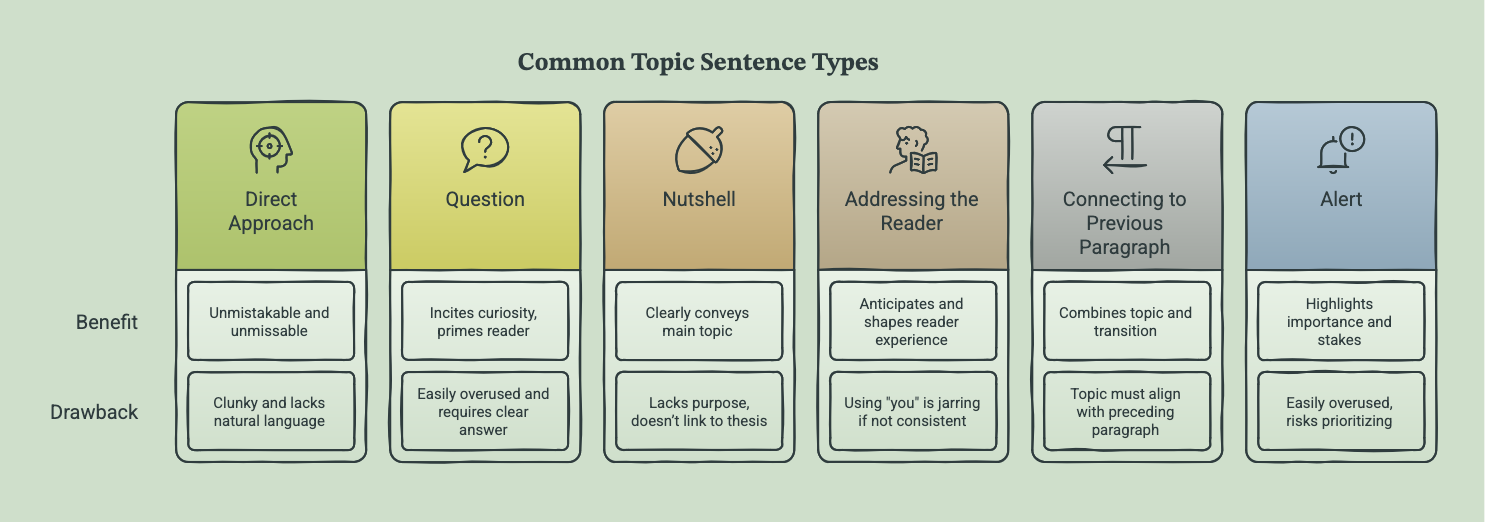
Allan Hancock College identifies 6 types of topic sentences, each with benefits and drawbacks to consider. Choose one that suits your purpose and mitigate its drawbacks.
The Direct Approach

- Benefit: The topic sentence is unmistakable and unmissable.
- Drawback: It’s clunky and lacks natural language.
The Question

- Benefit: Incites curiosity, primes the reader for the answer.
- Drawback: Easily overused and requires a clear answer.
The Nutshell

- Benefit: Clearly conveys the main topic.
- Drawback: Lacks purpose because it doesn’t link the topic to the thesis.
Addressing the Reader

- Benefit: Anticipates and shapes the reader’s experience.
- Drawback: Using the 2nd person viewpoint (“you”) is jarring if the rest of the paper isn’t written in that perspective.
Connecting to the Previous Paragraph

- Benefit: Combining a topic sentence and transition creates great flow.
- Drawback: The topic must align with the preceding paragraph, which doesn’t always happen.
The Alert

- Benefit: Highlights the importance of your point and the stakes for the reader.
- Drawback: Easily overused and risks prioritizing one section over others.
How to Write a Masterful Topic Sentence
Summarize the paragraph
Parts of a topic sentence can be taken from your essay outline or the roadmap section in your introduction. Queen’s University notes, “You might find it easier to write the topic sentence after writing a draft of the entire paragraph.”
Using an AI tool to summarize your paragraph can help you rephrase and explain your writing; however, some professors are able to spot AI-generated content and will not be impressed if your topic sentence sounds flat-toned, formulaic, or lacking in subject knowledge. Assess the output with an AI checker for students that will give you actionable feedback so you can make thoughtful decisions about your writing.
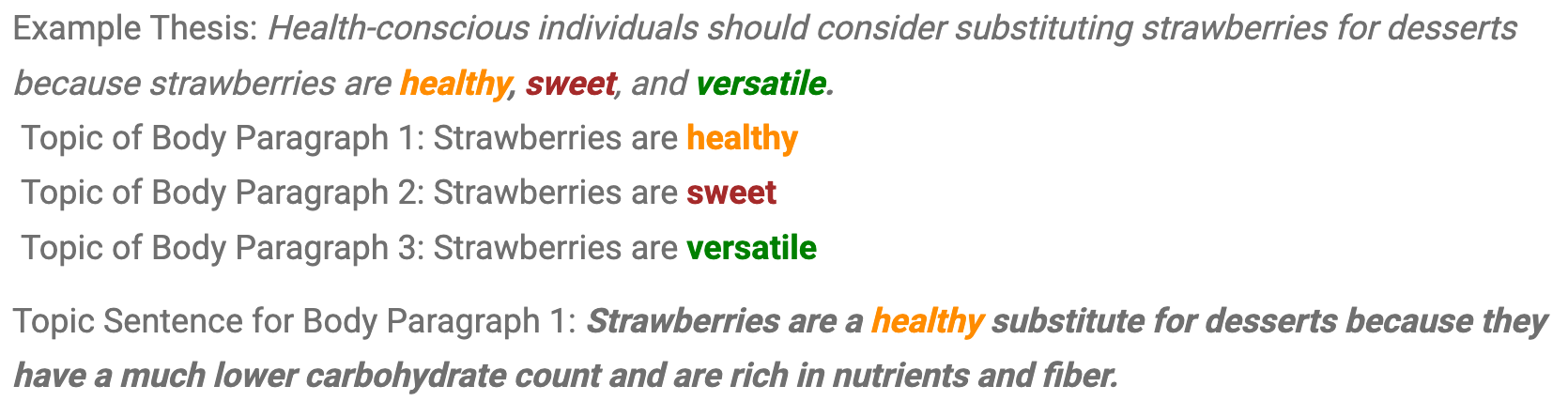
Link it to the thesis
Indicate how the paragraph helps advance your main argument. This clarifies the paragraph’s purpose and strengthens the coherence of your essay.
Incorporating a keyword from your thesis can create a strong link, but do not merely restate your thesis. Inform your reader how your paragraph contributes to the development of your argument.
If you’re struggling to write topic sentences, return to this task after you’ve finished writing your paragraphs.
Edit for clarity and focus
Polish your writing to make your topic sentence as clear as possible. Consider improving your sentence structure and writing quality with a grammar checker.
Verify your topic sentence with Regent University’s checklist and make sure that you’ve captured the idea of your paragraph, it flows logically from the previous selection, and you’ve removed unnecessary phrases.
For practice crafting and identifying topic sentences, try this workbook from National Geographic Learning.
What Makes a Good Topic Sentence?
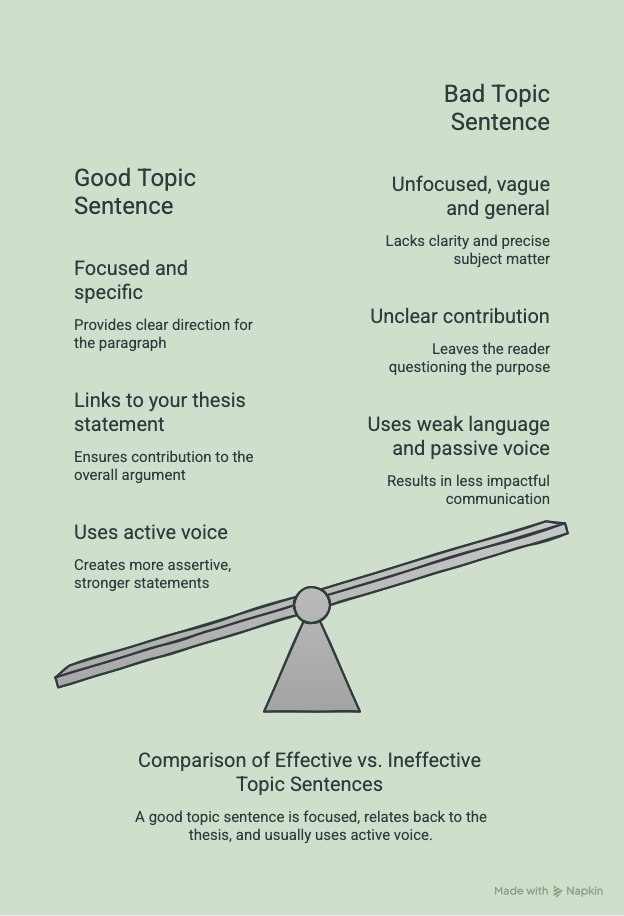
A good topic sentence is focused, relates back to the thesis, and uses active voice.
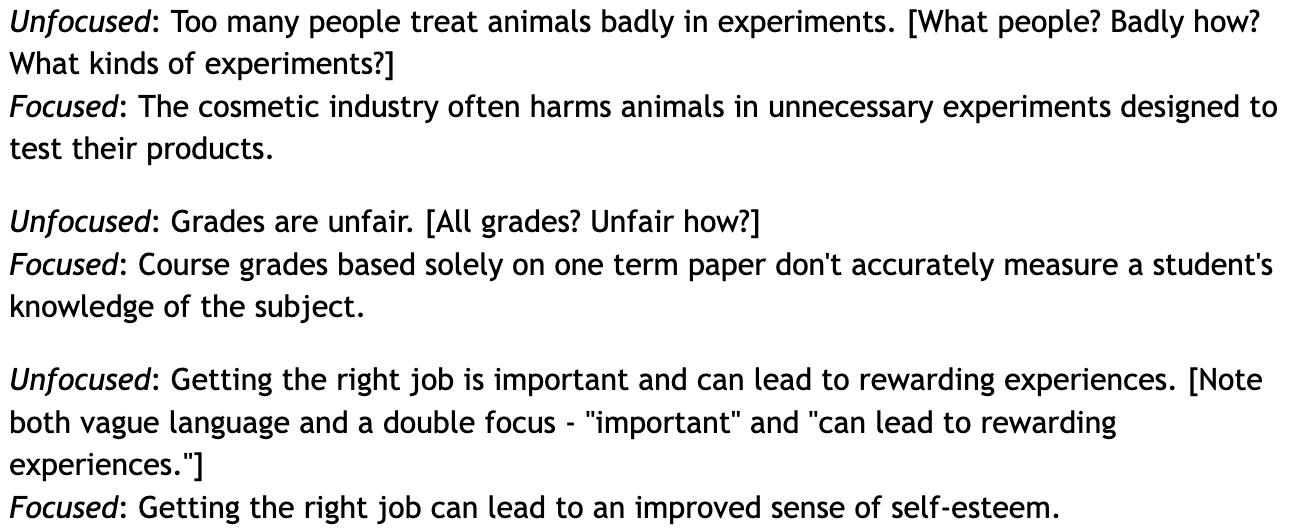
A good topic sentence is focused.
Colorado State University shows these great examples of topic sentences that are too vague, broad, and unspecific, and how to transform them into focused statements:
A good topic sentence links to your thesis statement
The two main goals of a topic sentence are to convey the paragraph’s main point and relate it back to the thesis of the paper.
A good topic sentence uses active voice.
Although passive voice can be effective in some situations, active voice creates more assertive, stronger statements.

FAQ
Are topic sentences always at the beginning of a body paragraph?
Not always, but the University of Toronto notes, “this is usually the most logical place for it.” In academic writing, placing a topic sentence at the beginning sets the reader’s expectations and prepares them to understand the paragraph’s contents. In non-academic writing, you may want to prioritize narrative style or suspense-building over efficiently conveying the paragraph’s point.
Can I write a body paragraph without a topic sentence?
Your writing will be less clear and will show fewer signs of organization, which may lower your essay mark. Depending on your discipline, your professor may recommend using section headings instead. Consult your assignment instructions and ask the professor.
How long should a topic sentence be?
This writing guide advises, “topic sentences should not be compound but could be complex.” Topic sentences may convey a complicated idea, but they should not contain multiple points. If your topic sentence is several lines long or a compound sentence, it may indicate that your paragraph is trying to address multiple topics and needs to be split.
What’s the difference between a thesis statement and a topic sentence?
A thesis statement, unlike a topic sentence, applies to the entire paper. Topic sentences only address the contents of the body paragraph they’re in. However, theses and topic sentences should be logically interconnected because your body paragraphs contain the evidence and analysis that backs up your thesis.