Imagery in Writing: Definitions and Examples
Imagery brings writing to life by appealing to the senses and evoking memories, emotions, and associations. Learn the seven types of imagery, how imagery differs from symbolism and motifs, and how to use it effectively in your own writing.


Imagery is a writing technique that creates mental images in the reader’s mind by using language that evokes sensory perceptions and memories.
“The movie theatre lay hushed beneath the dimming lamps, its crimson seats folded like rows of petals, while the pale screen shone before us like a quiet moon, and the warm, buttery scent of popcorn drifted softly through the stillness.”
The imagery in the sentence above transports the reader; you can imagine yourself there, your eyes adjusting to the dim light as you listen to tranquil silence and breathe popcorn-scented air. Compare it to this passage with little imagery: “The movie theatre was empty and the screen was blank.” By comparison, it hardly evokes our senses or memories at all.
This guide will explain the different types of imagery in writing and how imagery differs from other literary techniques. Learn what imagery is, how it works, and why to use it in your own writing.
What is Imagery in Writing?
Despite the name, imagery is about more than visual images. Imagery is language that appeals to our five senses (sight, hearing, smell, taste, and touch) as well as other impressions we perceive in the world and in our own bodies.
Literal Imagery vs Figurative Imagery
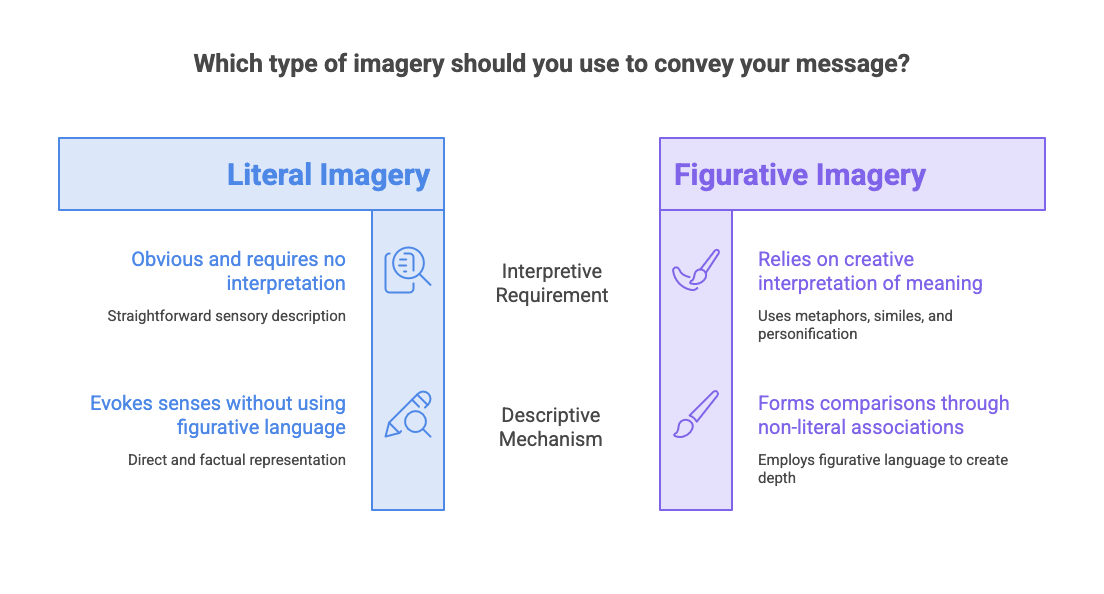
Direct description that evokes the senses without using figurative language is literal imagery; its meaning is obvious and requires no interpretation. Imagery that uses figurative language like metaphors, similes, and personification is figurative imagery.
Literal imagery reads like this:
- She had messy, curly black hair.
This description is straightforward and requires no creative interpretation of meaning. Her hair is literally curly, messy and black.
A figurative description of the same thing could read like this:
- Her hair was a wild bramble of midnight.
Here, the hair is not literally a bramble bush and, of course, cannot literally be made out of 12am. Through metaphor, figurative imagery forms comparisons: brambles grow in thatches that twist and tangle like unruly hair; midnight is an hour of night when we experience darkness that can be as black as black hair.
What is the Purpose of Imagery?
Professor of American Literature at Oregon State University, Raymond Malewitz explains that imagery “does more than simply present sensory impressions of the world: it also conveys tone, or the attitude of a character or narrator towards a given subject.”
Without imagery: There was heavy rainfall.
With imagery: The rain came down like the sky had broken open, pouring its grief over the city.
Imagery is an extremely powerful literary technique “because it connects to the personal experiences, or memories, of the reader.” Imagery not only provides rich descriptions that allow readers to sensuously imagine and experience settings, people, and events, it also imbues these descriptions with meaning and emotion.
If you’ve ever heard the time-honoured writing advice: “show, don’t tell,” using imagery is part of how to accomplish that. Bring bland, robotic sentences to life with imagery and consider using an AI tool for writers to identify passages that would benefit from sensory and evocative language.
7 Types of Imagery
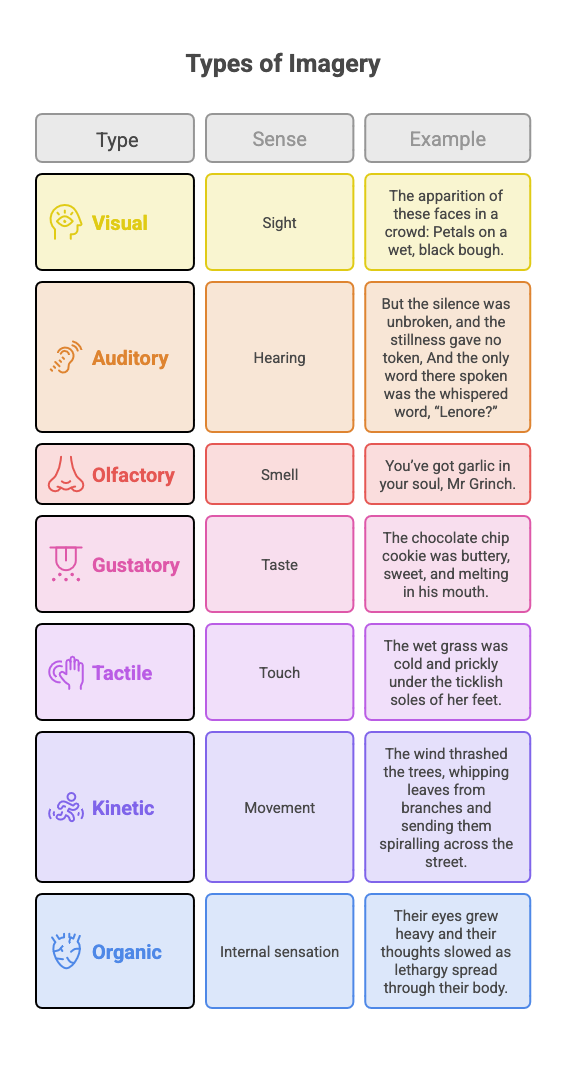
Traditionally, there are five types of imagery that match the five human senses—visual, auditory, olfactory, gustatory, and tactile – but two “broader categorizations” also exist: kinesthetic and organic. Here is a quick definition of all seven types, with examples.
Visual
Visual imagery is the most common and familiar form of imagery in writing. It conveys the appearance of a scene or object that is perceived through the sense of sight. Visual imagery often includes colours, shapes, sizes, and patterns.
Ezra Pound’s 14-word poem, “In a Station of the Metro”, is a classic example of visual, figurative imagery.
Example: The apparition of these faces in a crowd:
Petals on a wet, black bough.
Auditory
Auditory imagery evokes a reader’s sense of hearing. It describes sounds or the absence of sound, and often makes use of onomatopoeiae (words that mimic sounds, like meow or splash), repetition, and alliteration.
Edgar Allen Poe’s “The Raven” makes extensive use of auditory imagery throughout the poem.
Example: But the silence was unbroken, and the stillness gave no token,
And the only word there spoken was the whispered word, “Lenore?”
Olfactory
Sense of smell is evoked by olfactory imagery, which can describe pleasant scents and fragrances, or nasty odours and stenches.
Example: You’ve got garlic in your soul, Mr Grinch.
Gustatory
Gustatory imagery speaks to our sense of taste, describing flavours like sweet, salty, spicy, and sour. Like olfactory imagery, gustatory imagery relies heavily on the reader’s past experiences, evoking memories that bring powerful associations with them.
Example: The chocolate chip cookie was buttery, sweet, and melting in his mouth.
Tactile
Textures and physical sensations are used to convey strong impressions through the sense of touch. It often references hot or cold temperatures or the textural qualities of objects.
Example: The wet grass was cold and prickly under the ticklish soles of her feet.
Kinetic
Kinetic imagery relates to physical movement, conveying qualities like speed and direction that impart a sense of motion and dynamism.
Example: The wind thrashed the trees, whipping leaves from branches and sending them spiralling across the street.
Organic
Organic imagery is notoriously abstract. It speaks to sensations that are internal to the body, including feelings like hunger and energeticness, but also emotional sensations like the buzz of excitement or the cold paralysis of fear.
Example: Their eyes grew heavy and their thoughts slowed as lethargy spread through their body.
Imagery vs. Motifs vs. Symbolism
Imagery, motifs, and symbolism are literary devices that elicit emotion and deeper understanding in readers. Their functions are related, but distinct. While imagery allows readers to vividly imagine elements of a narrative, motifs are recurring patterns of emphasizing certain words or images, and symbolism is the technique of using something concrete to represent an abstract concept.
How to Use Imagery in Your Own Writing
Most creative writing, be it a poem, a play, a song, or a speech, benefits from imagery to enhance its descriptions. A scientific report or a research paper, however, are not the kinds of documents that accept imagery as part of their stylistic conventions.
In your writing, consider which senses you would like to appeal to and how it fits your subject. If you’re writing about a meal, gustatory, olfactory, and organic imagery will help convey the experience of hungering for something that smells and tastes delicious, or alternatively, being nauseated at the stench or bitterness of something disgusting.
If you’re describing a landscape, visual, auditory, and tactile imagery will deliver an impression of how the place is experienced through sight, sound, and touch. You can add layers of kinetic imagery on top of this setting and consider how characters move through that space; are they zipping and rushing, or strolling and meandering?
Imagine yourself in the scene you’re describing and bring out as many details as possible, engaging all of your senses and perceptions, to deliver a more vivid, visceral experience to your reader. Effective imagery is about more than simply describing things; it’s about choosing sensory details that suit your subject and purpose so you can help readers see, hear, smell, taste, and feel the world you create.