How to Write an Effective Essay Hook
Learn how to write an effective essay hook that captures attention, introduces your topic, and creates a strong first impression. Explore popular hook types, examples, common mistakes, and practical tips for engaging readers from the very first sentence.


Stuck on the first sentence of your essay? You’re not alone. It’s a high-pressure sentence. Snagging your reader’s interest and attention from the first line is key to good writing, and this guide offers useful and actionable advice to help you nail it.
Essay hooks can turn a weak introduction into an engaging one. Grab your reader’s attention, get straight to addressing your topic, and keep your work off of Reddit’s r/Professors “Worst essay openings?”
This guide will help you boost your essay writing from the first line and clinch a strong first impression. Learn how to write a powerful essay hook by reviewing strong examples of popular formats, comparing good and bad hooks, and avoiding common mistakes.
TL;DR
- An essay hook is the first sentence of an academic paper; it aims to capture a reader’s interest and direct their attention to the paper's topic.
- Use quotations, statistics, bold statements, interesting facts, sensory descriptions, dilemmas, personal anecdotes, and questions to captivate your reader and avoid opening sentences that are boring, off-topic or make generalizations.
What Is an Essay Hook?
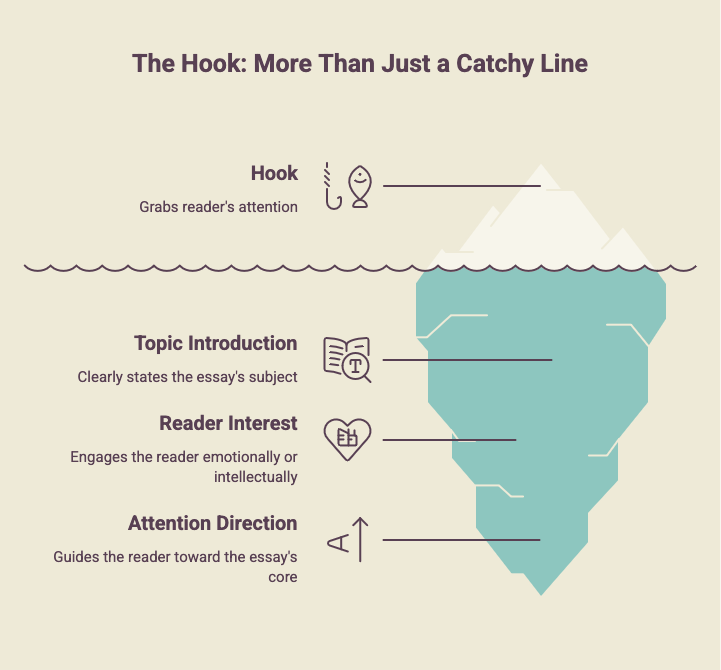
An essay hook is the first sentence or two of an academic paper. After the essay title, the hook is usually the first thing your reader will read, making it a powerful part of a good essay introduction.
According to Harper College, the main purpose of a hook is to introduce the topic and to get the readers interested. It aims to snag and hold a reader’s interest while directing their attention toward the topic of the essay.
8 Types of Essay Hooks (With Examples)
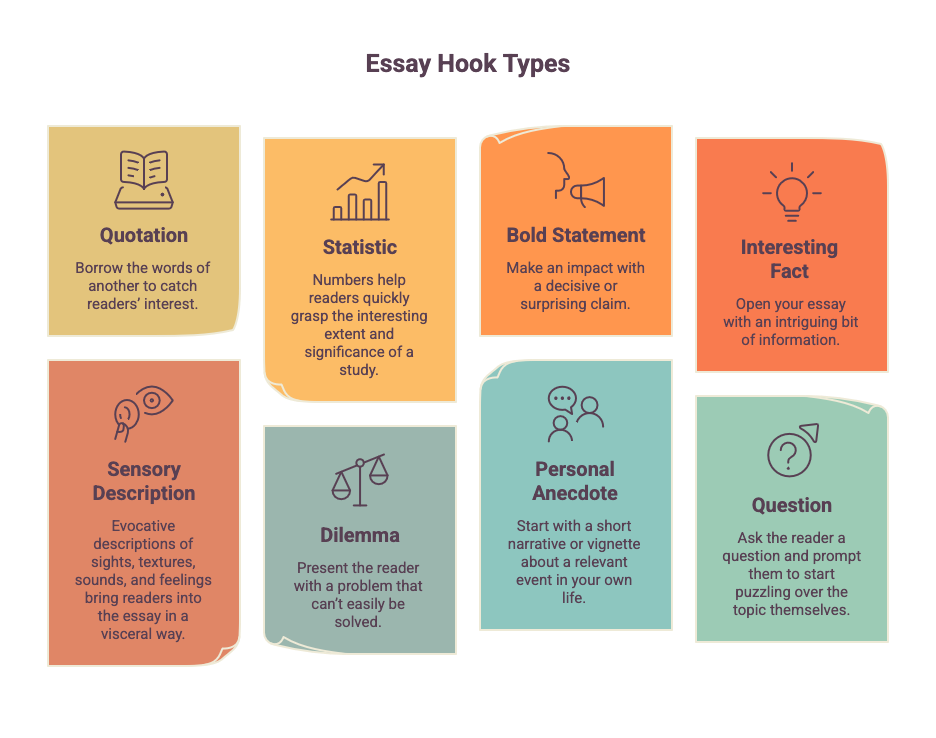
Good hooks must be interesting and on-topic: beyond that, the possibilities are limitless. Be creative! A hook is a chance to have a little fun, tantalize your reader, and showcase a fascinating part of your topic. Find inspiration in these powerful essay hooks by undergraduate students.
Quotation
Borrow the words of another to catch readers’ interest – but don't forget to cite it.
This essay by Aliana Wallace at the University of British Columbia uses a quotation by a famous politician to dive into her philosophical analysis of social contracts and revolt:
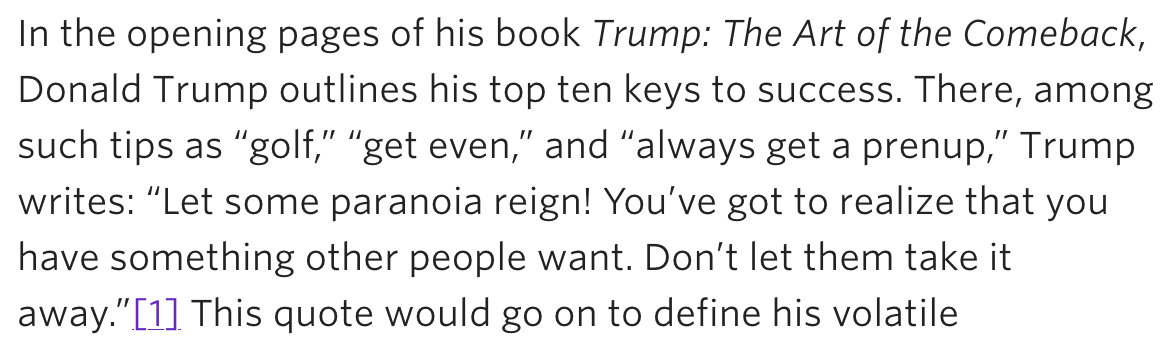
Once again, it's critical to properly cite any quotation that appears in your hook.
Tip: If you’re worried you missed a citation or can’t find the source of a quotation, run your paper through a Citation Checker for a quick assessment and concrete feedback.
Statistic
Numbers provide a quick grasp of a study’s extent and significance.
This essay by Corper et. al. at the University of British Columbia studied urban bird populations to better understand the ecological health of greenspaces. The authors effectively use opening statistics to convey the scale and impact of urbanization that necessitated the study.
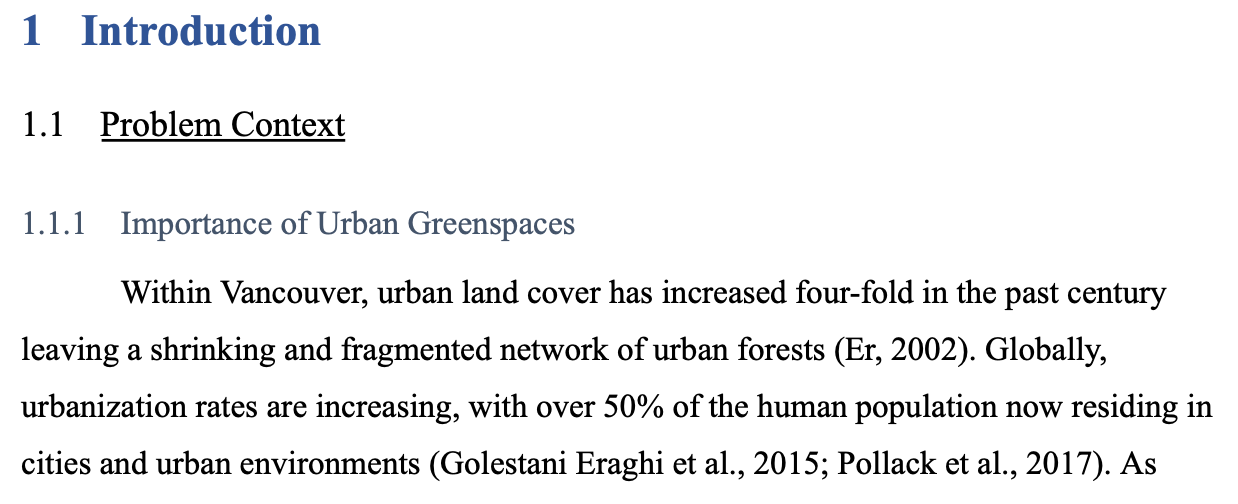
Tip: Verify that your statistics are coming from legitimate sources with a Hallucination Detector that can help recommend credible academic sources to back up your claims.
Bold Statement
Make an impact with a decisive or surprising claim.
This essay from the undergraduate journal Generations makes a contentious statement that defines one of the core problems the essay addresses:
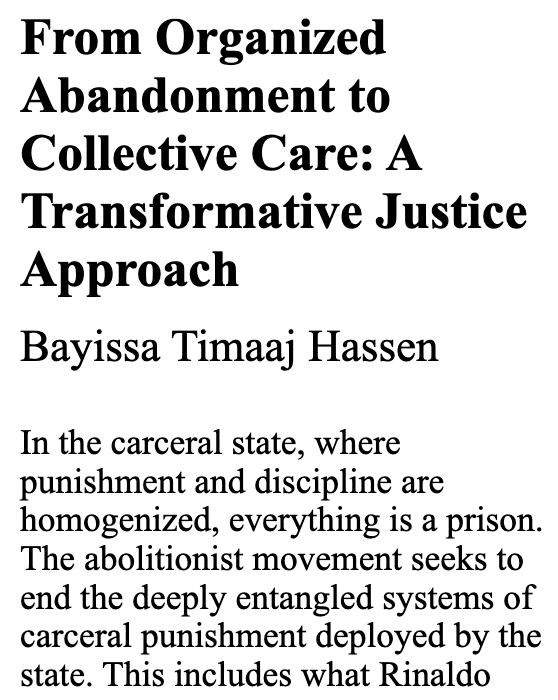
Be careful not to overstate your case. This essay argues that carceral logics extend beyond prison walls, so the bold claim that “everything is a prison” is supported within the essay.
Interesting Fact
Open your essay with an intriguing bit of information. Teaching your reader something in the first sentence immediately suggests the value of your essay.
Kenny Reilly makes great use of a little-known historical fact in their essay from Mount Royal University:

Not all facts qualify as “interesting.” Look for information that is relatively unknown by most people, or facts that contradict commonly-held beliefs.
Sensory Description
Evocative descriptions of sights, textures, sounds, and feelings bring readers into the essay in a visceral way.
In this essay by Ntibinyane Alvin Ntibinyane in Communication at MacEwan University, the student makes excellent use of a descriptive opening:
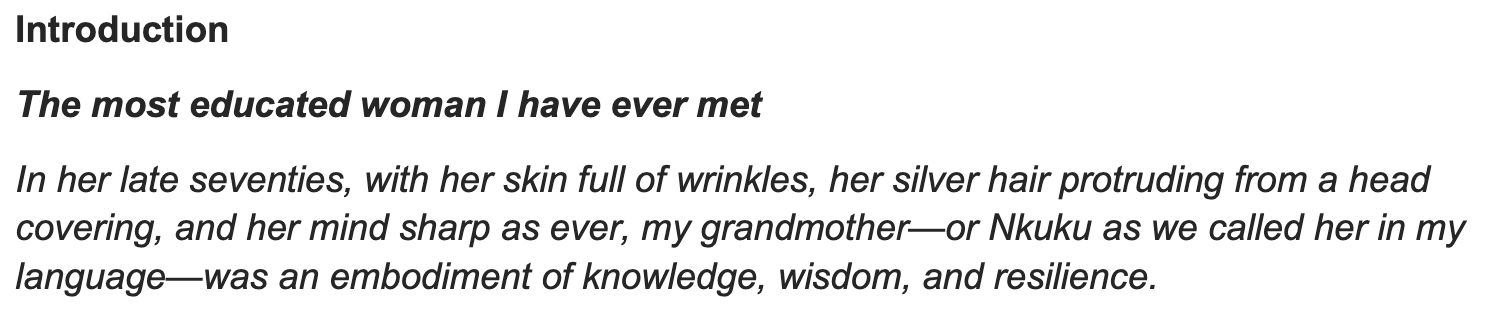
While this may seem unconventional for an essay opener, the essay’s thesis argues for the inclusion of lived experience and traditional knowledge in journalism education. Opening with their grandmother’s story effectively reflects the essay thesis.
Dilemma
Present the reader with a problem that can’t easily be solved.
This essay by Brandon Biglow from MacEwan University’s Student eJournal effectively highlights a concerning predicament for contemporary politics:

It can be risky to start an essay with a claim about “modern society,” but in Brandon’s case, the hook narrows in on the specific topic of adversarial political messaging as a recognizable problem in political discourse.
Personal Anecdote
Stories are compelling! Start with a short narrative or vignette about a relevant event in your own life.
An essay about protecting biodiversity by Kadyn Skipper at the University of Oregon’s Undergraduate Research Journal makes great use of a personal anecdote:
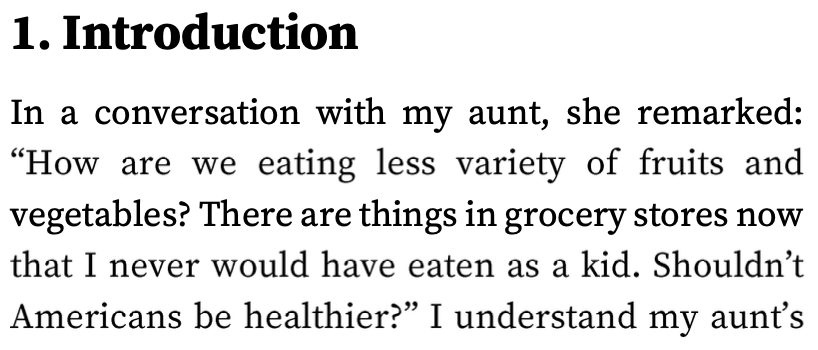
Why isn’t this an example of a Quotation format for a hook? Because the quotation is coming from the author’s aunt, it’s not a famous quote, it’s not a statement by an expert, and it’s not taken from published material. Its only link to the essay is through the author’s personal experience.
Question
Ask the reader a question and prompt them to start puzzling over the topic themselves.
Lainey Costa’s research essay from Oregon University analyzes how humans form memories as discrete events. They make great use of an opening question to draw readers’ curiosity toward the research gap being addressed.
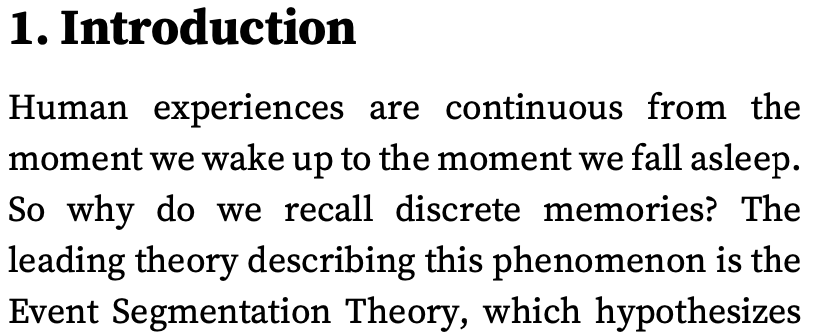
Note that the question is not merely rhetorical – the essay is going to answer it.
Check out further styles and examples of essay hooks here.
Weak vs Strong Essay Hooks
Essay hooks can be polarizing. Harvard University discourages hooking readers with “a dramatic promise” and recommends using the introduction to explain “why your essay is going to be interesting to read.” However, this is exactly the purpose of a good hook: to immediately spark the reader’s interest in your essay topic.
What makes a good hook?
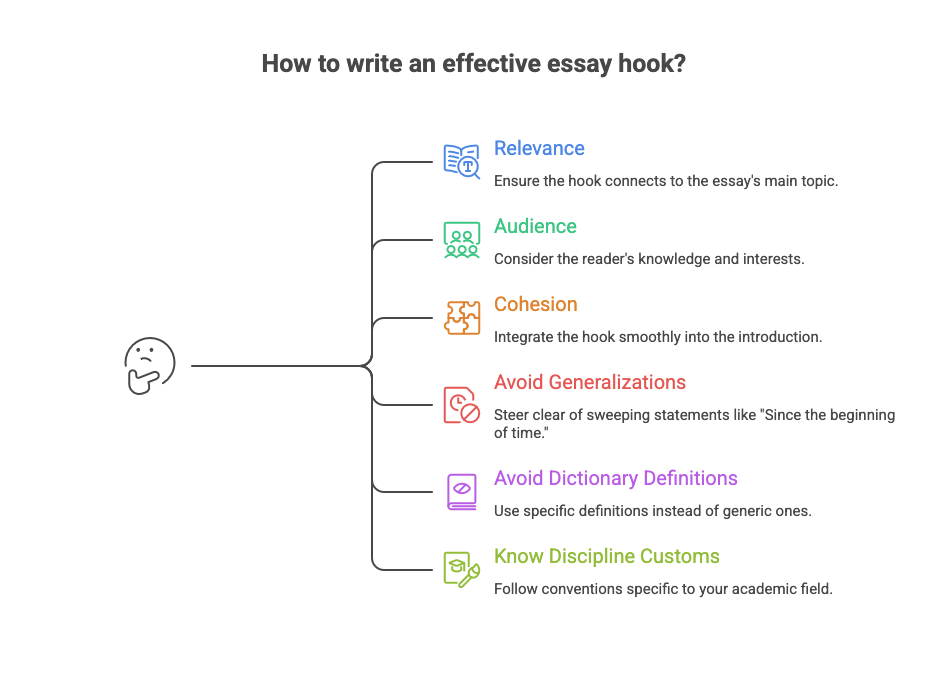
Indeed recommends three criteria for assessing a good essay hook:
- Relevance: it fits the purpose of the essay. Is it connected to the main topic of the paper?
- Audience: it anticipates the knowledge and interests of your reader. Are you addressing a general audience or a professor with expertise in the field?
- Cohesion: it integrates into the introductory paragraph well. Does it transition easily to your essay context and thesis?
What makes a bad hook?
Avoid sweeping generalizations
Let’s return to Reddit's r/Professors “Worst essay openings?” While many of the entries are funny because of factual inaccuracies, the most common and reviled essay opener is the sweeping generalization: “Since the beginning of time…” or “Throughout history…” or “In today’s world…”
Another unpopular first line in an essay is a dictionary definition. While defining a key term in a way that is specific to your field and your paper topic is a good idea, beginning your essay with “According to Webster’s Dictionary…” appears amateurish and uninformed.
Know the customs of your discipline
Finally, some academic disciplines do not use hooks, and starting with a catchy first sentence will contravene writing conventions. For example, a biology report written for a biology course will open with the main point rather than a hook.
Conclusion
A strong essay hook captures your reader’s interest, and what keeps it interesting is often whether you use a quotation, statistic, bold statement, interesting fact, sensory description, dilemma, personal anecdote, or question. Ideally, a good hook keeps readers engaged and also helps them understand why your topic is worth reading.