
How to Write an Opinion Essay in 6 Steps (With Examples)
An opinion essay is a type of academic paper where you share your evidence-based opinion on a specific topic or issue.



We all have opinions. If you have an essay assignment on your desk that’s asking you to share yours, you might be tempted to start writing right away. Although your opinion is an important part of the assignment, it’s not the only thing you have to consider. A strong opinion essay doesn’t simply present your opinion; it also supports it with compelling, authoritative evidence.
Opinion essays go wrong when students focus on their opinion and fail to provide the necessary evidence to prove their point. Similar to other essay formats, your opinion essay needs a strong structure that presents your argument in light of convincing evidence.
In this guide, we will show you exactly how to write an opinion essay from start to finish. We share the six steps you need to follow to achieve a top-notch result, as well as some examples and templates to help you along.
Quick Takeaways
- An opinion essay takes a personal position on a topic and defends that position with evidence.
- There’s a six-step process to writing an opinion essay: choose a topic, take a position, gather evidence, outline, draft, revise, and polish.
- An opinion essay follows the same structure as the standard essay – introduction, ending in a strong thesis, body paragraphs that develop and support the argument, and a conclusion that restates your point in light of the evidence you presented.
What Is an Opinion Essay?
An opinion essay is a type of academic writing that presents your personal opinion on a topic and supports that opinion with evidence, examples, and sound reasoning. As the British Council's LearnEnglish guide explains, the goal is to make your opinion clear throughout.
Opinion essays are common in English language classes and show up on many exams. They test your ability to structure an argument and present the information in a clear way to the reader. Although it might seem deceptively similar to other essay types, especially the argumentative essay, this table shows exactly where it differs:
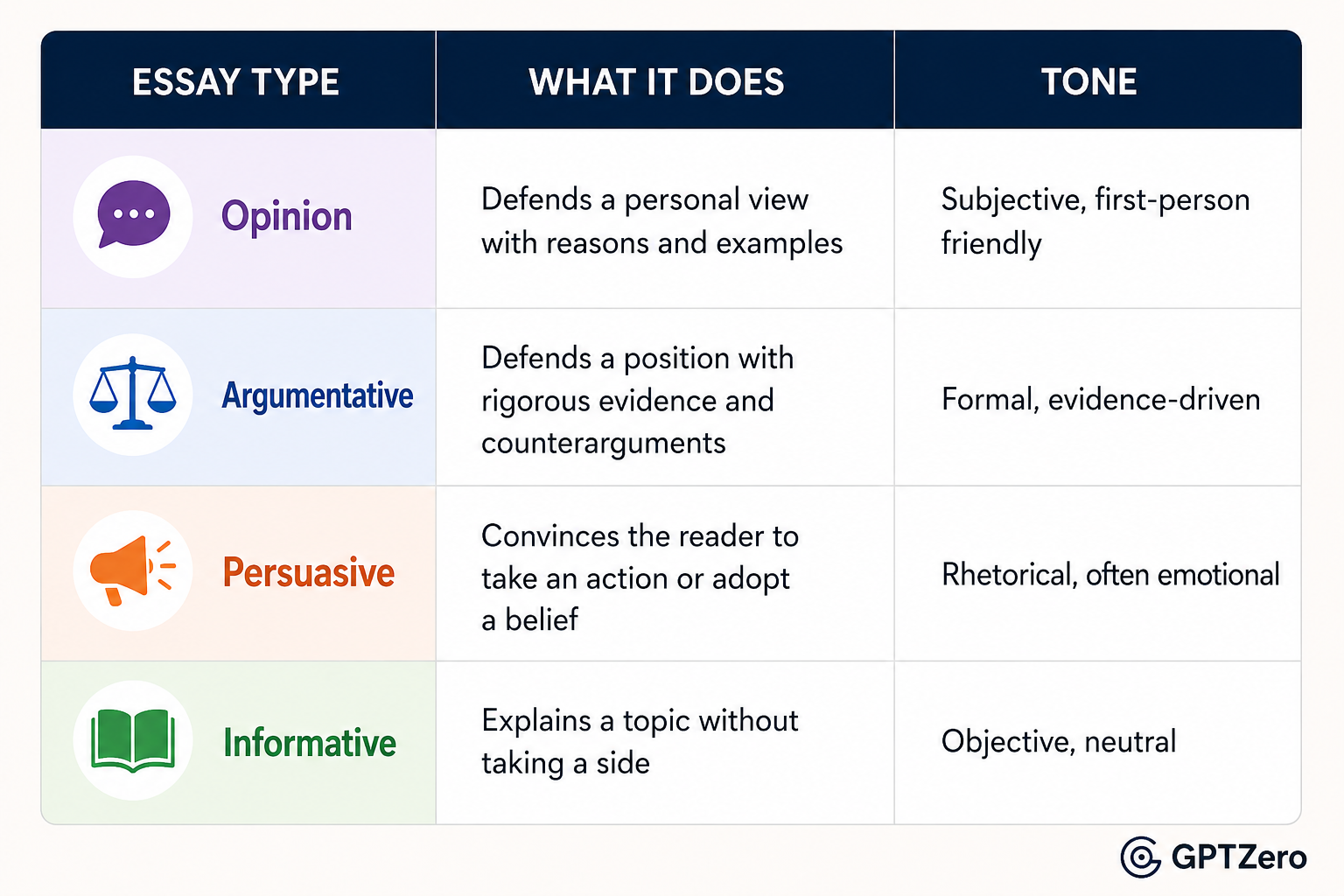
Opinion Essay Structure & Format
The opinion essay follows the classic essay structure found in many academic papers.
Introduction
Begin by restating the question or topic in your own words. You can do this by adding a compelling hook, statistic or other information that might entice the reader – followed by two or three sentences providing context on your topic. End with your thesis or opinion. Make your opinion explicit and clear.
You will find more tips on how to write a good introduction in this guide.
Body Paragraphs
Include three body paragraphs, each developing one reason that supports your claim. Each paragraph should begin with a topic sentence that states what the paragraph is going to focus on. Weave authoritative evidence from credible sources into your argument to strengthen it. One paragraph is often dedicated to refuting the opposing argument.
Tip: Credible sources are key to a successful opinion essay. A source finder can help you locate and confirm your sources before submitting.
Conclusion
Restate your opinion in light of the evidence you have presented and summarize your main points. You can end with a broader insight, but avoid introducing any new ideas or angles at this point.
Format checklist
- Double-spaced
- 12-point readable font
- One-inch margins
- Indented first lines
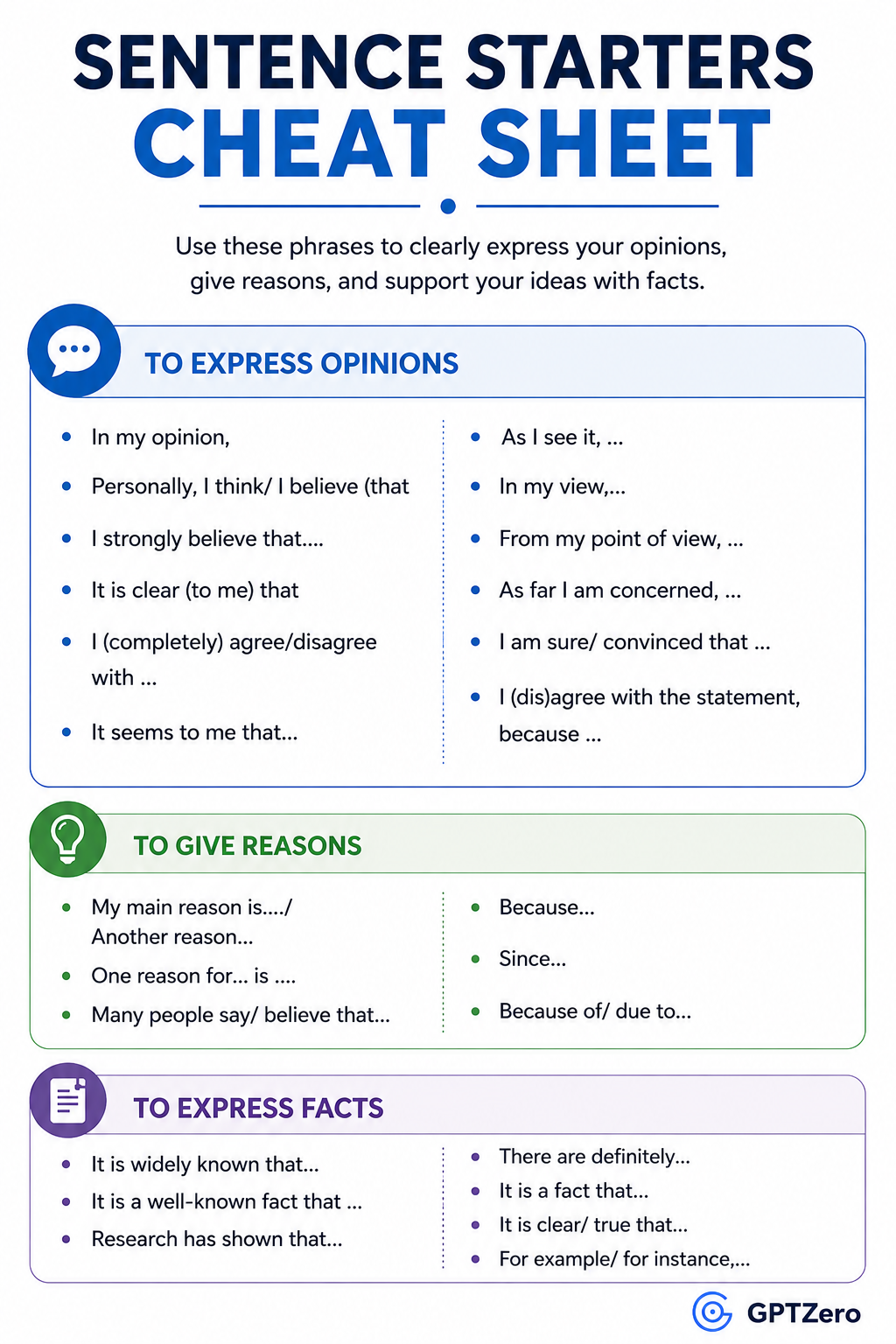
How to Write an Opinion Essay in 6 Steps
Step 1: Pick a Debatable Perspective
Not every opinion is worthy of an opinion essay. Choose a topic that invites natural debate. For example, arguing that “exercise is good for you” and everyone should do it is generally agreed upon to be good advice. Not everyone will agree, however, that “schools should require mandatory physical activity in K-12”.
Step 2: Take a Clear Position
An opinion essay is the one place where you shouldn’t be afraid to hold a strong opinion on a subject- in fact, taking a clear position will only make your essay stronger. Be as specific as possible when formulating your opinion. The more granular, the better.
Here are two examples:
Although social media can help people stay connected, its overall effect on teenagers is more harmful than beneficial.
AI tools should be allowed in schools when used responsibly.
Tip: If you use AI tools in your work, it can sometimes be hard to discern where AI ended, and you picked up. Running your work through a reputable plagiarism checker will avoid accidentally including work other than your own.
Step 3: Gather Supporting Reasons and Examples
AI tools should be allowed in schools when used responsibly.
Now that you have the opinion statement that will guide your essay, jot down three supporting arguments and begin gathering sources to back up your claims. Focus on credible sources like peer- reviewed articles, academic journals, published books, and official data.
Step 4: Build an Outline
Even a simple outline will save you time and make the drafting process smoother. An outline should include your thesis statement, the points you want to make in your body paragraphs, and an acknowledgement of the opposing argument. It's a good idea to jot down the sources you want to include as well. For more guidance on this important step, read our guide on how to outline your essay.
Step 5: Write the Draft
Begin with a hook that draws your reader in and introduces your topic. Each paragraph should also begin with a topic sentence that states what will be covered in the paragraph. Try not to over-edit at this point. Focus on finishing the draft and leave the small edits to your grammar checker.
Step 6: Revise and Polish
Revisions are best done in two passes. On the first pass, check for the flow and structure of your argument. Notice any transition sentences that need attention, especially between paragraphs and ideas. On the second pass, you want to resolve any spelling and grammar mistakes. You should also double-check your references and sources. It's a good idea to check for hallucinations to make sure your sources are real and link to the right places.
Opinion Essay Outline Example
Here's a complete outline showing the structure in action.
Topic: Should social media companies be legally required to verify users' ages?
Introduction
Hook: Millions of children under 13 use platforms that officially ban them. Restate the question and add a couple of sentences for context.
Thesis: Social media companies should be required to verify users' ages, because the current self-reporting system has proven ineffective at protecting minors.
Body Paragraph 1
Main point: The current system fails.
A child can lie about their birth year in seconds. Connect the statement back to the thesis.
Body Paragraph 2
Main point: The documented harms of social media.
Growing evidence links heavy social media use to mental health declines in young users. Cite public health research and parental testimony.
Body Paragraph 3
Main Point: Address the counterargument.
Include any pushback that might come from the perspective of the social media companies. How do they defend their choice not to verify age?
Conclusion
Restate the opinion and summarize the main reasons. End with a forward-looking thought about what better protection could look like.
What to Include vs. What to Avoid
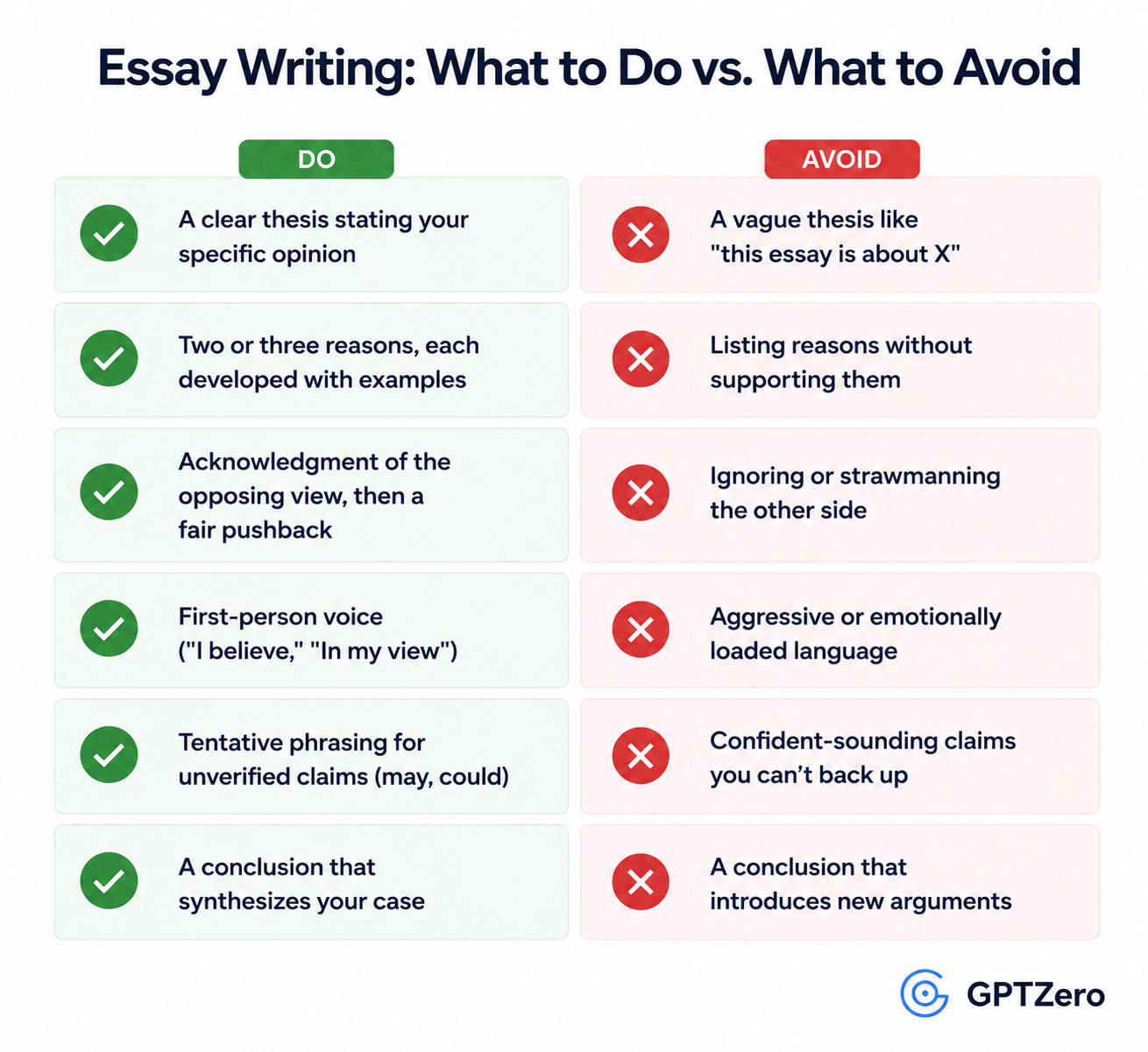
Infographic comparing essay writing dos and don’ts, highlighting best practices
FAQs
How do you start an opinion essay?
Open with a hook, a striking statistic, a brief observation, or a question. Follow with one or two sentences of context, then state your thesis (your opinion) clearly. The reader should know exactly where you stand by the end of the introduction.
How do you write an introduction paragraph for an opinion essay?
Your introduction should restate the question or topic in your own words. Then give the reader some context, and end with a thesis that states your opinion. Most introductions are three to five sentences, so think of each sentence as having a job to do.
Can you use "I" in an opinion essay?
Yes. Opinion essays are one of the few academic formats where the first person is welcome and encouraged. Sentences that start with "I believe," "In my view," and "Personally, I think" are common.
How long should an opinion essay be?
It depends on the context, but most run between 300 and 1000 words. Exam essays (IELTS, TOEFL) usually have a specific word range, and classroom assignments vary widely. Always check your syllabus for instructions on word count.
Do opinion essays need sources?
Yes. You need to back up your opinions with some data. You don’t have to go as in-depth as you would in an informative essay, for example, but showing you have done your research will only strengthen your opinion.