Accenture "Upskills" Its Hallucinations Game


Paul Esau, Avikam Mangla, Midhun Dandamudi
29 min read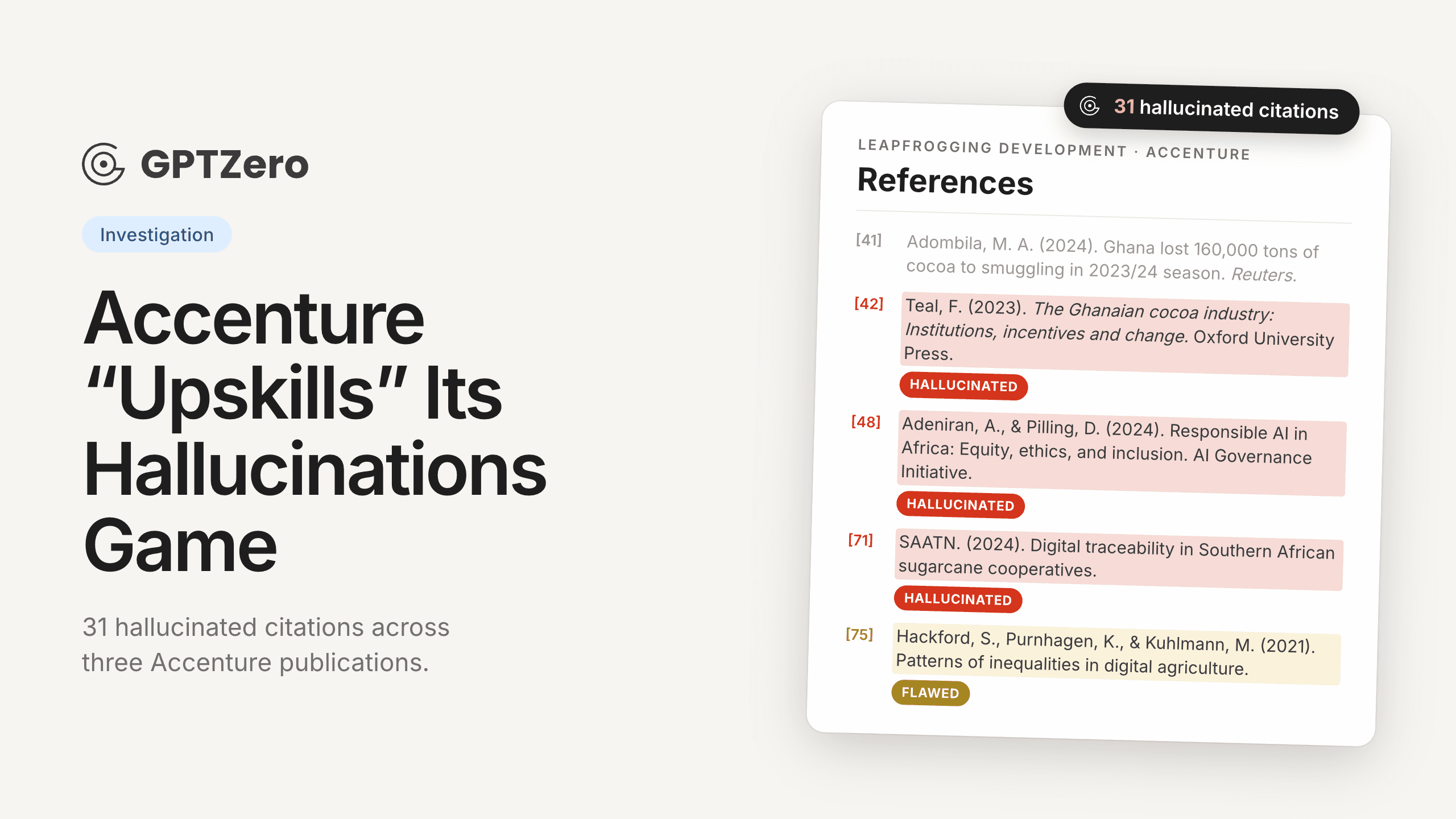
Earlier this month, Accenture officially brought its tokenmaxxing era to a close by imposing a $29-a-month cap on many employees’ Claude accounts. While Accenture rejects this characterization, claiming the policy implements a new “funding approach” rather than a “firm limit,” it’s clear that the days of employees spending up to $1000 a month on LLM usage are over.
Unfortunately, a GPTZero investigation of recent Accenture publications reveals that not all tokens paid for by Accenture were spent productively. Using an automated pipeline and our Hallucination Detector, we surfaced three Accenture products containing a combined 31 hallucinated sources, numerous fabricated claims, and other likely signs of AI generation. To avoid making the same mistake as Accenture, a real human verified each hallucination.
The first document is a policy paper co-produced by Accenture’s African arm and professors from the Madrid campus of IE University’s Global Policy Center. It examines the potential for African economies to capture more value from agricultural exports like coffee, cocoa, and sugarcane using AI. The second is an academic paper posted on arXiv by researchers from Accenture’s Center for Advanced AI. The third is another arXiv paper posted by members of an Accenture research lab in Bangalore, India.
While neither arXiv paper is an official Accenture publication, both were authored by Accenture researchers using their Accenture emails and bylines on behalf of Accenture. Also, code from the first arXiv paper is being stored on the official Accenture GitHub organization.
One specific citation from the third paper shows how the risks of AI-generated citations extend beyond hallucinations. On page 16, a reference intended to corroborate a claim about a malicious chatbot called “FraudGPT” included a link to a fake GitHub repository for the chatbot that contained real malware. Readers of the paper who attempted to access the linked repository prior to its deletion sometime in 2026 may have infected their computers. This type of mistake — failing to discern between a credible source and a fraudulent website proliferating malware — is indicative of the unsupervised use of an AI research or citation tool.
Need more information on our Hallucination Detector? Here is our technical report.
Accenture publications containing hallucinations
31 hallucinated citations out of 245 across three publications
| Publication | Published | Hallucinated citations | AI score |
|---|---|---|---|
| Leapfrogging Development: Unlocking Africa’s Potential in Global Value Chains with Artificial IntelligenceLeapfrogging Development Policy paper · Accenture Africa with IE University | Nov 2025 | 15 of 89 | 85% MixedCitation scan ↗ |
| ContextEcho: A Benchmark for Persona Drift in Long Agentic-Coding SessionsContextEcho Research paper · Accenture Center for Advanced AI | May 22, 2026 | 7 of 102 | 100% AICitation scan ↗ |
| Authenticity Debt and the Synthetic Content Threat Landscape: A Layered Framework for Trust, Provenance, and IP Governance in the Generative AI EraAuthenticity Debt Research paper · Accenture, Bangalore | May 30, 2026 | 9 of 54 | 100% AICitation scan ↗ |
The Accenture Arc
Accenture is one of the largest consulting firms in the world, offering IT and other professional services from between 52 and 120 countries (we burned some of our own Claude tokens to determine the real number is closer to fifty). In 2025, the firm bet heavily on AI by reorganizing its operations, shrinking its workforce, and announcing major deals with Anthropic and OpenAI. Accenture CEO Julie Sweet warned employees that their jobs were dependent on AI upskilling, while the Anthropic deal made Accenture one of Anthropic’s three biggest enterprise clients. By February 2026, the firm was monitoring staff use of AI tools — making promotion to leadership positions dependent on “regular adoption.”
Yet this ruthless pursuit of LLM-fueled productivity slowed as token spending increased. During the summer, leaked meeting audio revealed that Accenture was struggling to prevent non-technical workers from burning tokens on converting PDFs to slides and other trivial tasks. Accenture even launched a new service (called Tokenomics) to help other companies track, manage, and reduce ballooning token spend across their workforces. Yet by early October, the firm decided its best option was a $29-a-month cap on per-employee spending.
Before the cap was implemented, an unknown quantity of tokens was burned on inaccurate reports, fake statistics, and hallucinated citations.
A List of Non-Existent or Mangled Sources
GPTZero’s Hallucination Detector surfaced 31 hallucinated citations from 245 total citations across three Accenture products. As always, GPTZero uses a strict definition of hallucination and manually confirms that each citation meets this definition, which is calibrated to give authors the benefit of the doubt.
31 hallucinated citations
Citations that don’t match any real source, or that splice real sources together. Tap a publication to expand it.
Leapfrogging Development15 hallucinated
| Ref | Citation as printed | What’s wrong with it |
|---|---|---|
| [5] | World Economic Forum. (2023). Stanford University AI Index Report. https://www.weforum.org/stories/2024/04/stanford-university-ai-index-report | URL exists, but the citation title and date are inaccurate. The title is pulled from the URL slug. |
| [14] | Afreximbank. (2024). African Trade Report 2024: Intra-African Trade and Regional Value Chains. https://media.afreximbank.com/afrexim/African-Trade-Report_2024.pdf | Citation mostly references this report, but the subtitle is a garbled reference to another Afreximbank report. |
| [19] | UNCTAD. (2022). Leveraging digital solutions for trade facilitation in developing countries. United Nations Conference on Trade and Development. UNCTAD/DTL/ECDC/2022/4. https://unctad.org/publication/digital-economy-report-pacific-edition-2022 | Title appears to be fabricated. Document number and URL point to a different UNCTAD report titled “Digital Economy Report Pacific Edition 2022: Towards Value Creation and Inclusiveness” |
| [42] | Teal, F. (2023). The Ghanaian cocoa industry: Institutions, incentives and change. Oxford University Press. https://books.google.com/books?id=tlYYEAAAQBAJ | No title match. Author has written other works on Ghana. URL resolves to a different book on a similar topic. |
| [44] | CIAT. (2021). Climate impacts on cocoa suitability in West Africa: Vulnerability to climate change of cocoa in West Africa – patterns, opportunities, and limits to adaptation. https://www.cgiar.org/research/publication/vulnerability-climate-change-cocoa-west-africa-patterns-opportunities-limits-adaptation/ | All four authors have been replaced by their affiliation (CIAT). Part of the title is fabricated and the date is wrong. |
| [45] | Cocoa & Forests Initiative. (2024). Traceability and sustainability in West African cocoa: Overcoming challenges and driving sustainable change. https://worldcocoafoundation.org/news-and-resources/press-release/cocoa-and-forests-initiative-releases-annual-reports-overcoming-challenges-and-driving-sustainable-change | This is a press release published by the World Cocoa Foundation (not the Cocoa & Forests Initiative). The first part of the title is fabricated. |
| [48] | Adeniran, A., & Pilling, D. (2024). Responsible AI in Africa: Equity, ethics, and inclusion. AI Governance Initiative. | No author or title match. No similar source is available from the AI Governance Initiative. |
| [49] | London Consultants Group International. (2025, February). AI-powered cocoa disease management. https://lcgi.co.uk/ai-powered-cocoa-disease-management/ | No title match. URL is broken. |
| [53] | World Bank. (2019, June). CSA profile: Vietnam (Version 2.2). Climate Knowledge Portal. https://climateknowledgeportal.worldbank.org/sites/default/files/2019-06/CSA_Profile_Vietnam2.2.pdf | No title or author match. Citation loosely matches this document. |
| [61] | TechnoServe. (2024). Digital traceability in Ethiopian coffee cooperatives. https://www.technoserve.org | No title match, but this page is a potential subject fit. URL is for Technoserve homepage. |
| [68] | FAO. (2023). Digital agriculture in Latin America: Innovations and governance. Food and Agriculture Organization of the United Nations. https://www.fao.org | No title match. URL is the FAO homepage. |
| [70] | Gikunda, M., Obuya, J., & Mungai, N. (2024). AI interfaces for local-language digital agriculture services in Kenya. East African Journal of Digital Development, 6(2), 55–70. | No author or title match. Journal appears to be fake. |
| [71] | SAATN. (2024). Digital traceability in Southern African sugarcane cooperatives. Southern African Agriculture Transformation Network. | No title match. SAATN does not appear to be a real organization. |
| [80] | Inter-American Institute for Cooperation on Agriculture (IICA). (2023). Blockchain for cocoa traceability in Latin America. https://www.iica.int | No title match. URL is the IICA homepage. |
| [81] | Motta, A., Velez, S., & Rodríguez, J. (2024). Machine vision-based quality grading in Latin American coffee cooperatives: Performance and adoption. Journal of Agricultural Informatics, 15(1), 33–49. | No author or title match. No match in the journal issue. |
ContextEcho7 hallucinated
| Ref | Citation as printed | What’s wrong with it |
|---|---|---|
| [39] | Sayash Kapoor, Benedikt Stroebl, Zachary S Siegel, Nitya Nadgir, and Arvind Narayanan. AgentBench: Evaluating llms as agents. In ICLR, 2024. | Authors match this paper. Title and venue match this paper. |
| [51] | Xiaogeng Liu, Nan Xu, Muhao Chen, and Chaowei Xiao. Jailbreaking black box large language models in twenty queries. In NeurIPS, 2024. | Authors match this paper. Title matches this paper. Neither venue matches. |
| [52] | Xinran Liu, Yifan Wang, and Wei Chen. Agenteval: Holistic evaluation of llm agents. arXiv preprint arXiv:2403.16965, 2024. | No author or title match. The arXiv ID matches a different paper. |
| [67] | Nikhil Shah, Alexander Wei, and Aaryan Bhattacharya. Persona-driven sycophancy in large language models. arXiv preprint arXiv:2402.08471, 2024. | No author or title match. The arXiv ID it gives belongs to a physics paper. |
| [82] | Yuxin Wang, Akari Mishra, et al. Role-play with large language models. Nature, 2024. | Title and journal match this paper. Authors and year appear to be fabricated. |
| [88] | Robert Xiang et al. Tracr: Compiled transformers as a laboratory for interpretability. In NeurIPS, 2024. | Title matches this paper, but authors and year are wrong. |
| [95] | Yiran Zhao, Wenchao Lin, and Yuxin Zhang. Longcontextbench: A comprehensive benchmark for long-context language model capabilities. arXiv preprint arXiv:2403.18361, 2024. | No author or title match. The arXiv ID belongs to a different paper. |
Authenticity Debt9 hallucinated
| Ref | Citation as printed | What’s wrong with it |
|---|---|---|
| [4] | Brooklyn Law Review. Copyright and AI Training Data, 2024. https://brooklynworks.brooklaw.edu | No title match. URL is for the Brooklyn Law Review homepage. |
| [5] | Generative AI and Authorship Attribution, 2025. https://arxiv.org/abs/2509.13365 | No title match. URL links to a different paper. |
| [22] | AI Morphing and Image Editing. Springer Machine Learning, 2024. https://link.springer.com/article/10.1007/s00146-025-02620-3 | No title match. URL links to a different article. |
| [24] | AI Paraphrasing and Copyright. arXiv, https://www.arxiv.org/abs/2503.07697; Creative Commons, https://creativecommons.org/2023/03/23/the-complex-world-of-style-copyright-and-generative-ai/. | No title match. URL resolves to a different paper. |
| [25] | Synthetic Misattribution in AI Content, ACM Digital Library, 2024. https://dl.acm.org/doi/fullHtml/10.1145/3544548.3581318 | No title match. URL links to a different article. |
| [30] | A Survey on Digital Image Watermarking, MDPI, 2020. https://www.mdpi.com/2078-2489/11/2/110 | Paraphrased title. |
| [32] | Video Watermarking Survey, arXiv, 2025. https://arxiv.org/abs/2509.17773 | Paraphrased title. |
| [39] | AI Text Detection and Its Limitations, arXiv, 2024. https://arxiv.org/abs/2006.07397 | No title match. URL links to an unrelated paper on deepfakes. |
| [52] | FTC. Artificial Intelligence and the FTC, 2024. https://www.ftc.gov/ai | Paraphrased title. |
Another eight citations are flawed in ways that seem indicative of LLM generation, but do not meet our definition of hallucination. These include citations that add or remove 50% or more of the authors, that change or summarize subtitles, or can’t be verified against a specific source.
8 more flawed citations
Errors typical of AI tools that fall short of our definition of a hallucination.
Leapfrogging Development4 flawed
| Ref | Citation as printed | What’s wrong with it |
|---|---|---|
| [10] | African Development Bank. (2024). African Economic Outlook 2024: Driving Africa’s Transformation through Education, Skills, and Jobs. https://www.afdb.org/en/documents/african-economic-outlook-2024 | The 2024 report exists at the cited URL, but the real title is "Driving Africa's Transformation: The Reform of the Global Financial Architecture." |
| [18] | Harvard Growth Lab. (2024). Trade and growth in Africa: Sectoral analysis. | The Harvard Growth Lab exists, but this citation does not provide enough information to determine the specific page/report being cited. |
| [23] | CGIAR. (2022). Smart farming solutions in coffee systems: Climate-smart and regenerative agriculture in climate change adaptation for smallholder coffee farmers. https://cgspace.cgiar.org/items/4b94bbe2-0c87-429c-8820-d9fadd9b3864 | Source is missing first part of title ("Smart Farming Solutions in Coffee Systems") and date is incorrect. |
| [75] | Hackford, S., Purnhagen, K., & Kuhlmann, M. (2021). Patterns of inequalities in digital agriculture: A systematic literature review. Sustainability, 13(22), 12345. https://www.mdpi.com/2071-1050/13/22/12345 | This is a real paper, but two of the authors are fabricated and the other (Hackfort) is spelled wrong. |
ContextEcho2 flawed
| Ref | Citation as printed | What’s wrong with it |
|---|---|---|
| [65] | Nina Rimsky, Nick Gabrieli, Julian Schulz, Meg Tong, Evan MacDiarmid, Thomas Maxwell, and Alexander Matt Turner. Steering llama 2 via contrastive activation addition. In ACL, 2024. | Two authors in the reference are not found in the source: Evan McDiarmid and Thomas Maxwell. A third author discrepancy is the result of Nina Rimsky having changed their name to “Nina Panickssery.” |
| [93] | Y. Yu, Q. Zhang, L. Qiao, D. Yin, and F. Li. Sequential-NIAH: A needle-in-a-haystack benchmark for extracting sequential needles from long contexts. arXiv preprint arXiv:2504.04713, 2025. | The reference omits half (5/10) authors. |
Authenticity Debt2 flawed
| Ref | Citation as printed | What’s wrong with it |
|---|---|---|
| [7] | University of Maryland TRAILS. AI Imitating Artist Style and Copyright Law, 2025. https://www.trails.umd.edu | Title is an AI summary of the webpage. |
| [15] | FraudGPT: A Specialized LLM Engineered for Offensive Cyber Operations. https://github.com/fraud-GPT | This citation links to a deleted GitHub repository that impersonated “FraudGPT” for the purpose of spreading malware. |
The above citations are not an exhaustive list. The “ContextEcho” paper alone contains another nine citations that drop authors from the corresponding source (or add new authors). Only one citation in the “Authenticity Debt and the Synthetic Content Threat Landscape” paper actually includes the source authors (citation 26). Also, “Leapfrogging Development” cites an anonymous post on a defunct blog that now resolves to a Thai gambling site (citation 31). It’s hard to imagine that a human author would consider this blog a reliable source for a policy paper.
We should also disclose that these three are not the only Accenture publications with hallucinations or other signs of AI-generated citations. For example, this collaboration between Accenture and the World Economic Forum contains multiple citations with paraphrased titles as well as ten citations resolving to ChatGPT-generated URLs (each contains “utm_source=chatgpt.com”).
Fake Claims
In most cases, hallucinated citations indicate the presence of fake claims. We define fake claims in two ways: 1. claims that aren’t corroborated by the cited source, or 2. claims that are factually wrong. Because verifying claims manually is extremely labor-intensive, we limited our analysis to claims from the “Leapfrogging Development” policy paper. The following is a list of claims we believe are fake, the corresponding citation (if given), and an explanation of our reasoning.
[24] Oxford Insights. (2023). Government AI Readiness Index 2023. https://oxfordinsights.com/ai-readiness/ai-readiness-index/?utm
[52] Kouassi, K., Diarra, M., Edi, K., & Koua, B. (2024). Detection of cocoa leaf diseases using the CNN-based feature extractor and XGBOOST classifier. Open Journal of Applied Sciences, 14, 2955–2972. https://doi.org/10.4236/ojapps.2024.1410193
[48] Adeniran, A., & Pilling, D. (2024). Responsible AI in Africa: Equity, ethics, and inclusion. AI Governance Initiative.
[43] Bunn, C., Läderach, P., Ovalle Rivera, O., & Kirschke, D. (2019). A bitter cup: Climate change profile of global production of Arabica and Robusta coffee. Climatic Change, 129(1–2), 89–101. https://doi.org/10.1007/s10584-014-1306-x
[44] CIAT. (2021). Climate impacts on cocoa suitability in West Africa: Vulnerability to climate change of cocoa in West Africa – patterns, opportunities, and limits to adaptation. https://www.cgiar.org/research/publication/vulnerability-climate-change-cocoa-west-africa-patterns-opportunities-limits-adaptation/
[49] London Consultants Group International. (2025, February). AI-powered cocoa disease management. https://lcgi.co.uk/ai-powered-cocoa-disease-management/
[50] CropIn. (n.d.). Rainforest Alliance: AI-powered risk mitigation & crop protection [Case study]. https://www.cropin.com/case_study/rainforest-alliance-ai-powered-risk-mitigation-crop-protection/
[61] TechnoServe. (2024). Digital traceability in Ethiopian coffee cooperatives. https://www.technoserve.org
[71] SAATN. (2024). Digital traceability in Southern African sugarcane cooperatives. Southern African Agriculture Transformation Network.
[80] Inter-American Institute for Cooperation on Agriculture (IICA). (2023). Blockchain for cocoa traceability in Latin America. https://www.iica.int
[81] Motta, A., Velez, S., & Rodríguez, J. (2024). Machine vision-based quality grading in Latin American coffee cooperatives: Performance and adoption. Journal of Agricultural Informatics, 15(1), 33–49.
[41] Adombila, M. A. (2024, September 16). Ghana lost 160,000 tons of cocoa to smuggling in 2023/24 season, Cocobod official says. Reuters. https://www.reuters.com/world/africa/ghana-lost-160000-tons-cocoa-smuggling-202324-season-cocobod-official-says-2024-09-16
[42] Teal, F. (2023). The Ghanaian cocoa industry: Institutions, incentives and change. Oxford University Press. https://books.google.com/books?id=tlYYEAAAQBAJ
Changing the Game
Accenture isn’t the only company struggling with the financial and reputational costs of tokenmaxxing while reducing traditional human checks. Over the past year, GPTZero has identified hallucinations in reports published by all of the “Big Four” consulting firms: Deloitte, Ernst & Young, KPMG, and PwC. We’ve also used our Hallucination Detector to surface fake citations in academic papers submitted to prestigious machine learning / artificial intelligence conferences like ICLR and NeurIPS.
However, the results of this investigation indicate that even firms (like Accenture) that have made major investments in AI literacy and employee upskilling are still publishing AI-generated text and hallucinations. In other words, despite significant investment in AI use and training, some Accenture employees still skipped basic precautions like human review and verification. Even worse, this investigation reveals that hallucinations aren’t just appearing in low-quality Accenture products or promotional material, but also in academic publications and research papers. “Leapfrogging Development” is a comprehensive policy paper written in collaboration with a globally recognized university. “ContextEcho” is an academic article published by researchers from Accenture’s Center for Advanced AI, which claims to help other companies navigate the challenges and limitations of AI integration (including hallucinations).
As always, GPTZero contends that hallucinated citations are a clear and present danger to researchers, academics, consultants, students, and anybody else who happens to search the internet for information. Our previous investigations prove that hallucinated citations and fake claims published by reputable organizations spread passively across the internet, surfacing in AI summaries, chatbot responses, and LLM-generated research reports. Over time, these recycled hallucinations can “poison the informational well,” even if the original publication is never read by humans.
Our Hallucination Detector is our solution to this threat, as well as a way to hold consulting firms accountable for the research they produce. Try GPTZero’s Hallucination Detector for yourself, or reach out to GPTZero’s team.
What counts as a hallucinated citation
GPTZero defines a hallucinated citation (or vibe citation) as a citation that likely resulted from the use of generative AI. Vibe citing produces errors common to LLM generations but rare in human-written text, such as:
- Combining or paraphrasing the titles, author(s), and/or locators from one or more real sources
- Fabricating the author(s), title, URL/DOI, and/or container (e.g. publisher, journal, conference) of a source
- Modifying the author(s) or title of a source by extrapolating a first name from an initial, dropping and/or adding authors, or lengthening/shortening the title
Our definition excludes obvious spelling mistakes, dead URLs, missing locators, and other errors that are plausibly human. The table below shows the difference between a real citation, a flawed citation, and a hallucinated citation under our methodology.
| Real citation | Flawed citation | Hallucinated citation |
|---|---|---|
| Yann LeCun, Yoshua Bengio, and Geoffrey Hinton. Deep learning. nature, 521:436-444, 2015. | Y. LeCun, Y. Bengio, and Geoff Hinton. Deep leaning. nature, 521(7553):436-444, 2015. | Samuel LeCun Jackson. Deep learning. Science & Nature: 23-45, 2021. |
| A. Yang, B. Zhang, B. Hui, B. Gao, B. Yu, C. Li, D. Liu, J. Tu, J. Zhou, J. Lin, et al. Qwen2.5–math technical report: Toward mathematical expert model via self-improvement. arXiv:2409.12122, 2024. | A. Yang, (missing author), B. Hui, B. Gao, B. Yu, C. Li/, D. Liu, J. Tu, J. Zhou, J. Lin, et al. Qwen 2. 5–math technical report: Toward mathematical expert model via self-improvement. arXiv preprint arXiv:2409.12122, 2024. | A. Yang, B. Yang, C. Yang, et al. Qwen3.5–mathematical report for iterative model self-improvement. arXiv:2909.12233, 2024. |
Highlights mark what changed from the real citation.
Like GPTZero’s AI Detector, our Hallucination Detector has an extremely low false negative rate: it catches 99 out of 100 flawed citations. Because it flags any citation that can’t be verified online, the false positive rate is higher, which is why every flag here was reviewed by a person.