Chasing the Hallucinations: PwC report hallucinates product and government customers




Over the past year, a team of GPTZero investigators has used our Hallucination Check tool to uncover hallucinated citations in government reports, academic papers submitted to prestigious machine learning / artificial intelligence conferences like ICLR and NeurIPS, and research products from three of the big four consulting firms: Deloitte, Ernst & Young, and KPMG. This is the third in a series of investigations into reports containing hallucinated citations surfaced by an automated search pipeline.
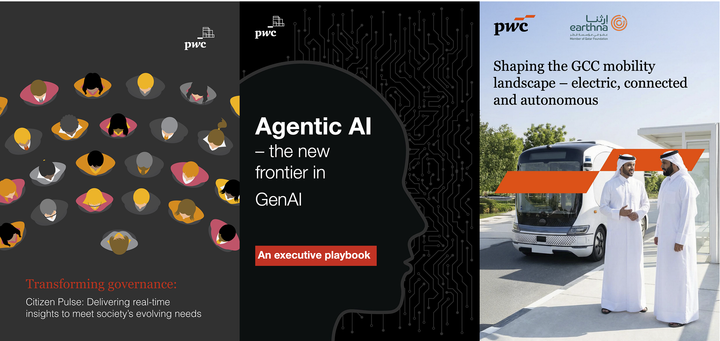
This investigation analyzes four reports published between 2024 and 2026 by the PricewaterhouseCoopers (PwC) member firm PwC Middle East. Together, these reports show a pattern of irresponsible AI usage resulting in hallucinated (vibe) citations, fabricated claims, and incomprehensible drafting and formatting decisions.
Unsurprisingly, our findings once again reveal a correlation between hallucinated citations, high AI detection scores, and fabricated claims. In other words, the four PwC Middle East reports that are flagged as suspicious by GPTZero’s Hallucination Check tool also tend to be flagged as “AI-generated” or “Mixed” by our AI Detector and tend to contain claims that are unrelated to or contradicted by the cited source:
| # | Report Title | Year | AI Score | Hallucination Check Scan | Number of Citations |
|---|---|---|---|---|---|
| 1 | Transforming Governance: Citizen Pulse: Delivering Real-Time Insights to Meet Society’s Evolving Needs | 2025 | 100% AI-generated or Mixed | References | 17 |
| 2 | Shaping the GCC Mobility Landscape – Electric, Connected and Autonomous | 2026 | 82% Mixed | References | 43 |
| 3 | Building a Cyber-Resilient eMobility Ecosystem | 2025 | 60% AI-generated or Mixed | References | 19 |
| 4 | Agentic AI – The New Frontier in GenAI | 2024 | 50% AI-generated or Mixed | References | 32 |
The most egregious example is Transforming Governance, an AI-generated 2025 report with multiple fake citations that promotes a PwC framework known as “Citizen Pulse”. Our team found little public evidence that the “Citizen Pulse” framework exists outside of this report, yet Transforming Governance claims that the governments of Denmark, Saudi Arabia, the United States, and Australia are using Citizen Pulse to improve key government services. None of the cited sources provide evidence for this claim, meaning PwC Middle East appears to have hallucinated both an entire product and business dealings with four separate nations.
Of course, this conclusion assumes that "Citizen Pulse" is what Transforming Governance says it is: a formal PwC methodology that "rather than relying solely on traditional methods such as surveys" (3) uses "AI-driven" customer experience tools (9) to conduct real-time analysis on data from "diverse touchpoints" (3) like digital service platforms, utilities usage, traffic patterns, and predictive models. If "Citizen Pulse" is simply a glorified survey tool, then a similar PwC product was used in Australia between 2018 and 2023. If "Citizen Pulse" includes non-PwC frameworks for real-time data analytics, then most governments are implementing "Citizen Pulse" in some capacity. Transforming Governance suggests the first definition, but many of the claims and citations are only valid if the second or third are used. This conflation of concepts or products with similar names or functions, combined with a tendency to exaggerate claims, is indicative of the use of an AI research tool.
According to our AI Detector, there is an 84% chance that Transforming Governance is entirely AI-generated. If the endmatter (including references) is ignored, the chance increases to 100%.
On the Menu: PwC Middle East
PwC is a network of member firms operating in 136 countries and employing around 370,000 people around the world. The member firm PwC Middle East has 12,000 employees and offices in twelve countries around the region.
Like many consulting firms, PwC Middle East tends to shorten reference sections by citing claims selectively and in a condensed style. In some cases, the quality of the citation or claim is so poor that it can’t be confidently verified. It is also possible that some of the sources cited in the following cases are only meant to evidence certain claims, or to provide a limited example.
The four reports highlighted in this investigation include numerous human mistakes. We’ve detailed our methodology for differentiating between human and AI-origin errors in Appendix 1 below.
The Pulse is False
Of all the reports we analyzed, Transforming Governance most obviously lacks a human heartbeat. The report describes a framework called Citizen Pulse that enables governments to capture and interpret multimodal feedback from citizens. Despite claims that this framework is already being used by governments in the Middle East and around the world, Transforming Governance appears to include the only mention of the framework in any PwC product anywhere on the internet.
The report’s grandiose claims, frustrating lack of detail, and factual inaccuracy undermine its credibility and indicate heavy use of AI. For example, Citizen Pulse is described as a “dynamic mechanism,” an “innovative approach,” and a “data-driven framework,” but it is never explicitly defined. Instead, the report devolves into AI-generated abstractions like “at its core, [Citizen Pulse] is a promise to honour each voice in the pursuit of a truly responsive and inclusive society.” While aspirational, these claims never explain what Citizen Pulse (frequently referred to as “Citizen Pulse, powered by CXi”) actually is, or what differentiates it from existing data-driven approaches.
Transforming Governance is similarly vague on scope and impact. Page 2 claims that Citizen Pulse is transforming “governance structures across the region” — an incredible impact for a non-existent product. Likewise, on page 13, the report claims that “regions that have implemented AI-enabled Citizen Pulse systems have seen improvements in service reliability and reduction in utility complaints.” Since no countries appear to have implemented the Citizen Pulse framework, this claim is almost certainly fake.
Transforming Governance is saturated with both human and AI mistakes. The most impactful errors include two hallucinated citations, multiple garbled or useless citations, and the fabricated assertion that several governments already use PwC's Citizen Pulse framework.
Citations
The citations of Transforming Governance don’t follow the normal academic or consultancy conventions. Only 10 of the 17 citations in the References section are numbered and actually correspond to footnotes in the body of the report. The other 7 lack numbers and associated footnotes, meaning they aren’t linked to specific claims. While there are only 10 references footnoted in the report, there are actually 12 footnotes (pages 7-8), since footnotes five and six appear twice each.
The footnotes are also not chronological; footnotes seven to ten appear on page 7, followed by one to six on page 8. Only two of the 17 cited sources are verifiable hallucinations. Another seven are either unverifiable or seem to loosely match an existing source. Six others are company or government homepages. Three references (13-15) seem to cite the same 2018 PwC report using different titles and different URLs. The only similarity between these three citations is that each insists the report is undated (“n.d.”).
| # | Citation Text | Verdict | Potential Match |
|---|---|---|---|
| 9 | World Bank (2023). Retrieved from: https://www.worldbank.org/en/topic/citizen-engagement | Unsure | https://www.worldbank.org/ext/en/topic/social-development/citizen-engagement |
| 11 | MIT Technology Review. (n.d.). Artificial intelligence in government services. MIT Technology Review. Retrieved from https://www.technologyreview.com/tag/artificial-intelligence/ | Fake | https://www.technologyreview.com/2026/04/16/1135216/making-ai-operational-in-constrained-public-sector-environments/ |
| 12 | OECD. (2020). Digital government and citizen engagement: OECD Digital Government Policy Framework. OECD. Retrieved from https://www.oecd.org/governance/digital-government/ | Unsure | https://www.oecd.org/en/publications/the-oecd-digital-government-policy-framework_f64fed2a-en.html |
| 13 | PwC. (n.d.). Customer experience is everything. Retrieved from https://www.pwc.com/gx/en/services/consulting/customer-experience.html | Unsure | https://web.archive.org/web/20210305173144/https://www.pwc.com/gx/en/services/consulting/customer-experience.html |
| 14 | PwC. (n.d.). The future of customer experience: Consumer intelligence series. PwC. Retrieved from https://www.pwc.com/us/en/services/consulting/library/consumer-intelligence-series/future-of-customer-experience.html | Unsure | https://web.archive.org/web/20250102104744/https://www.pwc.com/us/en/services/consulting/library/consumer-intelligence-series/future-of-customer-experience.html |
| 15 | PwC. (n.d.). The future of customer experience: Australia report. PwC Australia. Retrieved from https://www.pwc.com.au/digitalpulse/report-cis-future-customer-experience.html | Unsure | https://www.pwc.com.au/retail-consumer-markets/report-cis-future-customer-experience.html |
| 16 | World Bank. (n.d.). Governance and public service delivery. World Bank. Retrieved from https://www.worldbank.org/en/topic/governance/brief/public-service-delivery | Unsure | https://www.worldbank.org/en/topic/governance/brief/public-service-delivery-global-solutions-group |
| 17 | World Economic Forum. (2018). The Fourth Industrial Revolution: Smart cities and AI applications. World Economic Forum. Retrieved from https://www.weforum.org/reports | Fake | https://www.weforum.org/press/2018/09/report-cities-need-to-be-agile-to-capture-opportunities-of-the-fourth-industrial-revolution/ |
*Citation numbers greater than 10 have been added — they don’t appear in the original text.
Claims
Verifiable claims are rare in Transforming Governance — most of the report is spent selling Citizen Pulse and listing its potential benefits. However, the authors finally make a series of concrete assertions in six case studies on page eight. Here they claim that governments are “adopting innovative approaches, such as Citizen Pulse" generally, and that four countries (Denmark, Saudi Arabia, the USA, and Australia) are using Citizen Pulse specifically. According to our detector, page eight is 100% AI-written.
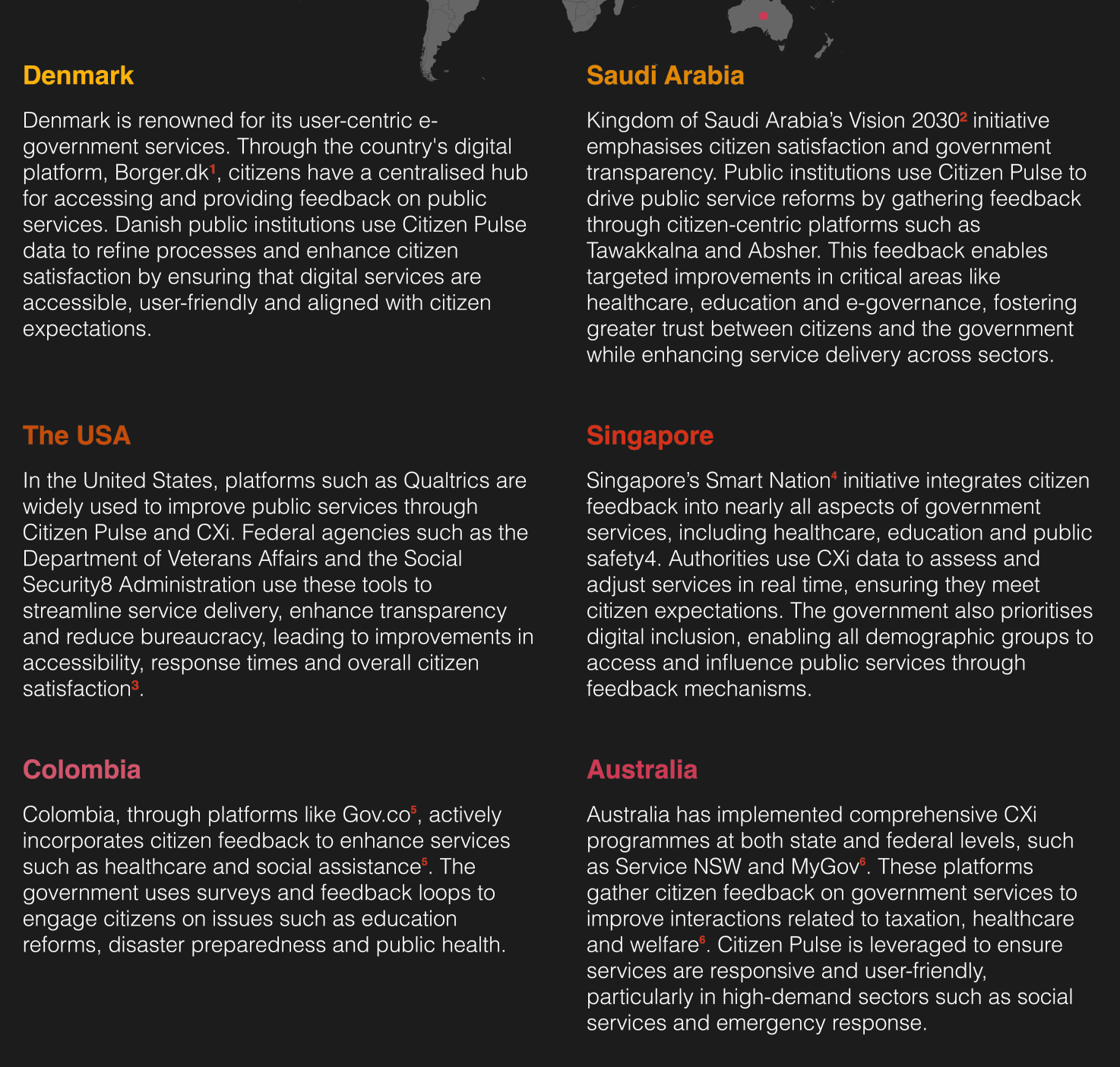
The footnotes in these case studies link to the landing pages of the corresponding government portal, none of which fully support the claims being made. We focused on the four cases that mention Citizen Pulse, since the Singapore and Colombia cases are too vague to be easily fact-checked.
Case Study 1: Denmark’s Borger.dk
The report claims that the “Danish public institutions use Citizen Pulse data” for several purposes. The linked source (Borger.dk) is Denmark’s official public service portal and doesn’t mention Citizen Pulse. Perhaps the Danish government is secretly using the PwC framework to improve its portal, but no publicly available information supports this claim.
Case Study 2: Saudi Arabia’s Vision 2030
The report claims that “public institutions” in Saudi Arabia “use Citizen Pulse to drive public service reforms”, yet neither the cited page (Saudi Arabia’s Vision 2030) nor further research provide any evidence for this claim.
Case Study 3: The USA’s usage of Qualtrics
Unlike the first two cases, this one cites a specific source (a 2022 Qualtrics press release) to prove that the US Department of Veterans Affairs and the Social Security Administration (SSA) use Customer Experience Insights (CXi) and Citizen Pulse. The press release doesn’t mention Citizen Pulse, Veterans Affairs, or the SSA.
Case Study 4: Australia’s CXi programmes
Lastly, the report claims that Australian federal and state service portals use Citizen Pulse to improve their operation. However, the cited source is a direct link to the Australian myGov homepage. Once again, the page lacks any reference to PwC’s framework.
There is some evidence that PwC Australia conducted Citizen Pulse-branded surveys in Australia between 2018 and 2023, including one in the state of New South Whales. However, the survey doesn’t appear to be connected to the “Citizen Pulse” framework and PwC has taken down the landing page and the final report, scrubbing it from the internet.
The Bottom (Flat) Line
If Transforming Governance does have a pulse, it’s worthy of a visit to the emergency room. Like much AI-generated text, the report is verbose and jargon-heavy, yet missing essential details. Many citations link to generic webpages, including distracting AI-generated artefacts, or don't exist. Additionally, the report seems unsure if "Citizen Pulse" is an existing PwC product or a vague exercise in thought leadership, cycling between describing the potential benefits of the Citizen Pulse framework and concrete claims about current use. This inconsistency is a common symptom of text generated by a poorly-prompted LLM.
The Other Three Reports
Ultimately, Transforming Governance is just one of four reports that indicate PwC Middle East has used (and abused) AI tools as part of the firm’s research and publication process. The three other PwC Middle East reports covered by this investigation also contain multiple fabricated claims. The following sections highlight three claims per report that are either unrelated to, or contradicted by, the cited source. Conflating statistics, citing unrelated sources, and confidently asserting false correlations are all characteristics of AI-generated text.
Report 2: Shaping the GCC Mobility Landscape – Electric, Connected and Autonomous
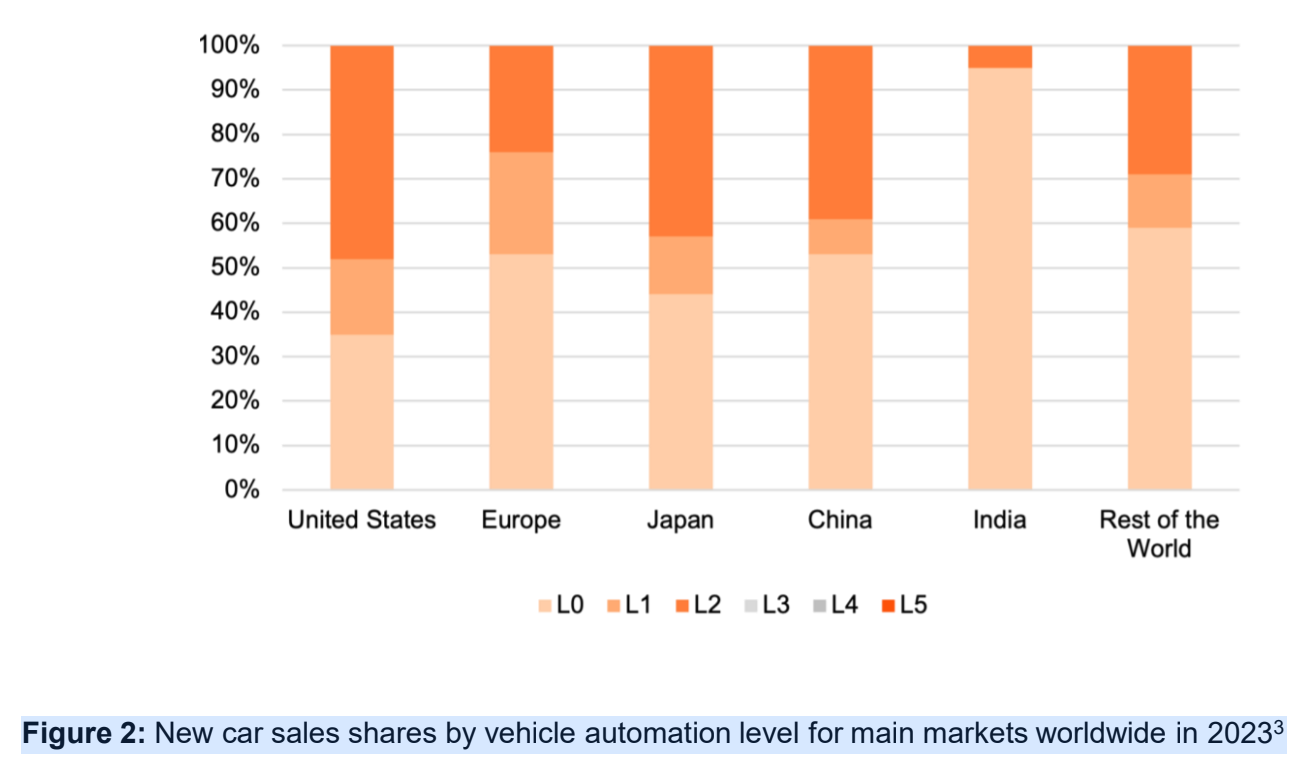
This report describes how Gulf Cooperation Council (GCC) states are adopting new vehicle technologies. Numerous claims, including the table below, are either misattributed or fabricated.
| Citation | Verdict | Justification |
|---|---|---|
| 3. World Economic Forum. 'Integrating autonomous mobility into the transport system: A Saudi Arabian case study.' 19 August 2024 | Not Supported | Neither the chart nor the underlying data are included in the cited WEF report. |
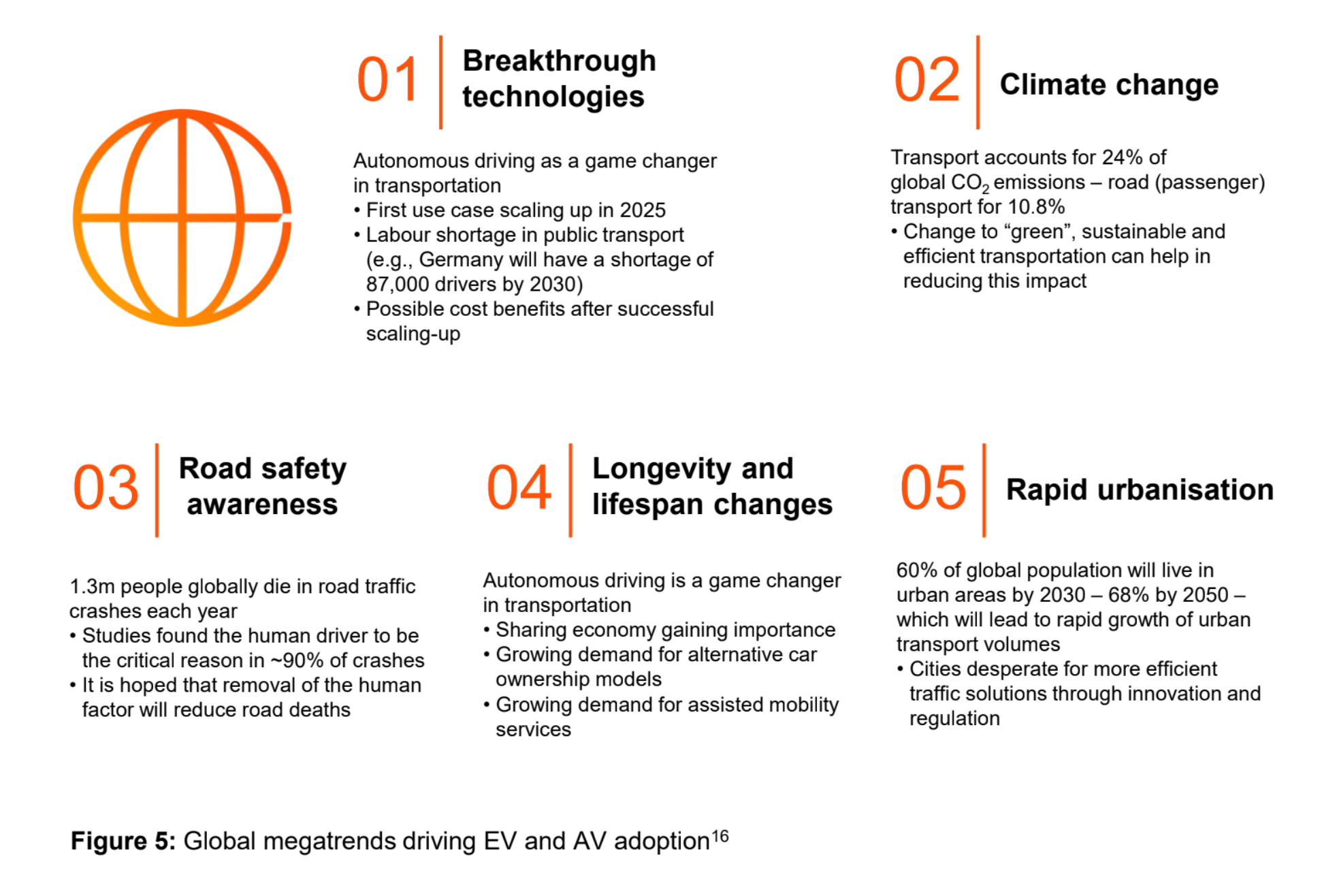
| Citation | Verdict | Justification |
|---|---|---|
| 16. MBI. 'Stellungnahme Bundesverband Deutscher Omnibusunternehmen (bdo) e.V. 21.' March 2023 | Not supported | The cited source for these “global megatrends” is an official statement by the German Bus and Coach Association. The document (written entirely in German) does not support any of the claims and seems unrelated to the footnoted graphic. |
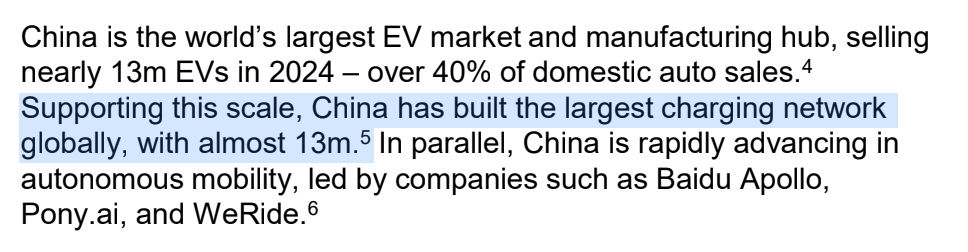
| Citation | Verdict | Justification |
|---|---|---|
| Iea. 'Global EV outlook 2025.' 14 May 2025 | Not Supported | The 2025 IEA Global EV Outlook indicates that there were 3.58 million public charging points in China in 2024, not 13 million. However, the 2026 IEA Global EV Outlook data set shows that 13 million electric cars have been sold in China since 2010. Misinterpreting visual elements on a webpage (resulting in the conflation of EV sales and charging ports) is indicative of AI use. |
Report 3: Building a Cyber-Resilient eMobility Ecosystem
This report argues that accelerating EV adoption among Gulf States exposes the region’s charging infrastructure and power grids to cyberattack. Many of the cited sources are related to the claims they are meant to evidence, but don’t include the claim-specific facts, terms, or statistics.
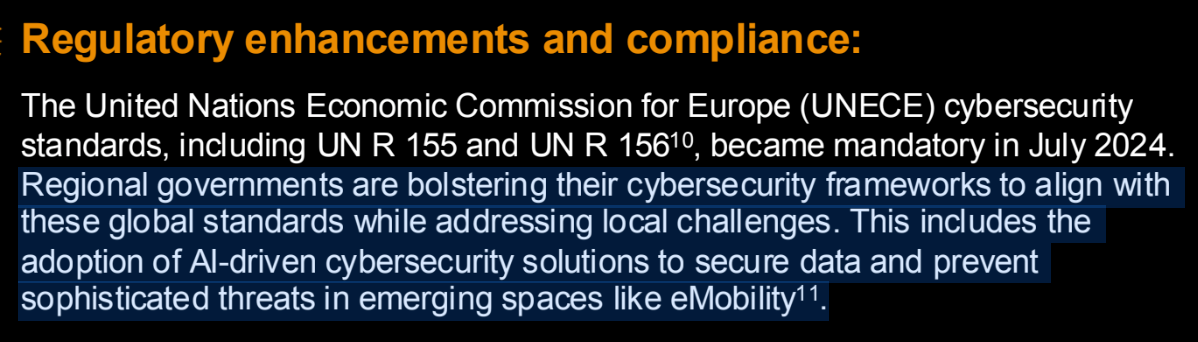
| Citation | Verdict | Justification |
|---|---|---|
| 11. https://unece.org/sustainable-development/press/un-regulations-cybersecurity-and-software-updates-pave-way-mass-roll | Not Supported | The source is a 2020 UN press release pertaining to two UN regulations on cybersecurity requirements for vehicle manufacturers. It does not mention any “AI-driven cybersecurity solutions”, nor any “regional governments” currently aligning their cybersecurity frameworks. |
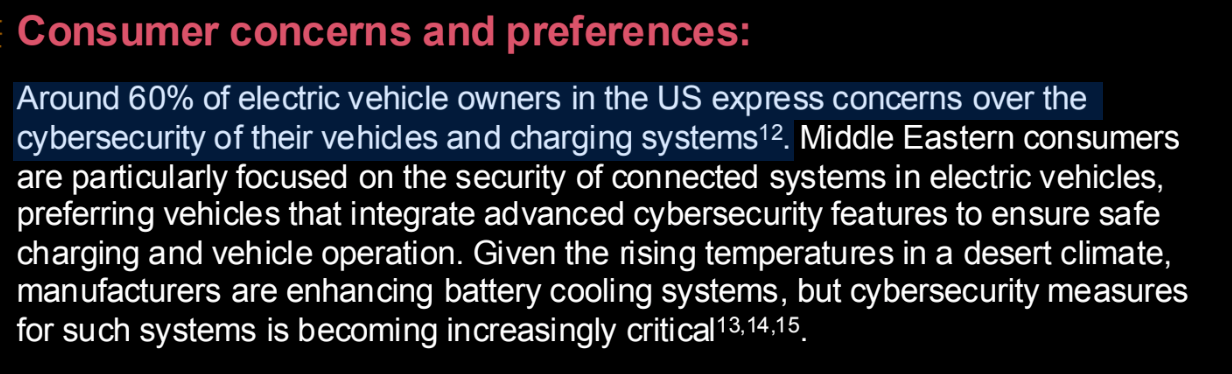
| Citation | Verdict | Justification |
|---|---|---|
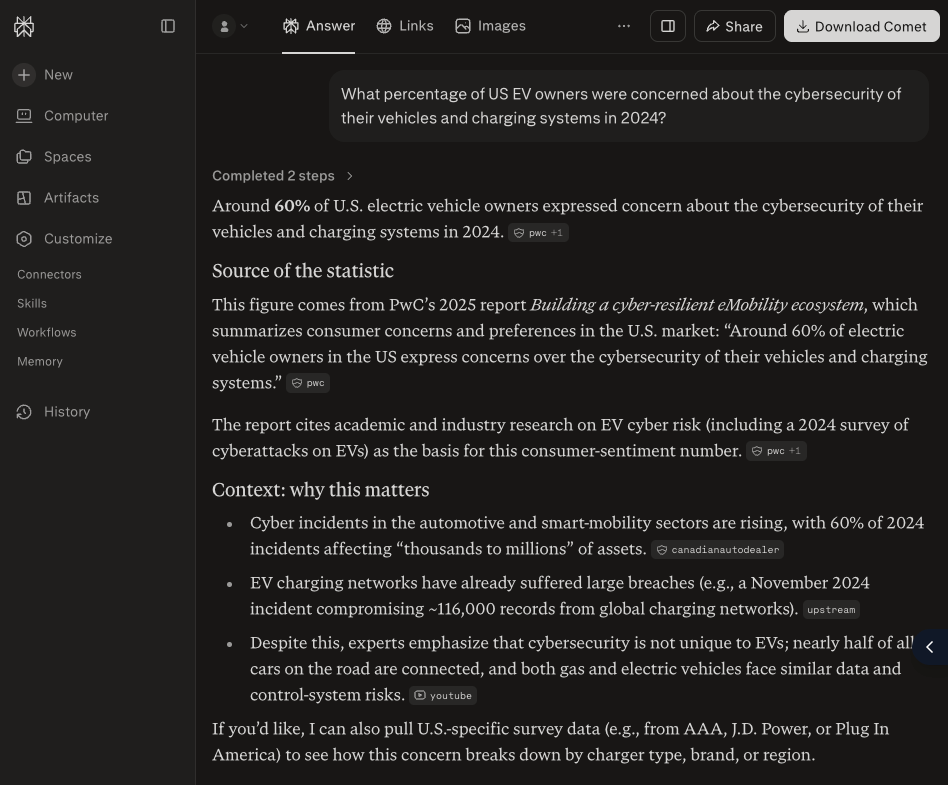
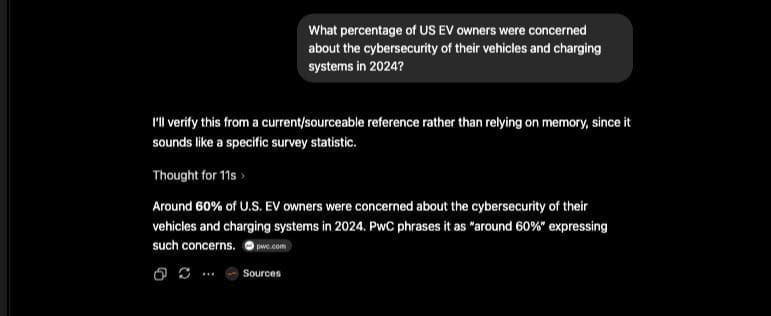
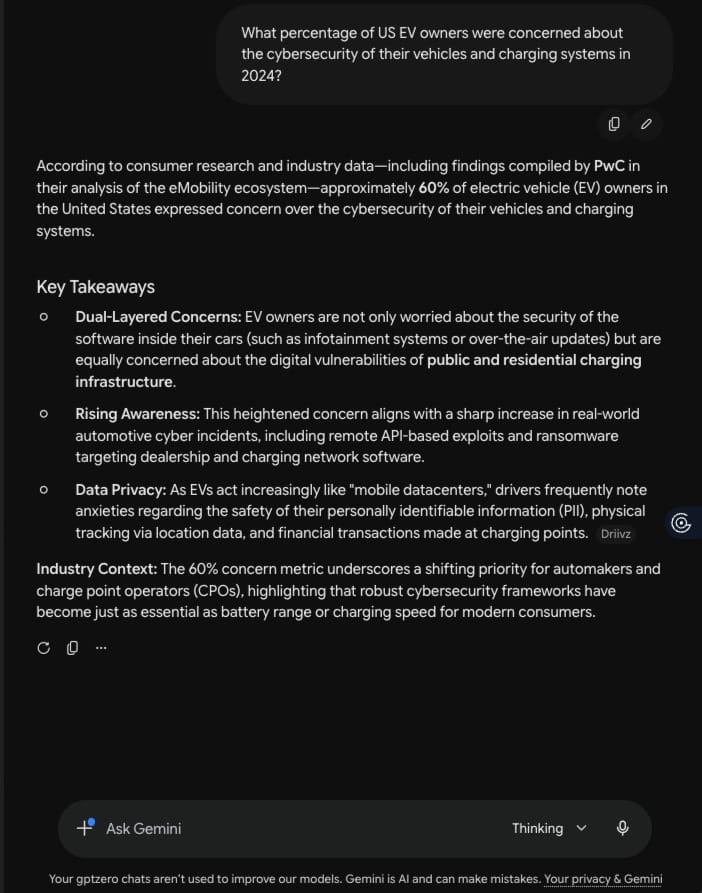
| 12. Aljohani, T., Almutairi A. (2024), A comprehensive survey of cyberattacks on EVs: Research domains, attacks, defensive mechanisms, and verification methods https://www.sciencedirect.com/science/article/pii/S221491472400151X https://www.thehindu.com/sci-tech/technology/are-uss-cybersecurity-concerns-over-chinese-evs-justified/article68745519.ece | Not Supported | Neither the academic survey nor the Hindu article contain the statistic about 60% of electric vehicle owners in the U.S. |

| Citation | Verdict | Justification |
|---|---|---|
| 17. https://epr.sustainablepackaging.org/ | Not Supported | The cited webpage describes Extended Producer Responsibility (EPR) proposals introduced or passed by U.S. state legislators. The proposals concern product packaging, not batteries. |
Report 4: Agentic AI – The New Frontier in GenAI
This report pitches multimodal, agentic AI to business executives in the GCC. Many of the cited claims in Agentic AI fall into two categories: claims too generic to actually require a citation, and claims evidenced by long sources that only briefly address the content of the claim.
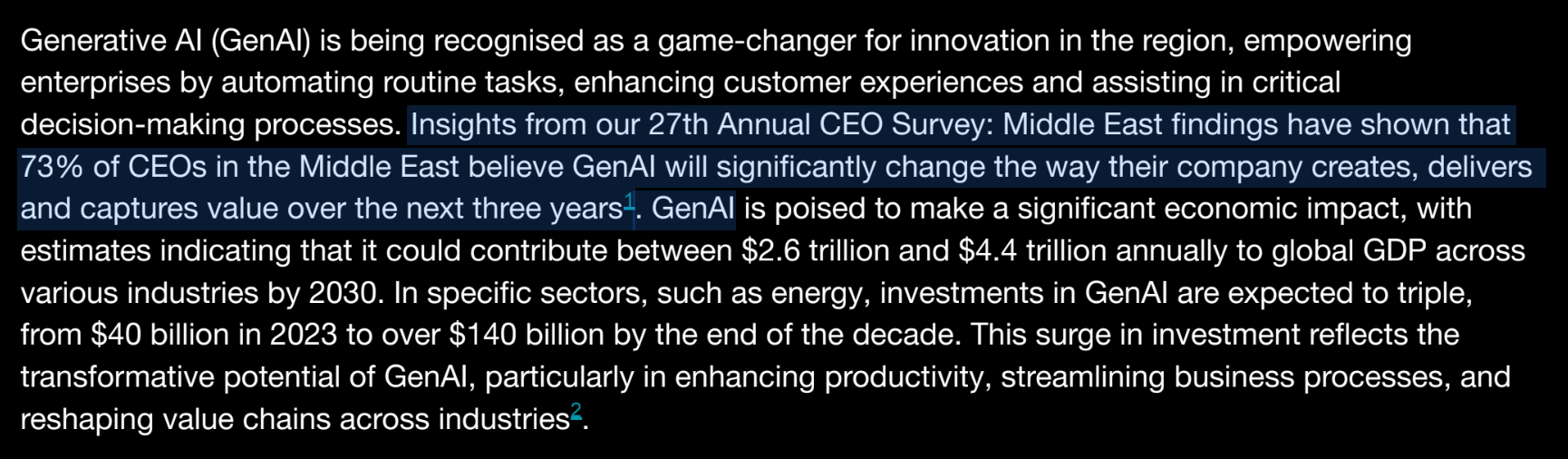
| Citation | Verdict | Justification |
|---|---|---|
| 1. Agentic AI: A deep dive into the future of automation | VentureBeat | Not Supported | The cited VentureBeat article explains the definition and potential of agentic AI. It does not mention PwC’s CEO survey or the 73% statistic. |
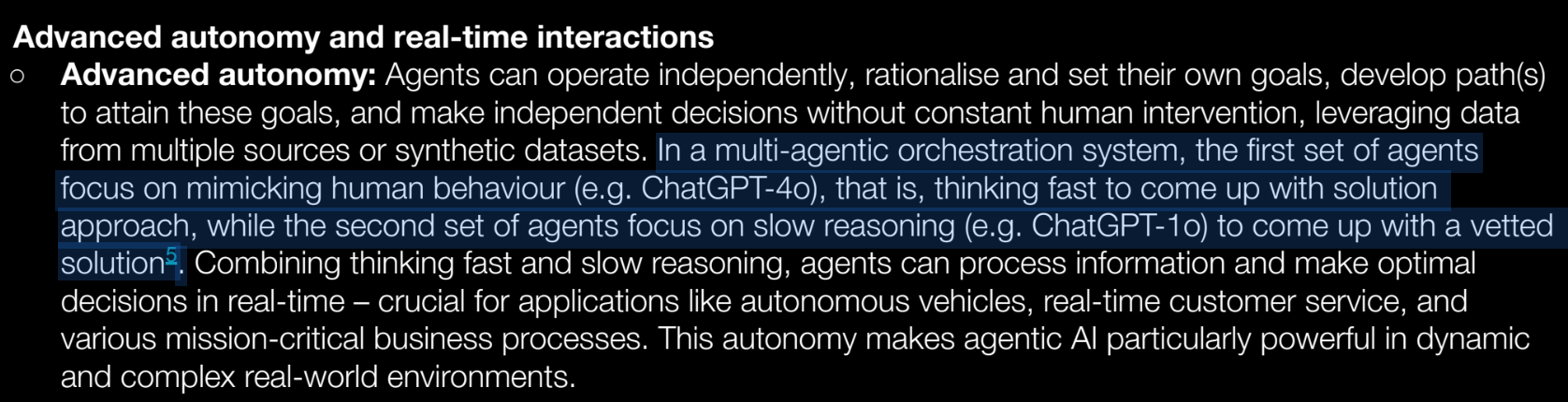
| Citation | Verdict | Justification |
|---|---|---|
| 5. From Bots to Agents: The Next Great Leap Forward Is Autonomous AI | Not Supported | The citation links to this article, but the title points to a different article. While both sources briefly mention multi-agent systems, neither includes the “thinking fast” / “slow reasoning” distinction or the example ChatGPT models. |
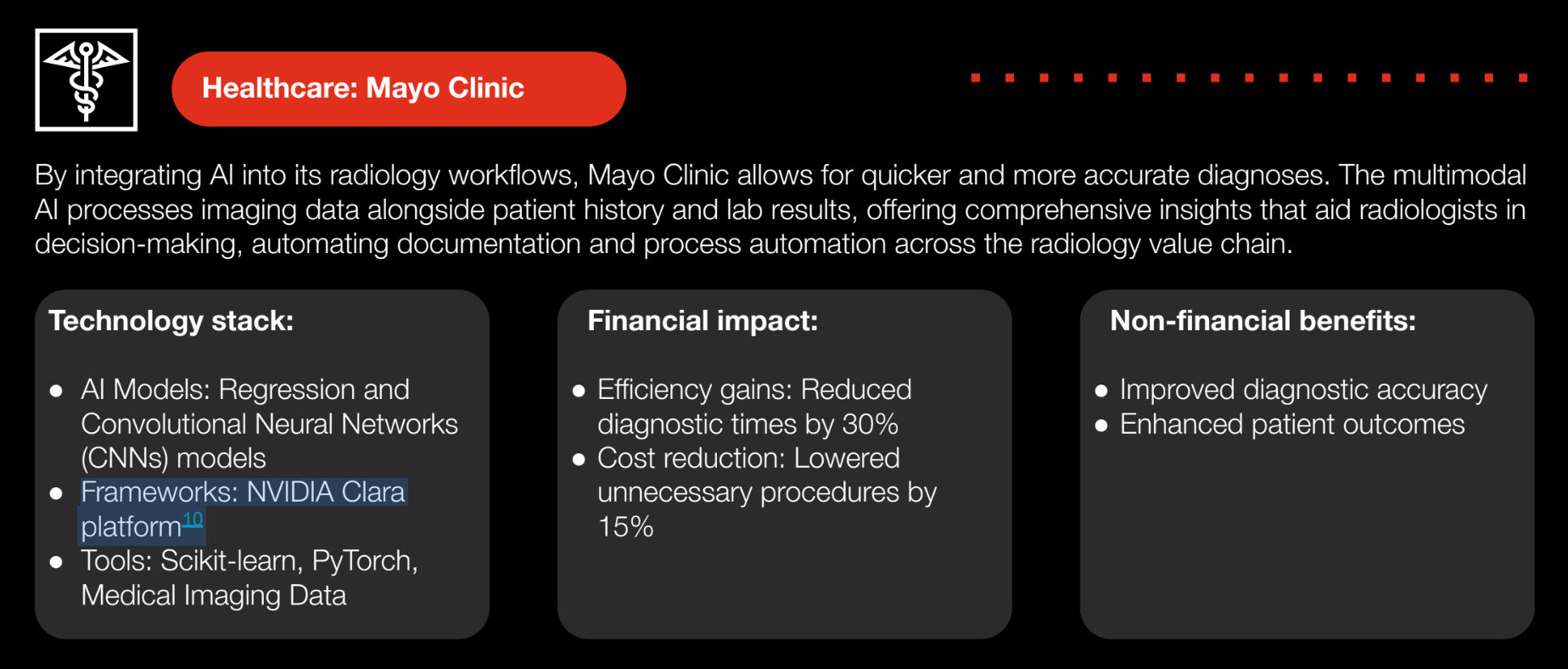
| Citation | Verdict | Justification |
|---|---|---|
| 10. Mayo Clinic’s Healthy Model for AI Success | Not Supported | The “NVIDIA Clara platform” isn’t mentioned in the cited article. The Mayo Clinic did announce a collaboration with NVIDIA in January 2025, but this PwC report was published in October 2024. |
PwC’s Vibed Citations
The condensed citation style used by many consulting firms makes source matching difficult. Judging from the reports we investigated, PwC Middle East doesn’t enforce a specific citation style across all publications, or consistently standardize formatting within a single publication. Because many citations are missing components, or consist of only one or two components, finding the “real” matching source can involve extensive detective work.
GPTZero’s Hallucination Check classifies citations according to a very specific taxonomy defined in Appendix 2 (here are the technical details). While many of the citations in the four reports are flawed, only four meet our definition of a vibe citation.
| Report | Citation | Verdict | Explanation |
|---|---|---|---|
| Report 3 | Alotaibi, S. A., Alghamdi, M. A., & Alzahrani, A. H. (2024). The impact of electric vehicle adoption on urban air quality in Riyadh. Journal of Transport & Health, 24(4), 151-162. https://doi.org/10.1016/j.jth.2024.10015 | Fake | No trace of article. No match in journal volume. |
| Report 2 | Christoph, M & Schober, H. Applied Sciences, 9(23), Article 5126. Autonomous Driving. A Crash Explained in Detail. 2018 | Fake | Partially matches this article, but authors and date are wrong. |
| Report 1 | World Economic Forum. (2018). The Fourth Industrial Revolution: Smart cities and AI applications. World Economic Forum. Retrieved from https://www.weforum.org/reports | Fake | Several reports have similar titles, but this specific title does not exist. |
| Report 1 | MIT Technology Review. (n.d.). Artificial intelligence in government services. MIT Technology Review. Retrieved from https://www.technologyreview.com/tag/artificial-intelligence/ | Fake | No article published by MIT Technology Review matches this title. |
Our definition is calibrated to give authors the benefit of the doubt. For example, here is a likely hallucination that doesn’t meet our standards.
| Report | Citation | Verdict | Explanation |
|---|---|---|---|
| Report 3 | Brighente, A., Conti, M., Donadel, D., Poovendran, R., Turrin, F., & Zhou, J. (2023). Electric Vehicles Security and Privacy: Challenges, Solutions, and Future Needs. IEEE Transactions on Intelligent Transportation Systems. https://doi.org/10.48550/arXiv.2301.04587 | Unsure | Journal is wrong (although the journal exists). This article was published in ACM Transactions on Cyber-Physical Systems. |
In addition, here are two other indicators of LLM use found in the citations of the four reports used in this investigation.
Metadata Mistakes:
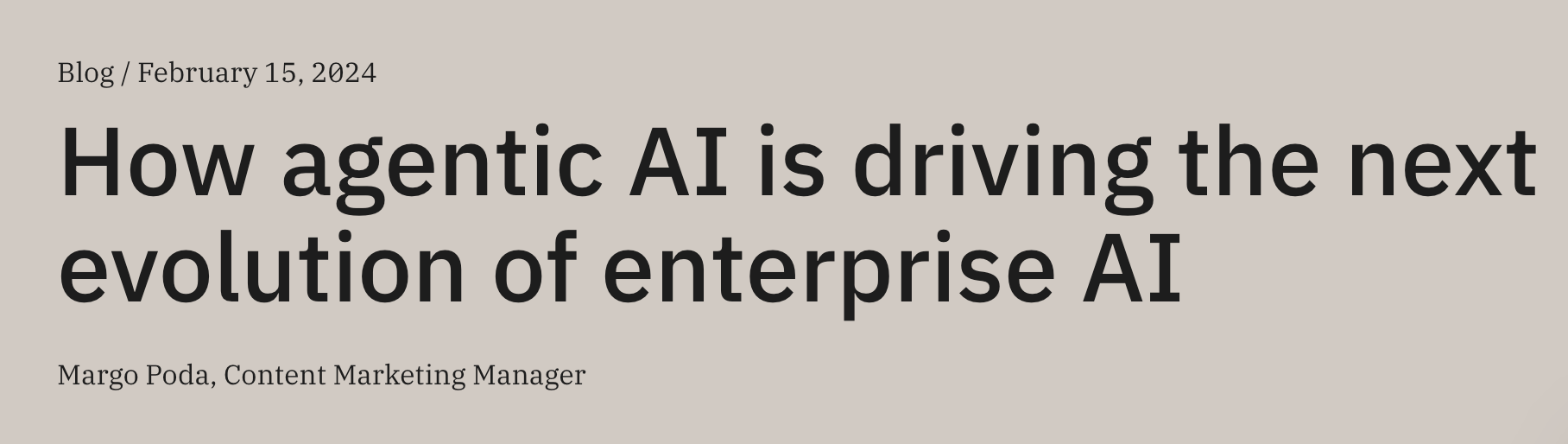

In Agentic AI – The New Frontier in GenAI (report 4), many citations use titles pulled from the source metadata rather than the human-visible title. These references are differentiated by the use of the typographic symbol “|” to separate components.
Suspicious URLs:

In Building a Cyber-Resilient eMobility Ecosystem (report 3) the URL for citation 4 includes “utm_source=chatgpt.com”, indicating it was generated by ChatGPT. The inclusion of author “Ferris, N” twice is a more ambiguous error that could be human or AI in origin.
Poisoning the Well
Vibe citations and fabricated claims don’t just impact the people that actually read these reports. The normalization of AI summaries, research agents, and search-enabled chatbots allows misinformation to spread passively across the internet, one AI-generated response at a time. To be blunt, the fabricated claims and citations in PwC Middle East’s reports don’t require human readers to “poison” the internet — they just need to be indexed, bot-accessible, and keyword-adjacent.
The following screenshots show three popular LLM tools repeating fake claims from Building a Cyber-Resilient eMobility Ecosystem (report 3).
Pulse Check
Over the past year, GPTZero investigations have documented vibe citations and fabricated claims in research published by each of the “big four” consulting firms — Deloitte, EY, KPMG, and now PwC. Using our Hallucination Check tool, we’ve highlighted the dangers of relying on AI tools to conduct research, draft analysis, and cite evidence, as well as the secondary consequences of these hallucinations and disinformation as they permeate the internet. These investigations (which will continue) have proven the accuracy of our AI detection and citation screening tools and exposed an industry-wide pattern of LLM abuse.
Of course, the problem isn’t confined to consulting. The legal industry is also confronting a tsunami of AI-generated hallucinations, as are academic conferences, news outlets, social media platforms, and educational institutions. Those who rely solely on human verification are going to drown under the wave.
Now, more than ever, it's crazy to accept citations on faith. Try GPTZero’s Hallucination Check for yourself, or reach out to GPTZero’s team.
Appendix 1: Human Errors vs AI Errors
While most consulting firm products use a condensed citation style, the four PwC reports are deeply inconsistent in both citation formatting and citation components. Some of these mistakes are obviously human; some are more ambiguous and could be human or AI in origin.
We consider spelling mistakes, citation numbering errors, incomplete URLs, and other possible typing or copy-paste errors to be human in nature. We also recognize that more ambiguous errors, such as duplicate components in the same citation, could result from the use of a citation manager rather than generative AI. However, the density of both human and AI-origin errors in many of the PwC Middle East reports strongly suggests that the works were not fully vetted prior to publication, suggesting a lack of oversight and reliance on AI-generated text.
Examples of human errors:
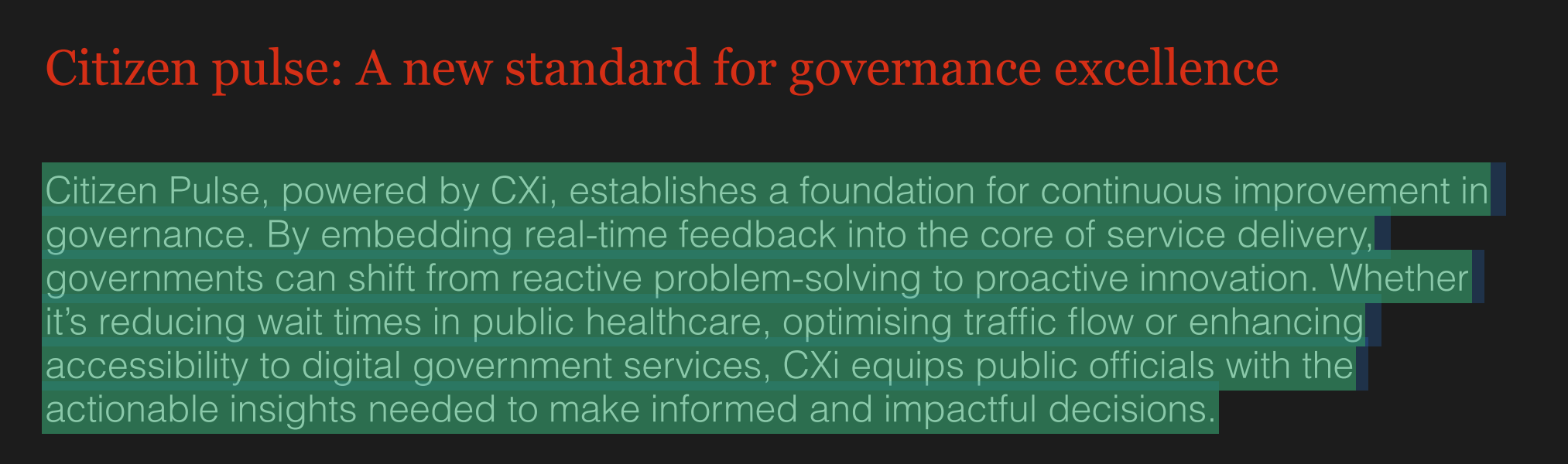
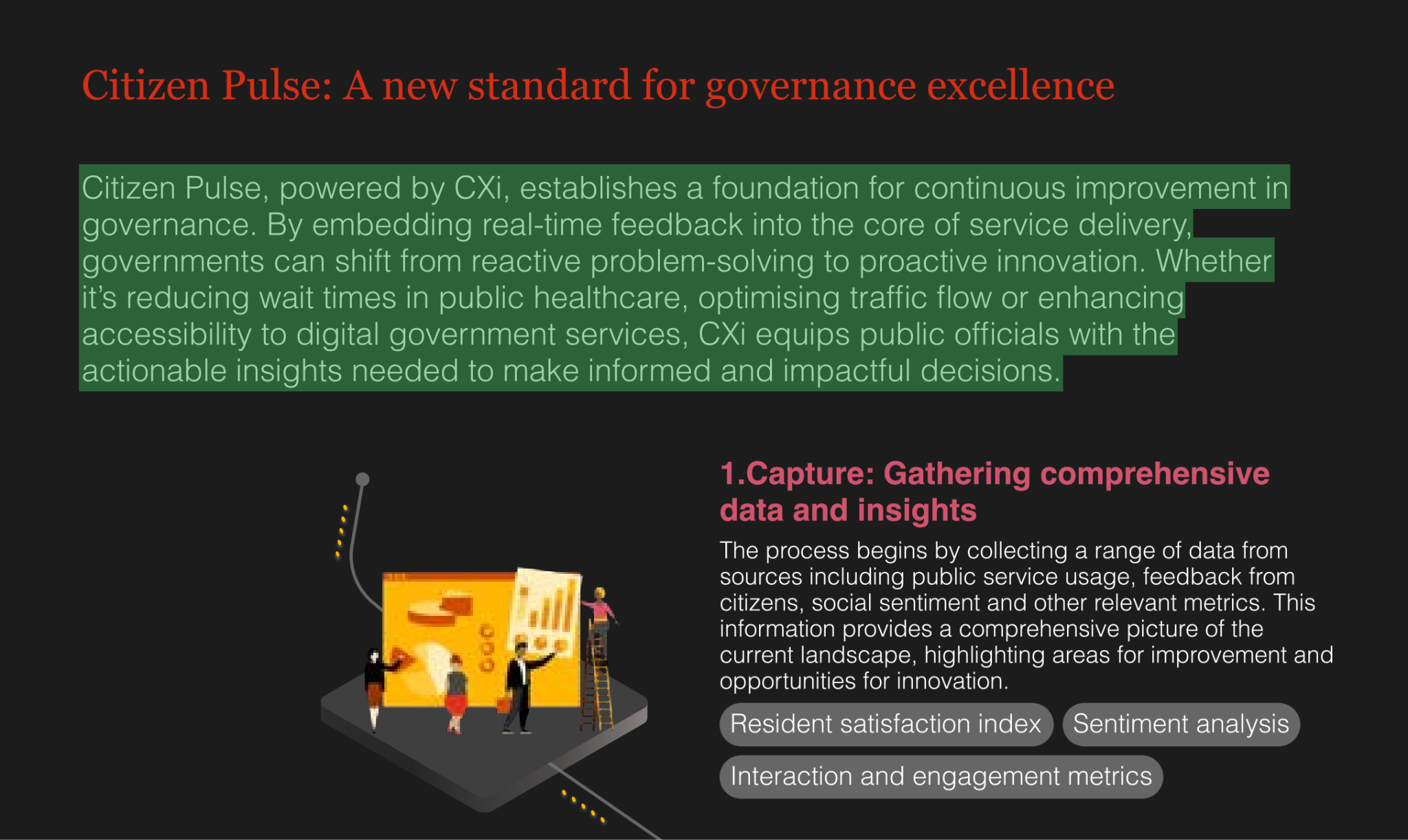
Transforming Governance (report 1) includes a duplicated subtitle and paragraph on pages 4 and 10:
Building a Cyber-Resilient eMobility Ecosystem (report 3) is missing reference 5. Additionally, there is no corresponding footnote for reference 4:

In Shaping the GCC Mobility Landscape (report 2), the title of reference 17 is missing a letter (a “w”):

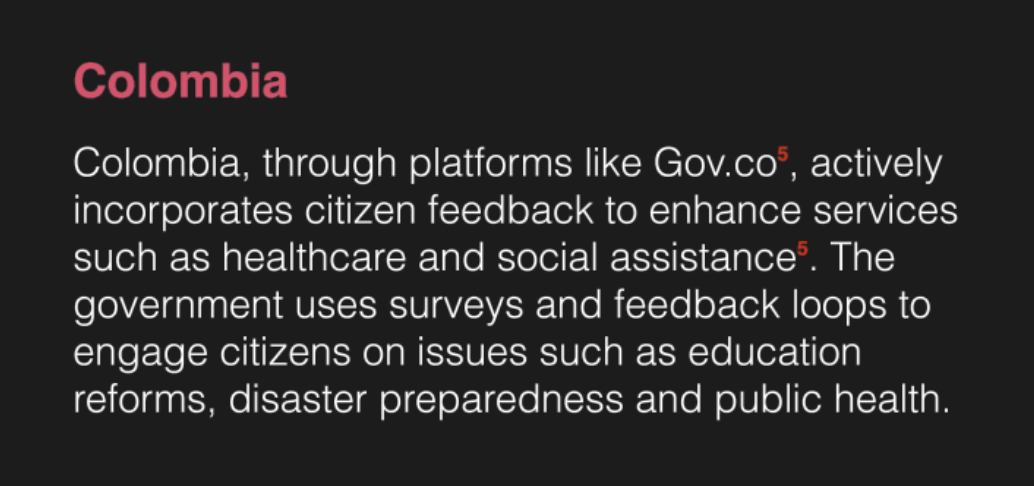
As noted above, in Transforming Governance (report 1) the same footnote number appears twice in a single sentence:
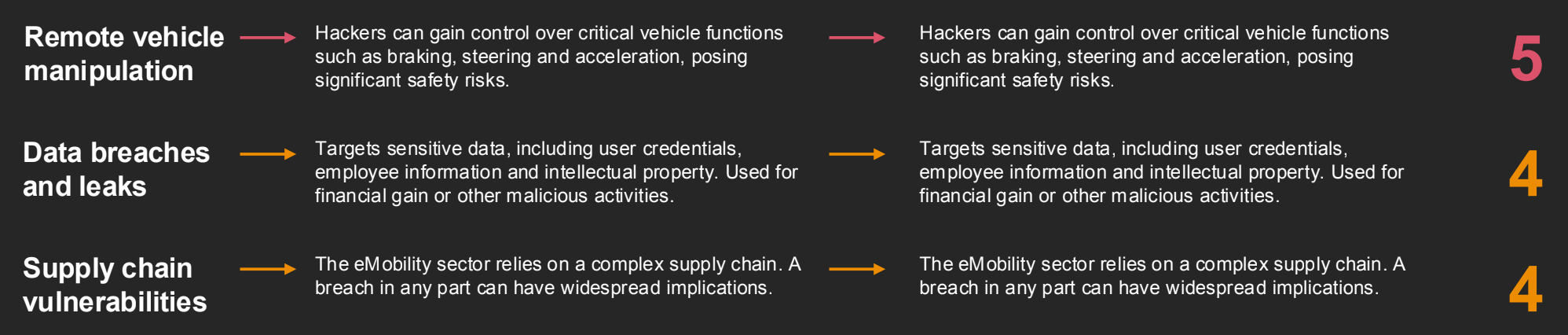
Building a Cyber-Resilient eMobility Ecosystem (report 3) repeats three points verbatim in a chart on page 18:
Examples of ambiguous errors:
In Transforming Governance (report 1) the publisher is often repeated as both the author and publisher of a source:

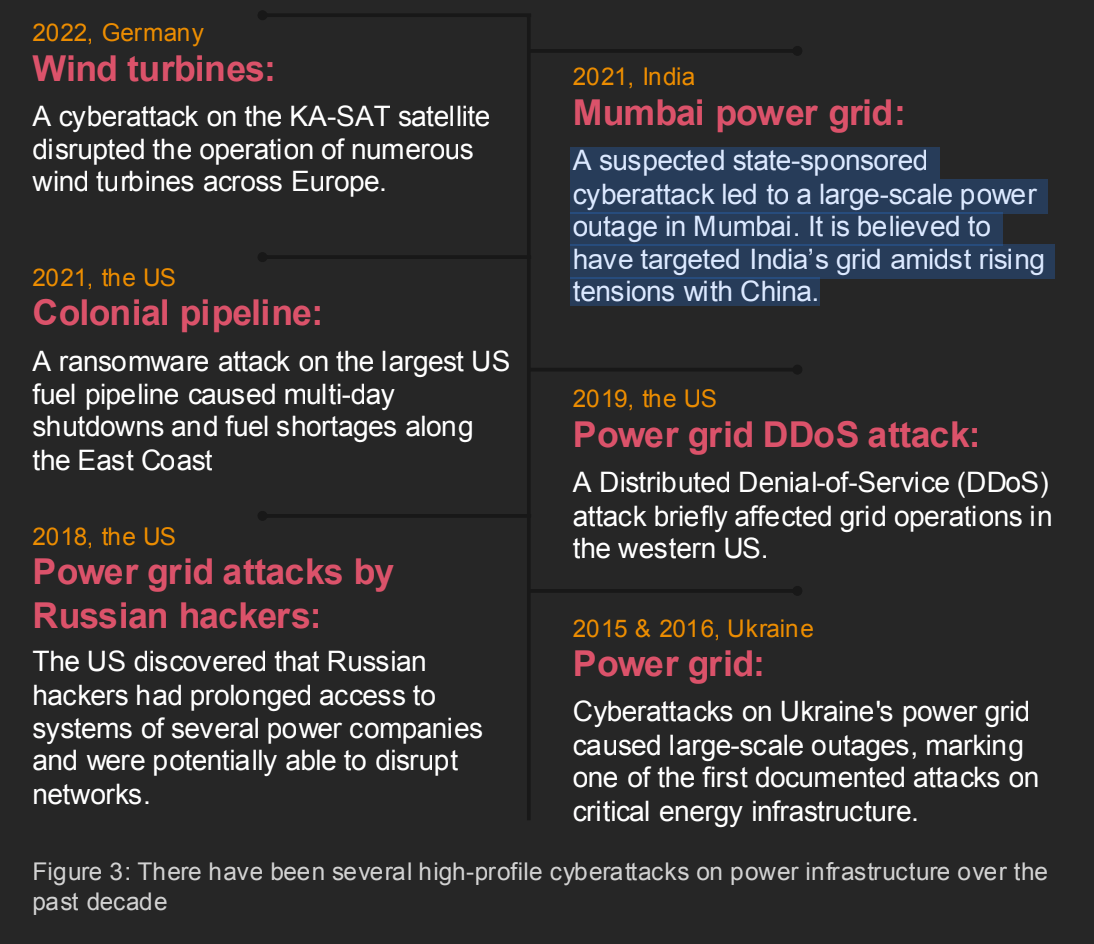
In Building a Cyber-Resilient eMobility Ecosystem (report 3), a cyberattack on the Mumbai power grid is misdated to 2021, rather than 2020. These sorts of small factual errors are frequent in PwC Middle East reports, but aren't clearly attributable to AI.
Appendix 2
Definition of a Vibe Citation
GPTZero defines a vibe citation as a citation that likely resulted from the use of generative AI. Vibe citing results in errors common to LLM generations, but rare in human-written text, such as:
- Combining or paraphrasing the titles, author(s), and/or locators from one or more real sources
- Fabricating the author(s), title, URL/DOI, and/or container (ex. publisher, journal, conference) of a source
- Modifying the author(s) or title of a source by extrapolating a first name from an initial, dropping and/or adding authors, or lengthening/shortening the title.
Our definition excludes obvious spelling mistakes, dead URLs, missing locators, and other errors that are plausibly human. The following table shows the difference between a real citation, a flawed citation, and a hallucinated citation according to our methodology.
| Real Citation | Flawed Citation | Hallucinated Citation |
|---|---|---|
| Yann LeCun, Yoshua Bengio, and Geoffrey Hinton. Deep learning. nature, 521:436-444, 2015. | Y. LeCun, Y. Bengio, and Geoff Hinton. Deep leaning. nature, 521(7553):436-444, 2015. | Samuel LeCun Jackson. Deep learning. Science & Nature: 23-45, 2021. |
| A. Yang, B. Zhang, B. Hui, B. Gao, B. Yu, C. Li, D. Liu, J. Tu, J. Zhou, J. Lin, et al. Qwen2.5–math technical report: Toward mathematical expert model via self-improvement. arXiv:2409.12122, 2024. | A. Yang, (missing author), B. Hui, B. Gao, B. Yu, C. Li/, D. Liu, J. Tu, J. Zhou, J. Lin, et al. Qwen 2. 5–math technical report: Toward mathematical expert model via self-improvement. arXiv preprint arXiv:2409.12122, 2024. | A. Yang, B. Yang, C. Yang, et al. Qwen3.5–mathematical report for iterative model self-improvement. arXiv:2909.12233, 2024. |
Like GPTZero’s AI Detector, Hallucination Check has an extremely low false negative rate, so we catch 99 out of 100 flawed citations. Because our tool will flag any citation that can’t be verified online, the false positive rate is higher.