How to Write a Term Paper in 5 Steps (With Example)
A term paper is an academic essay written at the end of a course to assess a student's knowledge and understanding of the course material.

The term paper can catch students off guard. Part of the challenge with this type of academic writing is the sheer scale of the information you have to consider. There's so much to cover that it can be hard to know where to begin. The Munich Business School Writing Guide puts it plainly: "When writing a term paper, many students feel overwhelmed."
After all, your professor or instructor is expecting more than just a summary of the course contents. A successful term paper synthesizes the information covered in the course and provides an original interpretation backed by evidence.
In this guide, we're going to show you how to do just that. We will cover exactly what a term paper is, how it's structured, the five-step process for writing a successful one, and some examples and tips for separating the strong term papers from the forgettable ones.
TL;DR
- A term paper focuses on a specific topic in depth and is usually submitted as a final assignment at the end of a course.
- The term paper follows the standard essay structure, including a title page, introduction, body paragraphs, conclusion, and references.
- Term papers are major assignments and can be 10 to 20 pages long (2,500 to 5,000 words). Length varies depending on the course and discipline.
- The biggest challenge students face when writing term papers is organizing the breadth of information that they need to cover and weaving it together into a coherent narrative.
What Is a Term Paper?
A term paper is an end-of-term assignment usually given to students with the goal of testing their understanding of a topic, their ability to research, and their capacity to structure a compelling argument.
Purpose
The point of a term paper is to test how well the student has engaged with the course material outside of the lecture slides. Term papers require a lot of research and the organization of thoughts and ideas, and so they give the instructor a clear view of how well a student has learned the course material.
How long is a term paper?
The length of your term paper will vary depending on whether it's at the undergraduate or graduate level. Typically, term papers can range between 10 and 20 pages or roughly 2500 to 5000 words. Some graduate term papers can run longer than that. Always check the assignment brief since the length is usually specified.
Term Paper vs. Research Paper vs. Essay
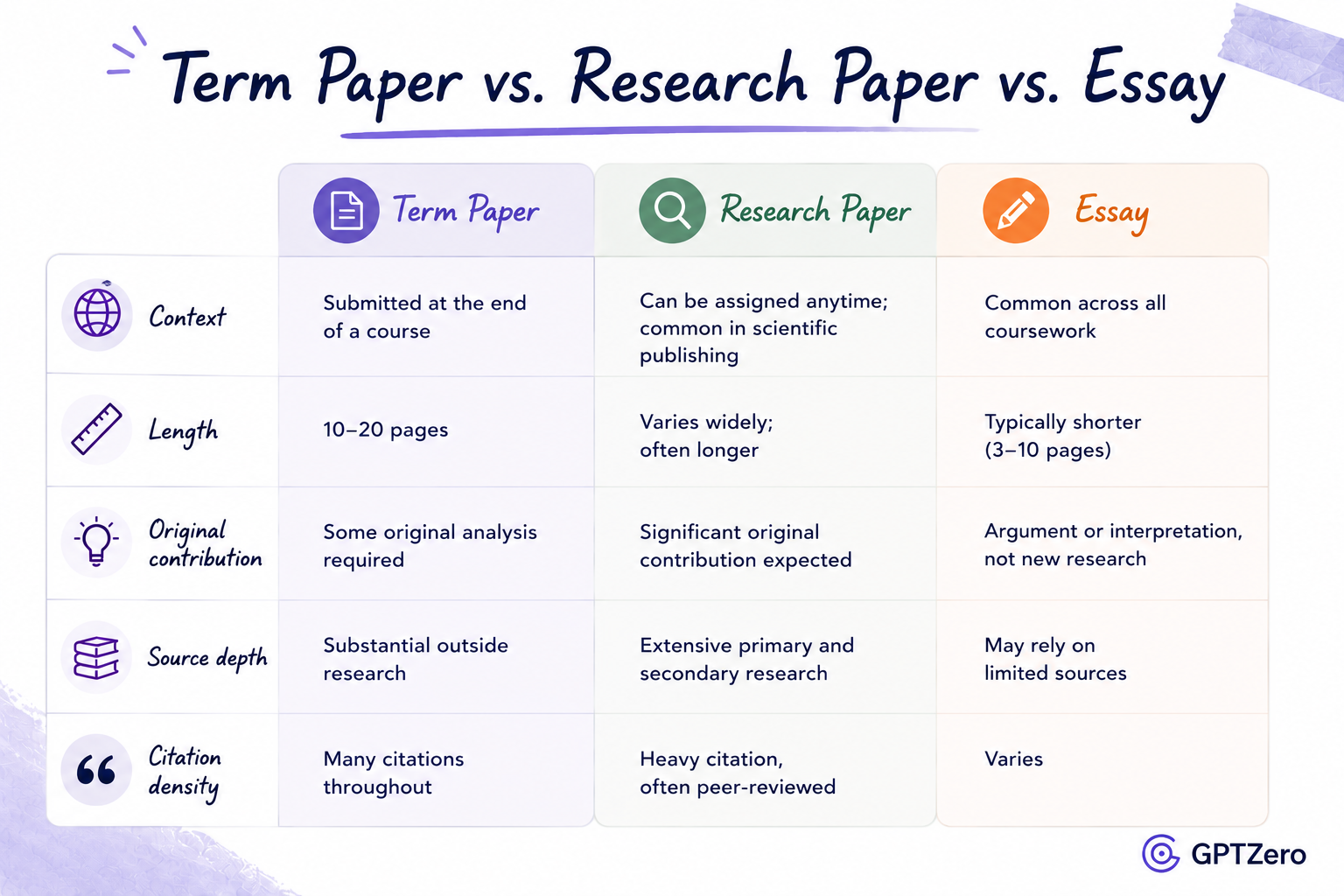
Tip: For a deeper look, see our guide on writing a research paper.
Structure and Format of a Term Paper
You will find that the term paper follows a familiar shape - that of the classic essay.
Title Page
The title page includes:
- title of your essay
- your name
- course information
- instructor's name
- submission date
Tip: Follow the template associated with your citation style (MLA, APA, Chicago).
Table of Contents
Your table of contents will list each section and the starting page number. Today, it is easy to generate a table of contents using AI. Always double-check your work with a human pass or use a trusted hallucination detector.
Introduction
The job of your introduction is to capture your reader's attention, introduce the topic, establish why it matters, and frame your research. Your introduction should always end with a strong thesis statement. The reader should know exactly what the essay is going to cover and your critical position.
Main Body
The main body of your term paper will usually contain 3 to 5 body paragraphs, each presenting a unique argument or important summary. The research that you present and the support of each argument are equally important in the body paragraph. It is a good idea to start each paragraph with a topic sentence.
Conclusion
Your conclusion is like the mirror image of your introduction. You want to begin by restating your thesis in light of the evidence that you have gathered and presented. You can then summarize the main findings within your body paragraphs and close with a statement that points to either open questions or broader implications.
References
A complete list of cited sources in the citation style your course requires.
Format basics
Most term papers use 12-point Times New Roman or Arial, 1.5 line spacing (some departments require double), 1-inch margins, and consistent page numbering from the introduction onward. Citation styles vary by discipline. Our guide on how to format a research paper covers APA, MLA, and Chicago in detail.
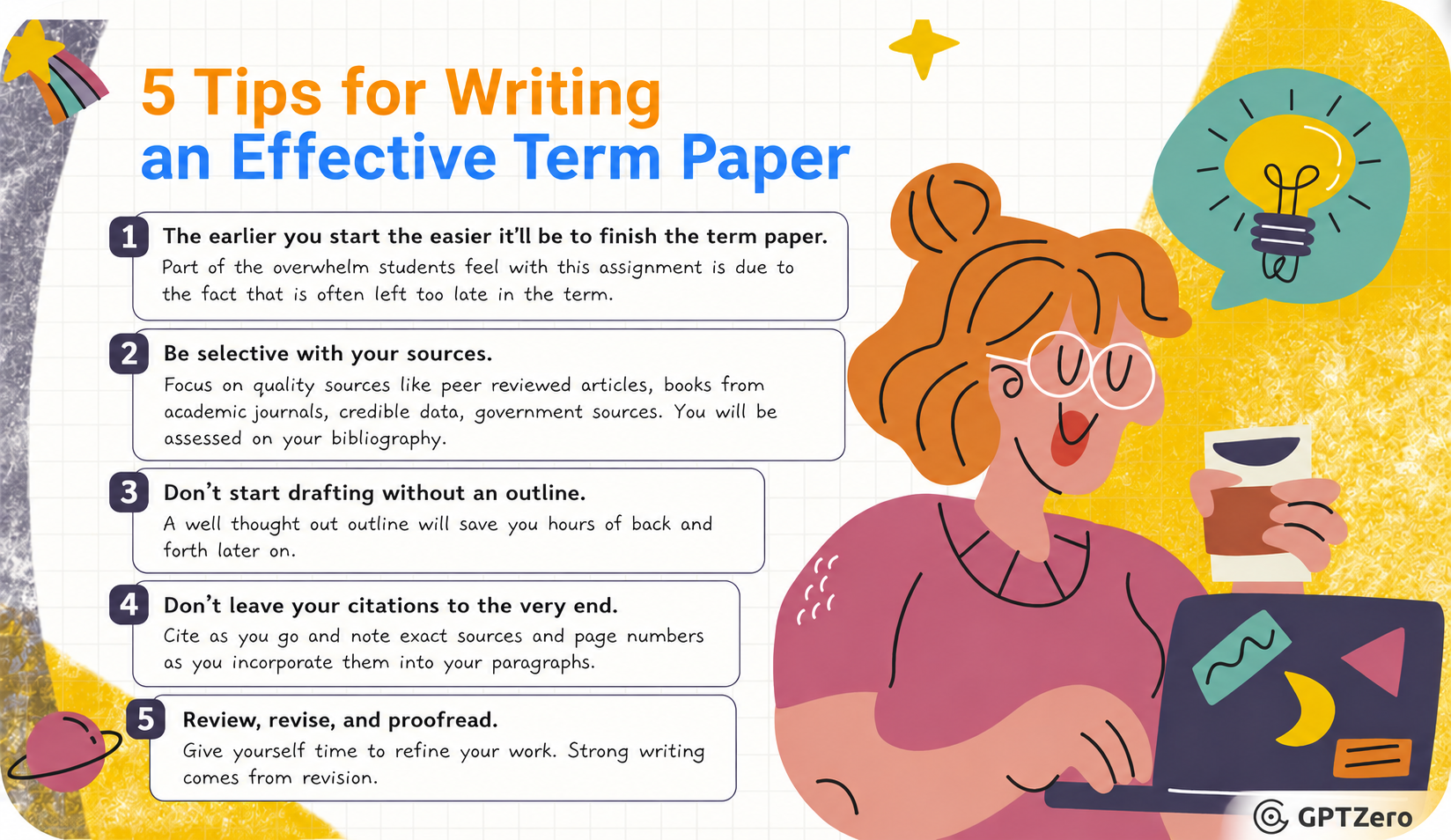
5 Tips for Writing an Effective Term Paper
How to Write a Term Paper in 5 Steps
Step 1: Pick a Topic You Can Actually Defend
A good term paper begins with a good topic or area of focus. It will not be possible to cover everything that you have learned in your course in a term paper. Focusing your topic or area of exploration will help you conduct better research and find a stronger thesis.
Tip: Look for areas where some disagreement or debate might be sparked. You might want to use AI as a brainstorming partner to help you uncover some angles you might have missed. If you do, make sure you double-check your work for accidental plagiarism.
Step 2: Research Before You Outline
Before you settle on a thesis or a specific angle, it's a good idea to read widely. Immerse yourself in your topic from all angles by skimming recent articles, scanning citation lists at the ends of other sources you've read, and paying attention to names and ideas that keep popping up. AI is a great way to surface research and sources, but before you build an argument on AI source material, make sure you scan your sources to confirm they're real.
Step 3: Develop a Thesis and Outline
It is very likely that during your thorough research in the last step come across your thesis. Your thesis statement should take a clear position, not just provide a summary. Ask yourself if someone could reasonably argue with your stance. If the answer is yes, then you have a good thesis.
You can skip writing the introduction for now. Guided by your thesis statement, begin developing an outline for your body paragraphs. Map out each paragraph and include the main point you want to make as well as supporting evidence to support that point. Make sure that each body paragraph topic tracks back and supports your thesis.
Step 4: Draft the Paper
Drafting can be daunting for many students. The good news is that you're not starting with a blank page - you're starting with a well-structured outline. Some students choose to draft the body paragraphs first and finish off with the introduction and conclusion. Others begin at the top and don't stop until the first draft is finished. However you approach it, it is best not to overthink the first draft and just get it out on paper.
Step 5: Revise, Cite, and Verify
Revising any academic work should always be done in layers. On the first layer, you should check for structure, logic, and the flow of your argument. During this pass, you may have to move paragraphs around, seek out further evidence, or rewrite entire sections.
The second layer of revisions should focus on polish. This is where you can address and clean up all grammar mistakes.
Tip: Students report difficulty integrating source material into their arguments naturally. This can sometimes lead to accidental plagiarism. If you find yourself copying and pasting large chunks of text during your writing process, an AI detector for students can help you polish your language and ensure a 100% human submission.
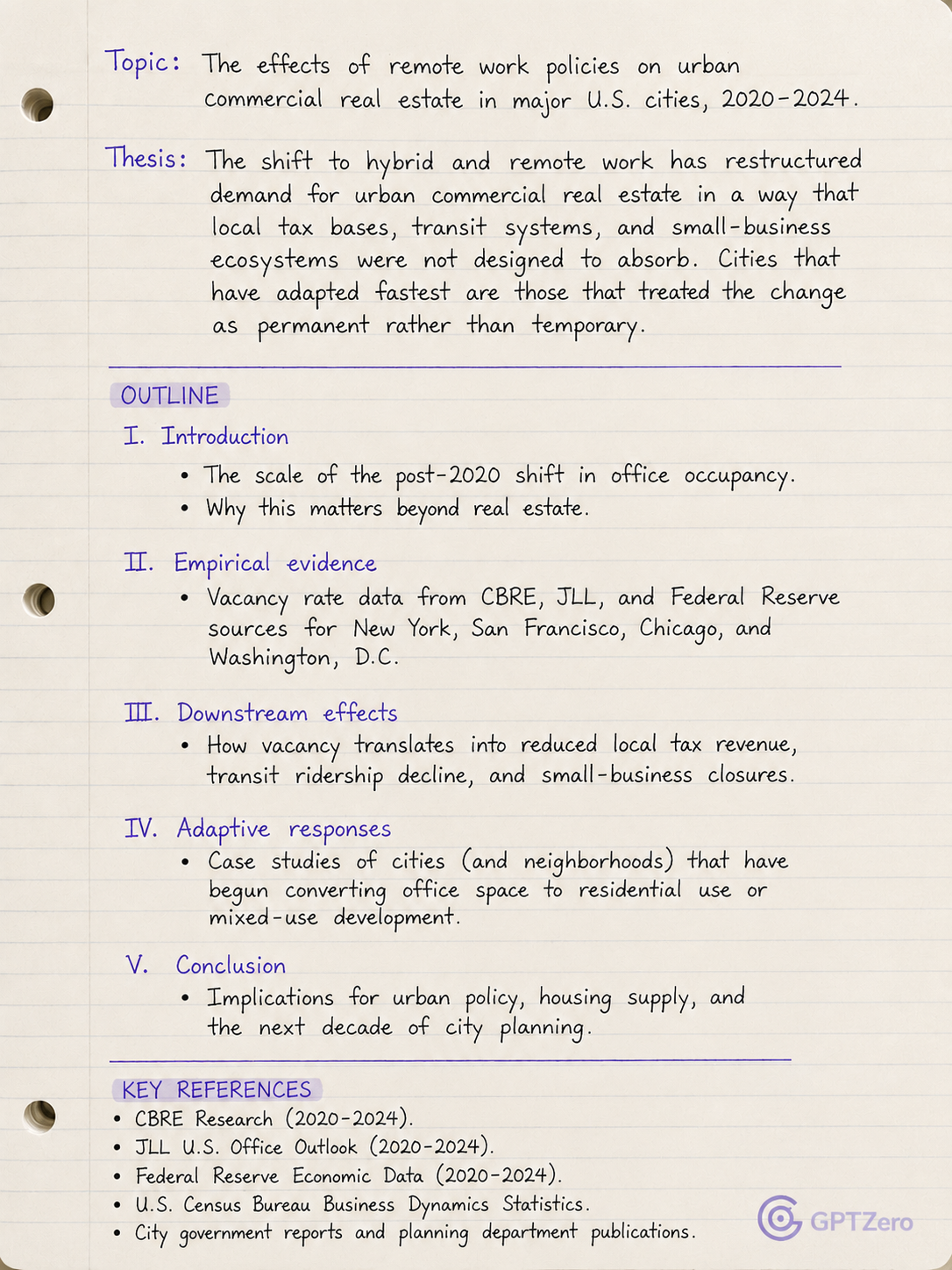
Term Paper Example
Here's a short example to show how topic, thesis, and outline come together.
Using AI Responsibly When Writing a Term Paper
AI has completely changed the way many of us write. It has become part of most students' workflows. AI tools can be great for brainstorming, outlining, and surfacing sources. There are a few areas, however, where the line gets blurry. Here are some prompts to help you stay human:
- Use AI tools as writing assistants. Brainstorm topics, outline your structure, or come up with variations for a title. Generating full paragraphs and calling them your own? That represents the other end of the spectrum. Avoid going there, and if you are unsure whether you have, an AI detector will show you exactly where you did.
- LLMs are notorious for fabricating information. They don't do it every time, but they do it enough times that it warrants a check. Avoid the embarrassment of building an argument on a non-existent source by double-checking your sources.
- Actually read the sources. Don't rely on outside tools to do the synthesis and thinking for you.
FAQs
What is the outline of a term paper?
Your outline should include an introduction and, more importantly, your thesis or thesis statement, three to five body paragraphs, a conclusion, and your references. In some cases, you will also be asked for either an abstract or an appendix.
How long is a term paper?
A term paper is a substantial piece of academic writing and can run anywhere from 10 to 20 pages at the undergraduate level. Graduate term papers and seminar papers can be longer. Most assignment briefs will mention a maximum word count.
How do you start a term paper?
The best place to begin is by reading widely on your topic. Begin to notice any patterns in the names that you see in your research, ideas that you encounter, and discrepancies that you notice. Your next step is to write an outline that lists your main points and supporting evidence. The actual writing of your term paper is done last.
How many sources should a term paper include?
A typical undergraduate term paper cites between 8 and 20 sources. Graduate-level work usually demands more in-depth research, and the right number depends on your topic and your discipline.