
How to Write a Persuasive Essay in 7 Simple Steps
A persuasive essay is a type of academic writing that takes a very strong position on an issue and uses a mix of evidence, reasoning, and rhetorical techniques to defend it.


Effective persuasive writing is not for the faint of heart. The best persuasive essays are not afraid to step out of neutral territory and take a stance. At the same time, strong arguments need to be backed by strong evidence and a clear structure.
Hamilton College's Writing Center emphasizes the importance of structure: "Structure and organization are integral components of an effective persuasive essay. No matter how intelligent the ideas, a paper lacking a strong introduction, well-organized body paragraphs, and an insightful conclusion is not an effective paper."
In this guide, we will walk you through exactly how to write a persuasive essay, even if you've never written one before. The guide covers:
- What a persuasive essay is
- The rhetorical techniques you can use to structure yours
- The standard essay structure
- The 7-step writing process, from idea to first draft.
Plus, we've added a few templates and examples to help you along the way.
TL;DR
- The goal of a persuasive essay is to defend one side of an issue and convert the reader to that side.
- Persuasive essays use the classical rhetorical appeals (ethos, pathos, logos) to structure their argument.
- The most common Mistake is focusing on how strongly the writer feels about the issue rather than presenting compelling proof and evidence.
What Is a Persuasive Essay?
A persuasive essay is a type of academic writing whose explicit goal is to convince the reader of a specific position or stance on a topic or issue. Unlike informative essays, which focus on educating the reader, the persuasive essay has one goal: to convince the reader to accept the author’s position.
Purpose
The persuasive essay is a great exercise in the craft of changing minds and defending a strong position. This particular format trains you to identify opinions and positions worth defending, anticipate objections, and respond to them. Knowing how to present information in this manner can come in useful outside the classroom: college applications, business proposals, and op-eds all require persuasive writing.
Typical length
Most persuasive essays are between 500 and 1,500 words long. Longer assignments (2,000+ words) are common in advanced writing courses. Always check the assignment brief, which usually specifies a word count.
Persuasive Essay vs. Argumentative Essay
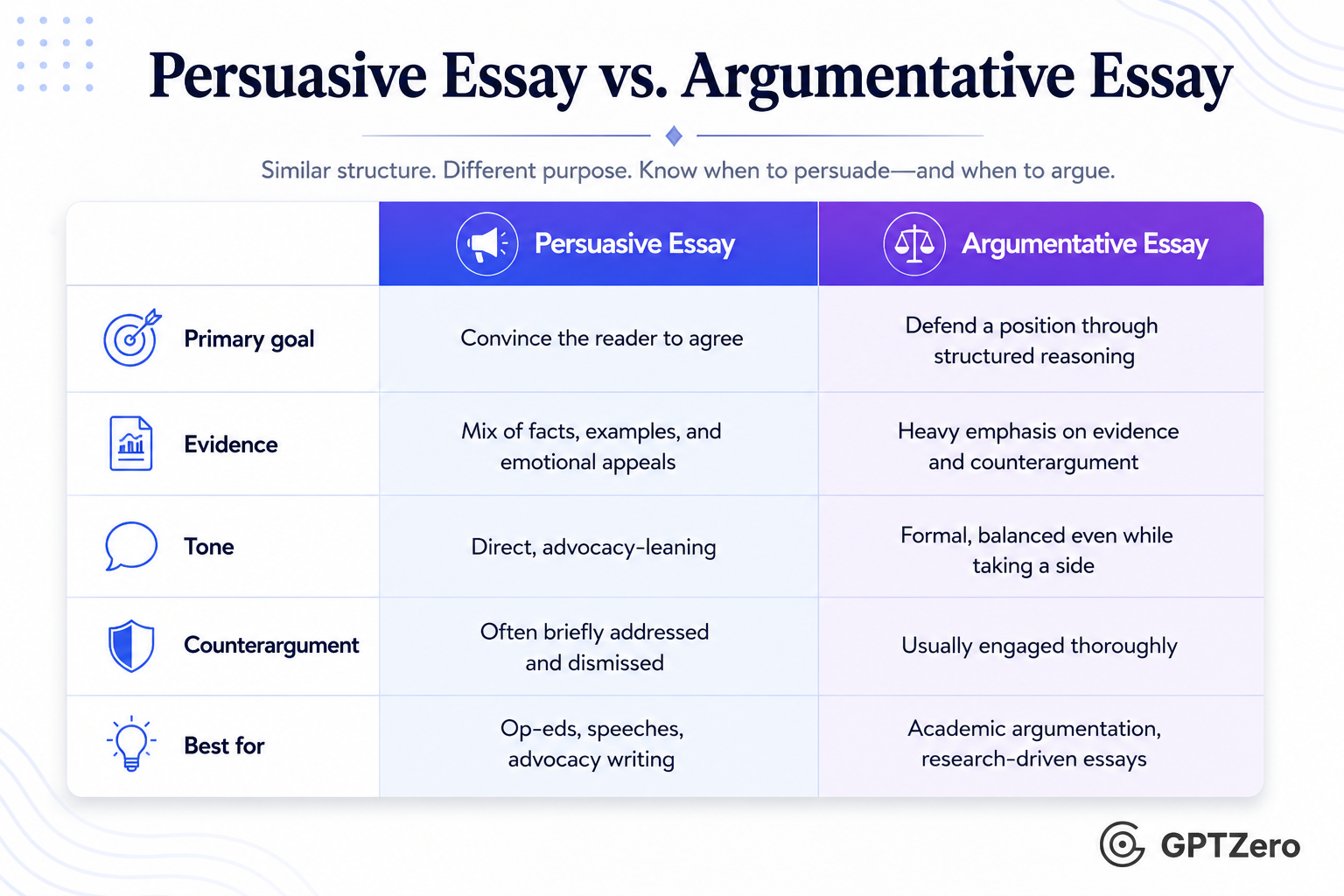
If your assignment is longer, our guide to the outline of an argumentative essay walks through the structure.
Ethos, Pathos, and Logos in Persuasive Writing
Ethos, pathos, and logos are the three rhetorical appeals identified by Aristotle that any persuasive writer or speaker should use.
Ethos (credibility)
Ethos is the appeal to authority. In a persuasive essay, you will build ‘ethos’ by citing trusted experts, demonstrating your deep understanding of a topic, and presenting your argument in a measured and somewhat formal way. All three elements help establish ethos, or credibility, in persuasive writing. Example: "According to the World Health Organization's 2024 report..." establishes ethos by anchoring your claim to a credible source.
Pathos (emotion)
Pathos refers to the appeal to the reader’s emotions, values and sense of fairness. It is important to note here that we don’t necessarily mean inserting melodramatic prose into your persuasive writing. Pathos really means giving your reader a stronger reason to care about your argument beyond the evidence alone.
Logos (logic)
Logos, or the appeal to reason, is the most common rhetorical technique used in academic papers. Think of Logos as the structural support for your argument. Statistics, studies, cause-and-effect chains, and well-constructed arguments all live here. Example: "Schools that implemented breakfast programs saw a 17% reduction in disciplinary incidents within one year, according to the USDA's 2023 evaluation."
When used together, ethos, pathos, and logos build a compelling argument.
Persuasive Essay Structure
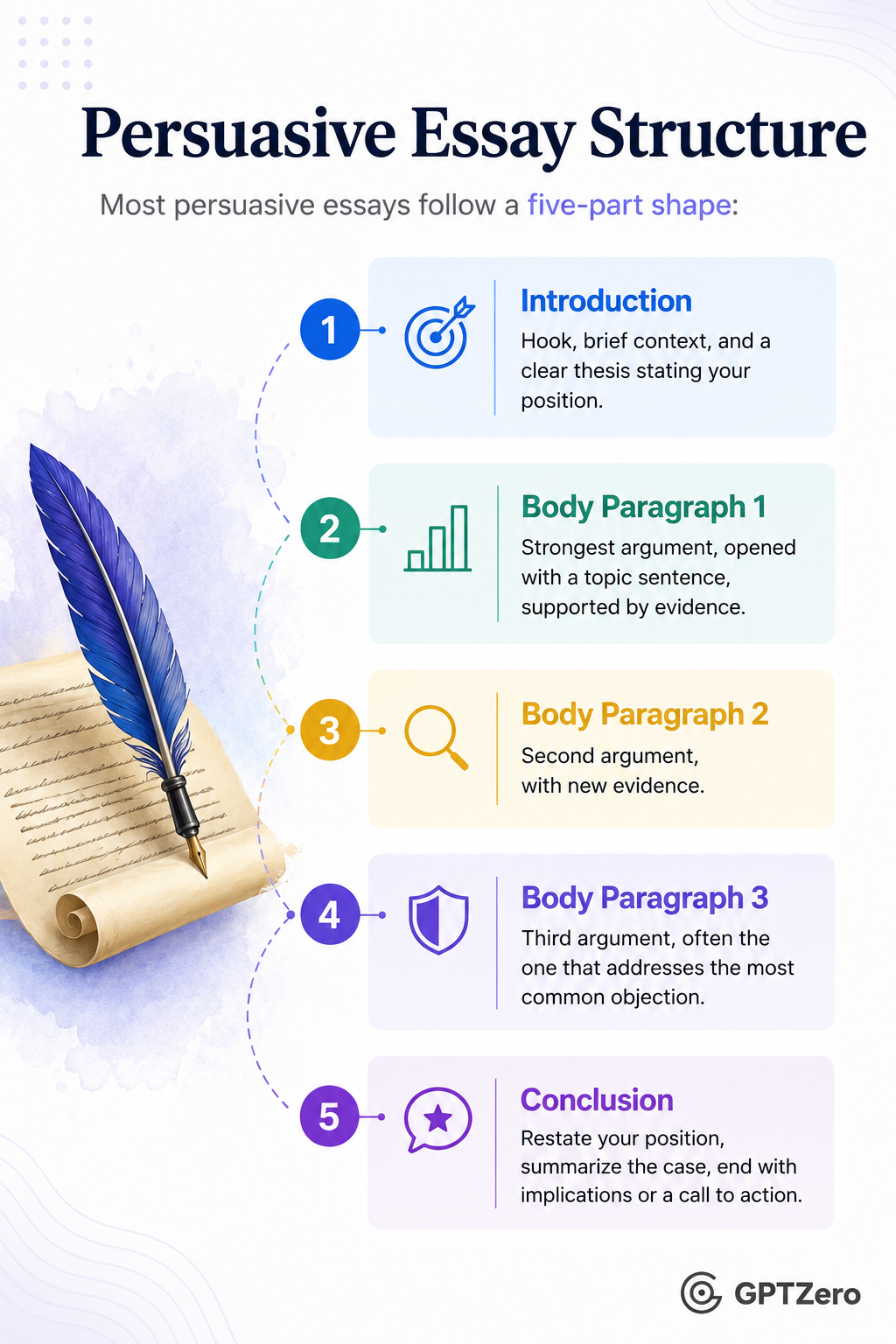
Most persuasive essays follow a five-part shape:
Introduction. Hook, brief context, and a clear thesis stating your position.
[Body Paragraph 1] Strongest argument, opened with a topic sentence, supported by evidence.
[Body Paragraph 2] Second argument, with new evidence.
[Body Paragraph 3] Third argument, often the one that addresses the most common objection.
[Conclusion] Restate your position, summarize the case, and end with implications or a call to action.
How to Write a Persuasive Essay in 7 Steps
Step 1: Pick a Defensible Position
The topic you choose is one of the important aspects of writing a successful persuasive essay. Make sure your topic or position can be argued strongly from both sides. Don't be afraid to lean into a little controversy if you feel strongly about the issue or topic.
Step 2: Research Both Sides
Immerse yourself in the arguments of both sides. Knowing what the opposing point of view is will only make your argument stronger. Keep track of your citations, and if you have used AI to surface any research or sources, this is a great time to check for hallucinations before building your essay.
Step 3: Write a Sharp Thesis
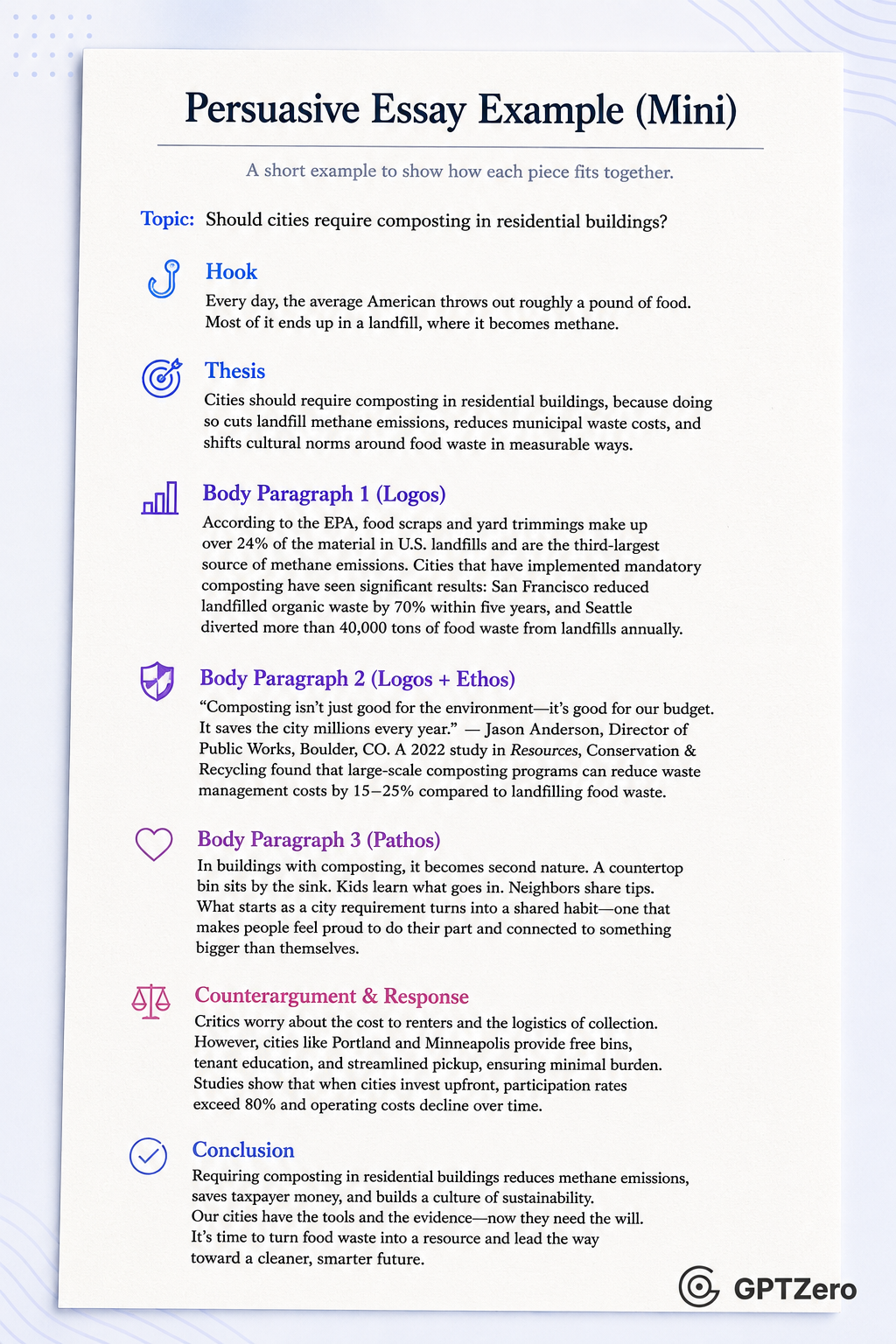
A strong thesis is very specific. The thesis is the "what" plus the "how": what you're arguing, and how you intend to prove it. A strong thesis doesn't just name the position that the author is going to take in the essay, but it also provides the reasoning and the scope of the paper. For example: "Cities should require composting in residential buildings because it cuts landfill methane emissions, reduces municipal waste costs, and shifts cultural norms around food waste in measurable ways."
Step 4: Build an Outline
Think of your outline like the map you're going to follow once you start actually writing your essay. It's never a good idea to start with a blank page and a blinking cursor in the top left corner. Your outline should include your finalized thesis, the points you want to make in your body paragraphs and all the sources you intend to use to support your claims.
Step 5: Draft With Ethos, Pathos, and Logos in Mind
As you draft your essay, keep in mind those Aristotelian rhetorical devices: ethos, pathos, and logos. Perhaps one of your body paragraphs will lean heavily towards the logos side and provide a lot of data and reasoning, while another might appeal to the emotional side of the issue. Setting that intention in your mind as you begin to draft will help steer your writing.
Step 6: Revise for Argument First, Language Second
Edit your essay in stages. On the first pass, pay attention to structure, quality of your argument, how persuasive your evidence is and other bigger picture priorities. On your second pass, you can focus on cleaning up your essay from grammar and spelling mistakes. Speed up the process with the quality grammar checker.
Step 7: Run Final Quality Checks
Many students are using AI to assemble their essays from the research phase all the way to final wording tweaks on the title. Before submitting your essay to your instructors, ensure it is 100% human by running it through a reputable AI detector.
For a refresher on the broader craft, our guide to writing an essay covers the foundations.
Persuasive Essay Example (Mini)
Common Mistakes to Avoid
- Avoid getting too caught up in the persuading and forgetting to back up your opinions with a citation, statistic, example, or expert source.
- Do not diminish the argument of the opposing side. Instead, become well-informed and provide strong evidence against it.
- Avoid hedging language like “perhaps”, “some might argue,” and other terms that soften your thesis.
FAQs
What makes a persuasive essay convincing?
The most convincing persuasive essays have a clear thesis, supported by evidence-backed reasoning and framed through all three rhetorical appeals ( ethos, pathos, and logos). The strongest arguments spend just as much time on considering the opposing side as they do in sharing their stance or position on an issue or topic.
How long should a persuasive essay be?
Most run 500–1,500 words at the high school and undergraduate level. Advanced coursework can extend to 2,000+ words. Always check the assignment brief as the word count is usually stated.
How do you write a persuasive essay thesis statement?
[Claim] + [reasons] + [scope] is a handy thesis formula for persuasive essays. Make sure your argument can be argued strongly from both sides and that you can defend both sides with ample evidence.
What's the best way to start a persuasive essay?
Open with a hook that makes the issue feel urgent: a striking statistic, a concrete example, a question, or a brief story. Follow with one or two sentences of context, then land your thesis. The reader should know your position before they finish the introduction.