How to Write an Argumentative Essay Outline
An argumentative essay outline helps you organize your position, marshal supporting evidence, and address counterarguments before you write a single sentence.



There are dozens upon dozens of Reddit queries asking, "What is the best way to win an argument?" While “act dead” is a fun option to consider, for essay writing, the best answer is to “back up your proposition with logic, reason and evidence.”
Use an argumentative essay outline to give your paper the upper hand in convincing your reader by marshalling supporting evidence, defeating counterarguments, and fortifying a strong position.
This guide will explain what an argumentative essay outline is and how to structure it, including three common formats for argumentative essays. You can follow a step-by-step guide to outline your argumentative essay, and review tips, best practices, and an FAQ on argumentative essay outlines.
What is an Argumentative Essay Outline?
An outline is a crucial first step to writing. In an argumentative essay outline, you will identify and organize your key points so that you can begin drafting with a strong plan of action.
Unlike other essay formats, argumentative writing requires a clear position on a debatable topic. There is an emphasis on surveying positions in an existing debate and firmly stating and defending your own position.
For information and advice on essay outlining more generally, check out this Writing Guide.
What is a Debatable Topic?
These are issues without clear or easy answers. They may be highly contentious topics in society (e.g., gun control, freedom of speech, medically assisted dying, etc.) or fairly banal (e.g., water fluoridation, tipping culture, dating apps, etc.), but there are significant arguments for and against these issues.
On the other hand, if you can’t imagine a reasonable person disagreeing with you, your topic may not be debatable. Conduct research to see if you can find opposing viewpoints from credible sources.
If you are concerned about the quality of your sources or want to check if they support your claims, try a Hallucination Detector to get AI-powered suggestions for credible academic sources.
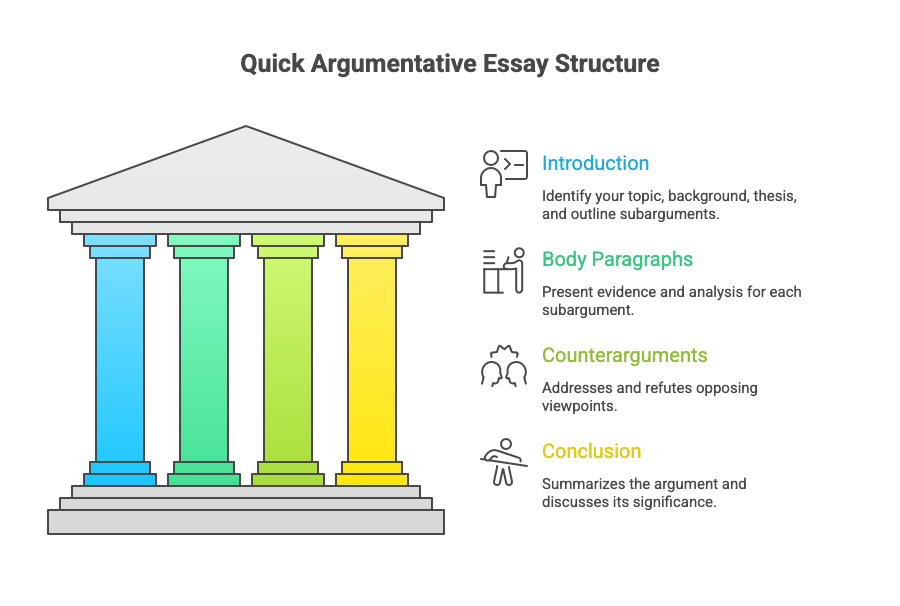
Common Formats for Argumentative Essay Outlines
Classical Outline Structure
Also called the Aristotelian model, the Classical Outline Structure is an ancient Greek method that assumes that if all parties understand the issue with utmost clarity, the correct position in the argument will become self-evident.
Toulmin Method
In 1958, Stephen Toulmin presented a structure for argumentation that emphasizes creating highly structured supports for key claims in favour of your argument – it's known as the Toulmin Method.
Rogerian Argument Outline
The Rogerian Argument Outline framework seeks to thoroughly understand all perspectives on an issue, even opposing viewpoints.
Step-by-Step Guide to Write an Argumentative Essay Outline
Brainstorm
Consider your assignment details and the focus of the course you’re writing for, and think of relevant topics you want to engage with.
Choose the main argument
Select a topic that is debatable and interesting, one that you feel you can persuasively argue for or against.
Research
Do preliminary research to uncover what positions exist in this debate, then conduct more targeted research looking for evidence and analysis to support your position.
Explore counterarguments
This is key to an argumentative essay. As you research, assess the merits of opposing viewpoints you encounter and craft rebuttals. As the University of North Carolina-Chapel Hill puts it,
“By considering what someone who disagrees with your position might have to say about your argument, you show that you have thought things through, and you dispose of some of the reasons your audience might have for not accepting your argument.”
Select subarguments and evidence
Review your research findings and make choices about what to include and how to group your evidence, analysis, and counter-argumentation into cohesive body paragraphs.
Format an argumentative essay outline
Choose from one of the above formats: Classical, Toulmin, or Rogerian. See which format best corresponds to the style of argument you want to make.
Argumentative Essays: High School vs University
Teachers will expect greater depth and complexity, more fulsome research, and a more specific thesis at the university level than in high school. Here are some key distinctions:
Tips and Common Mistakes to Avoid
Check that you’re not reproducing someone else’s argument
It’s challenging to research widely enough to know what arguments are already out there. A plagiarism detector can help flag parts of your argumentative essay that may require citations.
Keep it classy
An argumentative essay may invite a more combative style of writing, but be sure to keep your tone formal and respectful. Don’t trash the authors you disagree with; acknowledge the validity of their arguments and proceed to point out their limitations.
Crowdsource for quality control or counterarguments
Pitch your argument to a classmate or a friend. Tell them about the topic, explain what people on either side of the debate are saying, and state your position on the matter. Do they agree or disagree with you? Can they offer arguments that didn’t occur to you?
FAQ
What is the difference between an argumentative essay and an expository essay?
An argumentative essay takes a stand and argues in favour of its position on a debate. An expository essay does not advocate for one perspective over another, but gives an overview of existing perspectives.
Do I need a counterargument in my outline?
Not necessarily, but it’s a good idea. If the point you’re arguing is a debatable one (as it should be), then there will be credible counterarguments that you should deal with.
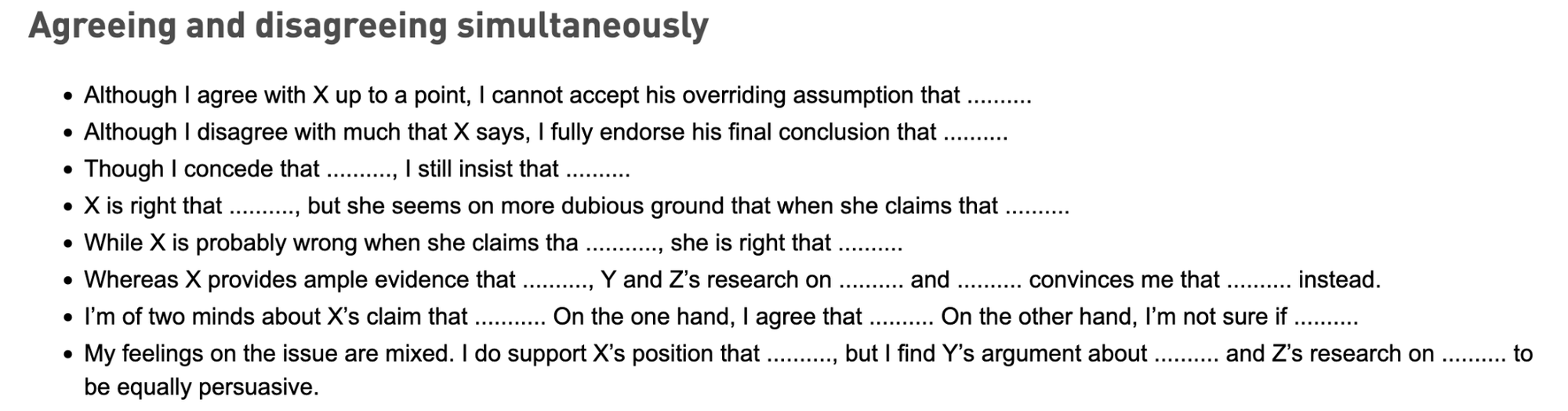
Do I have to disprove counterarguments?
The best way to address a counterargument is to acknowledge its merits, but explain why your own position is better. Consider using one of these template sentences from Simon Fraser University:
How long should an essay outline be?
If your essay will be 1,000 words, then aim for no more than 100-200 words. Include the essay’s key subarguments, but don’t get bogged down in details.
Can you end an argumentative essay with a question?
No, an argumentative essay should not raise new concerns at the end. Essay conclusions may sometimes mention future research possibilities, but it would weaken the strength of your argument to leave a genuine question dangling unanswered in the conclusion.