
How to Write a Discursive Essay in 7 Simple Steps (With Examples)
A discursive essay is a type of academic writing in which the author discusses multiple viewpoints and provides an in-depth discussion of a specific topic.



If you are in high school or your first year of university, the discursive essay assignment may have crossed your desk. This format aims to present a balanced, evidence-based inquiry in which both sides of an issue are considered equally and fairly.
A key characteristic of discursive essays is that it “appeals to reason, not emotions or opinions”. Think of it like a debate where the reader is exposed to multiple viewpoints on a topic.
This guide covers what a discursive essay is, discursive essay structure and template, how to write a discursive essay in seven steps, as well as some examples and tips.
TL;DR
- A discursive essay presents two or more sides of a debate in a balanced, evidence-based way — without picking a winner.
- It's different from an argumentative essay, which defends a single position.
- The standard structure is five paragraphs: introduction, two or three balanced body paragraphs, and a synthesizing conclusion.
What Is a Discursive Essay?
A discursive essay examines multiple perspectives on a topic and examines each with supporting evidence, educating the reader on the nuances of a topic and preparing them for a debate.
The purpose of the discursive essay is not to prove a point or sway the reader towards a conclusion or bias, like in the argumentative essay style, for example. A discursive essay’s job is to demonstrate that you know the topic so well that you can see it from multiple perspectives.
When grading your paper, your instructor will be looking for balance, depth, clear reasoning, and strong source material, not persuasion.
Key Characteristics of a Discursive Essay
- A neutral, unbiased, and often formal tone throughout.
- Discussion of two or three distinct viewpoints, each a strong example
- Use of quality evidence like statistics, expert opinion, and real-world examples. Each side or viewpoint must be supported by evidence.
Discursive vs. Argumentative Essay
These two essay formats are often mixed up by students, so we thought it was a good idea to clear things up before you start writing. Argumentative and discursive both present sides of a topic or argument; however, in a discursive essay, all persuasive language must be replaced with matter-of-fact, non-biased language, leaving the reader to weigh the sides you are presenting. Think of yourself as an impartial advisor.
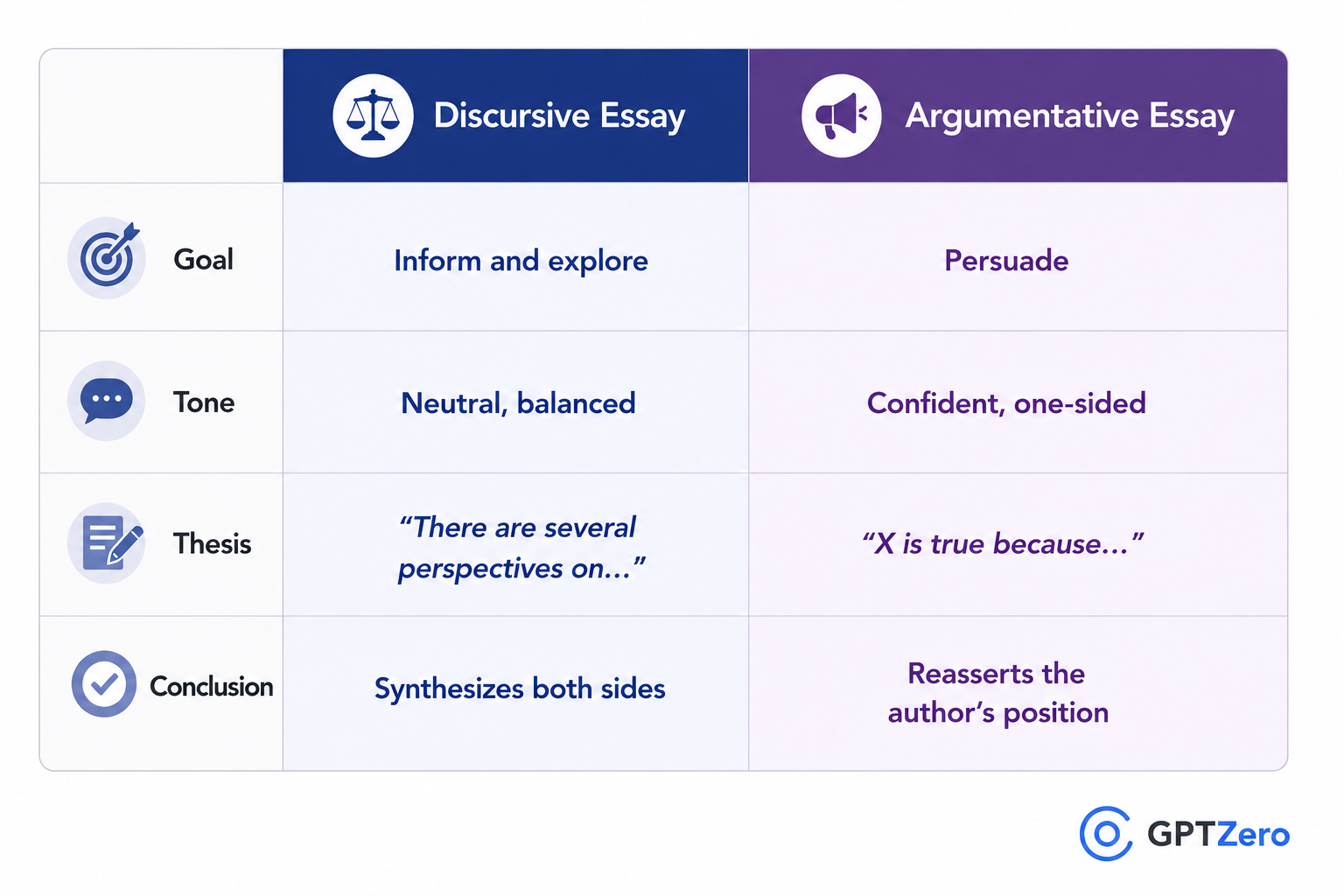
The type of essay you are expected to write isn’t always named in an assignment. A good rule of thumb is that if your teacher asks you to "discuss" a topic, that's discursive. If they ask you to "argue" or "convince," that's argumentative.
Discursive Essay Structure and Template (Copy and Paste)
The structure of a discursive essay will be familiar to you- it is the standard five-paragraph essay structure. Longer essays may use six or seven paragraphs. The template we share with you below will work for most essays you are tasked with writing.
DISCURSIVE ESSAY OUTLINE copy and paste TEMPLATE
INTRODUCTION
Hook:
Background on the topic:
Thesis statement:(Introduce the issue and signal that multiple viewpoints will be explored.)
BODY PARAGRAPH 1 — POSITION A
Topic sentence:
Evidence / Example 1:
Evidence / Example 2:
Explanation:
BODY PARAGRAPH 2 — POSITION B
Topic sentence:
Evidence / Example 1:
Evidence / Example 2:
Explanation:
BODY PARAGRAPH 3 — OPTIONAL NUANCED VIEW OR COUNTER-RESPONSE
Topic sentence:
Supporting evidence:
Explanation:
CONCLUSION
Summary of Position A:
Summary of Position B:
Synthesis:(What does the discussion reveal overall?)
Optional personal position (if permitted):
How to Write a Discursive Essay in 7 Steps
Step 1: Pick a topic with at least two strong sides
The best discursive essays leave plenty of room for disagreement. If you have not been assigned a topic by your instructor, spend some time choosing a worthy topic. Look for published opinion pieces on the topic and see if you can discern clear sides on the issue. If the answer is yes, you are close to a suitable topic.
Step 2: Research all sides in depth
You will naturally gravitate towards one side over another. You must stay focused and research both sides in equal depth. Think of yourself as a reporter who is asked to gather all the relevant information on a topic.
When researching, keep in mind that much of what you read will be opinion. In fact, a 2018 Pew Research Center study found that people across all age groups struggle to distinguish factual statements from opinions, so verify carefully and lean on peer-reviewed research, government data, and established journalism.
Tip: Run your sources through a trusted AI detector to make sure you present evidence that actually exists.
Step 3: Build an outline
Before you start writing, map out your essay by creating an outline. Outlines are thinking tools that allow you to build your argument, collect your evidence, and get a sense of how your paper will flow. They make it easy to make adjustments or beef up research prior to investing in the longer process of writing. Keep them in point form and brief, and use them as your guide for the next step.
Before writing a sentence, sketch which arguments go in which paragraph. List your strongest point for each side, then your second-strongest, then your third, and pair them up. This prevents the common failure of frontloading all your best arguments on one side.
Step 4: Write a clear, neutral introduction
Your introduction has to nail the tone of the discursive essay. You have to use a calm, balanced tone and introduce the multiple perspectives you are going to be discussing without simultaneously introducing bias into the discussion and turning this into an argumentative paper. Our guide on how to write a good introduction covers hooks, context, and thesis construction in detail.
Step 5: Organize your body paragraphs
Each body paragraph should follow this pattern: open with a topic sentence, followed by two or three pieces of evidence, a brief explanation, and a transition. Here’s a visual example:
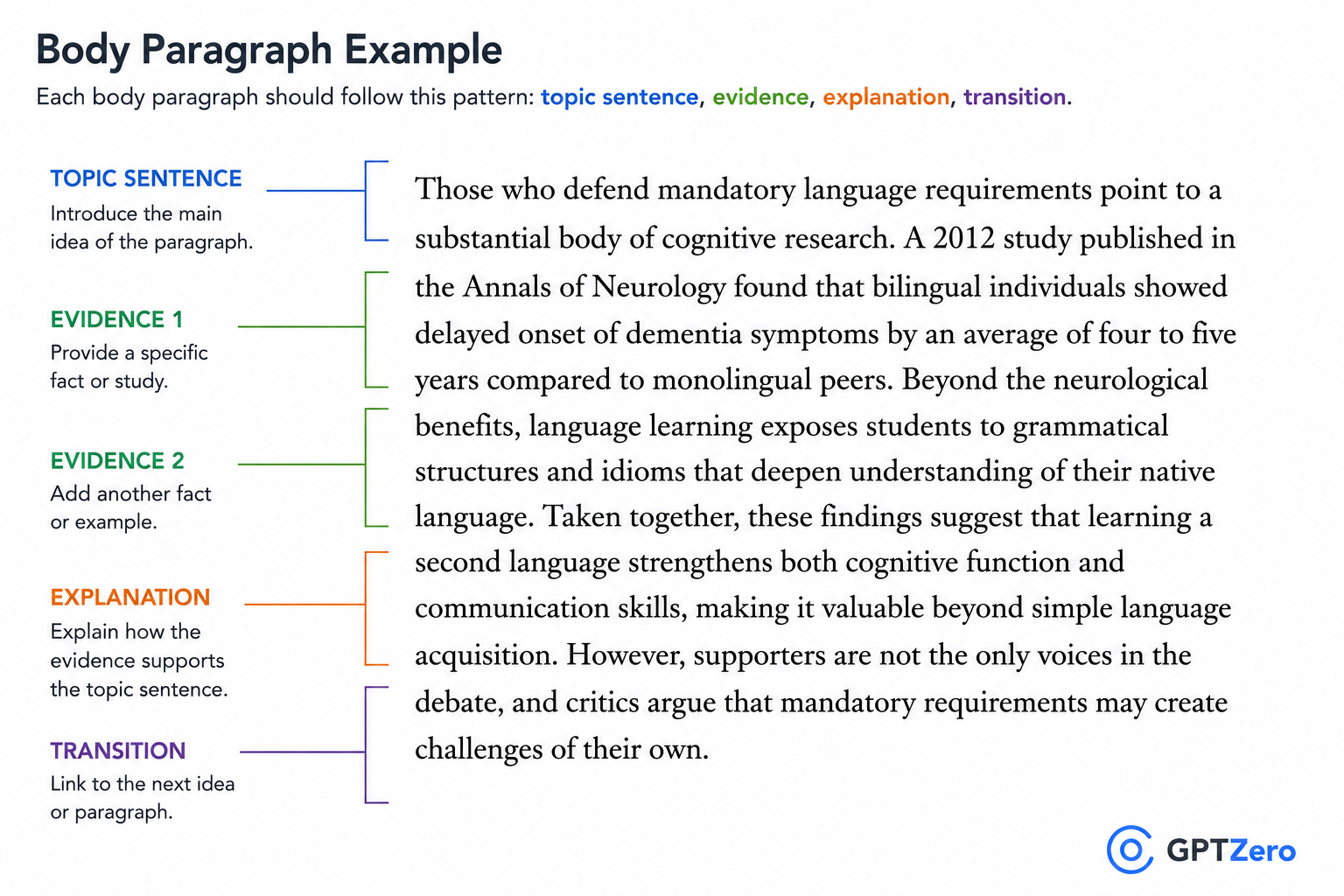
Our guide on writing body paragraphs covers paragraph construction in more depth.
Step 6: Write a summary conclusion
It can be tempting to want to add a “therefore…” style statement at the end of the essay. After all, most essays ask you to defend, prove, or argue your point or perspective. Not the discursive essay. Resist the urge to declare a winner and simply summarize and recap the main points for the reader. Sometimes your assignments will allow for personal opinion- this is the place for it.
Step 7: Edit twice, submit once
On your first editorial pass, feel free to lean on your grammar checker and clean up all the red underlines. Now that the grammar is out of the way, you can focus on the more important editing. Editing for flow, balance, and evidence is a bit more subtle and may take you longer. Don’t be afraid to make substantial changes to your paper if it will make it stronger.
Before submitting, run your essay through an AI vocabulary checker to make sure you hand in a completely human draft.
Discursive Essay Examples
Short introduction
Topic: Should secondary schools require students to study a second language?
Few subjects in the secondary curriculum generate as much debate as foreign language requirements. Supporters argue that learning a second language sharpens cognitive flexibility, broadens cultural understanding, and improves job prospects in a global economy. Critics counter that mandatory language study consumes hours that could be spent on subjects students will actually use, and that mediocre exposure to a language produces neither fluency nor genuine cultural insight. This essay examines both positions before considering what a balanced policy might look like.
You can view a sample of a full discursive essay here.
Tips for Writing a Strong Discursive Essay
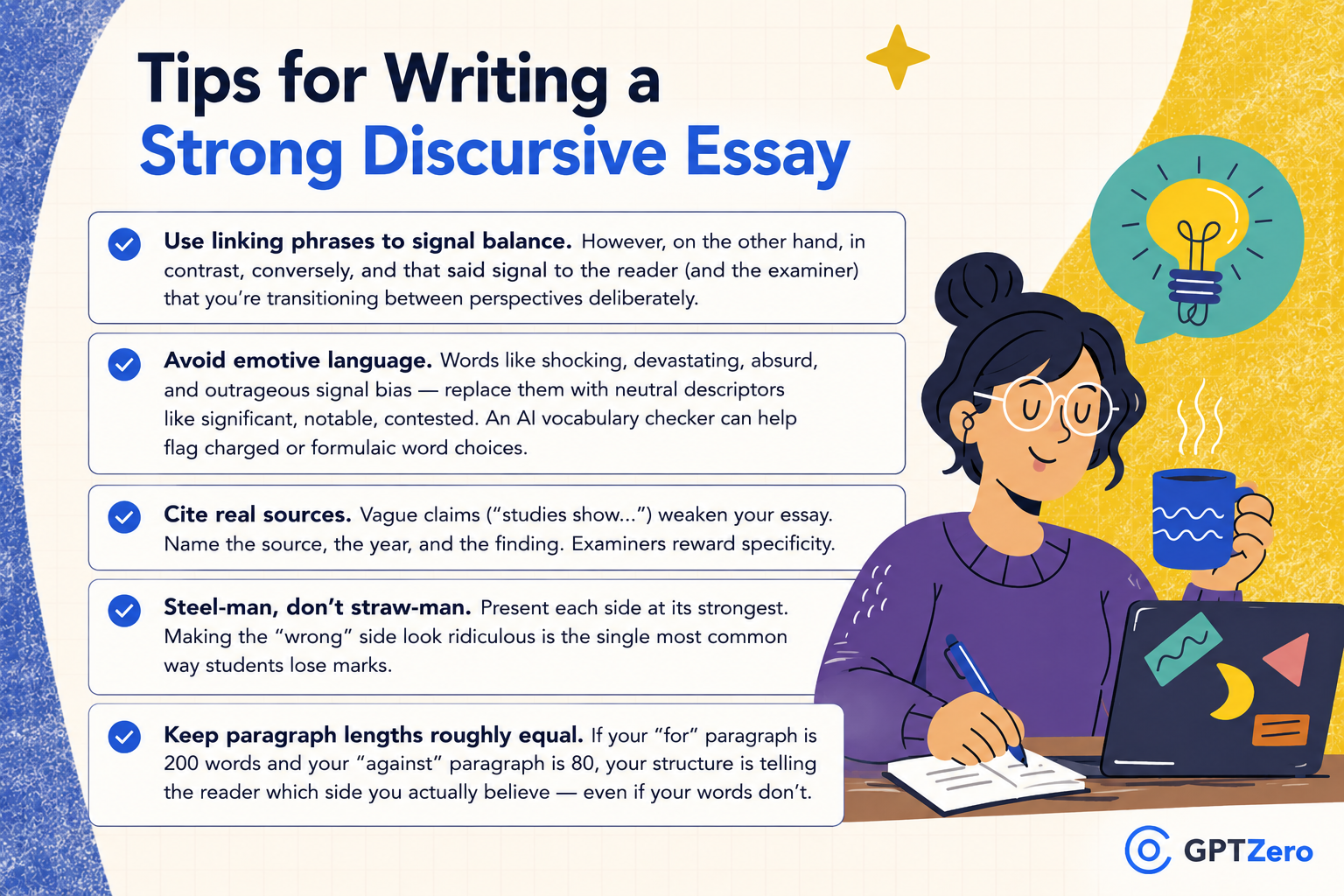
FAQs
How do you start a discursive essay?
Begin your essay with a hook that creates a frame for the debate. It can be a surprising statistic, a contested quote, or a question with no easy or obvious answer. Once you have the reader’s attention, you can give a brief background on why the topic matters and then end with your thesis that summarizes the different perspectives you will cover in your paper.
How do you write a discursive thesis statement?
A discursive thesis statement is different from a traditional thesis, where you make a claim and then proceed to prove or defend it in your paper. In the discursive essay, you simply want to list the different perspectives you are going to cover in your paper. Here’s an example: "Whether artificial intelligence will displace more jobs than it creates is a question economists, technologists, and policymakers continue to debate."
How long should a discursive essay be?
Most discursive essays assigned in secondary school will land between 800 and 1200 words. University-level essays typically run 1500- 2500 words. Always check your assignment guidelines.
How do I avoid sounding biased?
When you are editing your paper, check for areas that have emotional charge. Replace any strong language with more neutral words.