How to Write a Concept Paper in 7 Simple Steps (Complete Guide)
A concept paper, also known as a research proposal, is a short academic document that outlines a research project to seek feedback from a supervisor, committee, or grant program.


The concept paper is the prelude to a larger project. As the Rutgers School of Nursing puts it: "A concept paper is used to generate feedback and guidance from a program officer before a full grant proposal is developed." Master’s and PhD students often prepare concept papers once they have solidified their dissertation or thesis topic. Researchers write them to test the waters with a funding program before committing months to a full grant application.
In this guide, we'll walk you through what a concept paper is, the different types you'll encounter, the standard components, a seven-step writing process, and tips to make your paper as compelling as possible.
TL;DR
- A concept paper is a short proposal document that outlines an idea for a research project or grant before the full project is initiated.
- Most concept papers are between two and five pages, and they answer core questions: what's the problem, why is it important, how will you address it, what will the deliverables be, and how will you measure success?
- The most common reasons concept papers get rejected are unclear problem statements or vague methodology.
- Your concept paper is a pitch. It is important to write your concept paper for a specific reader, whether that's a thesis supervisor, a grants officer, or a scholarship committee.
What Is a Concept Paper?
A concept paper is a short academic proposal that outlines a research idea, defines scope and methodology, and provides an argument to support further study or research. Think of the concept paper as the early-stage pitch for a larger project.
Purpose
The purpose of a concept paper is to present an idea for a deeper inquiry or research body to a committee. The committee then approves, redirects, or rejects your proposal based on the information you have presented them with. Either way, feedback at this stage is useful as it saves you from writing a long piece of research without the necessary pressure testing.
Common uses
Concept papers are usually used by graduate students in order to get official sign-off or funding for a dissertation or thesis topic. In the world of research, concept papers are used when applying for funding or other programs. Even NGOs and nonprofits use concept papers when pitching projects to donors.
Why it matters
A concept paper is a great way to test the waters with your idea or argument. Going through the process of creating a concept paper forces you to think through your concept thoroughly and present it most elegantly and compellingly to your reader.
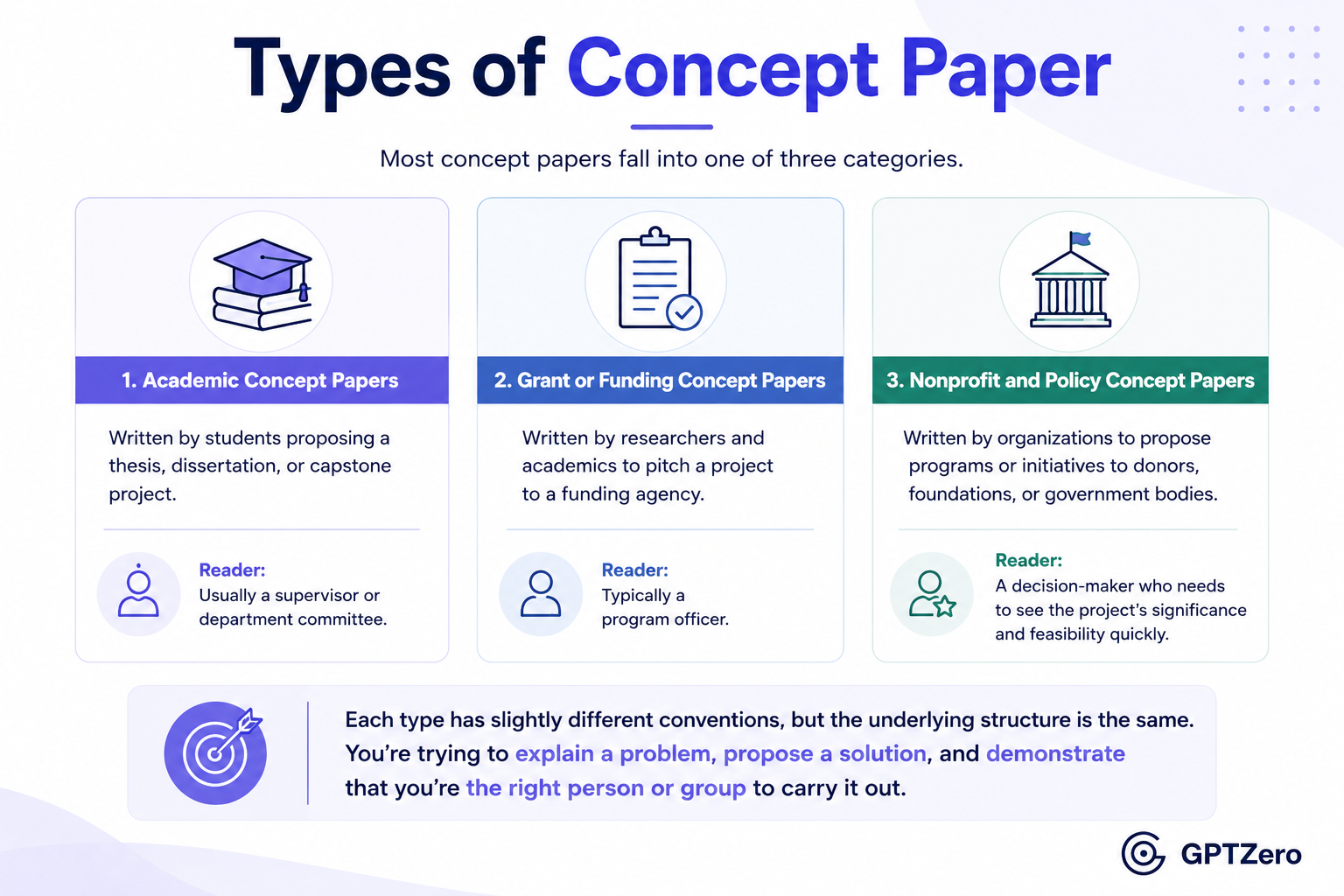
Types of Concept Paper
Components of a Concept Paper
Title
Include a short, specific title that captures the project. Avoid clever, marketing-style language and focus on clarity. The reader should know roughly what the paper is about just from the title.
Introduction
Your introduction should debut the topic, frame the issue, and orient the reader to the scope of your project. Many concept papers begin with a general statement about what you are trying to accomplish.
Tip: Our guide on how to write a good introduction covers the conventions in more detail.
Problem statement
Your problem statement has to be clear and concise. It is one of the most important sections of your concept paper, because it gives the case for why your research should move forward.
Purpose and significance
Explain why your project is worth pursuing. Think of this as the sales pitch of your concept paper. You need to convince your reader that there is something to be gained from embarking on this work.
Methodology
It is important to include a brief overview of how you'll carry out the research or project. You don't need full detail at this stage, but the reader should have enough to understand the approach.
Expected outcomes or deliverables
What do you expect to produce? This can include intangibles, such as new knowledge or partnerships, as well as tangibles, such as reports, datasets, or papers.
Timeline
Outline the milestones of the project and a rough timeline of when each step will be completed.
References
A short reference list of the most important sources you've used. If AI is part of your research process, make sure you check your citations for hallucinations before submission.
How to Write a Concept Paper in 7 Steps
Step 1: Identify Your Reader
Before you write anything, get clear on who you are writing for. A thesis supervisor will care about different things than someone considering releasing grant funding. Align your concept paper with the priorities of your reader. If you are applying for funding, read the mission statement of the granting body to boost your chances of success.
Step 2: Refine Your Research Topic
Your concept paper revolves around your research topic. Without a strong topic, it is unlikely that your work will move forward, even if everything else is presented beautifully.
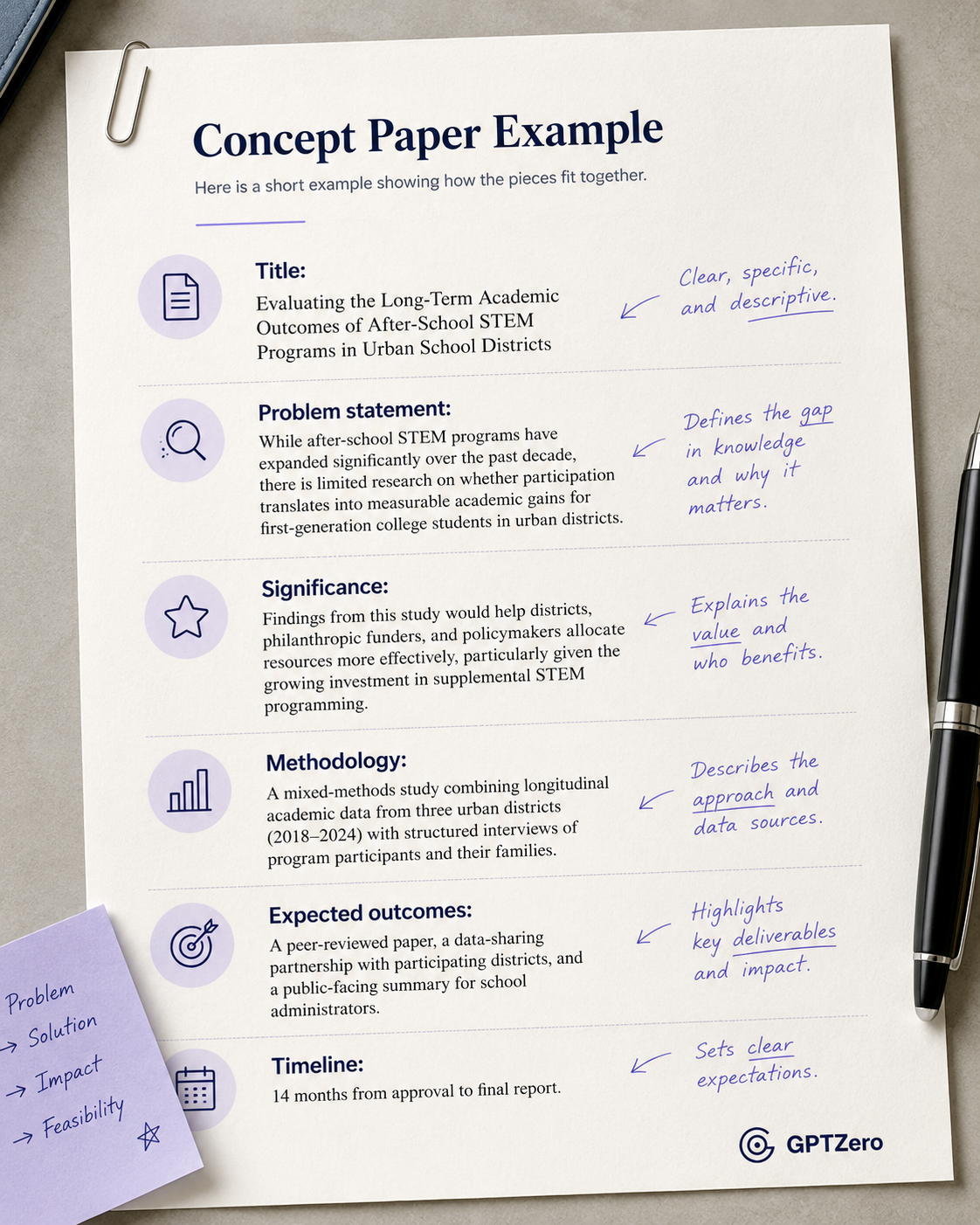
A strong concept paper starts with a focused, specific topic like: "How after-school STEM programs affect academic outcomes for first-generation college students in urban school districts".
Step 3: Draft a Clear Problem Statement
The problem statement is like the thesis statement you have written many times during your academic career. It should state the gap, the question, and the issue in a way that shows you’ve engaged with the literature on the topic. Vague problem statements are one of the main reasons concept papers fail.
Tip: Try writing your problem statement in one or two sentences. If you can't get it that tight, it usually means the problem isn't yet clear in your own mind. Spend more time on it before you move on. If AI is your brainstorming partner, using an AI Chrome extension will help you keep your ideas yours.
Step 4: Explain Why It Matters ("Who Cares?")
The ‘so what?’ or ‘who cares?’ question is the first thing your readers are going to test your concept paper against. This is especially true for grants and mission-driven projects.
The strongest significance statements connect the specific project to something bigger. A study on a narrow population may produce findings that apply to a much larger group. A new methodology may unlock research questions that were previously impossible to study.
Step 5: Outline Your Methodology
Include a brief description of your methodology. At this stage, you don’t have the space to go into full details, but you still need to show a credible plan. Outline your approach, your data sources, your sample (if applicable), and any methods that might be unfamiliar to your reader.
Step 6: State Expected Deliverables
What is going to result from this project? We are not just talking about the broader significance or implications here. What will actually exist that didn’t before? This can include published papers, datasets, trained personnel, software tools, policy recommendations, and more.
Step 7: Revise and Run Final Checks
Once your draft is complete, revise in two layers. On the first pass, check for structure and argument. Does the problem statement lead naturally to the methodology? Does the significance section actually answer "who cares?"
The second layer handles surface work, much of which can be easily handled by AI. A high-quality grammar checker will catch typos for you.
Tip: Our guide on how to write a conclusion is also worth a look if your concept paper includes a closing section.
Concept Paper Example
Concept Paper Template
Use this skeleton for your first draft:
- Title [Type your title here]
- Introduction [Brief context and orientation]
- Problem Statement [The gap or question your project addresses]
- Significance [Who benefits and why this matters]
- Methodology [How you will carry out the project]
- Expected Outcomes [What will exist at the end that didn't exist before]
- Timeline [Key milestones and total duration]
- References [Verified and cited according to assigned citation style]
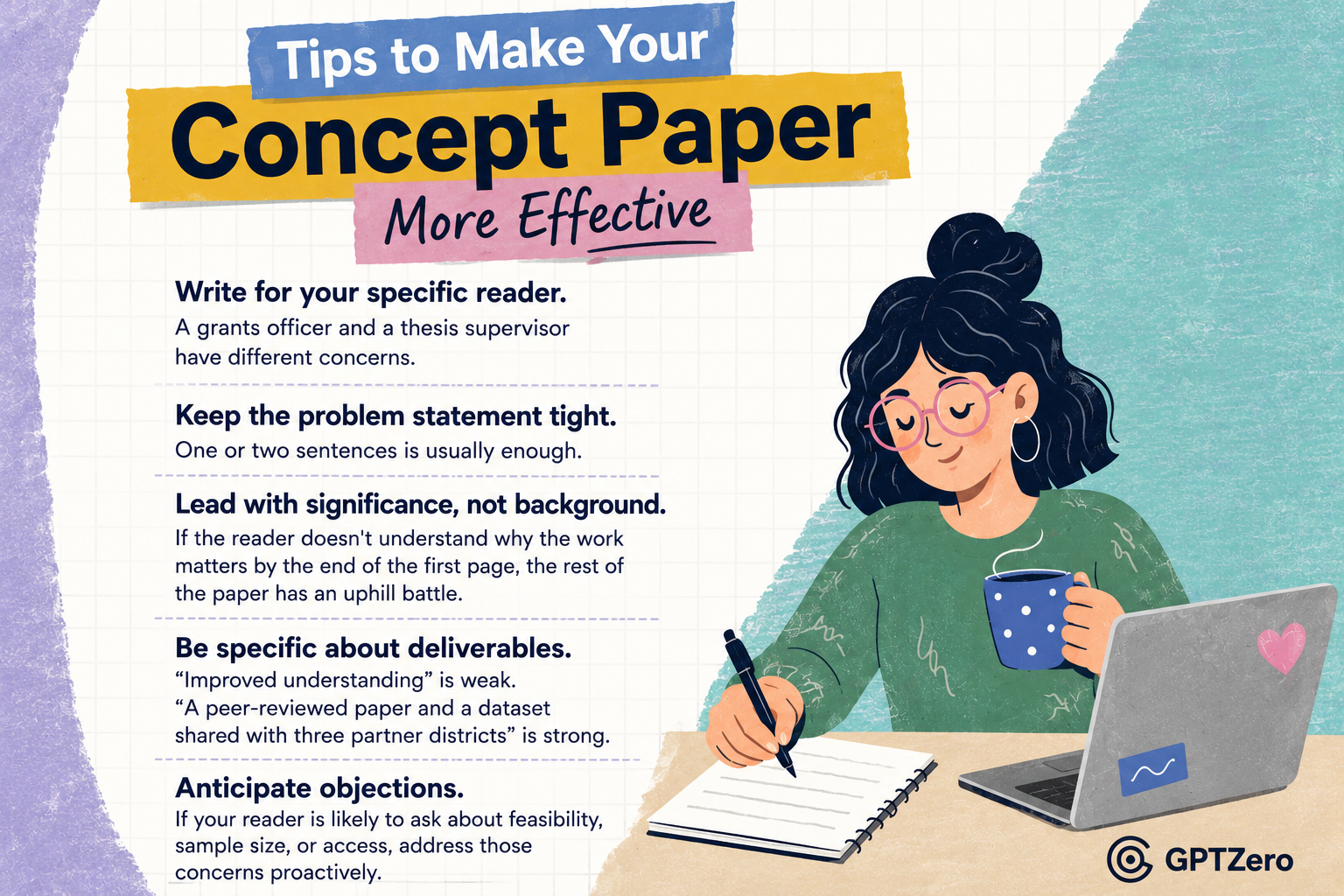
Tips to Make Your Concept Paper More Effective
FAQs
How does a concept paper differ from a research paper?
A concept paper is a short proposal written before longer, more in-depth research begins. It outlines what you plan to do and why it is important, given the context. It is a piece of academic writing used to gain approval or to submit an application for a research project or research paper.
How long is a concept paper?
Most concept papers are between 2 and 5 pages long, or roughly 500 to 2,500 words. Always check the submission requirements before you start writing.
What should I include in the introduction of a concept paper?
Your introduction needs to brief the reader on the topic you are covering, provide your argument via the problem statement, and keep your reader interested enough to continue.
What's the most common mistake when writing a concept paper?
The most common mistake is an unclear problem statement. If your reader can’t articulate the concept paper in one sentence, you have left it too vague. Spending more time on the problem statement will pay off.
Do I need references in a concept paper?
A concept paper still needs references, although the list may be short. Use a handful of your most important sources. You want to look for sources that establish your problem and hint at the significance.