Introducing GPTZero 5.0

Today, GPTZero announces the official launch of GPTZero 5.0: the most accurate AI detector according to 9 third-party benchmark datasets. It redefines what is possible in the AI detection space, exceeding the capabilities of competitors, and protecting human writers with a remarkably low false-positive rate and unbiased predictions.
| Benchmark | GPTZero 5.0b | GPTZero 4.11b | Pangram 4 |
|---|---|---|---|
| AI in Peer ReviewAI-edited human reviews: Recall | 96.96% | 96.25% | 58.7% |
| Sem-DetectAUC | >99.99% | >99.99% | 97.80% |
| DetectRLAverage F1 | 97.34% | 96.53% | 95.30% |
| UChicagoFPR (lower is better) | 0.00% | 0.00% | 0.00% |
| GEDEOverall: Recall at 1% FPR † | 95.57% | 91.77% | 94.94% |
| Epoch AIFNR (lower is better) | 1.18% | 1.52% | 2.86% |
| GRiDRecall at 1% FPR | 99.93% | 97.81% | 99.63% |
| Academic Integrity AbstractsRefined or regenerated abstracts: Recall | 97.06% | 95.86% | 96.4% |
| MELD (cleaned)Overall: Recall at 1% FPR | 100.00% | 100.00% | 99.99% |
The technical novelty behind GPTZero 5.0 has led to it officially being designated as the only patented AI detector for text, a proud accomplishment of our world-class team of researchers.
Between late February and mid-November 2026, GPTZero’s AI Vision scanned more than 45 million unique posts across 11 platforms, with over 10 million scans in October alone. That data shows how unevenly AI writing has spread: AI Vision flags nearly 40% of LinkedIn posts as AI-generated, compared with under 5% on Reddit.
Protecting Human Writers
One of GPTZero’s machine learning team values is empathy and the recognition that every false positive has a name. The thought of someone being falsely accused of using AI keeps us up at night, searching for new ways to improve our model. This is why much of the effort in developing GPTZero 5.0 was dedicated to reducing false positives. On essay-length text, GPTZero 5.0 falsely flags just 1 in 50,000 human-written documents, and fewer than 1 in 10,000 on argumentative essays, financial disclosures, and legal briefs.
1 in 50,000 false positive rate on essay-length text, across all writing domains
Human-written essay, read as humanFalsely flagged as AI
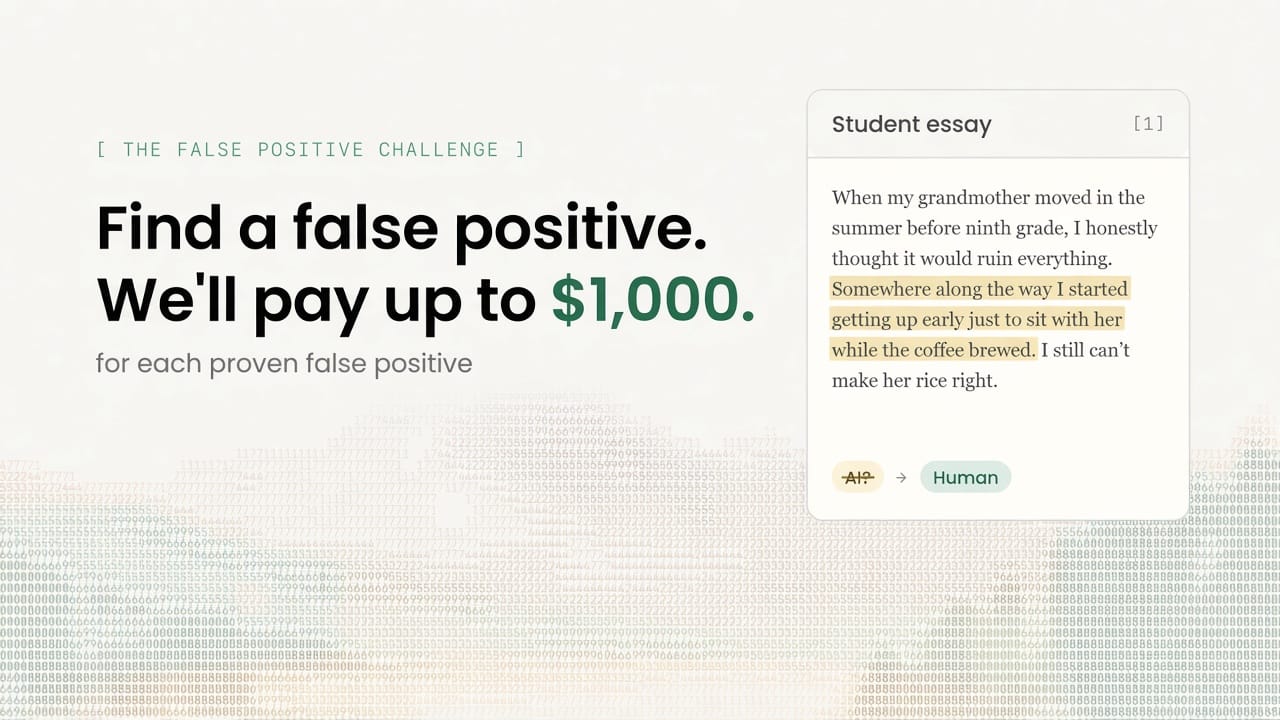
No AI detector is as openly and thoroughly tested as GPTZero, but many other AI detectors claim they are the “best”. This is why we are announcing the creation of GPTZero’s final frontier challenge: we’re offering up to $1,000 for provably human-written text that our detector incorrectly flags. We view this as a worthwhile investment in our users, a commitment to improving on the hardest texts to classify, and a testament to our dedication to being the most accurate AI detector.
Beyond overall false positive rates, a longstanding concern about AI detectors is that they might be biased against subgroups of writers who are not proficient in English, including ELL writers or those who have a disability. This concern originated in 2023, based on a limited evaluation of just 91 essays at a time when AI detectors used fundamentally different methods than they do today and were much less accurate.
GPTZero 5.0 demonstrably shows that this is no longer a concern, as the false positive rate on 5 learner corpora is just as low as the false positive rate on all writers for the same types of documents. GPTZero also has 0 false positives on the regularly referenced PERSUADE 2.0 dataset, including ELL writers and students with disabilities, showing that it’s safe to use broadly in education without a concern about unfairly penalizing marginalized writers.
Following Turnitin’s public evaluation protocol, we evaluate human-written English texts of at least 300 words and report aggregate False Positive Rates for L1 and L2 writers. L1 writers use English as their first language; L2 writers use English as an additional language. GPTZero results aggregate evaluation results from ASAP 2.0, ICNALE and PELIC. Published competitor results come from Pangram 4’s blog comparison and Turnitin’s public evaluation.
| Writer group | GPTZero 5.0b | GPTZero 4.11b | Pangram 4 | Turnitin |
|---|---|---|---|---|
| L2 English≥300 words · 5,527 texts | 0.00% | 0.05% | 0.02% | 1.40% |
| L1 English≥300 words · 4,097 texts | 0.00% | 0.00% | 0.00% | 1.30% |
| PERSUADE 2.0 | ||||
| All students10,402 essays | 0.00% | 0.02% | — | — |
| English language learners914 essays | 0.00% | 0.00% | — | — |
| Students with disabilities1,172 essays | 0.00% | 0.00% | — | — |
| Economically disadvantaged4,252 essays | 0.00% | 0.02% | — | — |
Some AI detectors still flag the U.S. Constitution as AI-generated. GPTZero 5.0 reads it as human, along with the 10,000 foundational texts behind our newest project.
“Preserve What’s Human” has been GPTZero’s slogan since inception, and as part of the GPTZero 5.0 launch, we are announcing the Library of Human Knowledge: a collection of books determined to be human by GPTZero, so that future generations of readers can have an easy way of accessing human knowledge. We are seeding this library with 10,000 of the most popular books from Project Gutenberg, all of which are determined to be human by GPTZero 5.0, further attesting to the low false positive rate. Over time, we will enrich this with recent books after the release of ChatGPT, giving knowledge seekers a chance to skip past AI slop and expand their minds.
State of the Art Performance
GPTZero 5.0 sets the state of the art on 9 third-party benchmarks spanning a wide range of writing domains, topics, and LLMs, shown in the table at the top of this post. Three changes drove the gains: higher-quality AI training text, broader domain coverage, and less reliance on shortcuts. Full results are in the GPTZero 5.0 model card.
Improving AI Text Quality
As LLMs continue to improve on nearly every possible task related to knowledge work, there is a possibility that LLM-generated text becomes less distinguishable from human text. Trends in LLM detectability have been something that GPTZero has monitored regularly, and with the release of Fable 5 in June 2026, we noticed a suspicious decrease in detectability. Upon investigation, we discovered that in some cases Fable 5 was writing so similarly to human text that it was verbatim plagiarizing long snippets of text. Part of our AI data generation pipeline involves a two-stage prompt which describes in detail aspects of a human text such as the topic, entities, and formatting. Fable was, in some cases, able to transform this description into the original human text.
An example of “AI-generated” text is copied from a human writer
… 1In 1215, the church decreed that a "licit" marriage must take place in church, but people who married illictly had the same rights and obligations as a couple married in church, and their children were legitimate. 2Not until the 16th century did European states begin to require that marriages be performed under legal auspices. In part, this was an attempt to prevent unions between young adults whose parents opposed their match. The American colonies officially required marriages to be registered, but until the mid-19th century, state supreme courts routinely ruled that public cohabitation was sufficient evidence of a valid marriage. By the later part of that century, however, the United States began to nullify common-law marriages and exert more control over who was allowed to marry. By the 1920s, 38 states prohibited whites from marrying blacks, "mulattos," Japanese, Chinese, Indians, "Mongolians," "Malays" or Filipinos. Twelve states would not issue a marriage license if one partner was a drunk, an addict or a "mental defect." Eighteen states set barriers to remarriage after divorce. In the mid-20th century, governments began to get out of the business of deciding which couples were "fit" to marry.
Marriage licenses came about in the late 19th century to prevent mixed-race marriages. That should be appalling to anyone, and is in my opinion the strongest argument to privatize marriage. Taking Marriage Private: 1In 1215, the church decreed that a “licit” marriage must take place in church. But people who married illictly had the same rights and obligations as a couple married in church: their children were legitimate; the wife had the same inheritance rights; the couple was subject to the same prohibitions against divorce. 2Not until the 16th century did European states begin to require that marriages be performed under legal auspices. In part, this was an attempt to prevent unions between young adults whose parents opposed their match. The American colonies officially required marriages to be registered, but until the mid-19th century, state supreme courts routinely ruled that public cohabitation was sufficient evidence of a valid marriage. By the later part of that century, however, the United States began to nullify common-law marriages and exert more control over who was allowed to marry. By the 1920s, 38 states prohibited whites from marrying blacks, “mulattos,” Japanese, Chinese, Indians, “Mongolians,” “Malays” or Filipinos. Twelve states would not issue a marriage license if one partner was a drunk, an addict or a “mental defect.” Eighteen states set barriers to remarriage after divorce. In the mid-20th century, governments began to get out of the business of deciding which couples were “fit” to marry. Courts invalidated laws against interracial marriage, struck down other barriers and even extended marriage rights to prisoners. But governments began relying on marriage licenses for a new purpose: as a way of distributing resources to dependents.
Expanding Domain Coverage
On our internal evaluation sets, we observed some slight performance gaps on short social media texts and poems relative to performance on other domains such as essays. Shorter texts are expected to be more challenging to classify due to there being less opportunity for human or AI signs of writing to emerge, but we insisted on improving our performance here regardless. By expanding training data coverage of these domains, an added benefit was improved accuracy on some third-party benchmarks such as GRiD and UChicago.
Discovering Causal Error Mechanisms
While some errors can be addressed by adding more human data in a domain with limited coverage, and others by removing clearly AI-plagiarized texts, achieving a 1/10,000 false positive rate on domains such as argumentative essays, financial disclosures, and legal briefs, requires a more methodical approach. We have discovered that subtle patterns can result in shifted model predictions when they occur at scale in the training data. For example, one such counterintuitive pattern we found was on a subset of essays written in response to a common prompt where nearly all the human essays had concluding statements such as “In conclusion,...”, and included personal statements of belief, whereas the AI pairs we generated did not. Thus, both false positives and false negatives could occur on a small subset of essays highly similar to these training essays, depending on the addition/removal of these two features. Using a proprietary approach to discovering such biases, we have found and removed several such patterns responsible for causing errors from our training data, leading to marked improvements in accuracy.
Technical Revamp
GPTZero was the first commercial AI detector, launched in January 2023 shortly after the release of ChatGPT. The machine learning methods powering our detector have changed significantly since then, leading to breakthroughs in accuracy every step of the way. The timeline below shows the progression of modeling approach and size over the years, culminating in the GPTZero 5.0 model. The progression from a perplexity-based approach in early 2023 to deep learning led to the first major breakthrough in accuracy. This then led to the development of Advanced Scan, the addition of our mixed class, later additions of our AI paraphrased class, which detects usage of bypassers, and the polished class. With every update which has scaled model size, increased data diversity and data quality, we’ve noticed an increase in accuracy, particularly at the subclass level where it can be more challenging to distinguish between human text and polished text than between human text and fully AI-generated text.
We released details about our approach in February 2026 in our whitepaper, capturing all of these industry-first innovations. This culminated in the granting of a patent, a milestone recognition in the AI text detection space.
 Vilkomir et al.
Trusted by the Community
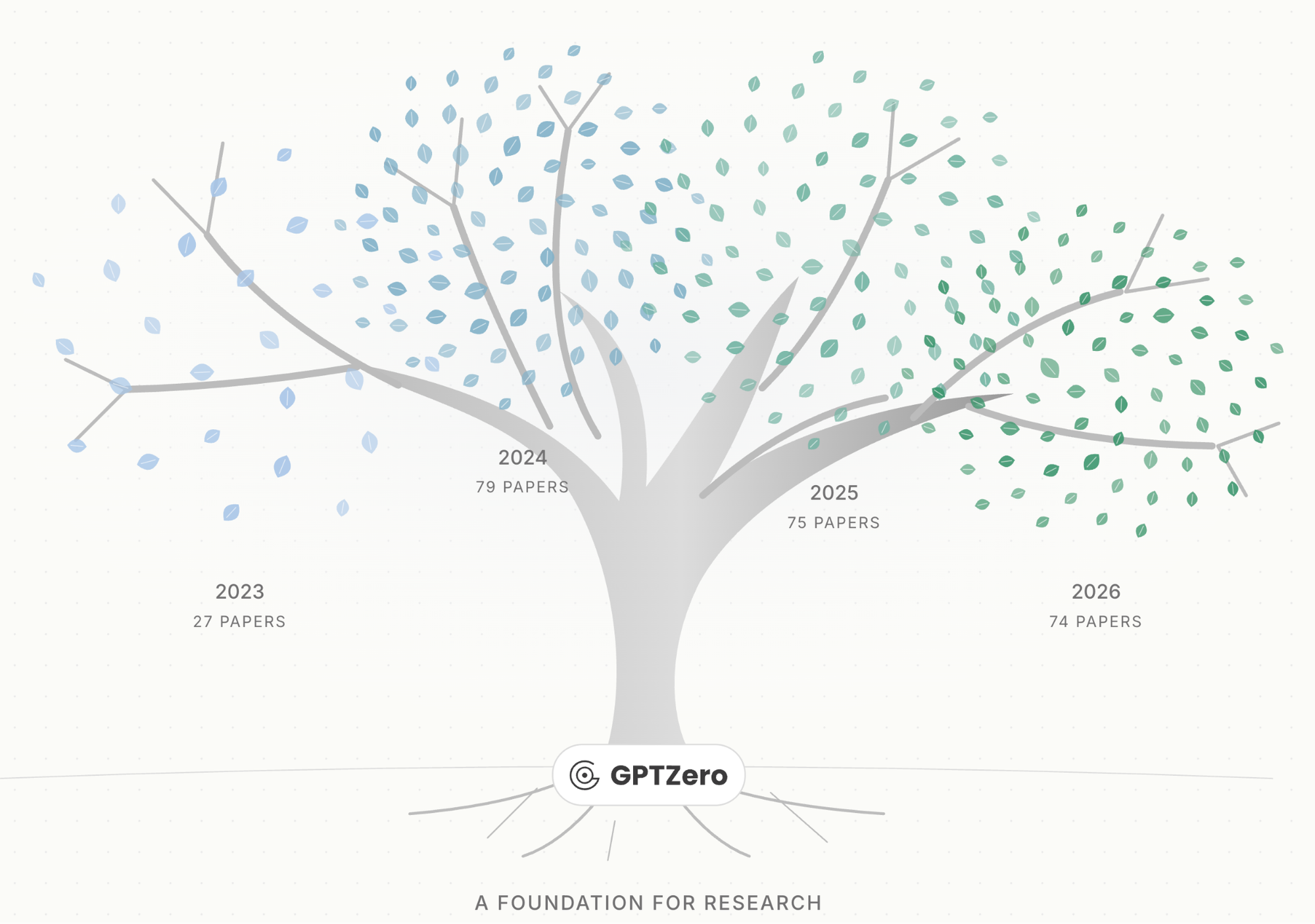
Beyond the millions of users who trust GPTZero for their AI detection needs, GPTZero has been adopted by the research community to enable dozens of foundational studies on the rise and prevalence of AI content in domains such as academia, journalism, social media, and financial reporting. For a comprehensive catalog of the research that GPTZero has powered, click on the image below.
Beyond formal academic research, GPTZero’s AI Vision product has allowed individual social media users to scan and report usage of AI across platforms such as X, Reddit, and Substack.
In October 2026 alone, over 125,000 people used AI Vision to run more than 10 million scans.
GPTZero has established a reputation in authenticity and transparency that transcends detecting AI-generated prose. Hallucination Scan, used to indicate if research and critical thinking were deferred to an LLM, has powered several groundbreaking investigations showing the risk of LLM-based misinformation impacting consequential human decision-making.
- Accenture Report https://gptzero.me/news/investigations-accenture
- EY Report https://gptzero.me/news/ey-retracts-study-after-gptzero-discovers-it-was-mostly-hallucinated-by-ai
- KPMG Report https://gptzero.me/news/investigations-kpmg
- ICLR Report https://gptzero.me/news/iclr-2026
Conclusion
GPTZero 5.0 looks very different from 1.0; the complexity of machine learning approaches, the sophistication of LLMs and bypassers, and the demand for knowing if genuine human effort was responsible for creating a text, have increased significantly since 2023. GPTZero has led the way in AI detection and the broader authenticity space, defining what’s possible, adapting to the fast pace of LLM releases, and protecting the safety and reputation of our users. 5.0 is a milestone in a long lineage of innovation driven by our dedication to our users. GPTZero remains vigilant about false positives, newly emerging bypassers, and shifts in the ways that humans and AI collaborate. Our future model updates will be a reflection of that.