GPTZero 5.0 · Official challenge

Today, GPTZero is announcing the launch of GPTZero 5.0. It redefines what is possible in AI Detection to preserve what's human on the internet and outperforms competitors as the most accurate detector in 9 third party benchmark datasets. Alongside the release, we are announcing a public prize challenge for researchers and academics.

The Challenge Board

01 · First to redeem

750 words, from 2020 or earlier

The first person to show a long, unmodified human text from 2020 or earlier that GPTZero 5.0 calls AI.

$1,000

Rules

02 · Each example we accept

300 words, already published

A shorter search for false positives: published human writing that GPTZero 5.0 still flags.

$100

Rules

03 · Every month

A research finding with GPTZero

Benchmark the detector, study a field, or follow a hallucination, and share it with the public. Credits included.

$1,000 × 12

Rules

Why we're doing this

GPTZero 5.0 is the most accurate AI detection model, with a false-positive rate below 1 in 50,000 essay-length texts. We're confident enough in its accuracy to put up a cash bounty, and to give researchers free API access to test it themselves.

We've worked closely with the research community since the start of GPTZero. In January 2026, our investigation of 100+ accepted NeurIPS papers with hallucinations was a pivotal moment in reckoning with AI use in academia and publishing. To date, over 250 academic papers have been published on arXiv with researchers using the GPTZero API.

This challenge has three goals:

  • Keep us accountable. We will proactively find and pay for false positives to ensure our model is state of the art in AI detection.
  • Raise the bar for benchmarking AI detection. Not all detectors are equal. GPTZero 5 was the most accurate AI detector in 9 out of 11 major benchmarks, beating the competition, including respectable models such as Pangram 4. We need to keep AI detector benchmarking updated as AI evolves.
  • Preserve what's human on the internet. Our detector has surfaced AI hallucinations covered on the front pages of the Financial Times, including investigations on EY and KPMG. With our MCP and API, there is much more for researchers to uncover.

Examples of studies this week:

  • Jackonomics tested detectors against humanizers and found GPTZero to be more accurate than Pangram on edited writing.
  • Professor Chakrabarty ran a study on AI detector bias in novels by African and diaspora authors, analyzing 187 books published between 2000 and 2026, and concluded AI detectors were resoundingly not biased. Pangram scored only 1 book above 1% AI, and GPTZero scored all 187 books as 0.0% AI.
  • University of Washington researchers Fortenbach, Wu, Mungra and Van Gelder, in Large Language Model Authorship (published in Ophthalmology, 2026), benchmarked four commercial AI detectors on control articles. GPTZero performed the best, so it was selected for the main study. They then used GPTZero to show that, by 2025, about a quarter of sampled ophthalmology papers contained likely AI-generated text, none of it disclosed (25.7% of research articles and 21.6% of commentaries).

Challenge 01

750 words, written in 2020 or earlier

$1,000

$1,000 to the first person who meets every condition below. One prize, one winner.

  • At least 750 consecutive words.
  • The text was written in 2020 or earlier. Show that it existed then and that the passage is unmodified: a Wayback snapshot, a publication page that includes the full text, a book edition we can check ourselves, or a Google Doc with its writing replay, which we can link to.
  • GPTZero 5.0 flags the passage as 75% AI or more. Mixed results do not count.
  • It is real human writing, written for people to read. Repeated words or phrases, machine translation, Markov output, early model text, and other trick passages do not count.
Submit a claim

Challenge 02

300 published words

$100

$100 for each example we accept. This one is a search. False positives are useful, and we want them in the open so the model can get better. We are glad to pay for a real one.

  • At least 300 words. It does not need to reach 750.
  • Published, and shown to be written by a human. A link to the publication is the proof.
  • The other conditions from Challenge 01 apply: GPTZero 5.0 flags it as 75% AI or more, and it is real human writing, not a trick passage.
Submit a false positive

Challenge 03

A research finding with GPTZero

$1,000 × 12

Use the API, with credits, and publish a research finding other people can read. A Substack piece counts. So does a technical writeup. Share it with the public. The aim is one each month, which is $1,000 × 12 across the year.

Already in print

255 papers

255 published research papers use GPTZero, across subjects and years.

Work that used GPTZero is collected in one place. Take part, and this challenge can list you there.
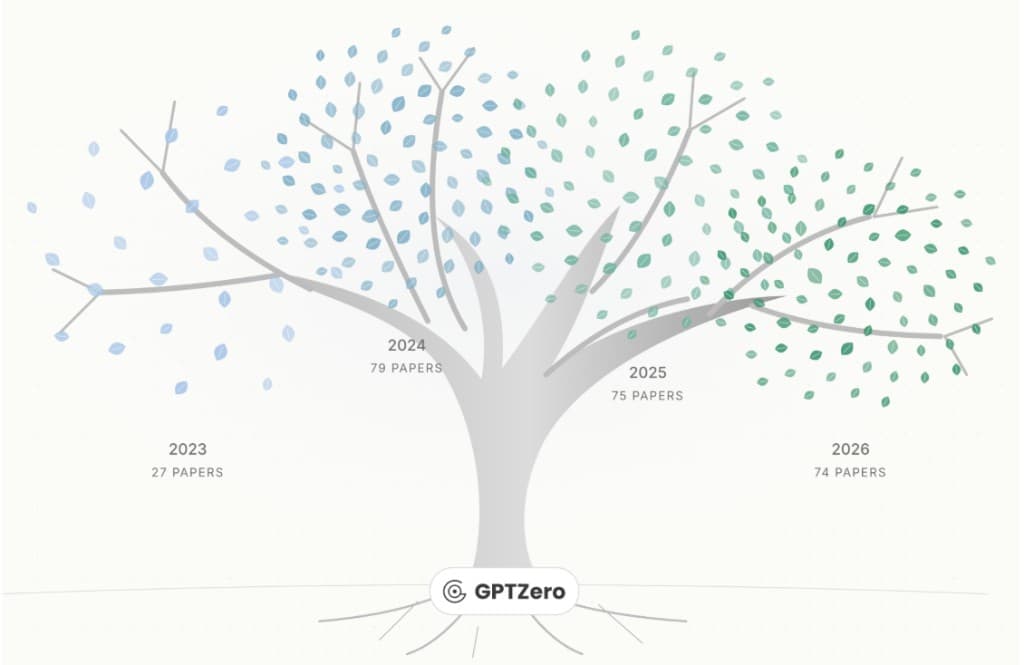
A tree of research papers that used GPTZero: 27 papers in 2023, 79 in 2024, 75 in 2025, and 74 in 2026.

A few directions, if you want a place to start:

  1. Benchmark GPTZero against other detectors.
  2. Look at AI detection in a particular setting. Research papers are one. Earnings reports are another. The interesting question is how the picture changes from field to field.
  3. Follow a hallucination. GPTZero also detects them, and the GPTZero MCP now exposes both the AI detector and the hallucination detector.

What you get:

  • API credits for taking part.
  • $1,000 for the best research paper or publication each month.
  • Winners meet one-on-one with the GPTZero team, and we share their work on GPTZero's social channels.