How to Write a Narrative Essay in 5 Steps (Complete Guide + Examples)
A narrative essay tells a story, usually from your own life, and uses it to make a broader point.

If you have a narrative essay assignment sitting on your desk, you might be wondering how to approach it. Is this a creative writing exercise or a regular essay? The answer is a little bit of both. Just like a regular essay where you have to prove a point by providing evidence and supporting sources, a narrative essay also has a thesis, except it uses a personal story or an experience to illustrate it.
This is where many students get hung up. It's not enough to just recount the events of something interesting that happened. You have to use it to support your point or the thesis of your essay. Purdue OWL puts it simply: "Make a point. Think of this as the thesis of your story. If there is no point to what you are narrating, why narrate it at all?“ The events you choose, which details you include, and in which order you tell them are very important to writing a successful narrative essay.
In this guide, we cover what a narrative essay is, the five-step process for writing an excellent narrative essay, and how to structure and format it. We will also share some tips and best practices to help you build a compelling arc.
TL;DR
- A narrative essay is a type of academic writing that tells a true story from your own experiences and uses that story to make a broader point.
- The standard structure of a narrative essay is the same as the traditional essay: introduction with the hook, body paragraphs that develop your story, and a conclusion that reflects your thesis and ties it all together.
- The most common mistake students make is writing a story without a thesis or a main point.
What Is a Narrative Essay?
A narrative essay is a piece of academic writing that uses storytelling to illustrate a point, idea, or insight. This essay format uses many conventions of fiction writing, such as setting, character, scene, dialogue, and sensory detail.
Narrative essays are assigned in English classes, college application portfolios, and in various writing courses across disciplines.
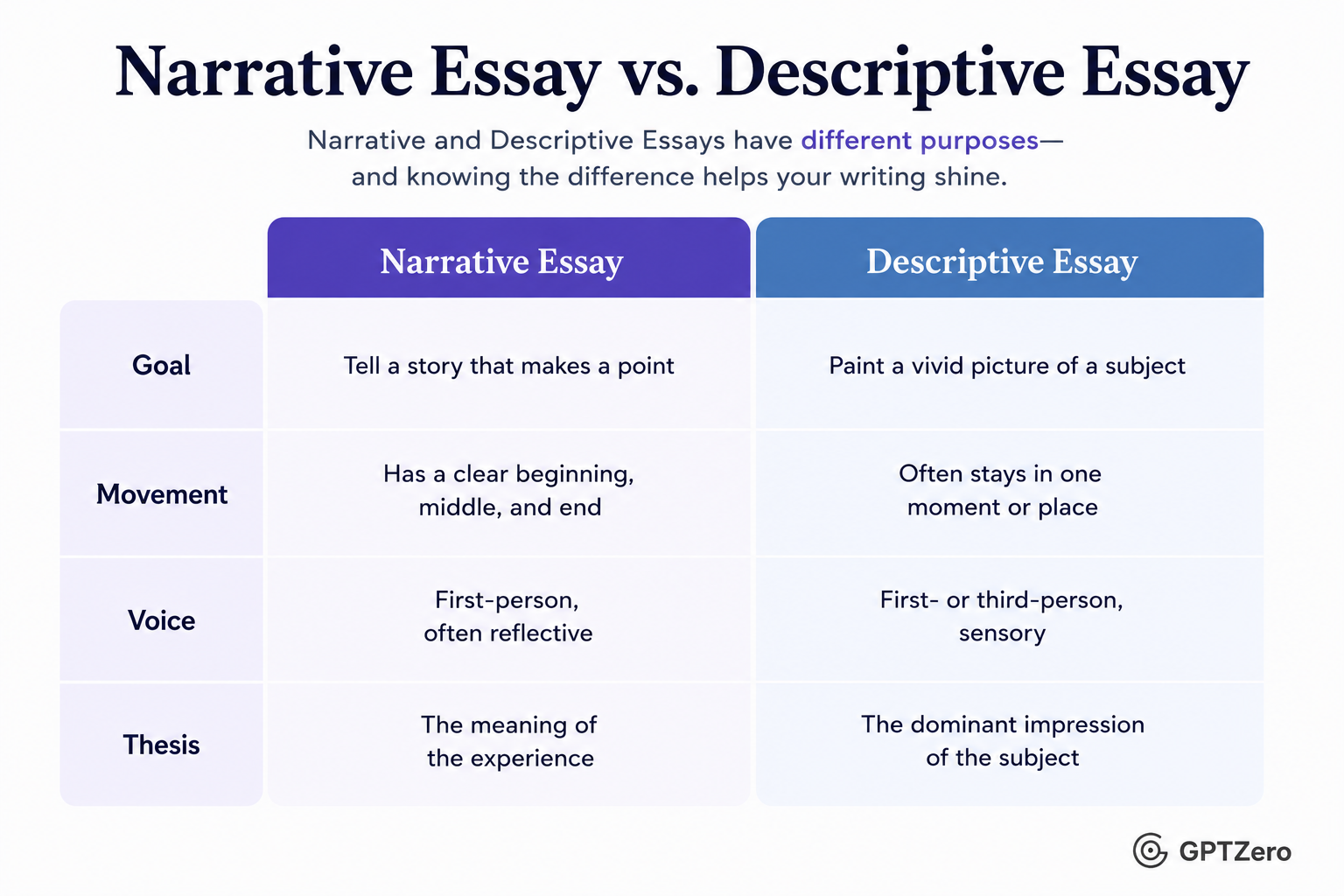
The narrative essay can sometimes be confused with the descriptive essay. Both types of essays use a lot of sensory details and the personal voice. The main difference is that a narrative essay uses the storytelling arc to take the reader on a journey. A great way to distinguish the two is to think of the descriptive essay as a vivid picture of something, a person, place, or thing, and the narrative essay as a moving story that takes you on a journey.
Narrative Essay vs. Descriptive Essay
5-Step Process to Write a Narrative Essay
Step 1: Choose a Topic That Means Something
The best narrative topics come from personal experiences that were meaningful to you. It's important that you still feel something about the series of events you're going to talk about. Choosing a topic of this nature can take a little bit of digging. Ask yourself what moments in your life taught you something.
Step 2: Identify Your Point
As we mentioned earlier, one of the biggest missteps students make when writing a narrative essay is sharing only a story without tying it to a broader point or thesis. Spend some time identifying the point you're going to be making with your narrative essay. You should be able to write it in one sentence. You can then use the sentence to guide you as you add more detail to your narrative.
Step 3: Create an Outline
Somewhere along the line in your studies, you would have heard of the story arc. The story arc follows a very prescribed pattern and includes:
- A hook that drops the reader into the moment
- Setting and context, the reader needs to make sense of what follows
- The inciting incident or central tension
- Rising action and a turning point
- Resolution and reflection
Tip: Map out your essay outline using our handy guide.
Step 4: Write the First Draft
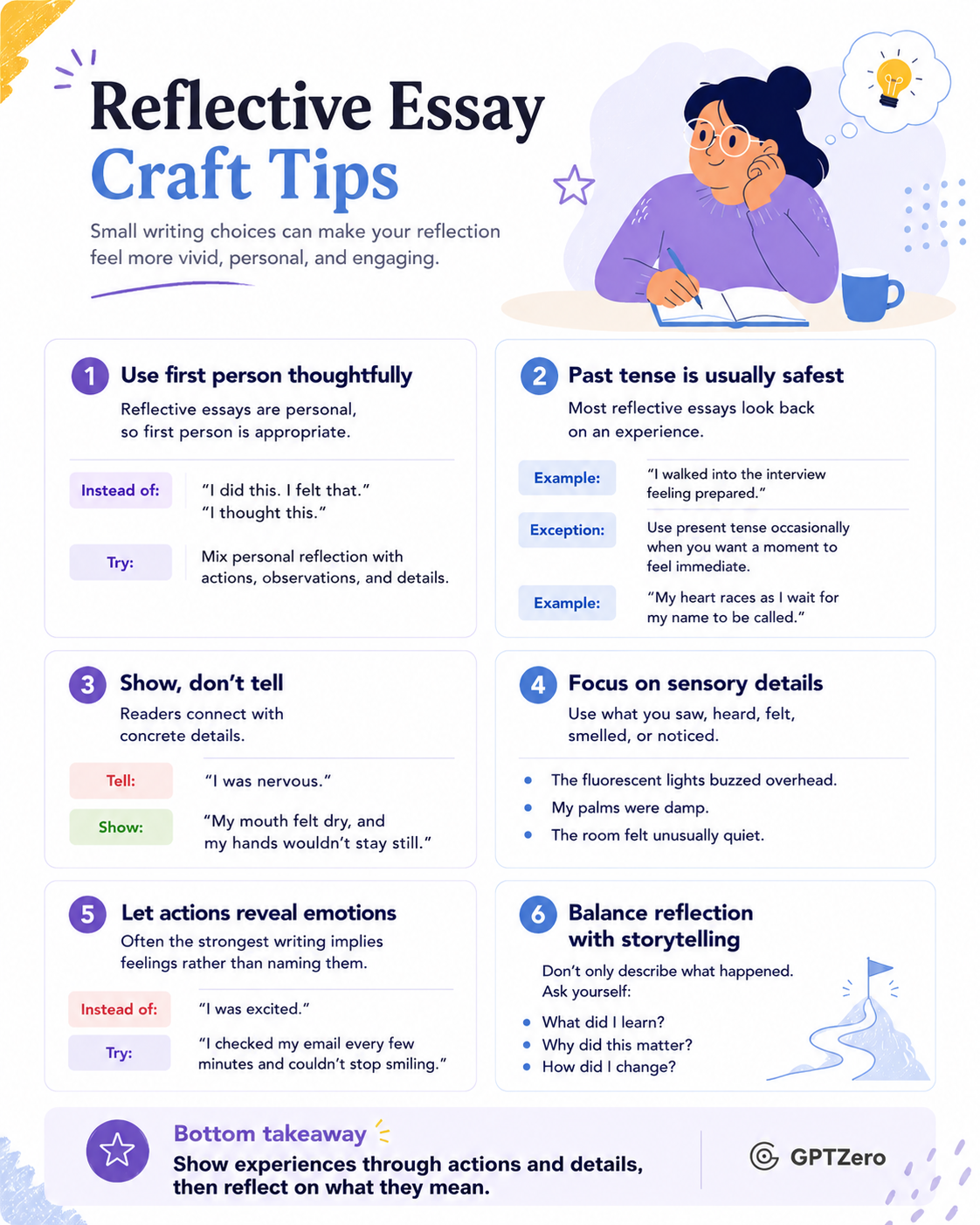
Now that you have your handy outline, begin drafting and don't stop until you are done. Begin your essay with an opening hook and move through the events in the order that you've outlined them. Narrative essays allow for very colorful language, so skip the generic and overly academic tone and focus on painting a vivid story that your reader can be immersed in. The more specific you can be, for example, the color of the sky, the smell of the room, the exact words somebody said in a conversation, the more compelling your narrative is going to be.
Step 5: Revise, Then Run Final Checks
As with other essays. You want to revise your narrative essay in a few passes. First, you want to focus on your structure. Ask yourself whether the story actually delivers on the point that you're trying to make. Are there any scenes you need to cut out or add? Does the ending give the reader a clear and compelling takeaway?
On the second pass, you want to look for grammatical polish and proper citations. Use a quality grammar checker to resolve all your typos and minor clarity issues that you might have missed.
Tip: If you've used AI to generate parts of your draft or polish your writing, it's a good idea to run it through a plagiarism checker to ensure that you're handing in a clean draft.
Structure and Format of a Narrative Essay
A narrative essay has the same three-part structure as most other academic essays.
Introduction
Your introduction should open with a strong hook that pulls the reader into the scene immediately or piques their curiosity. And in this type of essay, you can skip any introductory type of statements or preamble. Aim to drop your reader right into the moment and end with your thesis.
Body paragraphs
Use the three body paragraphs that follow the introduction to move the story forward. Each paragraph should cover a specific detail or scene from your narrative. Remember to use vivid sensory detail in your language, focusing on immersing your reader. Use your first body paragraph to describe the rising action and lead your reader to the climax of your narrative. In the middle paragraph, you can include the climax of your narrative and begin the falling action. Your last body paragraph can act as the resolution.
Conclusion
This is the part of the narrative essay that makes a lot of students stumble. A strong conclusion doesn't just summarize what happened. It ties into a larger meaning and reflects on what you learned, how that changed you, and why it matters. You don't have to tie things up neatly. Some of the best narrative essays leave a lot open at the end.
Format basics
- Double-spaced,
- 12-point readable font,
- one-inch margins,
- indented first lines.
Tip: Most narrative essays run between 500 and 1,500 words. College application narratives often have specific word limits, so check before you start.
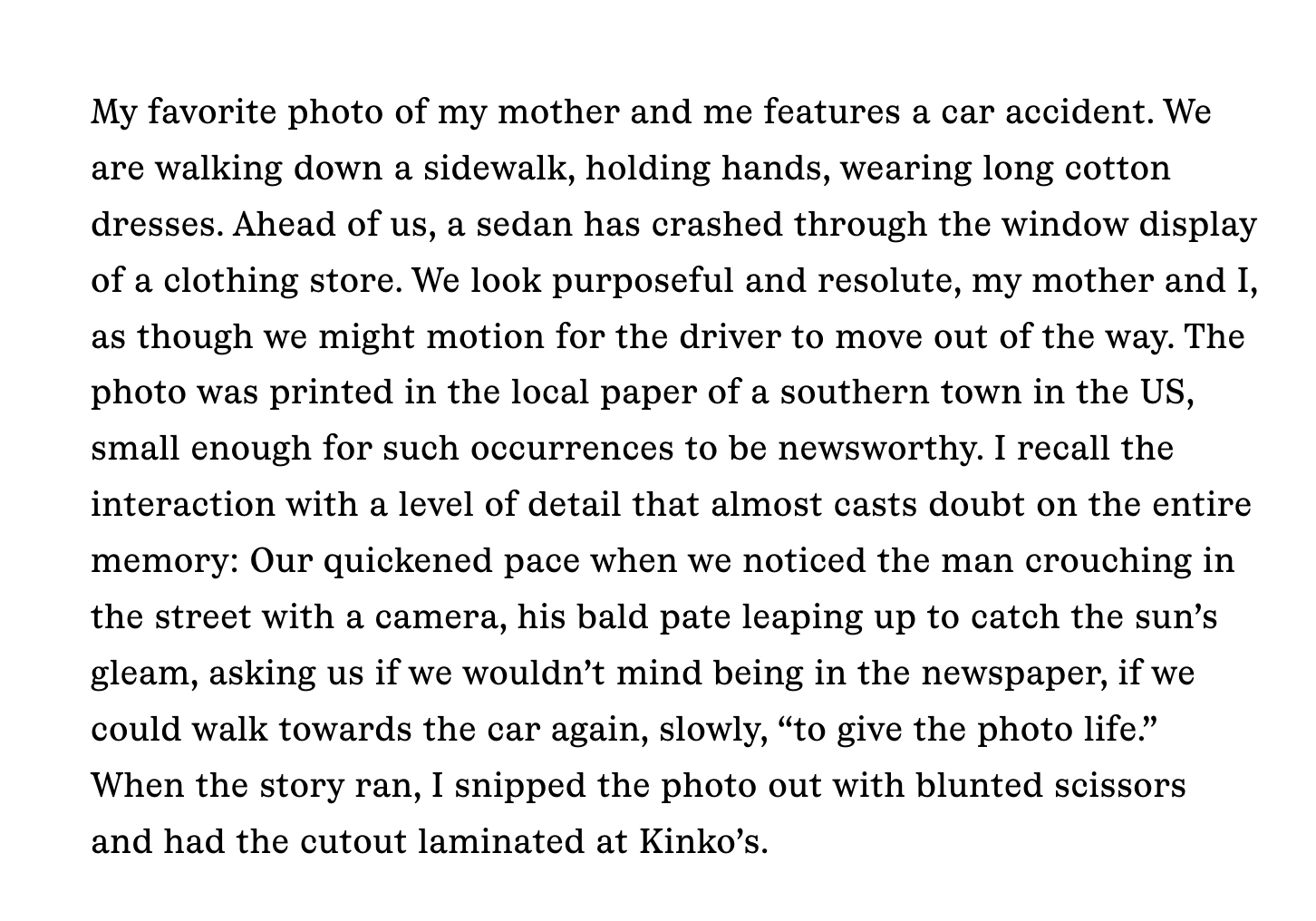
Example of a Narrative Essay (Excerpt)
Read the full essay: “My Mother’s Tongue” by Zavi Kang Engles.
What's working here:
Did you notice the opening hook? This narrative essay begins with a compelling question. The reader is then immediately whisked into the story without any preamble or warning. You'll also notice that the language is very descriptive and that it draws on multiple senses.
Another example:
Letting Go by David Sedaris in The New Yorker.
6 Tips for Writing an Effective Narrative Essay
FAQs
How do you start a narrative essay?
The first few seconds of your narrative essay are very important. You want to start with a hook that drops the reader directly into a vivid scene. Unlike other types of essays, narrative essays often avoid generic openers or any kind of lead-in. The strongest openings are action-driven and have striking amounts of detail. They also get the reader curious about where this is going.
How many paragraphs are in a narrative essay?
Most narrative essays follow the traditional five-paragraph structure: introduction, followed by three body paragraphs, and a conclusion. Longer pieces can have additional paragraphs in the middle, and the shape can shift a little bit as this genre is in the creative writing space. What matters most is a well-structured narrative.
Can a narrative essay be fictional?
Narrative essays fall under the creative nonfiction category, although they use elements of fictional writing and prose, such as the story arc; they are not usually fictional. If you're in a field where you're not sure if that is the case, you can always ask your instructor for details.
Can I use "I" in a narrative essay?
Absolutely. First person is actually the standard voice for the narrative essay. Try not to overuse it and remember that a strong narrative essay is action-driven and detail-rich.
How long should a narrative essay be?
Most narrative essays will end up between 500 and 1,500 words at the high school and college levels.