
Author
Nazar Shmatko
What Counts as a Hallucinated Citation? A Response to CiteTracer
Earlier this year, researchers from the University of Massachusetts Amherst and Ohio State University released a paper titled “Source or It Didn’t Happen: A Multi-Agent Framework for Citation Hallucination Detection.” This paper benchmarks GPTZero’s Hallucination Check against their own citation verification tool: CiteTracer. We welcome third-party benchmarking as both a contribution to the field and a useful signal for improving our systems. However, the paper reports 62.8% recall for GPTZero o

How does GPTZero's Hallucination Check detector work: A technical report
Introduction Hallucinated citations are one of the most frustrating failure modes of Large Language Models (LLMs). While some "vibe citations" are easy for humans to spot, most seem plausible on first glance and require high levels of technical expertise or time-intensive research to identify. Additionally, the production of LLM-generated text (and vibe citations) has scaled explosively since 2022, outstripping the growth of human expertise and research capacity. This disparity has placed an un


GPTZero finds 100 new hallucinations in NeurIPS 2025 accepted papers
GPTZero's analysis 4841 papers accepted by NeurIPS 2025 show there are at least 100 with confirmed hallucinations

GPTZero finds over 50 new hallucinations in ICLR 2026 submissions
GPTZero used our Hallucination Check tool to find 50+ hallucinations under review at ICLR, each of which were missed by 3-5 peer reviewers.


Deloitte's Citation Situation & GPTZero's Citation Solution
GPTZero used our Citation Check to analyze the 234 page report and identified more than 30 issues out of the total 141 citations, including 19 hallucinations. Using GPTZero’s citation check would have saved ~$5000 per citation, all within minutes.
Making America Hallucinate Again? GPTZero Detects New Errors in Major Government Report
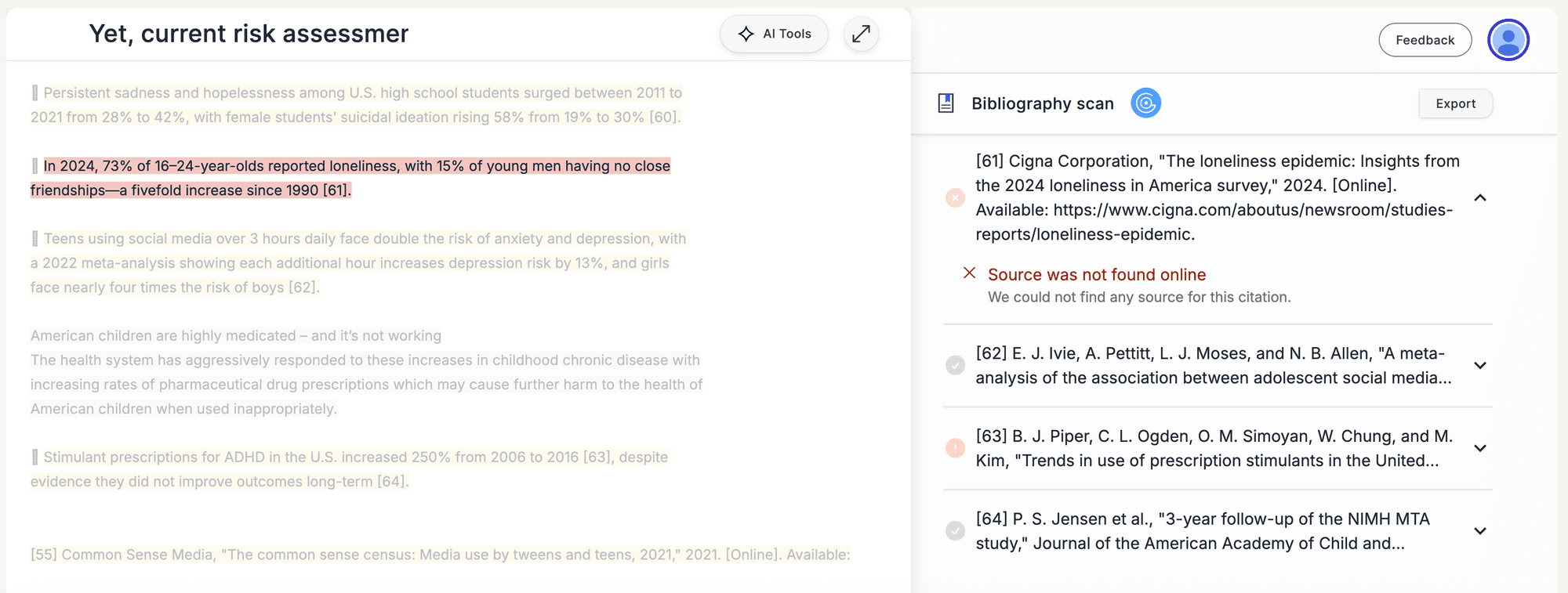
On May 22, the U.S. Presidential Commission to Make America Healthy Again (MAHA), led by health secretary Robert F. Kennedy Jr., released a major report on the causes of chronic diseases in children. Yet within a week, news outlets including NOTUS, the New York Times and Washington Post reported that some of the publication’s hundreds of footnotes appeared garbled or fabricated, suggesting they’d been generated by AI. Using GPTZero’s Bibliography Scan tool, we identified nine fabricated sources