How to Spot AI‑Generated Content in the Classroom
Could that assignment be written by AI? Here are some practical ways to spot telltale patterns and use AI writing checkers wisely.


With new paraphrasing and humanizer tools, it’s getting even harder to tell what and what isn’t AI writing – yet 74% of teachers report having no AI training. This makes it more critical than ever for educators to know what red flags to look for, and how to proceed with their concerns.
If you’re reviewing student work and feel like something is off, this guide will help you become more aware of AI-assisted writing signals and use AI detectors for assistance. By the end, you’ll know how to spot common signs of AI-assisted writing and follow up with students in a fair, evidence-based way.
TL;DR
- No single signal proves AI use on its own, but certain patterns can help you decide when to look more closely, including repetitive structure, formulaic sentences, flat tone, generic examples, and surface-level subject knowledge.
- AI detectors can support your concerns, but they should not be treated as final proof.
- Instead, the fairest approach is to review the work in context, compare it with prior writing, check drafts or revision history, and ask follow-up questions.
Why Detecting AI Content Is Getting Harder
Students can now easily find tools that can paraphrase their text and ‘humanize’ their AI-generated output, making detection even harder than it was a short while ago. As AI content editor James Presbitero Jr. says, “The AI humanizer tools market has exploded. Every week, a new tool promises to make your AI-generated text ‘undetectable’ and ‘human-sounding.’ The pitch is seductive: paste your ChatGPT output, click a button, get human-quality writing.”
Meanwhile, plenty of institutions don’t have solid, universal policies around using AI, as it is still such a new area. This means educators are operating largely in the dark, and as one high school teacher shared, it can become a “cat-and-mouse type game” as “there's always something kids can pay for to avoid being detected. And so we find that even if we have a certain level that would detect AI, that if there are ways for them to get around it.”
Quick Ways to Spot AI-Generated Content
No single trait proves that a student used AI. Still, certain patterns show up often enough that they can help you decide when to look more closely.
Repetitive Patterns in Text
Writing as humans means we tend to mix and match our language, with a rhythm that isn’t identical to someone else. In AI-generated writing, the text patterns can get overwhelmingly repetitive. The same types of sentences tend to get strung together, and AI tends to use similar phrases – again, and again, and again. The result can feel like reading the same point but expressed in a lot of different ways without much variation or flow.
Formulaic Sentence Structures
Humans tend to write with a mixture of long and short sentences. Usually, there’s a varied structure throughout their work. However, with AI text, even with the right prompting, there can be a rigid and formulaic style. If it feels too flawless or predictable – like there’s an eerily consistent flow without any breaks in style – that can be a red flag that it’s been AI-generated. As one teacher told us, “AI gives a uniform way of writing. The sentences tend to be almost equal.”
Monotonous Tone
Human writing tends to have an inherent sense of voice, even if the assignment is formal or the piece is a highly academic one. Meanwhile, AI-generated writing can feel quite flat, and completely lacking in warmth or distinctiveness. With such a monotonous tone, the text can read as if it has been stripped of its emotional energy and any personality whatsoever.
Atypical Voice or Stylistic Choices
As a contrast, sometimes people attempt to bypass AI detection by asking ChatGPT to write in the style, voice, or tone of a specific author. But this tactic, if you know your students well, will almost certainly raise flags. If your student suddenly starts turning in work that sounds like a New Yorker journalist or a Nobel laureate, you may want to take a second look and compare their work to their in-class or past assignments.
Lack of Personal Touch
Another obvious mark of AI writing is a total absence of a personal touch or imperfections. When students write, they ideally include original perspectives, examples that are unique to their own life, or insights that are theirs alone. If there aren’t any marks of imperfection at all, that could also be a warning sign.
Zero Typos
Work that has absolutely flawless grammar and zero typos can actually be suspicious. This is especially true if that particular student’s work isn’t typically this perfect. AI often generates impeccably clean copy, which lacks the small errors that can be expected when humans write – such as minor grammatical inconsistencies.
Generic Examples vs. Real-World Detail
A suspicious indicator of AI-generated content is vague examples that could be slotted in almost anywhere. The key word here is cookie-cutter: AI content tends to be vague and lacking in specificity, especially for recent events. If all the examples being used are one-size-fits-all, and there aren’t any insights or references to real-life situations that happened either to the person or to contemporary news, this can be a sign that AI has been used.
Lack of subject matter expertise
AI can spit out lots of words very, very quickly – but it tends to lack genuine subject matter expertise. Watch out for writing that only touches the surface of a topic or seems like it’s trying to sound more insightful without containing much originality. Students who actually understand what they are writing about will tend to have nuanced insights, while AI struggles to capture this depth.
|
Signal |
What it may look like |
What to check next |
| Repetitive patterns in text | The same sentence shapes, transitions, or ideas show up again and again | Look for repeated phrasing and compare with the student’s earlier work |
| Formulaic sentence structures | Sentences feel evenly built, polished, and predictable throughout | Check whether the rhythm and structure match the student’s normal writing |
| Monotonous tone | The writing sounds flat, steady, and emotionally neutral | Ask whether the piece sounds like the student’s usual voice |
| Atypical voice or stylistic choices | The submission suddenly sounds much more formal, literary, or stylised than past work | Compare it with in-class writing or previous assignments |
| Lack of personal touch | The piece is clean but missing original perspective, lived experience, or specific insight | Ask follow-up questions about why the student chose certain ideas or examples |
| Unusually flawless grammar or no typos | The writing is much cleaner and more polished than the student’s normal level | Treat this as context, not proof, and check for other signals too |
| Generic examples vs. real-world detail | Examples feel broad, interchangeable, or disconnected from the assignment context | Look for missing specificity, weak evidence, or a lack of concrete detail |
| Lack of subject matter expertise | The writing sounds polished but stays at the surface level | Ask the student to explain key ideas or connect them to class material |
Looking for ideas on setting assignments that outsmart ChatGPT? Here, we explore the art of designing AI-proof assignments.
Using AI Detection Tools for Insights
Besides using your own discernment, it’s helpful to get to know the AI detection tools that can give you a reliable “second opinion” on whether or not a piece was generated by AI. This can support or negate concerns you might have about a piece of work that differs from what a student usually submits.AI detection does not work the same as traditional plagiarism detection: there’s currently no “smoking gun” or definitive proof of AI usage, unlike a copied source. In an ideal world, even definitive results from AI detection should not be used to penalize students but rather to start a dialogue about originality and academic integrity.
How GPTZero Works: A Quick Guide for Educators
GPTZero has quickly become a favorite tool for teachers (here’s more on how it works). We’re here to help educators with reliable, advanced accuracy when it comes to detecting AI-generated content, and independent benchmarking shows that GPTZero’s Advanced Scan is leading the way in precision.
https://www.youtube.com/watch?v=zkbMi-KFl1U
GPTZero uses deep learning and sentence-level classification to assess whether a document is likely human, mixed or AI. Each result also includes a confidence category. Like any detector, it is not perfect, so results work best alongside drafts, revision history, and educator judgment. However, GPTZero scores the best in an English AI detection dataset for low FPR models.
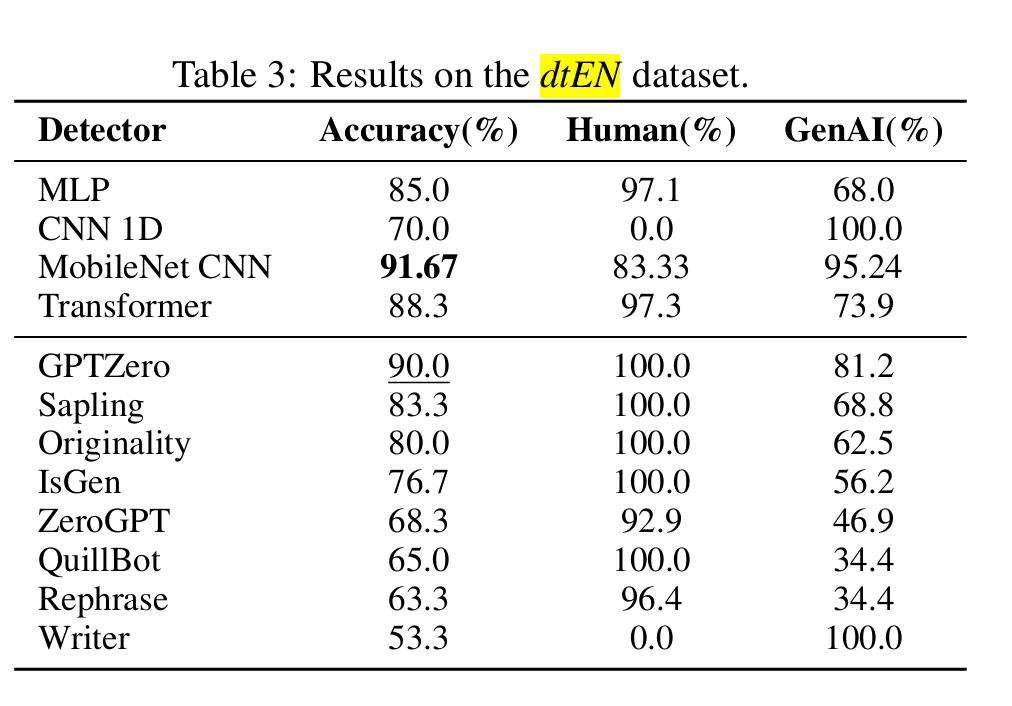
GPTZero is built around explainability, and highlights specific sentences and explains why they were flagged. This approach aligns with emerging transparency guidance from organisations like the OECD and UNESCO, and it’s why many educators use GPTZero as part of a broader conversation.
Practical Verification Methods
Based on the above, if you’re concerned about a student’s work, the next steps should be around practical verification.
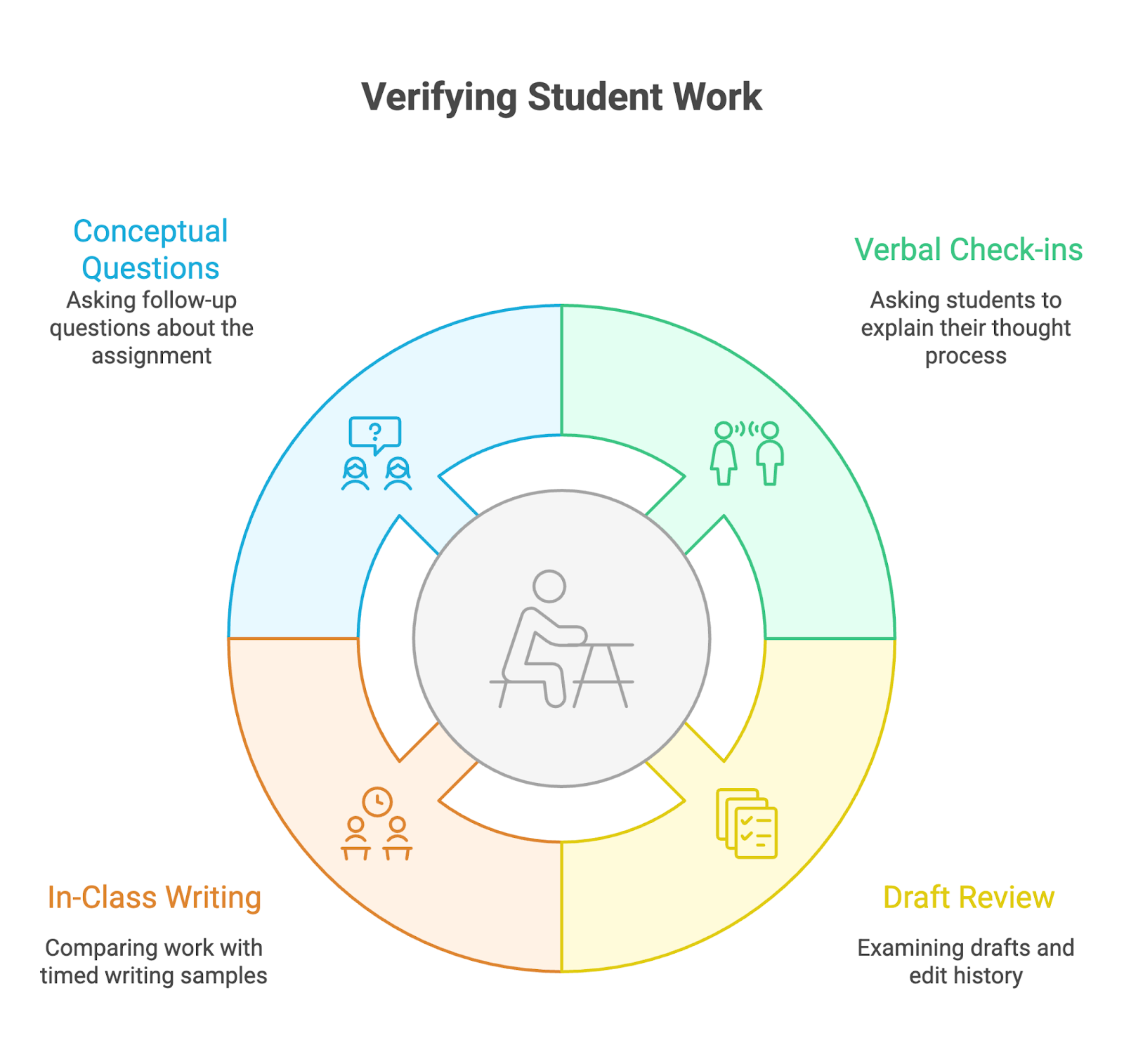
Ask the student to walk through their answer
You can tell pretty quickly through verbal check-ins whether or not a student has done the conceptual work behind their assignment. All you need to ask is how they came to certain ideas, why they chose those examples, or what they meant in certain parts.
As one teacher shared, “If a student submits an assignment, when sometimes the student tries to explain how he got to the answer, they can't. They can't really explain step-wise... that discrepancy means that it wasn't an independent work by the student.”
Request drafts or revision history
Looking for the history or paper trail of how a student arrived at their final output can help. Request their drafts, brainstorming notes, outlines, and edit history so you can see how the work came to be. If you’re looking for the most advanced way to see how a piece of writing was actually created, GPTZero’s Writing Report is built for just that.
https://www.youtube.com/watch?v=rUlX_Hd2dJ0
Compare with in-class writing
Getting the students to sit in class and do timed writing can give you a direct reference of the student’s baseline level around their typical voice and approach to the work.
Ask follow-up conceptual questions
Directly questioning whether or not they used AI is part of the process, but you can also ask:
- What do you think of [a specific part] of this assignment?
- How does this connect to last week’s work?
- What would you go back and change if you had more time?
AI vs Human Writing Examples
We’ve gone over the signs of telltale AI writing – but what does it look like in practice? Below, we go through samples of both AI and human writing.
On the topic of Memphis:
“Memphis — one of the great Southern cities — rarely gets its due. The city’s struggles, and the darker chapters of its history, are well-documented. But it’s easy, even on a brief trip, to tap into a vibrant and unpretentious city with plenty to be proud of. Pay pilgrimage to Elvis’s rhinestone-studded jumpsuits and Isaac Hayes’s fluffily upholstered Cadillac, and visit a sleek new Listening Lab that takes music fans through the sounds of a city where rock ‘n’ roll was born and the blues flourished.”
(This sample is human, written by Rick Rojas, and appeared in the New York Times.)
“Memphis feels like a city with soul in every sense of the word. It carries the weight of history, but it also has an energy that is warm, creative, and unmistakably its own. Music runs through everything there, from Beale Street to Sun Studio, yet the city is more than its legends: it is a place of bold food, deep culture, and strong local pride. What makes Memphis memorable is that it does not try too hard to impress you. It just is itself—gritty, welcoming, and full of character.”
(This sample has been generated by ChatGPT).
On the topic of milk:
“Milk and dairy products, such as cheese and yoghurt, are great sources of protein and calcium. They can form part of a healthy, balanced diet. Unsweetened calcium-fortified dairy alternatives, made from plants like soya, coconuts or oats, also count as part of this food group. These can make good alternatives to dairy products.”
(This sample is human and appeared on the NHS website.)
“Milk, cheese, and yoghurt are useful sources of nutrients like protein and calcium, so they can fit well into a healthy, balanced diet. Plant-based options such as fortified soya, oat, and coconut alternatives can also play a similar role, especially when they are unsweetened and enriched with calcium. For many people, these non-dairy choices are a practical way to get similar benefits while suiting different tastes or dietary needs.”
(This sample has been generated by ChatGPT).
Best Practices for Educators
AI isn’t going anywhere – and in the 21st century, helping students remember the value of critical thinking and integrity has become as important as imparting the knowledge content itself. These are some ways educators can set up their students for success in tomorrow’s world.
Don’t punish, discuss
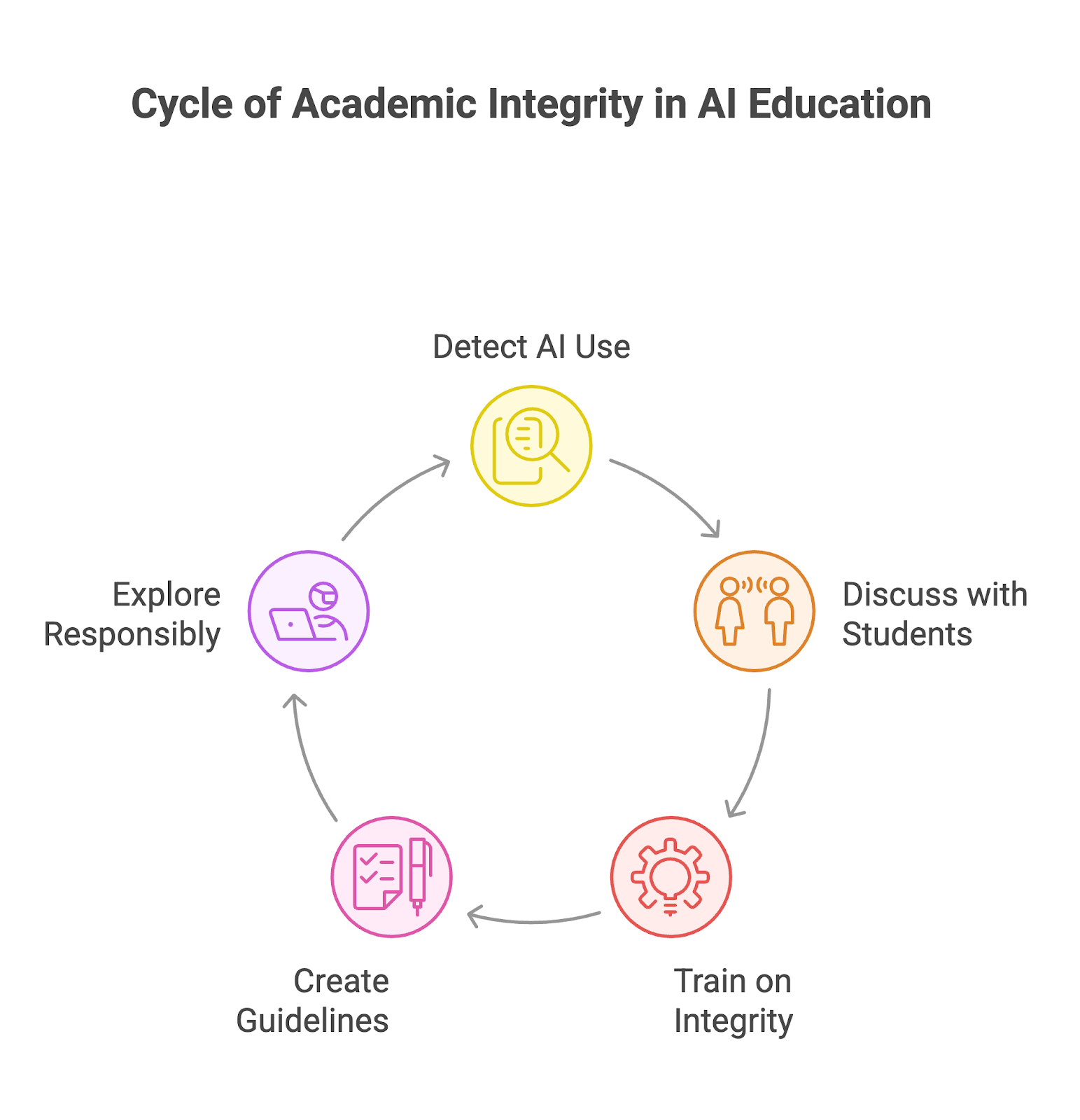
Suspecting AI or getting a positive result should not automatically result in academic punishment. If you receive a positive AI detection, think about taking these steps to work with students constructively. Crucially, see if there is a history of AI-generated text in the student's work – as it’s better to be on the lookout for a long-term pattern of AI use, not just a single instance, to gauge whether the student is using AI.
Training Students on Academic Integrity
Starting an open dialogue around the ethics of AI can help students see these tools with a more clear-eyed perspective, as opposed to seeing them as shortcuts to simply ticking the box of getting their work done. Show students that AI can be unparalleled when it comes to brainstorming while making it clear that relying on it too much puts them at risk of crossing acceptable lines of academic integrity and committing common types of plagiarism.
Creating Clear Guidelines for Assignments
Clarity has never been more important when it comes to using AI in assignments, though this can understandably be a challenging area for educators as it is still such a recent development. Articulating your expectations for acceptable AI use means that students have boundaries about what is and what isn’t okay when it comes to using AI tools. Guidelines can help students explore AI responsibly without veering into plagiarism territory.
Check out our guide on creating an AI policy for your institution.
Conclusion
As AI develops in importance as an area, so too will the value of academic integrity. Demonizing all AI technology and shutting students off completely from using it will not help them in the long run. What promises to be more helpful is to learn the nuances of AI-generated writing, understand which AI detection tools to use, and set transparent guidelines around AI use in the classroom.
FAQs
Can AI writing be detected accurately?
While AI writing can often be detected accurately, no detector is perfect and results are strongest on longer pieces of writing and should be used alongside human judgment, instead of being used as the sole and final proof.
Is ChatGPT detectable?
Yes – AI detectors look for patterns more common in machine-generated writing than in human writing – although results depend on the length, quality, and amount of editing in the text.
What are the signs of AI writing?
Common signs include repetitive sentence patterns, an overly neat and predictable structure, and a flat tone or lack of personality. Other warning signs include a sudden mismatch with a student’s usual voice, an absence of personal perspective or small imperfections, unusually flawless grammar, generic examples that could apply to anything, and surface-level analysis that sounds polished without showing real subject knowledge
Can students avoid AI detection by paraphrasing?
Paraphrasing may change the surface of a piece, but it does not always remove deeper patterns. It can also introduce awkward phrasing or inconsistencies that raise separate concerns.
What should a teacher do if a submission seems AI-generated?
Start by reviewing the work in context. Compare it with prior writing, ask follow-up questions, check drafts or revision history, and use an AI detector as one source of information rather than the only one.