How to Write a Reflective Essay: Step-by-Step Guide (With Examples & Template)
Learn how to write a reflective essay with this step-by-step guide. Includes structure, templates, example topics, and tips with real insights.


A reflective essay, also referred to as a reflection paper, is a personal response to an experience, situation, or new information that discusses what you learned and how you can apply the knowledge in the future.
Reflective essays can be tricky to write because they ask students to go beyond describing events or analysing data. According to the George Mason University Writing Center, reflective writing helps students connect theory with practice, strengthening critical thinking skills.
At GPTZero, we have seen many reflective essays come through our AI Detector, and we know firsthand what a well-crafted reflective essay looks like.
In this step-by-step guide, we will show you exactly how to start, structure, and complete a successful reflective essay. You will also find useful templates, prompts, and tips that will make your reflective essay stand out.
Key Takeaways
- A reflective essay is a personal response to an experience, situation, or new information.
- A reflective essay follows a specific structure: introduction, description, feeling, evaluation, analysis, conclusion, and action plan.
- The biggest mistake people make is simply describing the events without adding their personal analysis and learnings.
- Reflective writing is an extremely useful skill outside the classroom and is key when writing cover letters and applications of all kinds.
What Is a Reflective Essay?
A reflective essay is a personal written response to a text you have read or an experience you have had. It goes beyond description and focuses on what you learned and how you can apply that knowledge in the future.
The three most common types of reflective essays are:
- Personal Reflection: focuses on a lived experience in the writer's life.
- Academic Reflection: often assigned in academic settings and requires the student to analyse what they have learned in a course.
- Professional Reflection: commonly used in professional settings to assess skills, problem-solving abilities, and areas for improvement.
Whether you are writing in an academic or professional setting, every strong reflective essay answers three questions:
- What happened?
- How did it affect you?
- What did you learn?
Reflective Essay vs. Narrative Essay vs. Descriptive Essay
Although reflective essays share some commonalities with narrative and descriptive essays — such as their focus on telling a story or sharing an experience — they differ in their goals. The point of a reflective essay is to move past description and provide personal analysis by examining your experience in depth.
Here is a quick side-by-side look at how the three formats differ:
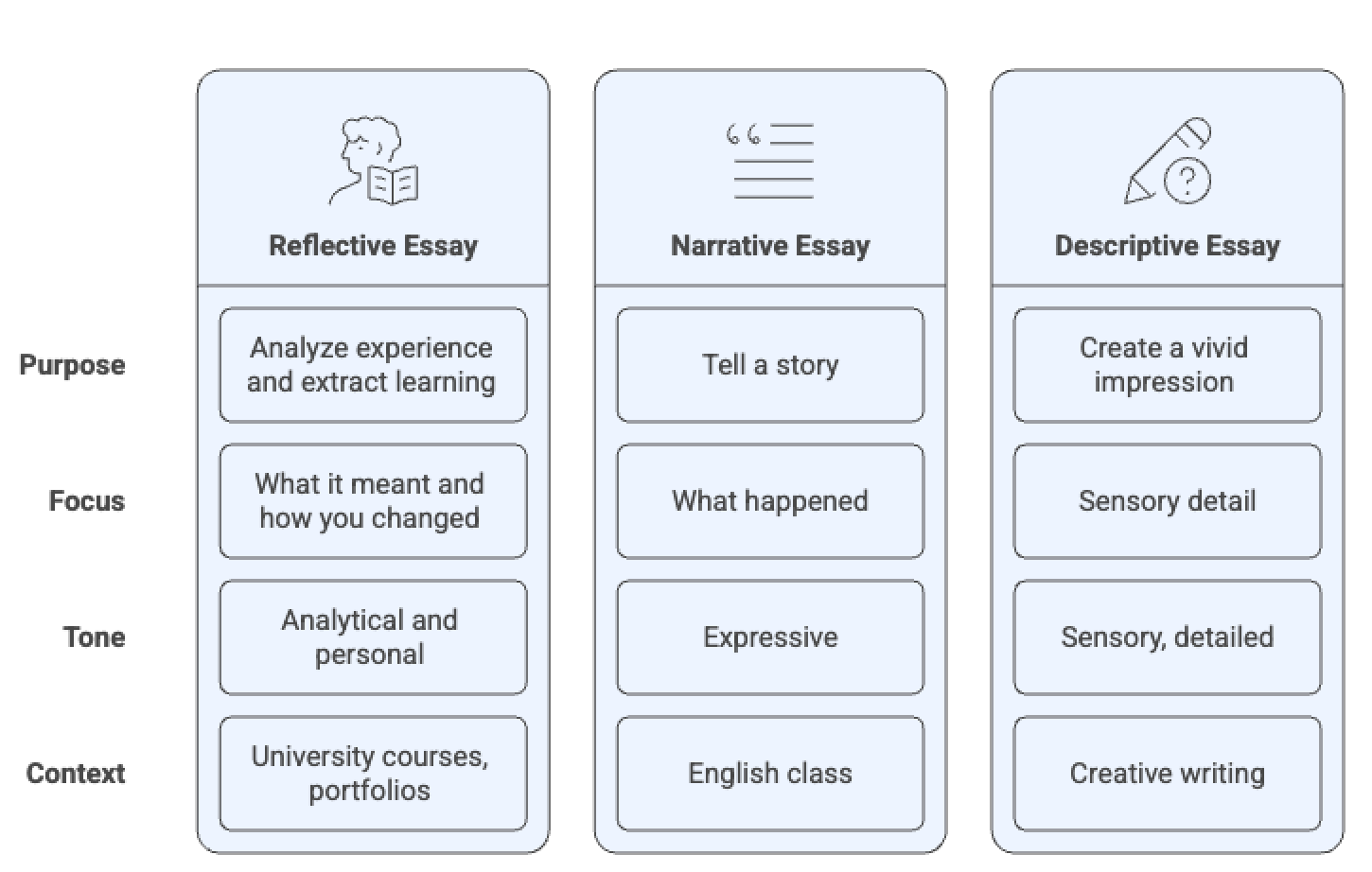
Similarities: All three essay types tell you about something the writer has experienced, observed, or thought about.
Differences: A narrative essay is mostly about the story itself. A descriptive essay is mostly about painting a picture. A reflective essay takes a step further and asks what the experience meant and what you learned from it.
How to Choose a Topic for a Reflective Essay
A good topic will make or break your final essay — the more specific and impactful, the more you can draw on that experience in your writing.
A strong topic has two things in place:
- a meaningful experience
- a clear learning resulting from that experience
Reflective Essay Topics & Ideas
Here are some tips for coming up with great topics:
- A failure or setback, and what it taught you
- Feedback that changed your approach
- A conflict and how you handled it
- Adjusting to a new environment
- A course concept that challenged your thinking
Questions to Ask Before You Commit
Before choosing your topic, ask:
- What exactly happened?
- How did I feel, and why?
- What do I understand now that I didn't before?
What Makes a Strong Topic
Weak topic: My internship experience
Strong topic: The moment I realised I got my internship role all wrong
Reflective Essay Structure
Reflective essays follow a predictable structure: introduction, body paragraphs, and a conclusion. Here is how to approach each section:
Introduction
Introduce the topic and hint at what the essay is going to be about, including the ideas you are going to share.
Here are some sentence starters to get you started:
- "Before this experience, I assumed…"
- "During this project, I encountered…"
Body Paragraphs
The body paragraphs develop your topic and add detail and nuance.
Your body paragraphs should include:
- A description of the event or experience (What happened exactly?)
- Your initial interpretation of the event or experience (What was your reaction?)
- Your evaluation or what you learned from it (What did you learn?)
Good sentence starters:
- "Reflecting on this now, I can see that…"
- "Later, I realised…"
Conclusion
The conclusion ties it all together and links your learning to future action — this is where your critical thinking truly shows. Make sure you answer this question: What will you do differently moving forward?
10 Steps to Writing a Reflective Essay
How to Start a Reflective Essay
Staring at a blank cursor? Begin with a thought-provoking question, an anecdote, or a specific moment. This part of the essay is called "the hook" — your chance to grab the reader's attention without bogging them down with details.
The 10-Step Process
- Review the assignment. Make sure you know what you are being asked to write by going over your assignment or project carefully.
- Reflect and brainstorm ideas. Generate several ideas before committing to a topic.
- Choose a topic. Ensure your topic is interesting and has a clear learning outcome.
- Gather your sources. Ensure sources are credible and relevant.
- Create your outline. Set the structure and add details.
- Write the body. Focus on the body paragraphs first and leave the introduction and conclusion for last.
- Write the conclusion. Summarise your main points and orient the reader to the future.
- Write the introduction. Start with the hook, summarise your topic and experience.
- Sleep on it and edit. Let your essay breathe for a day, then re-read with a focus on narrative and flow. If you are editing in your browser, the AI detector extension lets you check your writing without switching tabs.
- Final checks before submission. Make sure your essay is polished and entirely your own. Run it through an AI checker for students and review originality.
Reflection Paper Example (With Breakdown)
Breakdown
Introduction
The essay starts with a strong hook: "stepping into unknown territory," which immediately leaves the reader wondering about the outcome. It sets up the scene and also introduces the writer's internal state: "fear of failure clouded my judgement."
Reflection
Describes a specific moment when the experience caused a perspective shift: "A turning point came when…" This section explains the reasoning behind the turning point.
Learning
The essay concludes with the learning or perspective shift that resulted from that experience. "Looking back" is a great way to start a conclusion.
Reflective Essay Template (Copy-Paste Format)
Use this template as a starter. Insert your own content in place of all brackets.
INTRODUCTION During [experience], I [what happened]. At the time, I believed [initial assumption]. This essay explores what I learned about [key idea].
BODY — What Happened [Describe the key moment clearly.]
BODY — Reflection Looking back, I can see that [analysis].
BODY — Learning This experience taught me that [insight].
CONCLUSION Moving forward, I will [future action].
8 Tips to Write an Impactful Reflective Essay
- Use the first person. Write from your perspective and draw from your own personal experiences. If you write regularly and want to keep your voice consistent across drafts, an AI detector for writers can help you spot when your writing starts drifting.
- Follow a clear structure. Your essay needs an introduction, body, and conclusion.
- Go beyond describing. Don't just tell us what happened — show learning.
- Use vivid details. Paint a detailed picture for your reader.
- Connect to a broader theme. Find the universal themes that come through.
- Add emotion. Describe how you felt before, during, and after the experience.
- Stay professional. Use slightly less formal language than academic essays, but don't go too informal.
- Proofread. A clean draft is a credible draft. Read your essay out loud, check the flow, and run it through a Plagiarism Checker before you hand it in — especially if you referenced any outside sources while writing.
Common Mistakes to Avoid
- Only describing events without reflecting on what they meant.
- Choosing topics that are too broad to analyse in depth.
- Skipping the learning component and jumping straight to the conclusion.
- Being too vague about how you felt or what changed.
- Not running your essay through a grammar checker before submission.
- Forgetting that your work will likely be checked. Most educators now use tools like an AI detector for teachers to flag writing that doesn't sound original, so it is worth reviewing your draft the same way before you submit.
Conclusion
Learning how to write a reflective essay is about developing clarity in how you think, not just how you write.
Once you understand how to connect experience to insight and future action, the process becomes much more natural. This skill is useful not just in school, but in applications, interviews, and professional communication.
Before submitting, it's worth doing a final review to make sure your essay clearly reflects your own thinking. Running your draft through an AI Detector can help ensure your work is original and your voice comes through clearly.
Want to make sure your essay passes the human test? Run it through GPTZero’s AI checker for students to review originality before submission. If you want to refine your writing, an AI detector for writers can help you keep your voice consistent across drafts.
FAQs
What are example topics for a reflective essay?
Common topics include personal challenges, feedback you've received, conflicts you've navigated, a new environment you adjusted to, or a course concept that shifted your thinking.
How long should a reflection essay be?
Most reflective essays fall between 500 and 1,000 words, but always check your assignment guidelines.
How do I start a reflective essay?
Start with a specific moment, question, or realisation. A hook pulls the reader in far better than a general statement about the topic.