
How to Write a Cause and Effect Essay (Complete Guide)
A cause-and-effect essay is a piece of academic writing that aims to explain why something happened (cause) and the effects or consequences that resulted from it (effect).


Humans are wired to find causality in events happening around us. Most of us engage in cause-and-effect thinking daily. A cause-and-effect essay is built around the question “why?” Your job is to examine why something occurred and the effect that it had. A successful cause-and-effect essay demonstrates a clear understanding of the causes and effects, establishes logical connections between events, and supports all claims with credible evidence.
That is precisely what makes cause and effect essays both interesting and tricky to write, because a good cause and effect essay can’t simply be a list of connections.
In this guide, we will cover what a cause and effect essay is, how to structure and outline it, plus tips and examples to help you write a strong paper.
TL;DR
- A cause-and-effect essay examines the relationship between an event and its effects.
- Cause-and-effect essays have three main structures: Block, Chain, and Causal Chain. Each fits a different kind of cause-and-effect relationship.
- Strong cause-and-effect essays are objective, but still identify the most important causes and relationships.
What Is a Cause and Effect Essay?
A cause and effect essay is an examination of how one event/ condition/ phenomenon caused another. The cause is what makes something happen, and the effect is the result of that event. The main job of a cause-and-effect essay is to show the reader exactly how the two are linked and why that link is meaningful.
You will be asked to write this style of paper throughout your high school and university career. You may come across an assignment that asks you to explain why something occurred, for example, why World War I started. Some other common prompts could be the effect of a policy change on a population, or the effect of fertilizer on river ecosystems, etc.
The tricky part in writing this type of essay, and where you need to be careful, is that it can be easy to suggest that because one event preceded another, one caused the other. Simply because an event follows another in sequence doesn’t mean that it caused the other.
A great example from National Geographic: “People often complain that as soon as they finish washing their car, it starts to rain. Obviously, washing a car does not cause rain. Writers need to be sure that the causes and effects they describe are logically connected.”
Logical connection and sound evidence are the keys to success.
Cause and Effect Essay Structures
Cause and effect essays follow three main structures. Which one you choose depends on what your goal is and what you are trying to show.
Block Structure
In the block structure, you group all the causes in one section and then all the effects together in another. For example, if you have been assigned the topic of rising childhood obesity, you would first cover the contributing causes (food marketing, school lunch quality, screen time), then move to the effects (poor health outcomes, healthcare costs, social impact).
When to use it: When the causes you want to include are not obviously related to each other, and the relationship between them is easier to see when grouped.
Chain Structure
The chain structure distributes the causes to each body paragraph instead of chunking them together like the block structure. In each body paragraph, you will explore one cause and discuss its direct effect, then move on to the next cause and effect pairing.
When to use it: When you want to clearly outline each cause and effect connection and when the pairs can stand alone and don’t need the others to be understood.
Causal Chain Structure
The simplest way to think about this cause-and-effect essay structure is this: cause A produces Effect B, which becomes the cause of Effect C, which leads to Effect D. Imagine knocking over a row of dominoes.
When to use it: When you are following a sequence of events over time, especially when each step causes the next and culminates in a final point.
How to Outline a Cause and Effect Essay
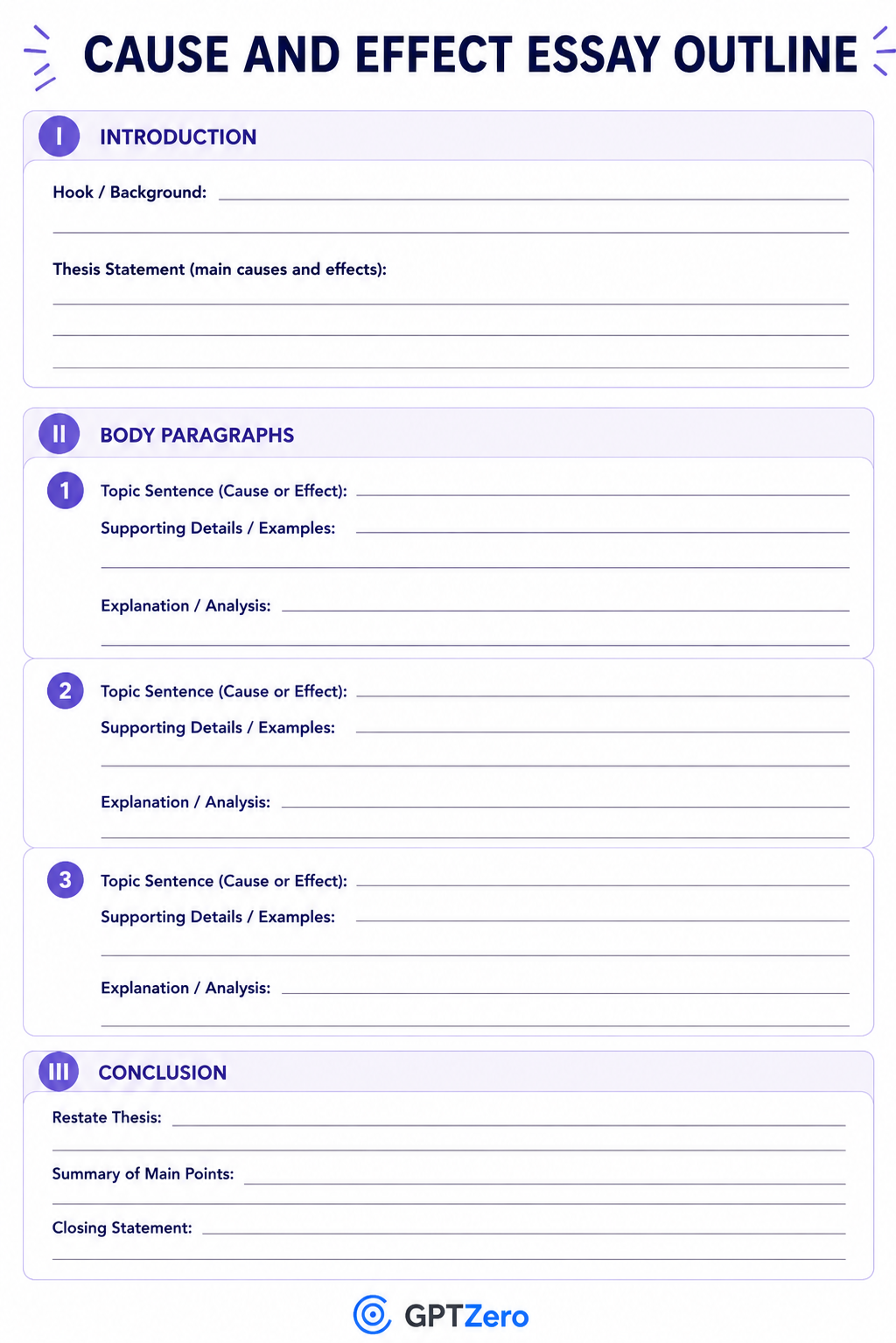
The basic structure of a cause and effect essay will be familiar to you from other essay types you may have written:
Introduction
Open with a strong hook, introduce the event or catalyst that you will be exploring, and end with a thesis that includes the main cause, main effect, and implications.
Body paragraphs (3–5):
Your body paragraphs will vary depending on which cause-and-effect structure you choose to guide you. Your paragraph should open with a topic sentence letting the reader know what will be covered in the coming sentences, followed by well-supported evidence and language that focuses on relationships.
Conclusion
Your conclusion is where you restate your thesis in light of the evidence you've presented. You will also summarize the main connections and end with a broader implication or a question for the reader to ponder.
How to Write a Cause and Effect Essay — Step-by-Step Guide
Step 1: Choose a Topic With a Clear Causal Relationship
Sometimes the topic will be assigned to you, and sometimes you will have to provide your own. If you are in the latter position, look for a topic where the cause-and-effect relationship isn’t totally obvious or could be disputed.
Step 2: Do the Research
The evidence you provide is probably one of the most important parts of the success of your paper. Make sure you are pulling from credible sources like peer- reviewed studies, government data, and expert testimony. Organize and catalogue your sources as you go, and consider a hallucination detector to verify your sources.
Step 3: Identify the Main Cause or Effect
Choose the causes and effects that matter most. You don’t have to track or catalogue every possible cause- focus on the most compelling ones. A good way to choose is to ask which one you can defend best with strong evidence.
Step 4: Write a Thesis Statement
Your thesis should summarize your main topic and state what you will be illustrating. E.g. Childhood obesity in the United States has been driven primarily by three forces: aggressive food marketing, declining school lunch quality, and a sharp reduction in unstructured physical activity. Be specific when crafting your thesis.
Step 5: Pick Your Structure and Outline
Use the guide above to choose which of the three main structures best fits your topic. It is a good idea to have your structure clearly in mind before you begin drafting to ensure the proper flow of evidence and information. Once you’ve chosen your structure, you can map your sources and main points in an outline. Use the handy template we’ve included above to get your ideas organized.
Step 6: Draft
Now that your paragraphs are mapped out with your main points and supporting sources, you can begin connecting your ideas into a clear narrative. We recommend drafting without stopping and leaving any copy editing for your favorite grammar checker. Our guide to writing strong introductions covers the opening section in more depth.
Step 7: Revise for Logic and Language
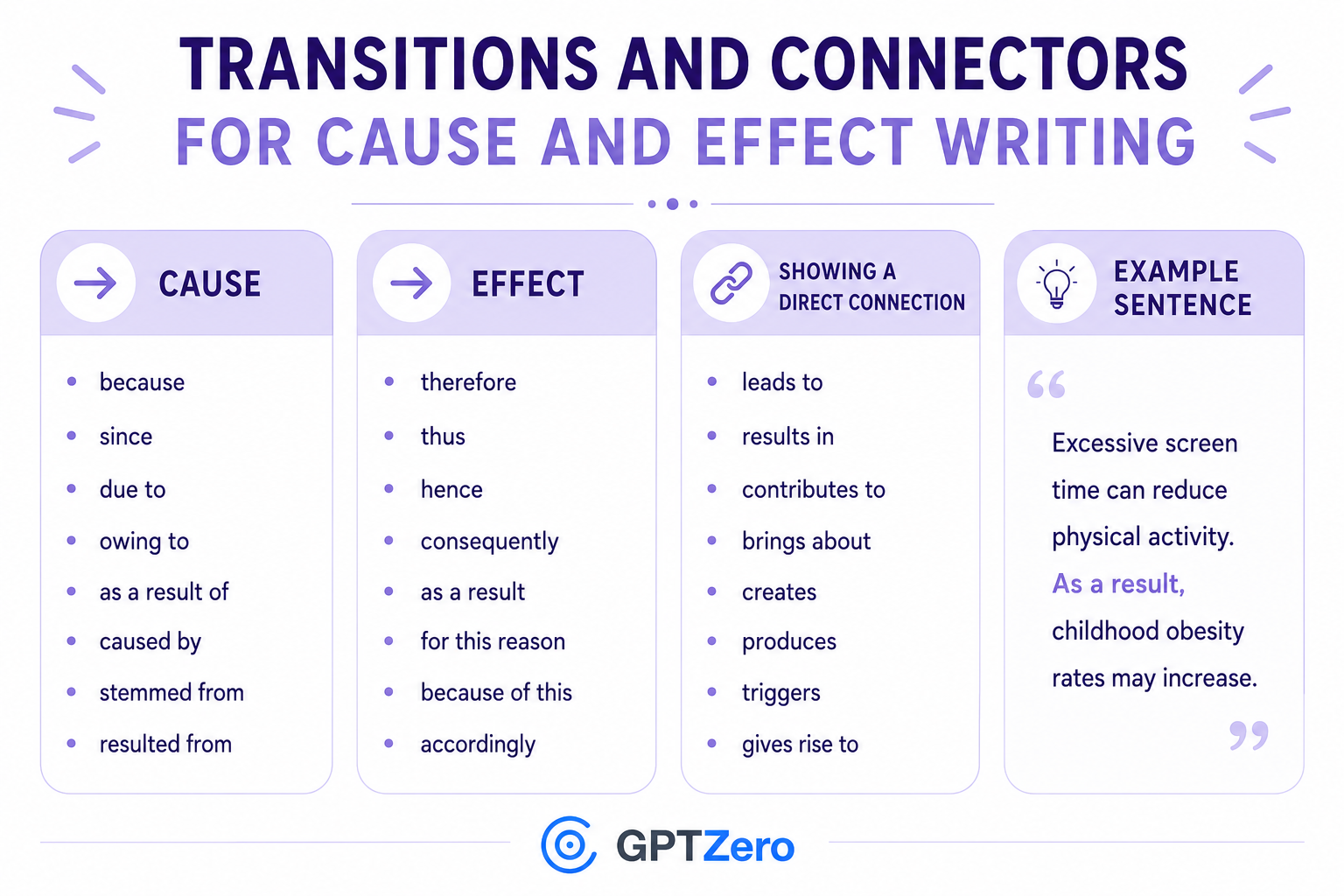
Once you have a rough first draft, begin your revision process by focusing on obvious gaps in logic, lightly supported claims, and confusing wording. Your first pass should focus on how well your paper flows. You may end up shuffling sections or entire paragraphs during this editorial pass.
Step 8: Run Final Quality Checks
Before submitting your paper, clean up all grammar issues and scan your work through an AI detector for students to make sure you submit a fully human draft to your instructor. AI vocabulary checkers can spot AI phrasing and claims that may need verifying.
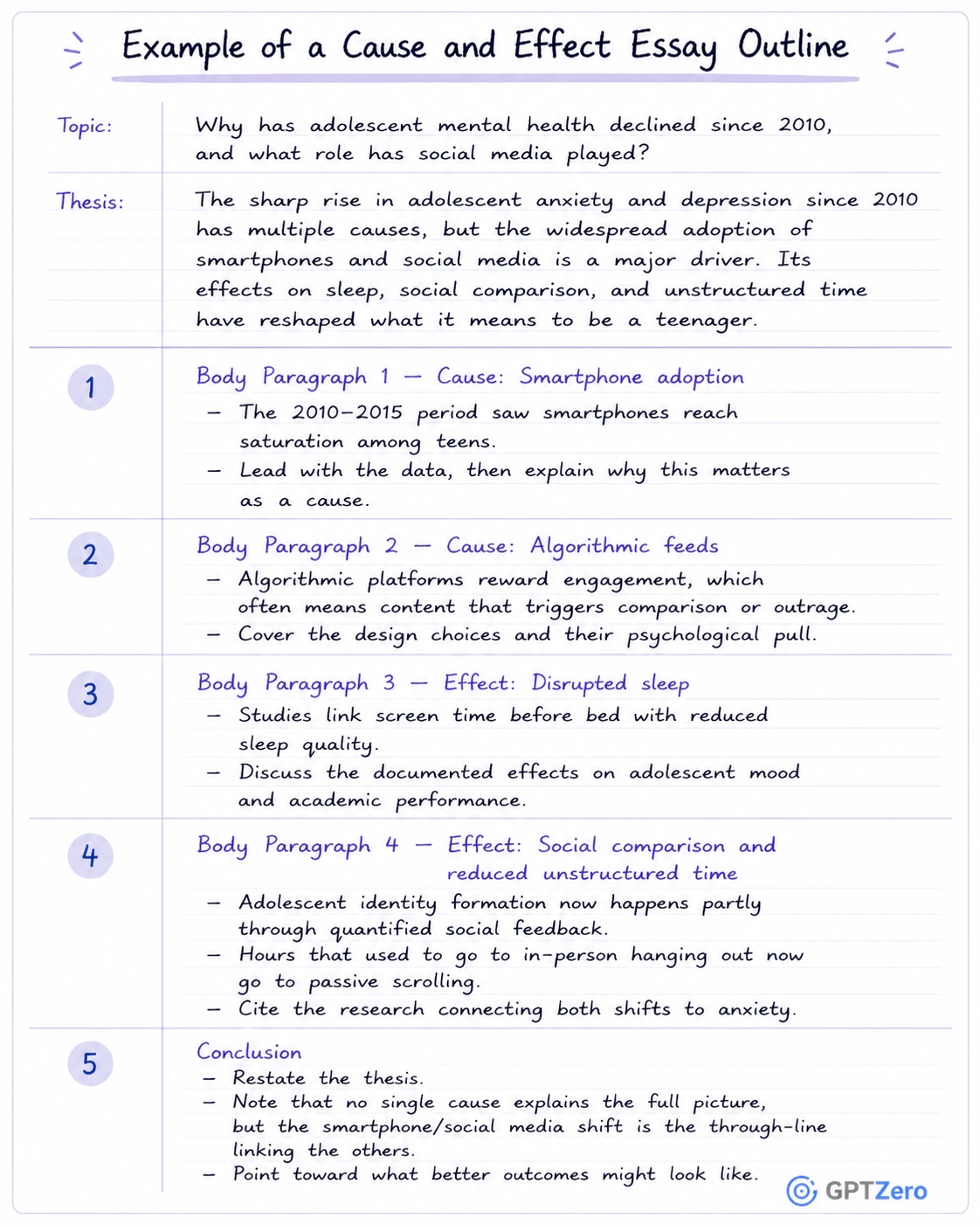
Example of a Cause and Effect Essay Outline
Here's a complete short outline using the Block structure.
For a fully developed example, Kellogg Community College hosts "Effects of Video Game Addiction" by Scott McLean, which models the form well.
FAQs
How do you write a cause-and-effect thesis statement?
A strong thesis states the main cause, the main effect, and outlines what you will discuss. Example: "Three factors explain X: A, B, and C. The most consequential effect has been Y."
What does cause and effect mean?
A cause is what makes something happen, and an effect is the result of that event or occurrence. Cause-and-effect writing examines the relationship between the two, showing how they unfolded.
Can correlation be enough for a cause-and-effect essay?
No. In fact, this is one of the most common mistakes students make- they assume correlation equals causation. You have to be observant enough to notice when a correlation exists and explain whether or not there is a causal link.
How long should a cause-and-effect essay be?
Most cause and effect essay assignments are between 750 and 1500 words at the undergraduate level. Check your assignment brief for specifications from your instructor.