How to Fact-Check ChatGPT in 5 Simple Steps
In five simple steps, we show you how to verify citations and check independent evidence when using AI.

ChatGPT’s confident tone can be misleading, as we’ve shown through numerous investigations, including our revelation that 50 of the 300 ICLR 2026 submissions we scanned contained at least one obvious hallucination. Each paper had already been reviewed by three to five experts, yet these errors went unnoticed.
It goes to show how slippery inaccurate references can be and how they can find their way into otherwise credible research. As OpenAI says: “ChatGPT can be helpful—but it’s not always right.” If you use ChatGPT in your own process, there’s a real risk these errors can make their way into your work.
Luckily, there are proven ways to fact-check GPT. In this guide, we'll show you how, including how to verify citations and check independent evidence. You'll also learn how to use GPTZero's Citation Check to review references that need more attention.
TL;DR
The first step to fact-checking ChatGPT output is to get specific on the factual claims you need to check. Then, find the original research, report, or other source behind each claim, and actually take the time to read what the source actually says (this includes checking the dates and context). Compare the points with independent evidence, and revise anything you can’t support. We also recommend keeping a record of the sources you’ve checked.
How to fact-check ChatGPT in 5 steps
Break down which claims need checking
After ChatGPT gives you information, instead of seeing it as a single block of text, review it carefully to distinguish the specific facts you need to verify. This includes names, dates, statistics, quotes, and research findings.
Start with the details that form the basis of your argument, or those that are most likely to cause errors if they are wrong. For example, if a statistic is the main reason you’re recommending a certain approach, verify it before building the rest of your argument around it.
While you can try to save time by asking ChatGPT to help list the claims, this isn’t always reliable. If you’re in a rush, this video shows how you can fact-check in two minutes, although we recommend taking a more thorough approach:
Review the original source
After you’ve broken down which parts you need to verify, it’s time to find the original source for each fact. This could be the original research paper being cited by ChatGPT, an article or URL it links to, or a table of data that it refers to.
Sometimes ChatGPT doesn’t list its sources unless you ask for them, so make sure you do that and then open the links yourself.
Start by confirming that the source exists and that its identifying details are correct. For academic references, check the paper title, authors, publication date, journal, and DOI (Digital Object Identifier).
The important thing is to go back over the original data point and make sure that what ChatGPT says actually matches what has been argued.
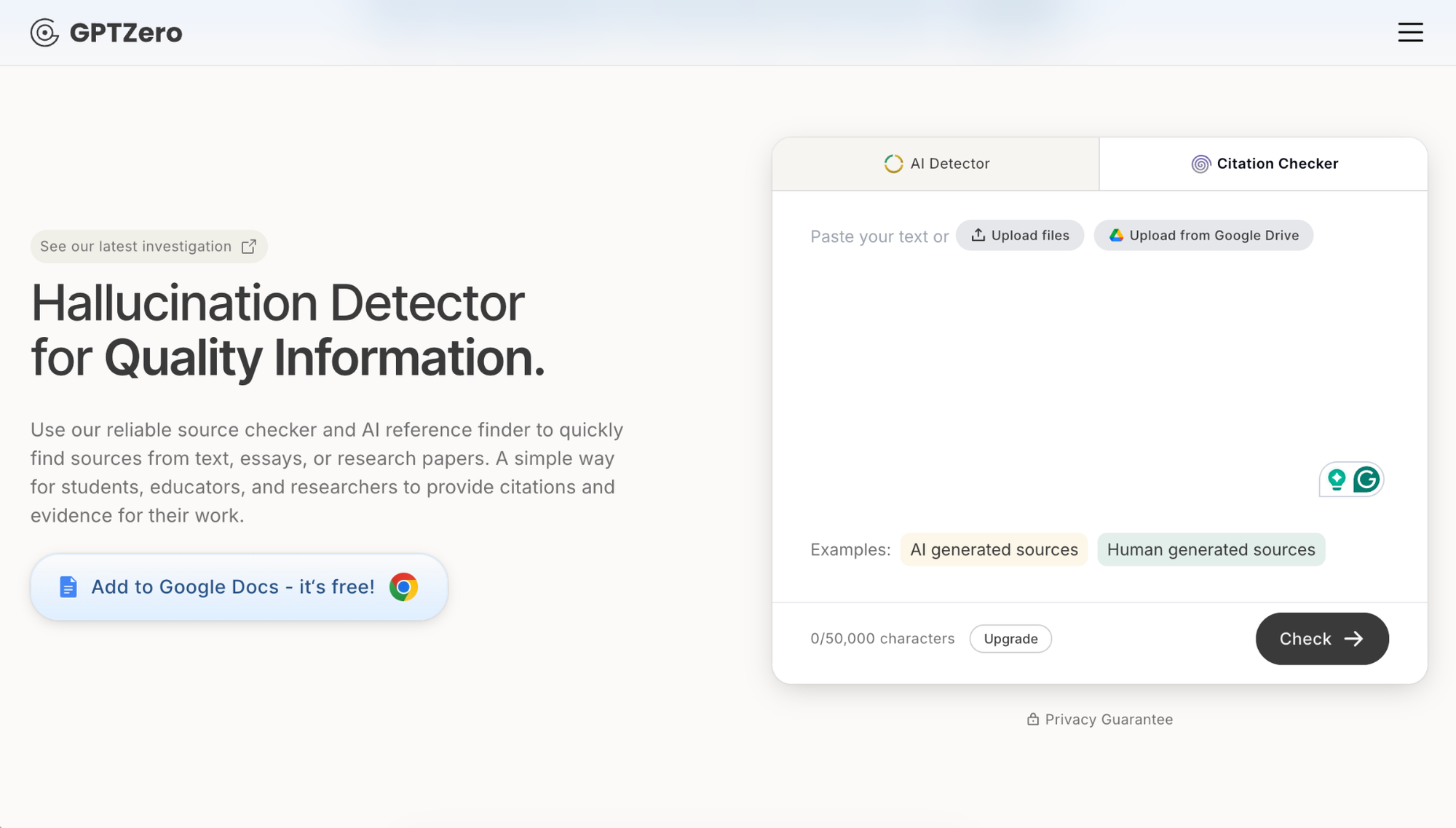
You can also use GPTZero’s Citation Check, also known as the Hallucination Check or Source Finder, to flag potentially fabricated academic references, suspicious DOI details, and citations that need further investigation.
Beware of the types of errors ChatGPT can include
Beyond checking the citations, you also need to read what the evidence actually says: the paper might be accurately cited and yet say something that differs drastically from how ChatGPT describes it.
This is when it’s worth checking when the information was published, and whether there are corrections or newer findings. For statistics, check the units and calculations: a percentage change and a change in percentage points mean different things.
Pay particular attention to claims with words such as "proves," "always," or "significantly," as these terms can make a finding sound stronger than it actually is.
We recommend being extra careful with direct quotes from academic studies, as language models are known to generate real-sounding references that have never actually existed, among other errors.
Here are five common citation errors to look for:
Use lateral reading to check multiple sources
“Lateral reading” is a term that describes exiting the ChatGPT window and looking up who published the original information, checking it against what other sources say about it, and whether or not the context has been mixed up.
Research by Stanford scholars Sam Wineburg and Sarah McGrew found: “Historians and students often fell victim to easily manipulated features of websites, such as official-looking logos and domain names. They read vertically, staying within a website to evaluate its reliability. In contrast, fact checkers read laterally, leaving a site after a quick scan and opening up new browser tabs in order to judge the credibility of the original site.”
After all, you can get several websites saying the same thing, only because they got it from the same press release.
For critical points, find independent evidence and consider how it was gathered. If the findings differ, check whether the researchers asked different questions or studied different groups, as you may need to reflect that uncertainty in your writing.
In this tutorial, Matthew Turner will walk you through how to fact-check a ChatGPT response by consulting other online sources to verify facts, identify gaps, and find alternative perspectives.
Revise your answer and keep your research notes
After doing all the above, you’ll know by now which parts of ChatGPT output you can use and what still needs investigation. Once you've checked the evidence, revise any claims that are incorrect, misleading, outdated, or unsupported; fix any errors in your own work and leave out details you can’t verify with certainty.
Make sure to keep the links and relevant passages in your notes, with a brief explanation of what each source supports, as this can make it a lot easier later on if you need to defend or demonstrate your research trail. Also, a simple research log can help you keep track of what you've checked:
The above helps you to produce a record that you can keep coming back to when editing your work, and makes it easier to explain why you kept a claim or changed it.
What this looks like in practice
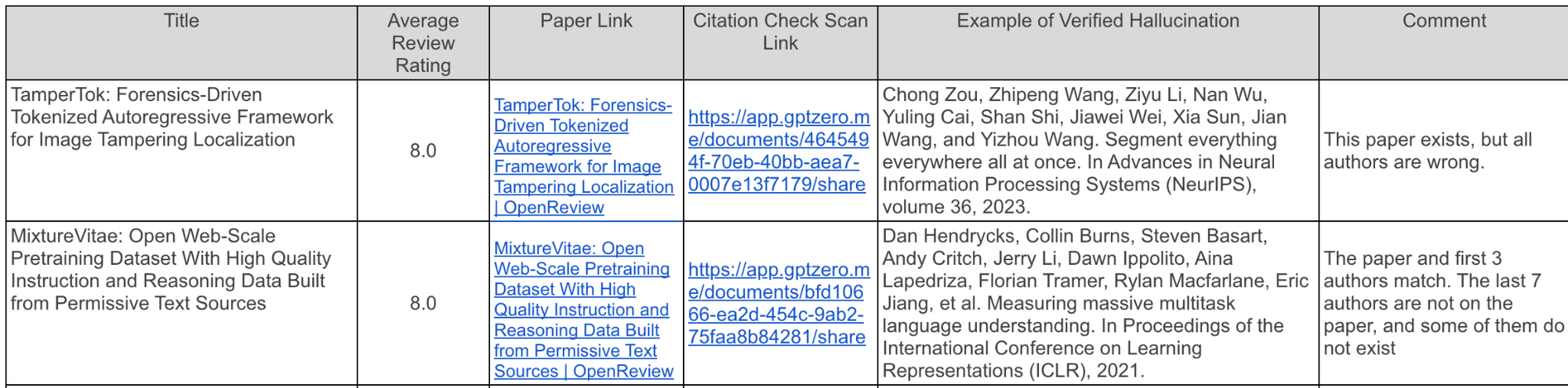
Here’s just one example from our ICLR investigation that shows why you can’t assume a paper quoted by ChatGPT actually exists as stated.
We found this was listed as a cited title: Measuring Massive Multitask Language Understanding, which does actually exist – it is a real paper. The first three authors were even listed correctly.
However, the list then included people who weren’t authors of the paper, and opening the original arXiv record shows the fourth author is Andy Zou, while the “fake” reference named Andy Critch.
When you run this through GPTZero’s Citation Check, you can see that the paper and first 3 authors match, while the last 7 authors are not on the paper, and some of them do not exist.
Why You Need to Fact-Check
As we have found over recent years, hallucinated citations are certainly not limited to academic research, and even well-known, major professional services firms have released reports with fabricated or misleading references.
Another GPTZero investigation showed KPMG's October 2025 flagship report, Total Experience: Redefining Excellence in the Age of Agentic AI, was heavily compromised by artificial intelligence hallucinations and fabricated references.
Of its 45 citations, only five accurately pointed to real sources. Another 28 contained altered details from real sources, while 12 were too vague or flawed to identify confidently.
There were also false case studies: one example described UBS using AI agents “across investment advisory, risk management and compliance monitoring,” apparently through a platform “co-developed with Microsoft.” However, a UBS spokesperson told the FT that these claims were “factually incorrect.” In response, KPMG removed this report.
Cases like this show why polished, professional-looking content still needs independent verification. Even major organizations can publish reports containing inaccurate citations or unsupported claims.

Tools that can help you fact-check ChatGPT
Since the above is only becoming a bigger problem online, there are now multiple tools that can help you verify information.
At GPTZero, our AI detector looks at whether writing is likely to be AI-generated: this is a different question from whether the information itself is actually accurate. While citation and source-checking tools can help you investigate, they cannot 100% guarantee that each and every statement you make is true.
This is why you need to be able to say why you kept a claim, or chose to edit it, and keeping this evidence in your notes makes this process easier.
ChatGPT Fact-Checking Checklist
Before you submit any work that has in any way used content from ChatGPT, we recommend running through this checklist:
- Identify the factual claims, statistics, and quotes.
- Check that every cited source exists.
- Verify author names, publication details, URLs, and DOIs.
- Read the original evidence rather than relying on summaries.
- Confirm that each source supports the claim being made.
- Check dates, calculations, units, and relevant context.
- Look for independent evidence when a claim is important.
- Correct or remove anything you cannot verify.
- Keep a record of the sources you've checked.
You can also run your references through GPTZero's Citation Check to help identify suspicious citations that deserve another look.
Conclusion
While ChatGPT can be a thought partner when used responsibly, remember that just because it sounds convincing, that doesn’t mean it’s correct. If you use ChatGPT in any part of your work, we highly recommend getting into the habit of checking original sources, comparing independent evidence, and keeping a record of your research.
For academic papers and assignments with multiple sources, GPTZero’s Citation Checker can help to flag suspicious sources that need a closer look.
Check your citations with GPTZero before you decide which sources you can confidently use in your work.
FAQs
Can you trust ChatGPT when it searches the web?
While turning on Web search gives ChatGPT access to current sources, it can still misinterpret what it finds or contain errors. This is why we recommend that you open the original links, check the publication details, and confirm the sources support your claims.
Can you cite ChatGPT as a source in academic writing?
If you are using AI in your work (and assuming it is allowed in that particular context at your institution), then we absolutely recommend citing an AI conversation, and we provide guidance on how to cite AI.
How can you tell if ChatGPT is hallucinating?
No matter how smooth the text from an LLM can sound, it can still include untraceable quotes and unsupported statistics. An answer can be wrong but sound eloquent, so it's critical to check the evidence as thoroughly as possible.
Can ChatGPT fact-check its own answers?
ChatGPT can suggest potential sources or identify claims that might need another check, but asking it to fact-check its own responses doesn’t always work: it might repeat its original errors or give an inaccurate explanation.