How to Write an Unforgettable Speech: Step-by-Step Guide
A speech is a piece of writing specifically written to be read or recited out loud to move an audience to feel, think, or do something.

At some point in your academic or professional career, you are going to have to give a speech or write one for someone else to give. For many people, the very thought of delivering a speech sends them into a low-grade panic. There’s a bit of pressure when writing speeches because they need to be impactful.
As the UNC writing center puts it, your audience "has only one chance to comprehend the information as you read it, so your speech must be well-organized and easily understood." The key difference between writing persuasive speeches and writing persuasive essays is that speeches are designed to be heard, which means the reader can’t flip back a page and reread for clarity. The best speeches are purposefully written to be spoken, and that is the biggest challenge with this type of writing.
In this step-by-step guide, we will walk you through what makes a great speech, the different kinds of speeches, how to write one, as well as different strategies for making your speech unforgettable.
TL;DR
- A speech is a piece of writing that is written to be heard and not read. This means shorter sentences, repeated key messages and terms, and more elegant, emotional prose.
- The goal of a speech is to make the audience feel something, think something, or take action.
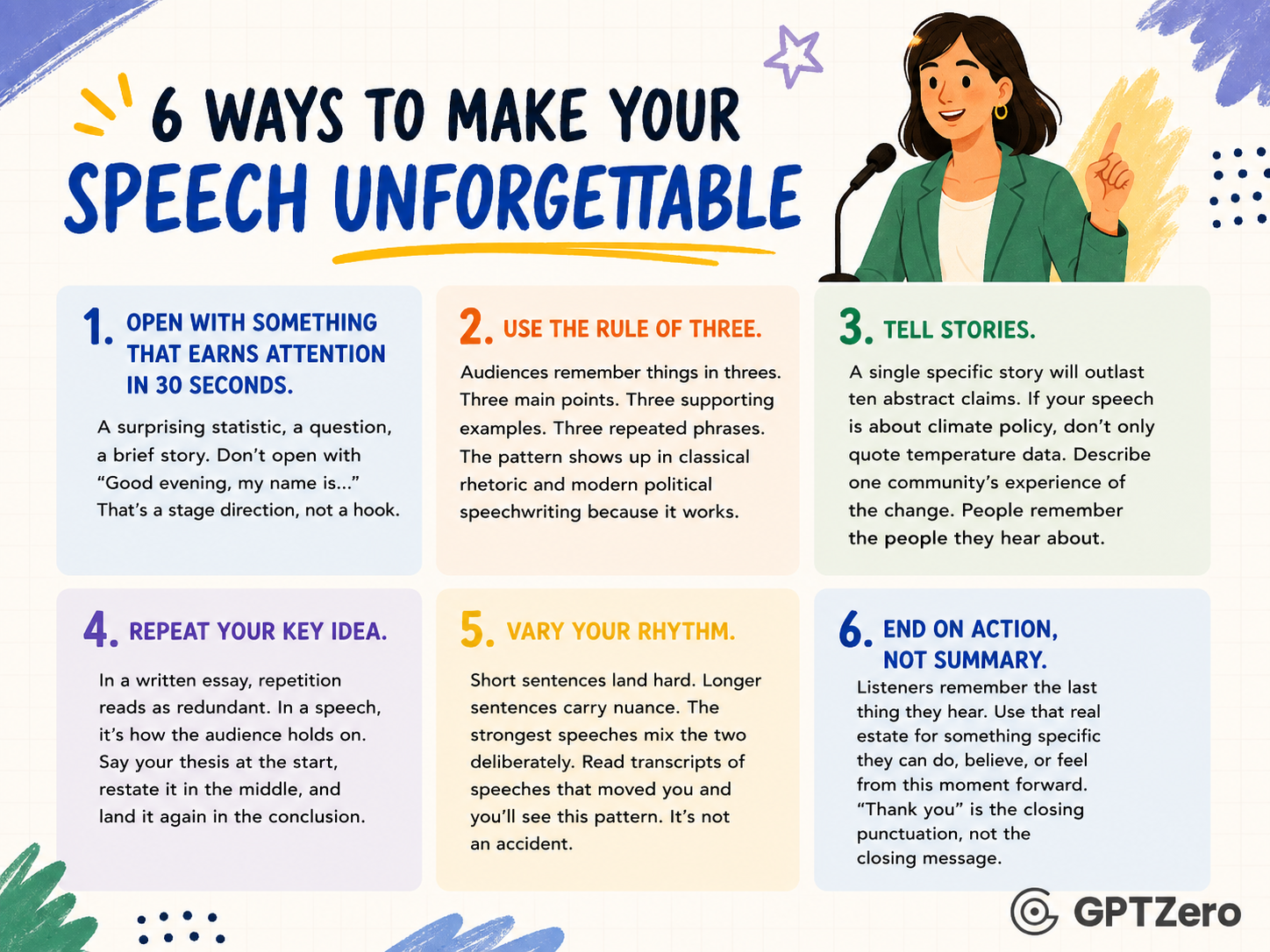
- A strong speech grabs your attention in the first 30 seconds, repeats the key idea throughout, and ends with something the audience can carry with them – often an internal transformation.
What Is a Speech?
A speech is a structured piece of writing designed to be spoken during a presentation or an address. It is usually delivered to a live or recorded audience and has clear prose. Speeches follow a deliberate structure and use language that is more emotive than other forms of writing.
What separates speeches from essays is the listener. When you write an essay, your reader is largely in control of how they consume your writing. They can go back and review, they can read the conclusion first, they can re-read passages that weren’t obvious. Not so with speeches. The dense prose you may be used to with other academic tasks will not work with speeches. A great exercise is to go ahead and read one of your essays out loud – you will immediately see the difference.
Effective speeches lean toward short sentences with the subject and verb close together. They purposefully repeat key terms instead of trying to vary them for elegance. Another aspect of speeches that can be challenging is the use of previews or letting the audience know what you will be talking about: “I’m going to talk about three things today…”
Types of Speeches
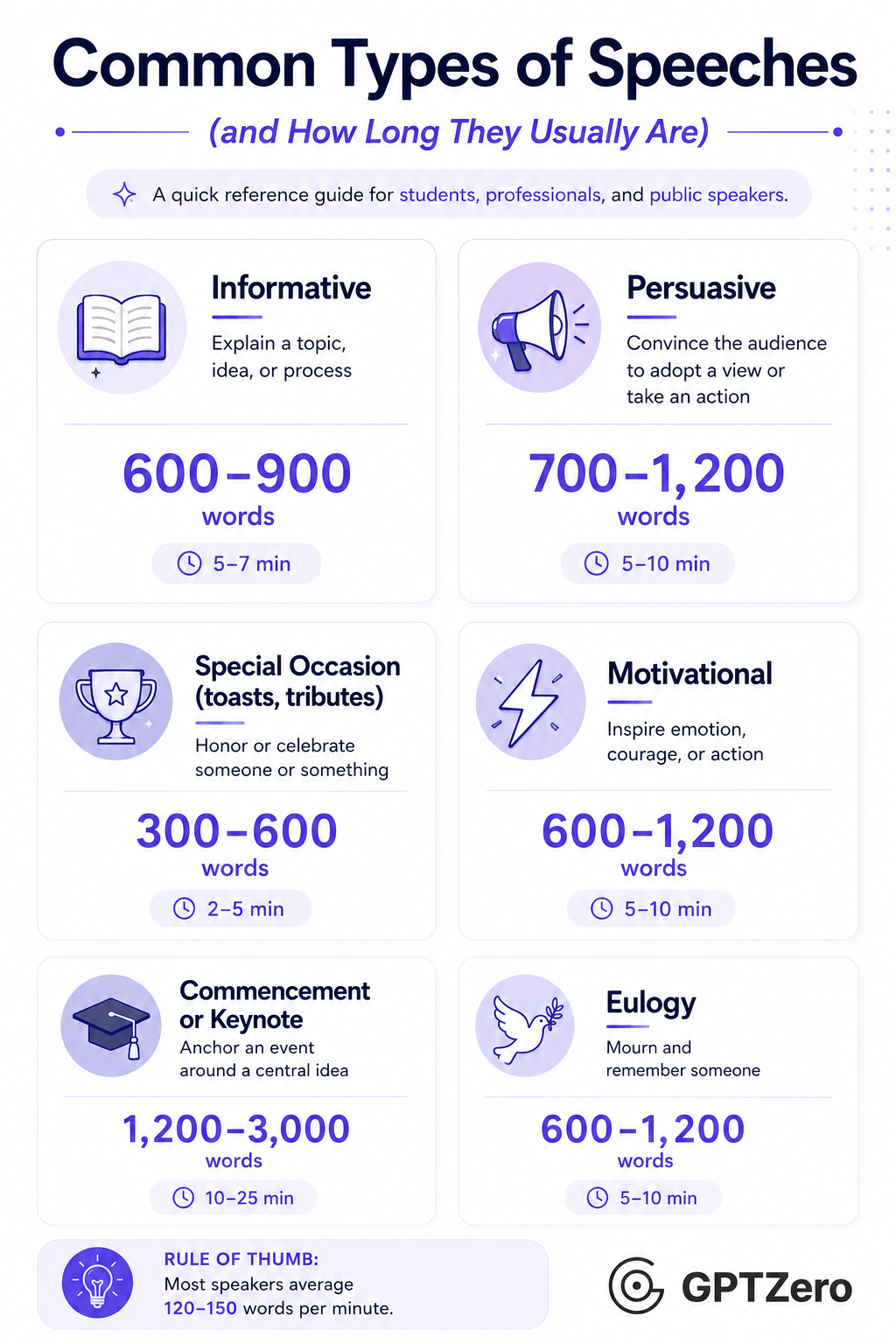
Different occasions call for different types of speeches. We have included the most common ones in this table so you can decide which one works in your specific situation.
How to Write an Impactful Speech
Step 1: Know Your Audience and Your Purpose
Before you write a single sentence, you need to know exactly who you are speaking to and what your goal is for the speech. What do you want them to feel, take away with them?
Depending on your context, you will adjust how you write your speech. For example, a eulogy’s goal is likely to invoke feeling, whereas a commencement address may want to inspire action.
Step 2: Choose a Core Message
A strong speech really drills down on one idea, not three. Everything in your speech should support a clear main message. You should be able to say your core message in one sentence. It’s important to keep working on this until you have it. Moving forward to writing when your idea is still unclear will only slow down your work later and lessen the effectiveness of your speech.
Step 3: Research and Organize
Once you know what your topic is, you can begin gathering supporting material. You want to look for things like statistics, expert quotes, story examples, and even personal observations, depending on the kind of speech you're writing. It's always a good idea to collect more than you will need so that you have a lot of choice and a lot of options to work with later. It's also not a bad idea to use an AI source finder to confirm that all the citations and quotes you're using are accurate.
Remember that speech openings need to be quick, not like essay openings or introductions – you want to skip the preamble and get right to the point.
Step 4: Create the Outline
All great speeches begin with a great outline. Just like an essay, getting your main ideas on paper before you start putting them together will make your speech stronger and the process easier. We've included a full outline for a speech a little further along in this guide.
Step 5: Write for the Ear
How do you write for the ear? The fastest way to understand whether what you've written is going to land is to read it out loud. Reading your work out loud will immediately show you where you need to improve. It'll show you where you need to cut words, shorten sentences, or adjust the vocabulary.
Tip: Try the voice typing feature in Google Docs when writing your speech.
Step 6: Revise, Time, and Verify
Once you've got a first draft down, it's time to revise. You'll want to do two different types of revisions. The first revision you want to do is the reading-out-loud revision. Read your entire speech end-to-end without stopping and time yourself. Do this several times and polish as you go.
The second editorial pass is for things like grammar and sources. Run your entire speech through your favorite grammar checker. If you have used sources or cited statistics or quotes, it's a great idea to check for hallucinations before you deliver your speech.
Speech Writing Outline
Here's a basic template you can adapt for most speeches. (Copy and paste into your doc)
Introduction
Hook: open with a story, question, or striking statistic
Connection: explain why this matters to this audience
Thesis: state your core message in one clear sentence
Preview: briefly signal what's coming ("I'm going to make three points today")
Body
Main Point 1: supporting evidence, story, or example
Transition that connects Point 1 to Point 2
Main Point 2: supporting evidence, story, or example
Transition that connects Point 2 to Point 3
Main Point 3: supporting evidence, story, or example
Conclusion
Restate your thesis in light of what you've just argued
Briefly remind the audience of the key takeaways
Call to action or final memorable line that resonates
6 Strategies to Make Your Speech More Impactful
FAQs
What makes a speech impactful?
A memorable speech leaves you feeling something. It allows you to carry something with you when you leave. That is achieved by a strong main point, emotive language, and a deep knowledge of the audience that the speech is written for.
How do you prepare for a speech?
Preparation is an important part of giving a successful speech. Practice reading the speech to yourself or your friends before the big day.
How do you start a speech?
You have a very short amount of time to catch everybody's attention and keep it. Unlike an essay or other types of academic writing, speeches have a very short window of time before the listeners disengage. It is very important to get to the point and to hook the listeners' attention as soon as you possibly can. That means cutting out a lot of nervous filler that many inexperienced speakers naturally add to their speech.
How long should a speech be?
The length of your speech will be determined by your context or specified in your assignment brief. A eulogy might take you 5-10 minutes. If you're giving a persuasive speech in front of your peers or your boss, 15 to 25 minutes might be more appropriate to the context. Always understand who you're writing for and what the goal of the speech is.