
How to Write a Thesis: A Step-by-Step Guide for Students
A thesis is an in-depth piece of academic writing, usually assigned as the capstone to a master’s degree.


Writing a thesis can feel like writing a novel. It is by far one of the most in-depth and intimidating pieces of academic writing you will encounter in your career. The main reason for the overwhelm is that most Master’s level thesis papers can range between 60-100 pages, well above the length most students are used to handling in their academic careers. This type of writing is going to require a different approach if it is to be successful.
The biggest challenge with this type of project is planning and the discipline required to work on it for months. The good news is that if you’ve made it to graduate school, you already have the foundational skills to write a successful thesis. The gap in knowledge is around scale, which is why we wrote this guide.
We will walk you through what a thesis is, how it's structured, the eight-step writing process, common mistakes to avoid, and how to prepare for the defense if your program requires one.
TL;DR
- A thesis is a long piece of academic writing that presents your own original research or contribution to a field, normally required to finish a Master’s degree.
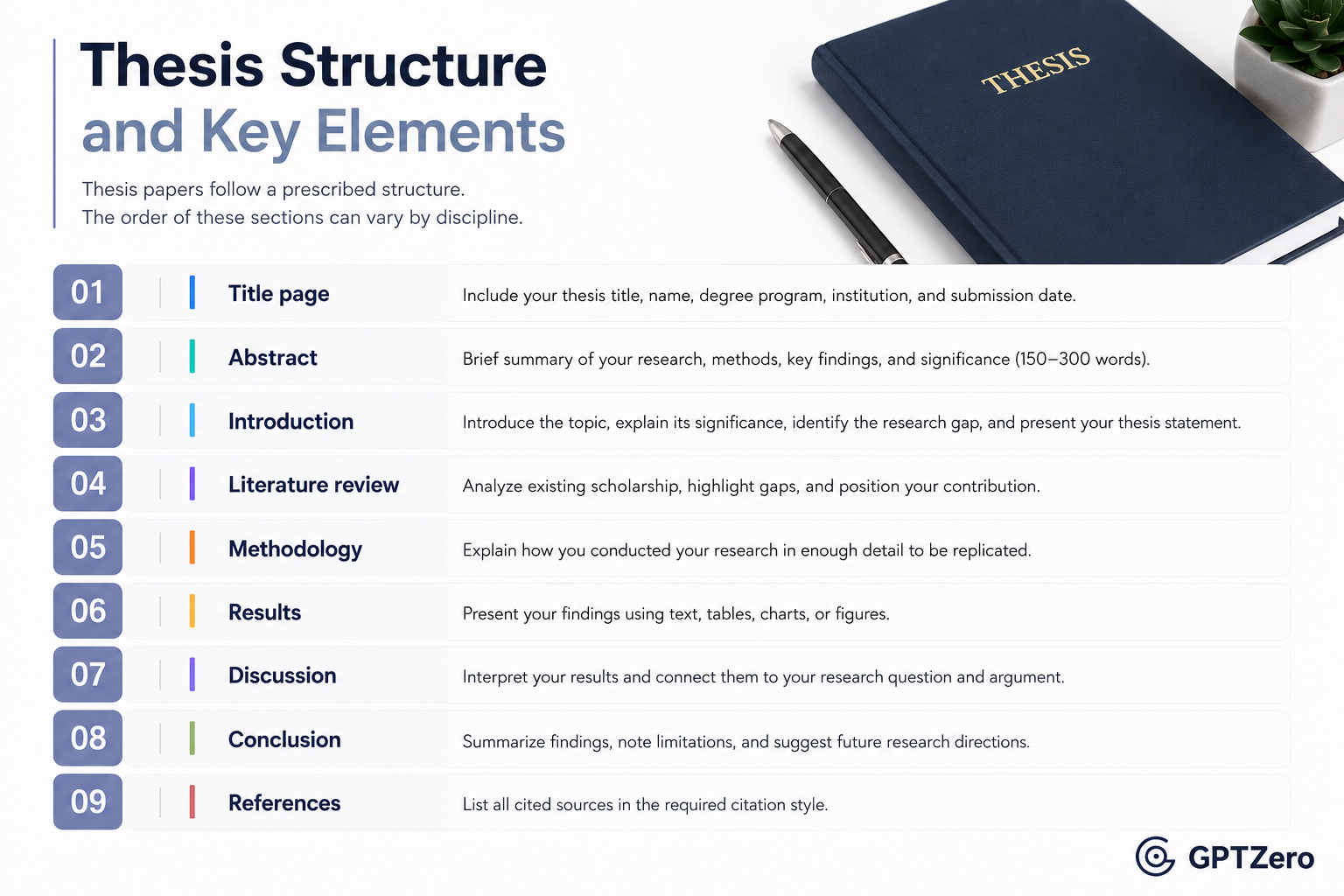
- The thesis follows this structure: title page, abstract, introduction, literature review, methodology, results, discussion, conclusion, and references.
- Most master's theses range from 15,000 to 60,000 words and take six months to a year to complete.
- The most common mistake students make is treating the thesis like a long essay. A thesis has to be structured in chapters.
What Is a Thesis?
A thesis is a piece of academic writing that presents original research, backed by evidence on a specific topic. The thesis paper is usually assigned as the culminating piece of scholarship required to graduate from a Master’s degree, just like a dissertation is required to complete a PhD.
The purpose of the thesis is to stretch your academic skills and prove that you can conduct yourself like a researcher. The thesis paper doesn’t just test your ability to write many thousands of words – it also develops your ability to ask smart questions, see gaps in knowledge, and gather extensive evidence to support your thesis. Arriving at a defensible conclusion is the main challenge with thesis papers.
The thesis paper is a serious undertaking and is usually supervised by a faculty member. Your thesis supervisor is one of the most important choices you are going to make. Choosing the right one can get your paper published in important journals, introduce you to job opportunities, and keep your project on time. A thesis advisor will also try to poke holes in your argument to find vulnerabilities.
Thesis vs. Dissertation
The terms thesis and dissertation are often used interchangeably, especially outside the United States. In the US, a thesis is associated with the completion of a Master’s degree, while a dissertation is the original research project required for the completion of a PhD. A dissertation is a slightly scaled-up version of the thesis. Our guide to writing a dissertation covers the doctoral format in more detail.
Who Writes a Thesis?
Master’s programs in research-based programs almost always require a thesis. Some programs have thesis and non-thesis tracks that you can choose before you enroll. Because thesis work takes months and is usually supervised by a faculty member, that information should be listed in your degree prospectus.
Thesis Structure and Key Elements
Thesis papers follow a prescribed structure. The order of these sections can vary by discipline.
How to Write a Thesis in 8 Steps
Step 1: Refine Your Topic and Research Question
The strength of your topic is what is going to keep your thesis paper together. Your supervisor will likely keep you at this stage until you have refined a strong topic and research question. This preliminary work is what is going to set the scope and direction of the work that is to follow.
Part of selecting your focus will involve seeing what areas haven’t been explored or discussed in previous scholarship. It is possible that your final research question may not appear until you have delved deeper into the next step- the research.
Step 2: Conduct a Thorough Literature Review
Before you write a single word, you will likely spend months buried in reading. Read as widely as you can on your topic. Scan the citation lists of your sources to uncover more. This is the stage where your ideas will start to solidify, and you will begin to spot patterns in the literature. Many students use AI to help surface sources or summarize literature; double-check every reference before you include it. A Hallucination detector can help you confirm that the sources AI surfaces actually exist before they end up in your bibliography.
Step 3: Develop Your Thesis Statement
Your thesis statement summarizes the entire argument of your thesis paper. A strong thesis statement is purposefully debatable with a strong counterposition and competing evidence.
It is common to refine and rewrite your thesis statement as your work develops, so long as the compass is still pointing in the same direction.
Step 4: Plan Your Methodology
Your methodology has to be carefully thought out, and usually with the help of your supervisor. Your methodology should explain how you arrived at your conclusions, and it needs to be rigorous enough to withstand the scrutiny of a defense committee, who are looking for flaws.
Planning matters because of how many downstream decisions and outcomes it affects. It's a good idea to document both the strengths and the limitations of your methodology. Knowing your own blind spots will only strengthen your argument.
Step 5: Build a Detailed Outline and Draft in Chunks
Do you remember pulling an all-nighter in undergrad and writing your last-minute essay just in time for the submission deadline? This approach will not suffice when it comes to thesis writing. Chances are, you have never written something on this scale before. You will need to outline and chunk the writing. Think of your thesis more like a book than a long essay. Each chapter will contain several shorter essays. A chapter-by-chapter sketch that outlines each main point as well as the sources you are going to use as evidence and support.
Don’t expect to be able to hold a thesis in your head from start to finish. That’s why a detailed outline will save you so much time when it comes to the actual writing. You will be able to make progress in a section, knowing that you have thought through its importance vis-à-vis your thesis.
Step 6: Set Weekly Writing Targets
Writing a thesis is a marathon, not a sprint. Ok, if we’re to be honest, it’s a grind. But the best possible kind. The best way to get through this large-scale project is to set weekly writing targets. Don’t aim for brilliant scholarship; aim to sit down and write. Setting even a modest weekly word count can compound over time and give you a complete manuscript before you know it.
Don’t fall into the trap of waiting for long, unbroken stretches of time to do your work. Most graduate students don’t have that luxury, and it just sets unrealistic expectations. Find time to write in pockets of available time throughout your week.
Slow and steady wins the race.
Step 7: Revise Section by Section
Revising a document this size is not possible in one pass. We recommend revising as you go, then doing a full pass once the draft is complete. The first revision pass should focus on structure, logic, and argument. Does each chapter advance your thesis? Are there sections that wander off-topic or that need more supporting evidence?
Once the structure is solid, focus on polish. A good grammar checker will catch typos and awkward phrasing, freeing you up to spend your revision time on the substance.
Step 8: Final Integrity Checks
At GPTZero, we work with millions of students and educators, and we see that many universities now screen submissions for AI use. The best course of action is to hand in a 100% human draft every time.
Before you submit, run a few final checks. An online plagiarism checker catches any citation gaps that accumulate over months of drafting.
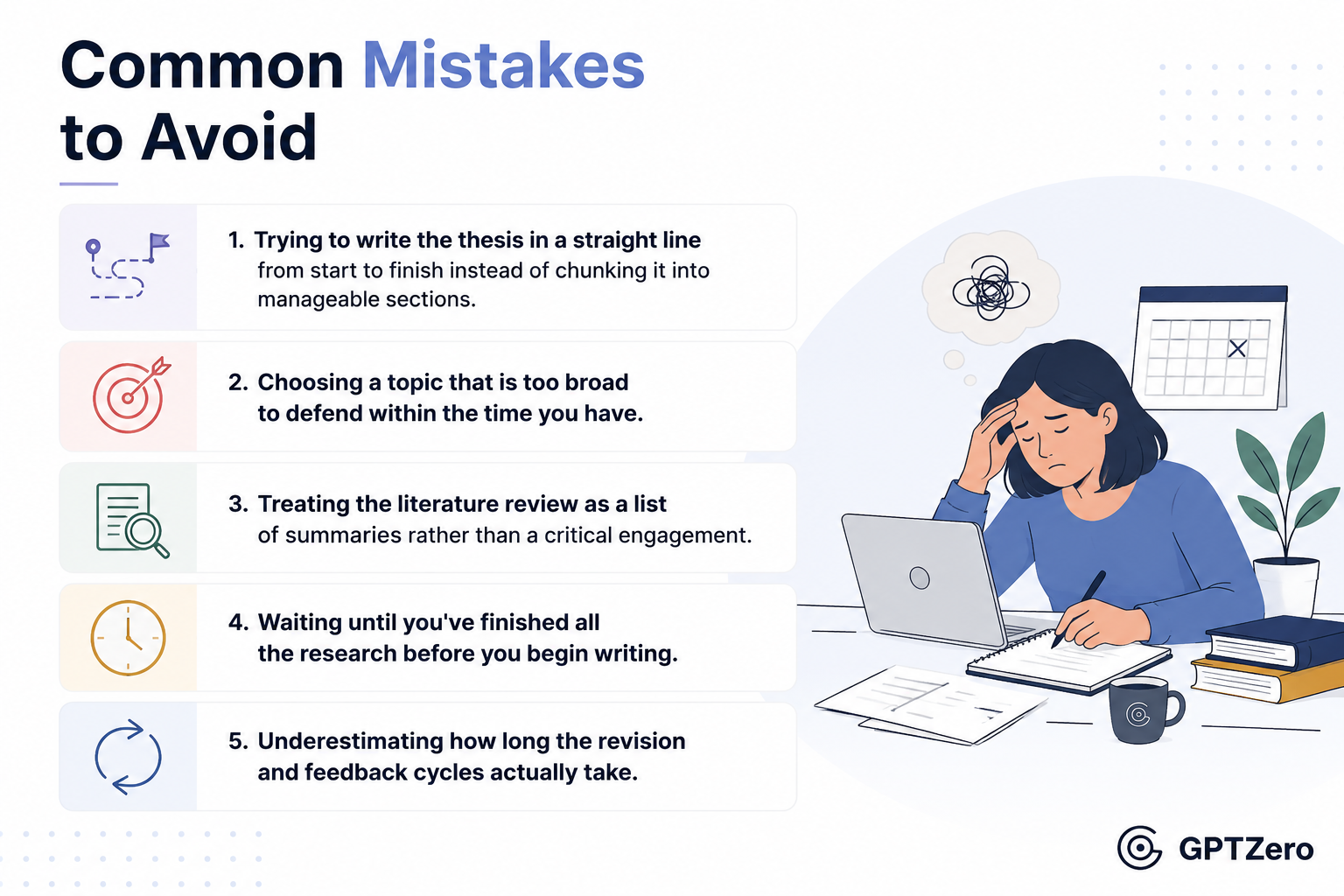
Common Mistakes to Avoid
How to Prepare for Your Thesis Defense
Not all programs will require an oral defense. If yours does, the purpose of the defense is to pressure test your thesis before granting you a degree.
Defenses usually last between one and two hours. You'll be asked to present your research, then answer probing questions about your argument, methodology, and findings.
A few preparation tips:
- Re-read your thesis from start to finish so that you are familiar enough with most of the text.
- Try to anticipate hard questions and prepare to answer them. Your thesis supervisor will be able to help you prepare.
- Practice your opening address out loud. Try to memorize your talking points well enough to be able to deliver them without reading.
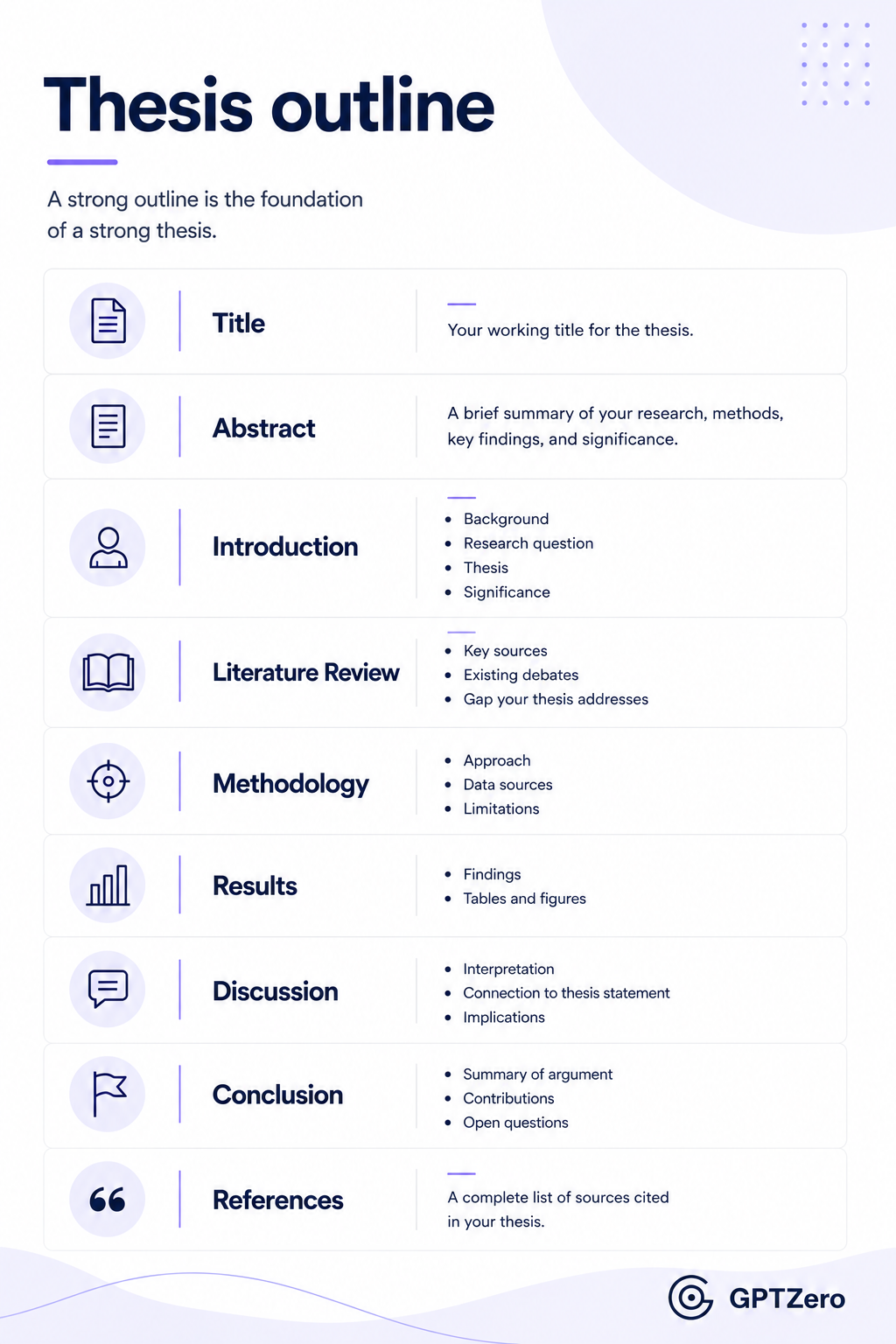
Thesis Template
Use this as the skeleton for your first outline:
FAQs
How long is a thesis?
Thesis papers vary quite a bit in range, but usually fall between 15,000 and 60,000 words. Humanities thesis projects tend to run longer than those in STEM fields. Your department will have more specific guidance on the range.
How long does it take to write a thesis?
It can take six months to a year to complete a Master’s level thesis. Most of the time is spent on research, revision and feedback cycles, with the actual drafting taking three months or so. Treat your thesis like a marathon and set weekly writing targets to make sure you meet your timeline.
What is the difference between a thesis and a dissertation?
In the US, a thesis is written to complete a Master’s degree and a dissertation is written to complete a PhD degree. In Europe, the two terms can be used interchangeably.
Can I write a thesis in one month?
It is not possible to write a successful thesis in a month. The main reason is that thesis writing is not a solo activity. There are formal review cycles that you will have to go through within your department. Even if you used AI heavily, you will still need to hand in a human draft, as many professors now scan their students' work, especially at the graduate level.