
How to Write a Dissertation: A Step-by-Step Guide for Students
A dissertation is the cumulative piece of original research typically required to complete a PhD program.



The prospect of starting a dissertation can be daunting for many students. It can feel impossibly large when you first begin, and unlike most essays or academic papers that may have crossed your desk in the past, the dissertation is not something you can write in an inspired weekend. A project of this size requires careful planning, strategy, and many months of execution.
Although for many, writing at this scale is a new skill, chances are you already have the skills to execute it successfully. The UNC Writing Center has a useful reframing: "It can help to think of your dissertation as an expanded version of a long essay: at the end of the day, it is simply another piece of writing."
A systematic approach is key to success when writing a compelling dissertation. In this guide, we will walk you through how to write a dissertation step-by-step, the structure you need to follow, as well as tips on preparing for your dissertation defence.
TL;DR
- A dissertation is original academic research that presents the writer's own contribution to the field, backed by evidence, observation, and argument, and is normally required for the completion of a PhD.
- The dissertation follows a standard structure that includes: title page, abstract, introduction, literature review, methodology, results, discussion, conclusion, and references.
- Most PhD dissertations range from 50,000 to 100,000 words and can take anywhere from 1 to several years to complete.
- The most common mistake students make is trying to write in a straight line from beginning to end instead of chunking sections.
What Is a Dissertation?
A dissertation is a comprehensive, long-form research document that presents your own contribution to a specific field, supported by rigorous evidence. In most cases, your dissertation will be the cumulative piece of writing required to complete a PhD program.
The purpose of the dissertation is to showcase original thought in the context of evidence. You have to demonstrate thorough and original research and use that research to frame and support your claim. In most cases, you will need to present your dissertation in front of a panel of academics, also known as “the defence.”
The process of writing a dissertation is usually guided by your PhD supervisor and will include proposing a research topic or arena, conducting thorough literature reviews, formulating a hypothesis, collecting data to support it, and finally, defending your findings orally in front of a panel.
Typical Length by Degree Level
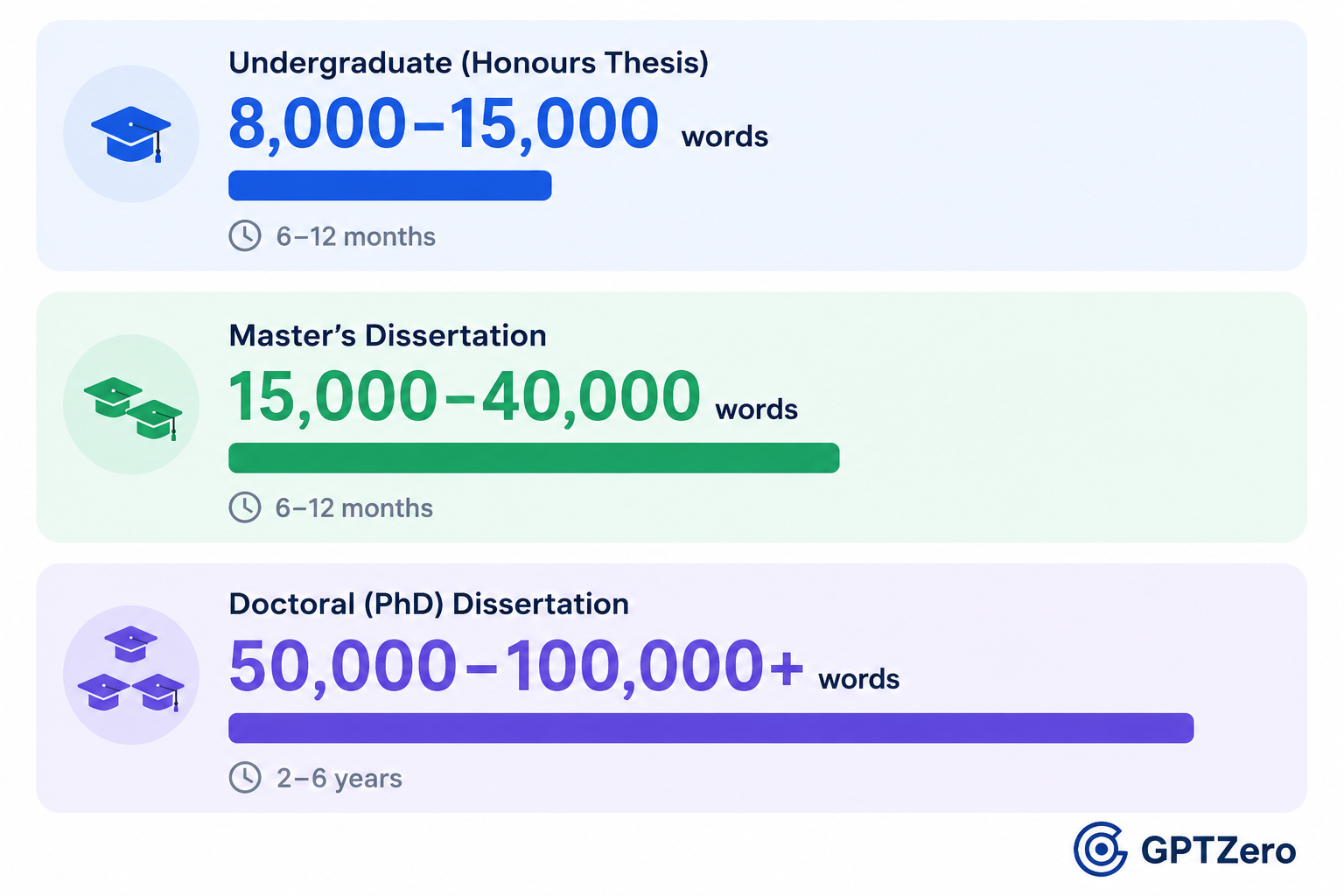
Word counts vary quite a bit when it comes to dissertations. Humanities tend to produce longer papers than STEM fields. A PhD in the sciences may total fewer words than a single chapter in a humanities PhD. Unlike other types of academic work, dissertations do not come with word count limits.
Dissertation Structure and Key Elements
Title page
Your title page should contain the title of your dissertation, your name, degree program, institution, and submission date. Your graduate school will likely provide a required template or specify the citation style you should follow.
Acknowledgments
Similar to a dedication in a book, a short, personal section thanking the people who supported your work, like your PhD supervisor, collaborators, funding sources, and maybe even your mom.
Abstract
The abstract is a short 200- to 350-word summary of your dissertation meant to give the reader a high-level overview of what is covered in your paper. It includes your research question or thesis, methods, key findings, and significance.
Introduction
The introduction section in a dissertation is structured in a similar way to other types of academic papers. Its job is to set up the topic, explain the significance, and identify a gap in the research or body of knowledge that you are going to discuss. It is a preview of your dissertation.
Literature review
Each dissertation includes a critical analysis of existing scholarship on your topic. The idea is that by mapping the existing research, you show the gaps and fill them with your contribution. This is a critical component of a defensible dissertation.
Methodology
Your methodology shows exactly how you went about your research. It gives enough detail that another person can replicate the process. In this section, you can cover things like: data sources, analytical methods, and limitations.
Results or findings
During your time as a PhD candidate, you would have spent years studying a very specific subject in great depth. Hopefully, your work has culminated in a compelling result that contributes original thought to the body of work. The results of your findings are the culmination of that research. Think of it as your PhD thesis or hypothesis.
Discussion
The discussion weaves together the literature, evidence, and your own hypothesis into a structured argument. This is where you carefully arrange your evidence and lead toward your thesis.
Conclusion
The conclusion, which can span many pages in the case of dissertations, summarizes your findings and acknowledges limitations or blind spots. It then points towards future research possibilities.
References and appendices
Your references are a key part of the success of your dissertation. Like your argument, they will be scrutinized by your defense committee. Not only are they looking for how extensive they are, but also for their quality and veracity. If AI tools were part of your research gathering methods, it's important to check for hallucinations before submitting for review to your supervisor.
Ensure you follow the proper citation style and basic formatting standards like 1-inch margins, double-spaced text, and a 12-point readable font.
How to Write a Dissertation Step by Step
Step 1: Refine Your Research Question
As a PhD candidate, you will not be starting with a blank page. By the time you get to the actual writing of your dissertation, you will have had multiple discussions with your doctoral supervisor about the direction and scope of your dissertation. It's important to be crystal clear right at the start. If you are starting with a blurry thesis, your paper will be harder to complete. Take the time to get clear on what you are arguing.
Step 2: Conduct a Thorough Literature Review
Literature reviews can take years. Often, different languages are involved, and PhD candidates have to acquire proficiency in them in order to read the materials they need. You can’t speed past this step. It's easier than ever to gather and summarize information using AI tools. The issue with that is that many students bypass reading. You must aim to be thorough at this stage.
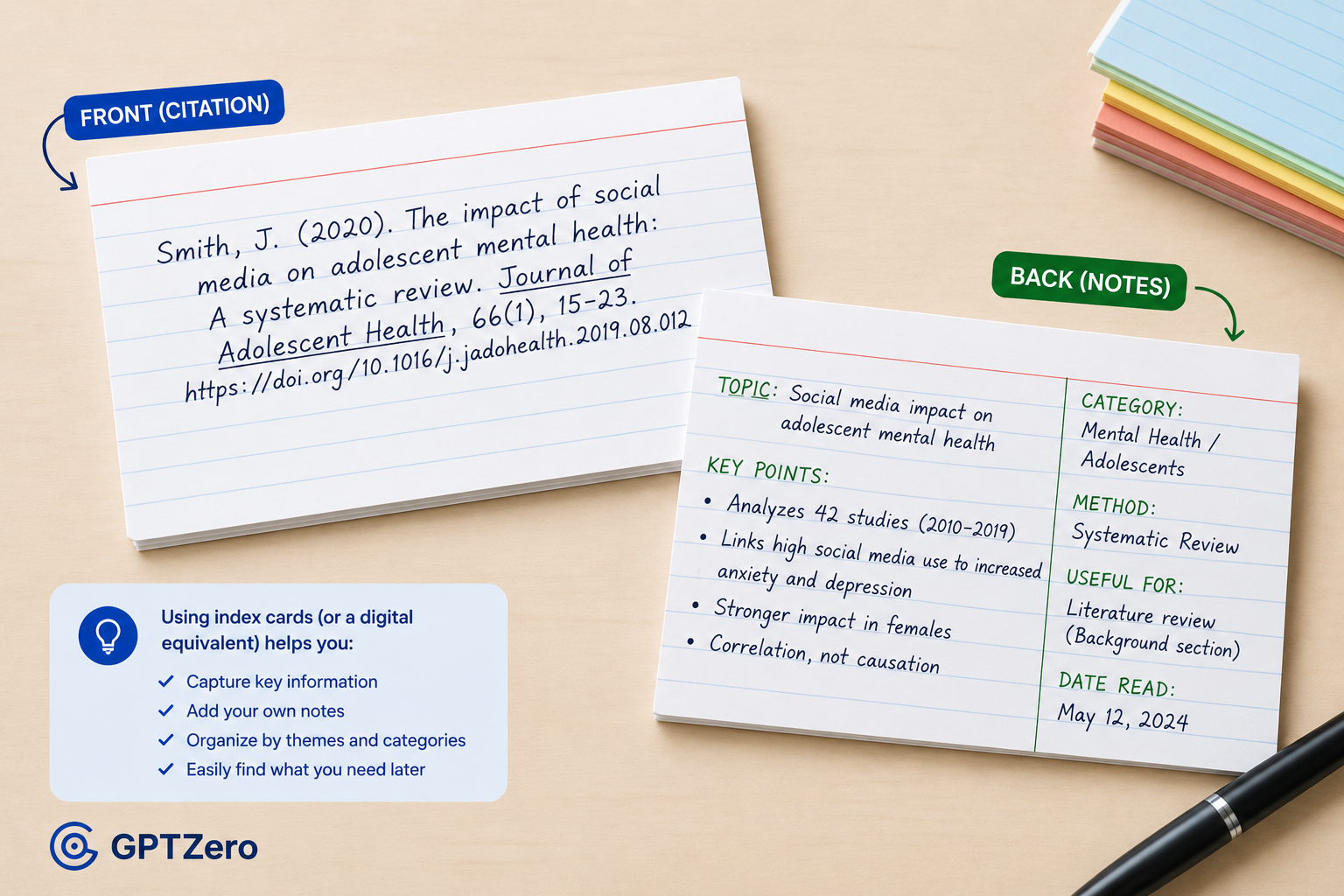
Tip: Organize your sources as you read. Create flash cards with notes on them and put them into categories or chunks. This will help you outline your dissertation later.
Step 3: Plan Your Methodology
This is the part you need to talk through with your advisor. When it comes to writing your dissertation, you need a plan of attack. You will have to share in detail your methodology, or how you came to the conclusion you are presenting. Your defense committee will try to challenge your methodology during the oral defense. You can prepare for that now, but be mindful of how you proceed with the work.
Step 4: Draft in Chunks, Not in Order
Writing a dissertation is not the same as writing an essay. Even longer academic papers, like the research essay, are short enough to hold conceptually and draft from start to finish. Think of a dissertation like you would a book. Most dissertations are as long as published books. Think in chunks or chapters and draft that way. Consider using an AI assistant to help you achieve a 100% human draft on the first pass.
Step 5: Use a Citation Manager and a Solid Outline
As you delve into the research, you will begin to see patterns and ways to organize the different sources into buckets. It’s important to begin with a strong skeleton outline and decide what you will tackle, how, and in what order.
Track every source and make notes. Check for plagiarism or any other issues using a quality AI detector. You want to catch any problematic sources now so you don’t accidentally incorporate them into your work. Always cloud-sync your work.
Step 6: Set Weekly Word Targets
Many PhD students struggle with the grind of writing a dissertation. It's really a marathon, not a sprint. It can take years to draft and many months to edit and refine. The trick is to set aside weekly writing time and aim for a modest and manageable word count. Relying on days of free time when you are likely also teaching a heavy course load is not realistic. Slow and steady wins the race.
Step 7: Revise Section by Section
Revision of such a large document can be a challenge. We recommend revising as you go and doing the work in chunks. A good grammar checker will handle much of the busy work, and you can focus on the structure and argument.
Step 8: Final Quality and Integrity Checks
At GPTZero, we work with millions of educators and students. We see that many universities are choosing AI screening tools as a way to ensure the future of academic integrity and quality research. You should expect that your paper could be scanned for AI use. The best course of action here is to hand in a 100% human draft.
How to Prepare for Your Dissertation Defense
What a defense is
Not all, but many PhD programs have an oral defense component. You are assigned a committee that is tasked with pressure- testing your dissertation before you are granted your doctorate. Finally!
During the oral defense, you will answer probing questions about your thesis, methodology, and findings. Typically, these defenses last 2-3 hours
Quick preparation tips
- Go over your dissertation and even re-read it from front to back. Be familiar with what you wrote.
- Be prepared for hard questions and see if you can anticipate where they may focus. Craft answers in advance.
- Practice your presentation out loud. Learn your talking points without a script or reading.
Dissertation Examples
Reading other dissertations can be a great way to deepen your research while getting a feel for structure and flow. Most universities host their own dissertation databases and will have paper copies in their library system.
Here are some online places to find dissertation examples:
- ProQuest Dissertations & Theses Global — the largest single dissertation database, covering most US institutions and many international universities.
- EThOS (British Library) — a free database of UK doctoral theses.
- DART-Europe — open-access European doctoral theses.
FAQs
How long is a dissertation?
Dissertations are very extensive pieces of writing and are book-length. You can expect anywhere from 15,000 to 40,000 words, with dissertations in the humanities exceeding that number sometimes.
How long does it take to write a dissertation?
Many factors affect the time it takes. The clarity of your thesis, the pace and involvement of your supervisor, and your own productivity. A work of this depth can take a year or two to assemble.
What is the difference between a dissertation and a thesis?
A dissertation specifically relates to the Doctoral degree. Usually, a thesis is something you write for a master's degree.
Can I write a dissertation in one month?
It's impossible to speed up the rigorous process of writing a dissertation. The calibre of work you have to present couldn’t take that little amount of time, even with help from AI.
How many references should a dissertation have?
This varies widely by field, but you can expect to reach a hundred or more by the time you are done.