
What Is Technical Writing? A Complete Guide
Technical writing is a type of professional writing that turns complex information into clear, accessible content for a specific audience.


Technical writing is everywhere in everyday life, but you probably haven’t noticed it. It's the writing behind the software documentation you skim, the appliance setup instructions you follow, the API references you copy from, and the safety procedures pinned to factory walls.
If a product or process needs to be understood by someone who didn't build it, technical writing is what enables that. Tami Love, a senior technical writer and communication instructor at Southern New Hampshire University, sums it up: "A technical writer takes complex information and transforms it into consumable content based on the user's needs. The documentation is just as important as the product or service that it documents."
If you are thinking of becoming a technical writer and are curious about what it takes and what to expect, this guide is for you.
We will cover what technical writing is, what a technical writer actually does, how to break into the field, and some industry examples and tips to get you started.
TL;DR
- Technical writing turns complex information into clear, accessible content that helps users accomplish a specific task.
- It shows up across nearly every industry: software, healthcare, manufacturing, government, finance, and education.
- The strongest technical writing is invisible. Readers don't notice it because it just works.
What Is Technical Writing?
Technical writing is a form of professional communication designed to inform a specific audience about a specific task, product, or process. Every choice in the document, from word selection to layout, exists to serve the reader's ability to act on the information.
Purpose
Technical writing exists to remove friction between knowledge and use. A user opening an app for the first time, a nurse setting up a new monitor, an engineer onboarding to a codebase. All of them need information that they can act on quickly, without spending mental energy on figuring out what the writer meant.
Audience
Unlike most other writing, technical writing isn't written for a general audience. Each document is built for a defined audience with defined needs. End users, developers, technicians, patients, regulators, and internal teams. Knowing exactly who you're writing for shapes every other decision in the document.
Goal
The goal of all technical writing is to enable the reader to accomplish a task, whether that is assembling a new chair or completing a complex industrial installation.
Key characteristics
Technical writing reads very differently from most other nonfiction prose. The strongest technical writing is concise and only features the minimum information needed to convey an idea. The best technical writing examples are also highly aware of their intended audience, including only the information relevant in that particular context. Visual communication is also a big part of technical writing. Often, presenting tables, diagrams, or screenshots helps readers comprehend quicker.
Why it matters
Because technical writing is tied to enabling action, there are often real-world consequences to confusing or unclear technical writing. For example, a medical device manual that is unclear or confusing to the end user can result in real consequences for patients. Good technical writing should feel invisible.
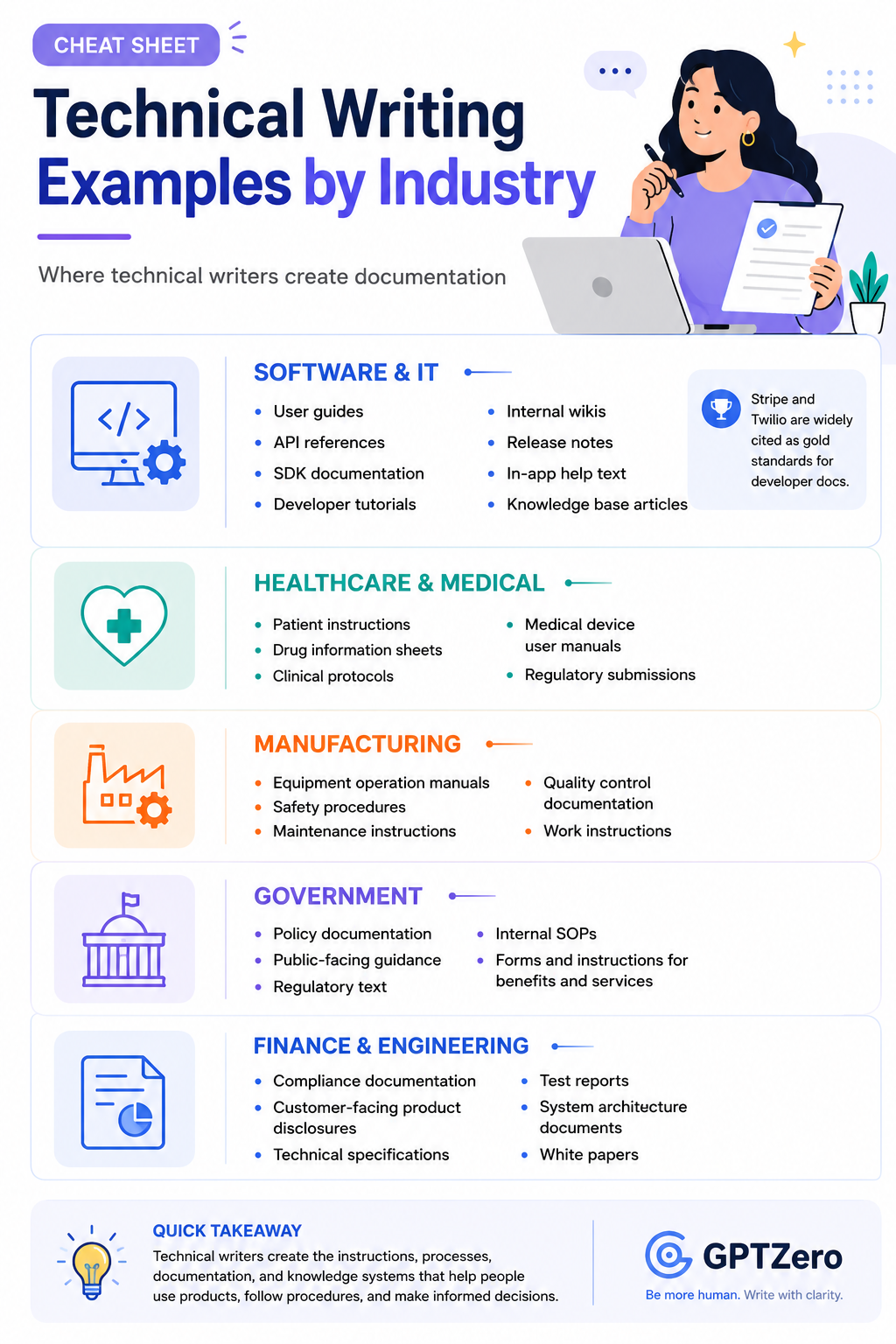
Technical Writing Examples by Industry
What Does a Technical Writer Do?
Think of a technical writer like a translator. Surprisingly, much of the job doesn't involve writing. A large part of the job is extracting information, organizing ideas, and interviewing experts. Here's a rough idea of a week in the life of a technical writer:
Research
Interviewing subject matter experts, reading source material, and testing the product or process firsthand
Planning
Mapping the document structure, defining audience needs, deciding what to include and what to leave out, and choosing the right format.
Education
Building enough familiarity with the subject matter to write about it credibly. Most technical writers become experts in many domains over the course of their careers.
Writing and revision
The actual drafting, then revision based on feedback from subject matter experts, user testing, and editorial review. Today, many technical writers use AI tools to help them with cleaning up grammatical mistakes and catching hallucinations.
Collaboration
You will find technical writers interacting with almost every department in your organization. They work with CEOs, engineers, designers, product managers, legal teams, external agencies, and sometimes media.
Did you know technical writers can command high salaries? Just look at the top job postings for technical writers:
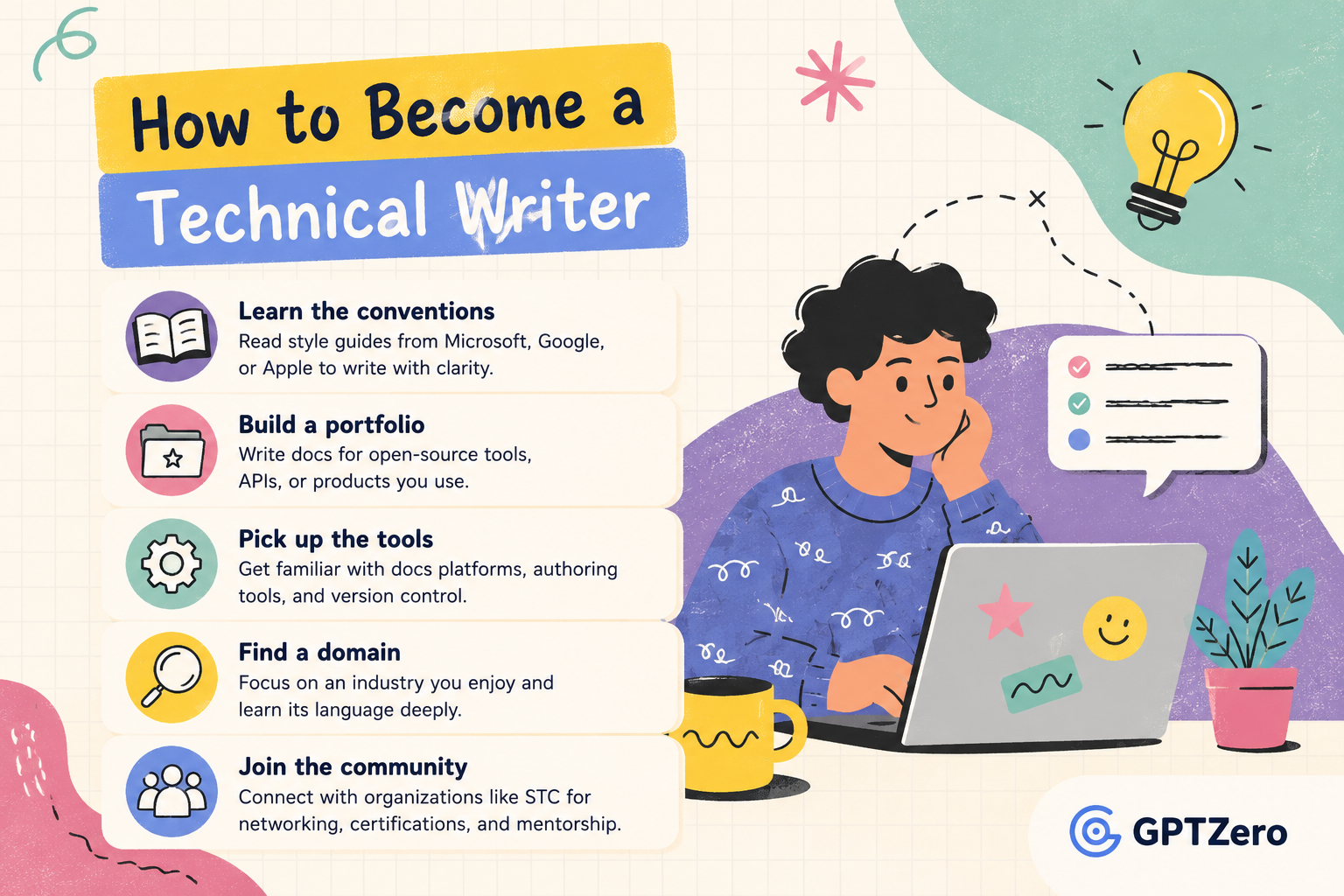
How to Become a Technical Writer
Technical writing can be a lucrative career option for graduates from diverse fields. In fact, many technical writing positions ask for relevant experience or education, depending on their niche area.
The wonderful thing about technical writing is that there is no single path to get there. It really is all about getting your foot in the door and getting that experience under your belt, and building on it. That being said, it is helpful to have mastery over the English language, and degrees in communication, English literature, or journalism tend to provide the foundation you need to jump right into technical writing.
Tips for Effective Technical Writing
- Know your reader before you start writing. Understand what their context is and know what they need to understand to complete the task.
- Remember, technical writing is task-oriented. Lead with the task or the outcome. Users come to documentation with a goal, so open with what they're trying to accomplish.
- Use plain language. Even when writing for experts, simpler language reads faster and reduces misinterpretation. Never try to sound smart. Choose clarity.
- Diagrams, screenshots, code samples, and tables often communicate faster than prose.
- Test on real users and adjust.
Tip: AI tools are increasingly part of the workflow, especially for drafting first versions and surfacing reference material. An AI detector extension can help you check whether you are working from a human draft.
FAQs
What qualifications do you need to be a technical writer?
Qualifications for this career are more flexible than in many other fields. Although degrees in English, communications, and journalism are a natural fit, a strong portfolio and expertise in a relevant area can outweigh many formal educational requirements. Many technical writers move into the field from engineering, healthcare, or other technical backgrounds and learn the writing craft on the job.
What's the difference between a technical writer and a technical editor?
The writer is responsible for the process all the way to the polished first draft, which includes research, interviewing, outlining, and writing. An editor is there to refine the work and make sure it follows style guides and other quality standards.
Can AI replace technical writers?
AI can greatly speed up the process from idea to first draft, but it’s not a reliable replacement for a skilled writer. It can also make mistakes and hallucinate. It requires human oversight at almost every part of the writing process. That being said, it’s a powerful scaling tool for writers who are open to collaborating with an LLM.