What is Narrative Writing? A Guide
Learn what narrative writing is, how it differs from informational writing, and what makes stories compelling. Explore narrative elements, common styles, practical writing tips, and examples to help you craft engaging, memorable narratives.


Narrative writing is a rhetorical style that tells a story. Stories can have powerful effects on those who hear them; they can change our minds, open our hearts, and encourage us to change our lives. Researchers have found that narratives make messages more persuasive.
Unlike informational material like brochures and textbooks, narrative genres like films, novels, or journalistic storytelling have a much greater effect on our beliefs, attitudes, and behaviours. Political messaging uses narrative writing to make ideological appeals; advertisements tell narratives to push products; and song lyrics tell stories about the depths of human emotions.
Brush up on your narrative writing by learning about the features that make narrative writing interesting and compelling. This guide will teach you the styles and characteristics of narrative writing, and discuss effective techniques you can adopt to make your storytelling land with impact.
Defining Narrative Writing and Its Purposes
What does narrative writing mean?
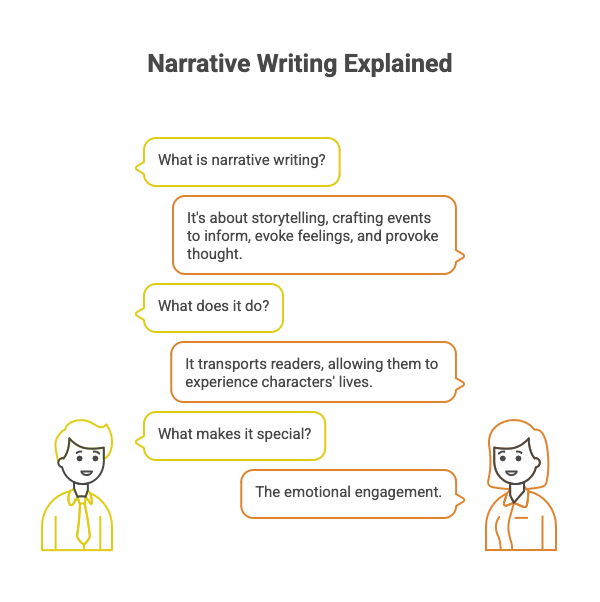
Another term for narrative writing is story writing: it’s a written account of connected events that can be either fictional or nonfictional. This common rhetorical style allows a writer to engage their reader with a story.
Characteristics of narrative writing
A narrative style of writing requires a sequence of events that can be told as a story. These events might be told in chronological order, or the writer may tell the story in a different sequence to create suspense or intrigue. Often, writers will use description and imagery about settings and characters not only to convey information, but also to help readers connect with the story imaginatively and emotionally.
How is writing a narrative different from giving information?
Here’s information about the Alberta Badlands:
“The Alberta Badlands are arid and rattlesnakes live there. Joseph Tyrell discovered dinosaur fossils there in the 1880s.”
Now, here’s a narrative set in the Alberta Badlands:
“I went hiking in the Alberta Badlands because I dreamed of digging up a great big dinosaur fossil just like Joseph Tyrell in the 1880s. Sadly, I had a terrible time! The air was hot and dry, the wind kept whipping sand and dirt into my eyes, and the sound of rattlesnakes hissing in the bushes scared me so badly I turned around early and went home.”
The same information is present in both accounts, but the narrative has embedded that information within a sequence of events that are told with the trappings of storytelling, like description, emotion, and voice.
When to use narrative writing
As you can see in the example about the Badlands above, narrative writing adds details and perspective in a way that lengthens the text. This is not always the correct move if you’re writing a professional or academic document that requires your writing to be concise and unbiased.
However, there are often moments, even in professional or academic writing, where narratives can be used very effectively. Narrative writing aims to relay a set of events in an emotionally engaging way, and this can be useful to emphasize events and their significance. A well-placed and well-told story can deliver impact, snag attention, or spark concern; this is exactly what a powerful essay hook aims to accomplish.
Elements of Narrative Writing
Plot, setting, and character
What happened? Where did it happen? Who was involved? Plot, setting, and character are core elements to any story. Plot is the sequence of events that happen in the narrative. Setting is the location and time period in which the story’s events take place. Characters are the beings (people, animals, or other sentient individuals) who appear in the plot and advance the story through their actions.
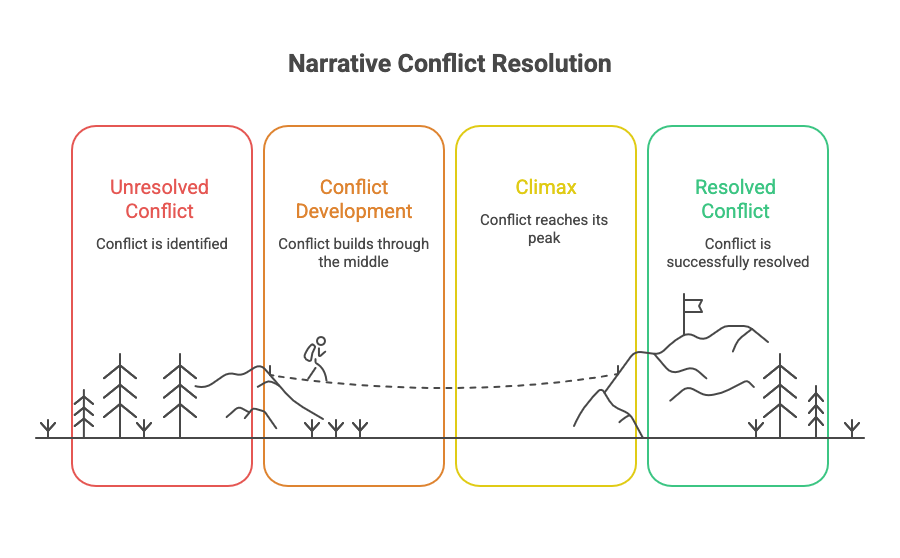
Sequencing and conflict are integral elements of the plot. A typical narrative structure has a beginning, middle, and end; conflict is identified and develops in the beginning, it builds through the middle and reaches a climax, and then the conflict is resolved by the end.
Theme
The theme of a narrative is the overarching idea that the writer is trying to convey. Sometimes the theme is obvious, as with a superhero comic exploring the theme of good versus evil. Themes often address complex issues, and a story may have several overlapping themes.
In Harper Lee’s To Kill a Mockingbird, one of the core themes is confronting racial injustice with moral courage, and this theme is explored through Tom Robinson’s trial and the actions and beliefs of Atticus Finch. You could also argue, however, that loss of innocence is a central theme, as the story is written from the perspective of the child Scout, who comes to understand that many of the people around her are not inherently good.
Check out Oregon State University’s video about what a theme is in literature to find out more.
Voice
Characters show voice, and we often see it through dialogue or inner thoughts, but narration also has a voice. This is apparent when the narrator is themselves a character, as in a first-person point of view narrative, but even a third-person omniscient point of view is using some form of voice.
Narrative voice comes in a wide range of styles, from an impassive voice aiming for neutral realism to a slangy and colloquial mode of narrating, and so many more. Learn more about narrative voice from The Open College of the Arts.
Tip: An AI detector can help you identify passages that are robotic-sounding so you know where and how to bolster your unique voice.
Types of Narrative Writing
Different types of narratives suit different purposes, and knowing when to use them can make your writing more impactful. Narration may be “linear, nonlinear, historical, viewpoint, or descriptive.”
Linear vs nonlinear
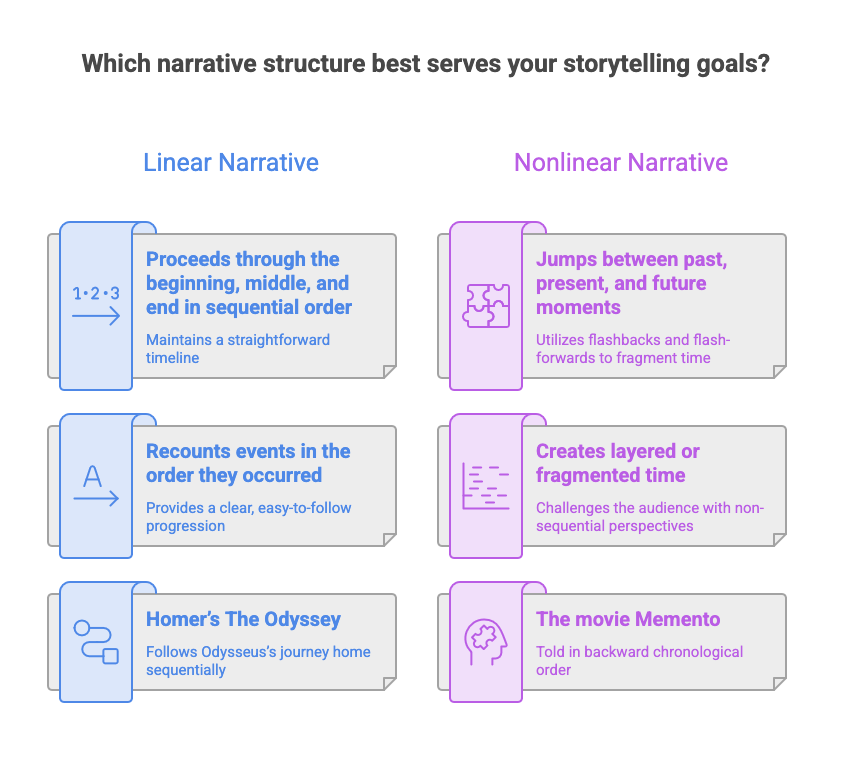
Most narrative writing is linear: it starts with the earliest event and proceeds chronologically through the beginning, middle, and end. There may be time jumps that create gaps of time, but the narrative remains linear if it recounts events in the order they occurred. A classic example is Homer’s The Odyssey, which tells the events of Odysseus’s journey home in sequential order.
Nonlinear writing jumps around between past, present, and future moments. The narrative usually uses flashbacks and flash-forwards, or switches perspectives to retell events, creating a fragmenting or layering of time. A famous example is the movie Memento, which is told in backward chronological order as the protagonist struggles with amnesia.
Historical
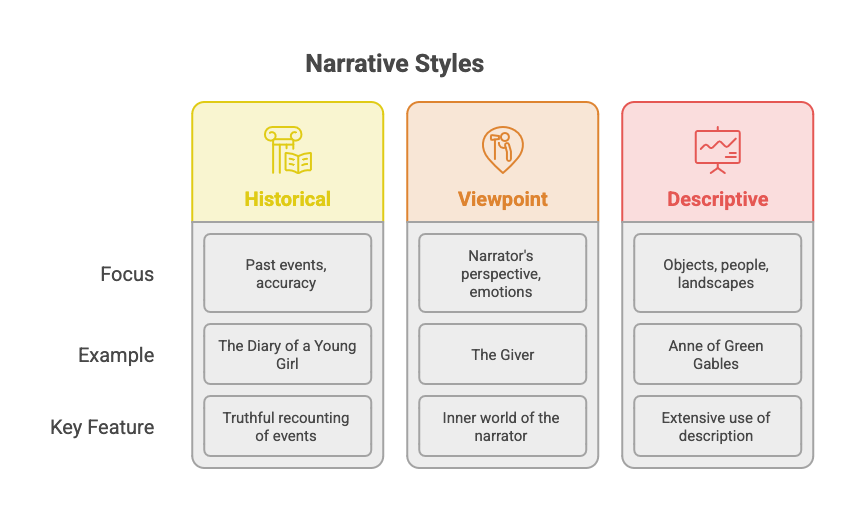
A historical narrative takes place in the past and attempts to recount events as truthfully and accurately as possible. One of the most famous and important historical narratives is Anne Frank’s The Diary of a Young Girl, which gives a firsthand historical narrative of a Jewish family hiding during the Holocaust.
Note: a historical narrative is different from historical fiction, which deliberately introduces imaginary events or characters into real historical settings.
Viewpoint
A viewpoint narrative centers on telling a story strictly through a narrator’s perspective. It embeds the narrative firmly in the inner world of the character telling the story, focusing on the emotions and perceptions that shape the narrator’s worldview. The Giver by Lois Lowry reveals the story’s plot twist through the limited and changing perspective of the young boy Jonas.
An unreliable narrator is a narrative technique that tells the story through a viewpoint that is heavily biased, delusional, or otherwise skewed so that readers begin to notice that they are being told a heavily edited version of events. This narrative style often leads to a revealing twist and exposes the psychology of the narrator themselves. Strong examples of this include the movie Fight Club or the novel Life of Pi.
Descriptive
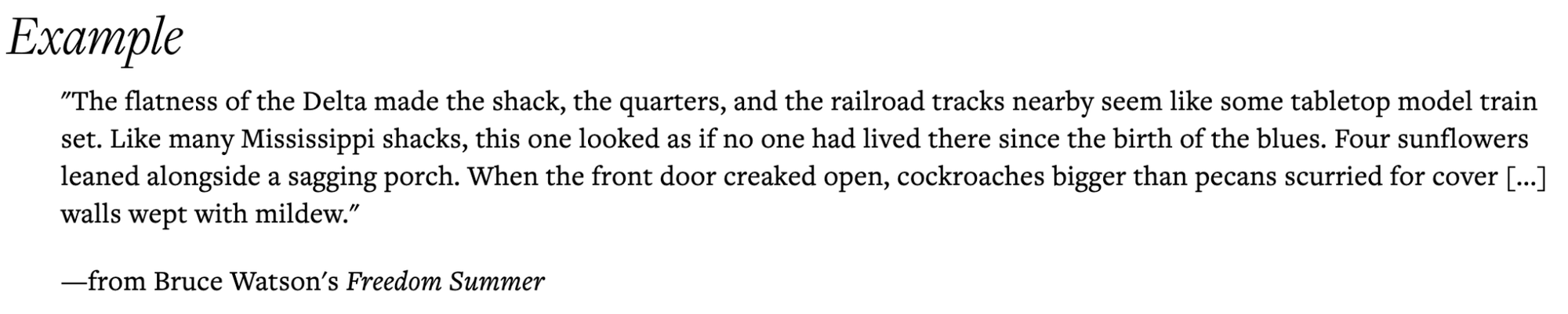
This style of narrative writing makes use of extensive description. It focuses less on characters’ actions and more on how objects, people, and landscapes look and feel. Lucy Maud Montgomery’s Anne of Green Gables is known for lush descriptions of Prince Edward Island.
Miami University notes that narrative writing often uses “thick description”, which includes “not only facts but also commentary and interpretation. The goal is to vividly describe an action or scene, often through the use of metaphors, analogies, and other forms of interpretation that can evoke strong feelings and images in your readers' minds.”
3 Tips for Narrative Writing
Show, don’t tell
Use descriptive writing to transport your reader into your narrative. It is more compelling for a reader to “see” something and understand it for themselves than to have the narrator simply state it as a fact.
“I said I wasn’t going to the party, and Alex got angry.”
Above is a simple statement of fact that leaves us with little impression of how Alex’s anger was expressed or felt. Below, anger is not explicitly stated; it’s perceived:
“I said I wasn’t going to the party and Alex’s hands tightened into fists, white-knuckled and trembling.”
Eliminate grammatical mistakes
A common error to watch for is tense confusion, and this is especially tricky in narratives that jump between past and present. Make sure that events in the past are told in the past tense, events in the present are told in the present tense, and the two do not become mixed together.
Detect and edit errors with a grammar checker to create a smooth reading experience.
Practice, practice, practice
If you want to improve your writing, immerse yourself in the task. Strong writers read other strong writers. Find examples of writing that you want to emulate, and as you read, be aware of the techniques and styles that other writers use to achieve the effects you admire.
Check out The New York Times’ teaching guide on narrative writing with prompts and lessons.