How to Write a Letter of Recommendation
Learn how to write a compelling letter of recommendation with this practical guide. Explore what to include, how to gather supporting information, when to decline a request, and how to use a simple outline and customizable template.


Finding opportunities isn’t just about who you know – it’s also about what the people who know you are willing to say about you. A strong letter of recommendation is a compelling vetting tool because, unlike a cover letter or the contents of an application, this information isn’t controlled by the applicant. It gives selection committees a unique glimpse into the person’s reputation and their observable traits and accomplishments.
If you’ve been asked to write someone a letter of reference, you’ve been entrusted with conveying, to the best of your knowledge, someone’s strengths and potential for a position. It’s a crucial document in an application package, and it needs to convey compelling information with as much candour and specificity as possible.
This guide explains what a letter of recommendation does and what points of information should be included. It helps tackle common challenges, like assessing whether you should write a letter or decline a request to do so, and seeking appropriate supporting documents to inform your letter. Review a simple letter outline and customize a basic recommendation letter template to craft a polished and persuasive letter.
What is a Letter of Recommendation?
Purpose
As part of an application package, a letter of recommendation aims to provide information that cannot be gleaned from other parts of the application, such as a resume or cover letter. Students often need a recommendation letter when applying for admission to university or an internship, or seeking financial aid.
Who should write one?
You should only write a recommendation letter if you can legitimately and enthusiastically support the student in their application. If you don’t feel that you can provide your full and unreserved support for the student’s candidacy, or if you lack sufficient knowledge about the student, it is okay to decline to recommend them.
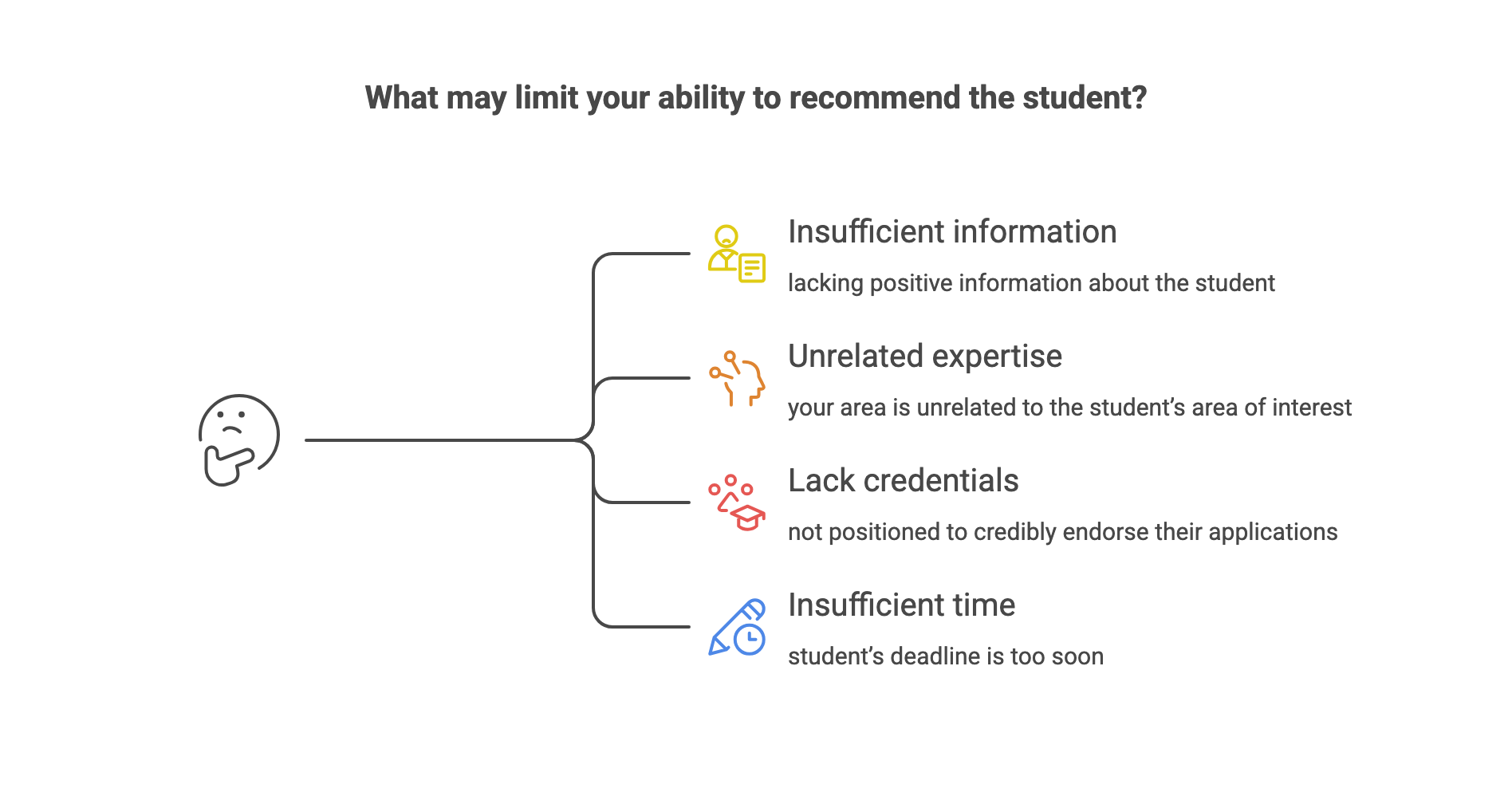
It is much kinder to politely and firmly turn down a student’s request for recommendation than to damn them with faint praise by submitting a weak recommendation that will sabotage their chances. Any of these reasons may make it appropriate to decline a student’s request for referral:
- You lack information about the student, or they haven’t performed well enough.
- Your field of expertise may be unrelated to the student’s area of interest.
- You may lack the necessary credentials to offer a compelling recommendation. For example, graduate student instructors may feel as if they cannot credibly endorse their students’ graduate school applications.
- You may not have time to write and proofread a strong letter before the student’s deadline.
Be fully upfront with students if you feel there are limitations to your ability to write them a strong recommendation. Your honesty may help students select a better referrer (give them suggestions if you can), or help them seek a second reference that fills in the gaps you cannot address.
What supporting materials do you need?
Always ask students to submit materials and information that will help you write a strong reference. Some students are already aware of how to assist you in writing the strongest letter or reference possible, but others may need to be prompted to provide:
- Documents that the student is submitting to the employer or graduate program - resume/CV, cover letter/personal statement, transcript, etc.
- Links to the specific jobs, internships, or graduate programs
- Any specific information the employer or graduate program wants you to address in the letter
- Copies of assignments the student completed for you in previous courses or work experiences
- Instructions on where and how to submit the letter
- Deadline to submit the letter: It is the student’s responsibility to request a letter of recommendation within a reasonable amount of time before the deadline. Faculty and staff should not feel obligated to write letters on an unreasonable timeline.
What to Include in a Letter of Recommendation
Elements to cover
You may be able to comment more about some attributes than others, but if you had a supervisory or mentorship role with a student that enabled you to observe their research or their work as an intern, you should seek to cover:
- Your relationship: How long have you known the student and in what capacity? Give the reader a frame of reference that contextualizes your perceptions of the student.
- Their contribution: What did the student accomplish, and why did it matter to the project?
- Their independence: How much guidance did they need, and how were they able to act autonomously?
- Their role on the team: How well did they collaborate, and how critical was their role?
- Their knowledge and skills: What competencies and accomplishments have you observed?
- Their research abilities: Consider their “originality, intellectual daring, insight, creativity, perseverance, and integrity” and connect these traits to concrete examples.
- Comparison: How does this student measure up to others you have worked with?
- Their motivation: What drives the student’s interest in research?
If you taught the student in a course, then your letter should seek to connect their performance in your class to their research and career aspirations. Give specific information about:
- What capacity you have worked with the student and how long you have known them
- How well they’ve performed in class and other academic work
- Specific assignments or topics where they excelled
- Extracurricular activities you are aware of that signal their contributions to intellectual life and community
If possible, you may try to comment on the student’s fit with the program or department they’re applying to. Depending on your own level of professional experience and institutional knowledge, you may or may not be able to offer these connecting insights. Oregon State University offers some incredibly useful advice about popular programs and scholarships, and what the admissions/selections committees tend to expect and prioritize in their decisions.
Format
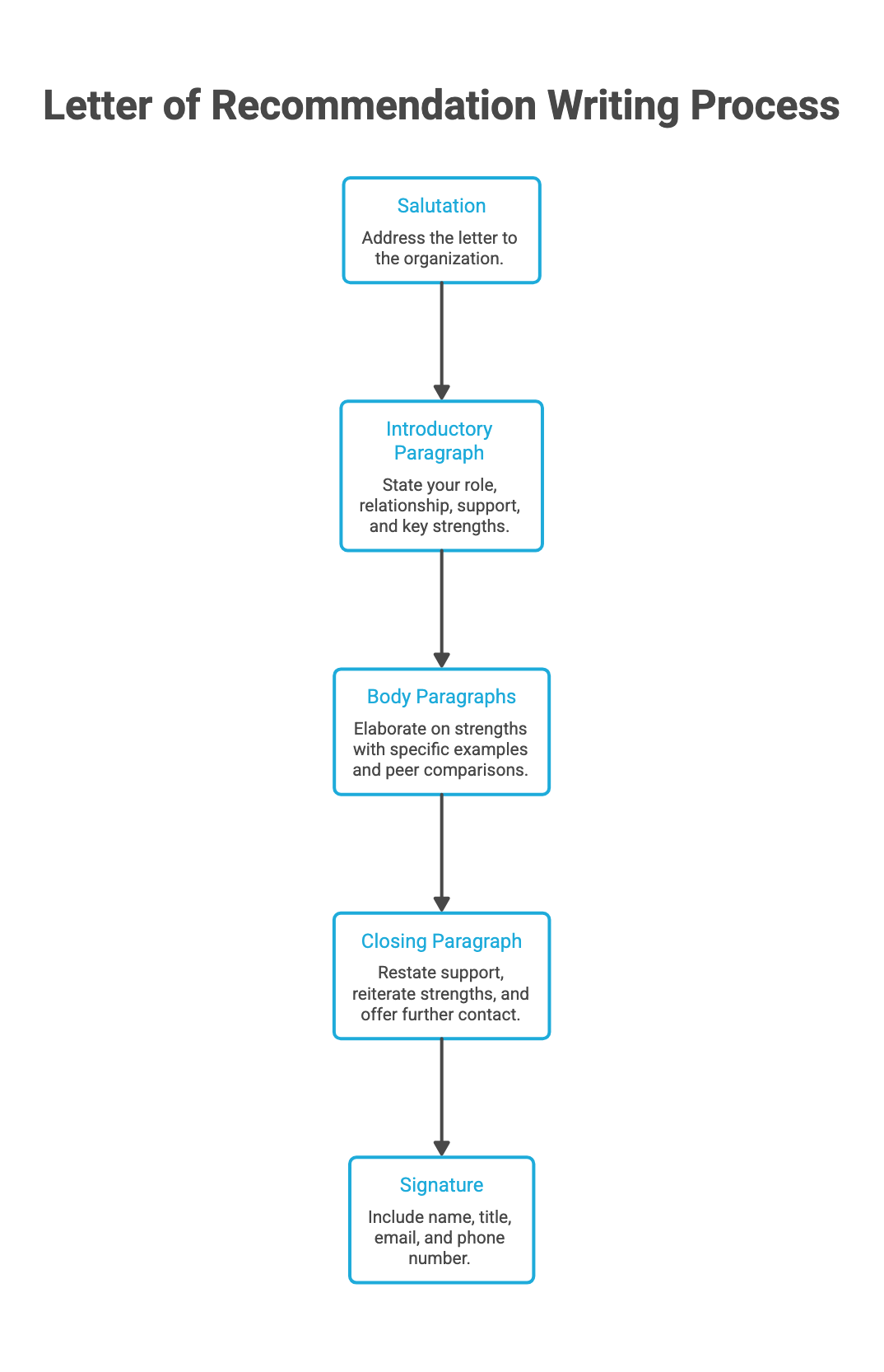
As a professional piece of correspondence, a letter of recommendation should use formal language and follow conventions for formatting a formal letter. Generally, 1 page is the ideal length unless otherwise specified in the application. Most letters of recommendation follow an outline like this:
Salutation: Address your letter to the organization the student is applying to.
Introductory Paragraph: Introduce yourself (your professional role and title) and state your relationship to the student, including how long you’ve worked with them. State your support for the student’s application and identify 2-3 strengths or skills that make the student an ideal candidate.
Body Paragraph(s): Elaborate on the student’s strengths identified above. Give specific examples from your work with them. Compare their work to the work of their peers.
Closing Paragraph: Restate your support for the student’s candidacy and briefly reiterate their strengths. You may invite the reader to contact you for further details if you wish.
Signature: Include your name and title. You may also include your e-mail and phone number.
Recommendation Letter Template
The University of Cincinnati offers this simple, customizable template for a recommendation letter that includes the necessary formal formatting features:
[Your Name]
[Your Position]
[School Name]
[Date]
Admissions Committee
[College/University Name]
Dear Admissions Committee,
I am pleased to recommend [Student's Full Name] for admission to [College/University Name]. I have known [him/her/them] for [number] years as their [role, e.g., teacher, coach], and in that time, [he/she/they] has demonstrated strong academic abilities and admirable personal qualities.
In [subject/class], [Student's First Name] consistently performed at a high level, showing a deep understanding of the material and a strong work ethic. For instance, [he/she/they] led a successful project on [specific topic], which was particularly impressive for its [specific attribute, e.g., creativity, thoroughness].
Beyond academics, [Student's First Name] is known for [his/her/their] integrity, leadership, and commitment to [specific interest or field]. I am confident that [he/she/they] will thrive at [College/University Name] and make a valuable contribution to your community.
Please feel free to contact me if you need further information.
Sincerely,
[Your Name]
[Your Title]
[Your School]