The Ultimate Guide to Writing a Thesis Statement
A strong thesis gives your essay focus, direction, and purpose. Discover how to develop a clear, debatable argument, explore five common thesis types, and use practical strategies to refine your statement and avoid common pitfalls.


Ah, the thesis statement—is there any part of an essay more intricate or more vital?
A strong thesis statement is the shiny central hub of your paper; it ties everything together and highlights the purpose of the paper and the connections between its parts. If you want to make a compelling argument that convinces your reader through well-organized reasoning, you need a properly refined thesis.
Why a thesis statement matters:
- It focuses your paper, giving a clear and coherent direction for your argument.
- It sets reader expectations, which allows them to better follow your argument.
- It demonstrates critical thinking and awareness of relevant debates.
- Grading rubrics often award a significant percentage of the mark to the thesis statement.
Follow this guide to learn what makes a strong thesis and follow six simple steps to draft and perfect your own. Review common types of thesis statements, consider helpful tools and templates to lend you a hand, and learn about common mistakes to avoid.
What Makes a Strong Thesis Statement?
“A thesis is the summary of your argument.” Crafting a thesis statement requires you to condense a lot of information into (ideally) one sentence (maybe two) that encapsulates what the paper is arguing and how. No mean feat!
A well-made thesis is invaluable to the reader. It primes them to anticipate and understand your argument, and–most importantly, if you’re being graded on the essay–it shows that you understand and are in control of your argument.
Precise
A thesis statement must have an obvious focus. It needs to make an exact claim about a specific topic. The claim should be decisive and unambiguous: avoid unspecific words like “some” or “may” that dilute the focus of your argument.
Have a clear-cut topic and be able to identify exactly what you’re making your argument about. A coherent essay requires sustained focus on a clearly delineated subject without ambiguities about what’s included and what’s not. Your thesis will not refer to “some people who experience seasonal affective disorder”; you will select a much more specific focus like, “men aged 17-25 who have undergone 2 months of light therapy for seasonal affective disorder.”
Debatable
Avoid “water is wet” arguments. A thesis should not be a factual statement. If you cannot imagine a credible, educated person making a coherent counterargument to your point, then what use is your essay?
Most essays are written within the context of a class with a topic focus that has, over the course of the semester, introduced you to various debates and perspectives. Situate your thesis within those relevant debates so that you know the topic has credible and conflicting interpretations.
Demonstable
There must be credible reasons and examples that support your thesis. In some cases, personal observations can be relied upon; this will likely involve an assignment seeking personal reflections or an auto-ethnographic method.
Usually, however, you will need to draw on outside sources that back up your perspective. This external information should come from peer-reviewed sources. Be sure to assess the quality of your sources, and be critical of how they’ve reached their conclusions and presented their information. Do not mistake popularity for credibility: remember that there are millions of people who think the earth is flat. Take in information that is empirical, logical, and has been produced by a credible expert and validated by other credible experts.
Reflects the paper
Be certain that your thesis faithfully reflects what your paper actually argues. It can be disorienting for the reader if your thesis tells them to expect one argument, and then your paper delivers a different one. This happens when students don’t revise their thesis after writing, or rely too heavily on formulaic or automated approaches to drafting. Make sure your thesis and the rest of the paper fit hand-in-glove.
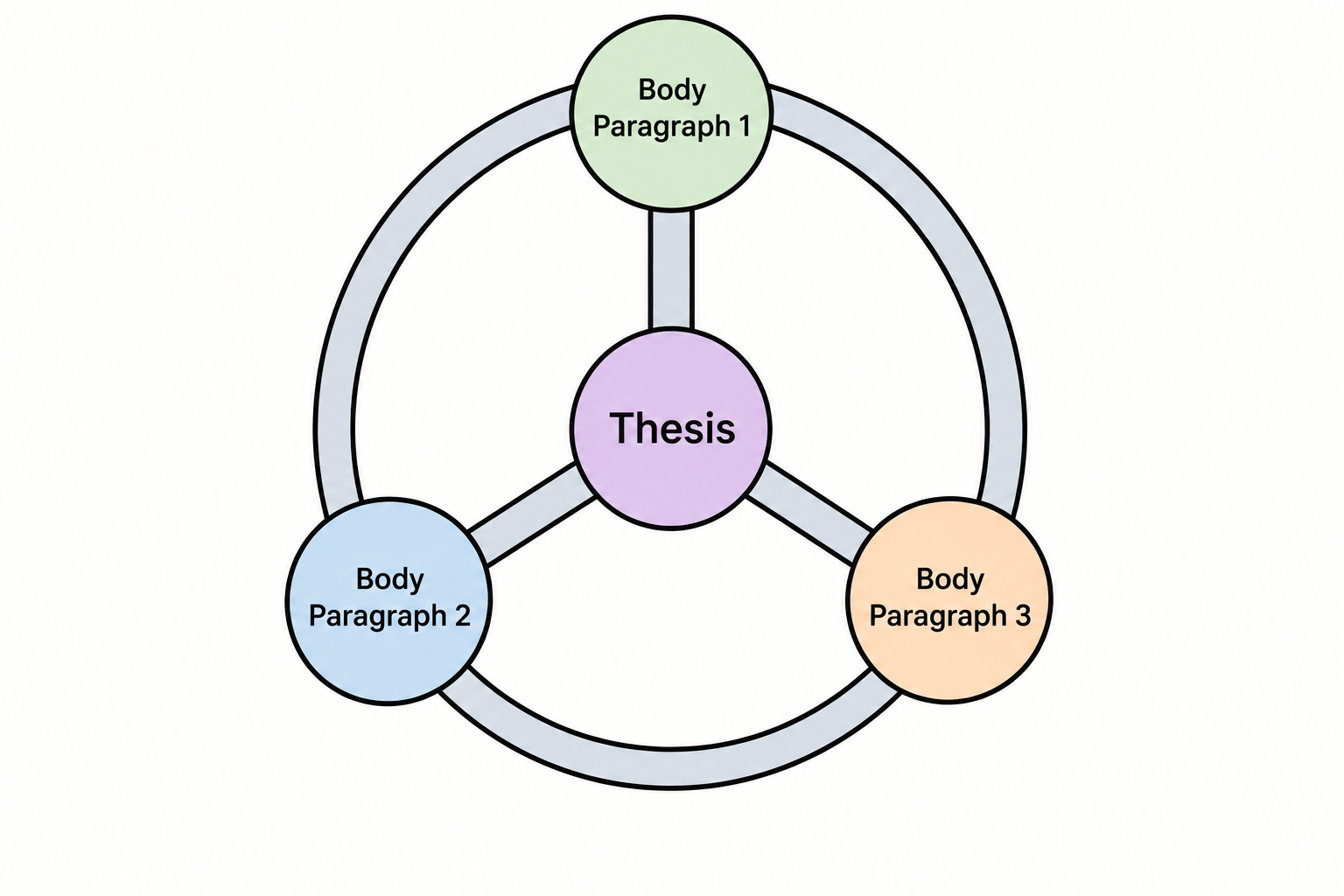
Carleton University says, “Visualize a wheel hub” that positions “your thesis as the central hub for your whole essay. Your body paragraphs split off from the thesis, and your topic sentences attach each spoke to the hub.”
Check that you’ve produced a robust thesis statement with the University of Guelph’s checklist of 5 questions to strengthen your thesis statement.
How to Write a Thesis Statement in 6 Steps
“A thesis is the result of a lengthy thinking process. Formulating a thesis is not the first thing you do after reading an essay assignment,” states The Writing Center, University of North Carolina at Chapel Hill. You need to conduct research, organize and analyze your findings, and think about the significance of the relationships you can see among known facts and theories.
Determine the kind of paper
Different formats have different elements to foreground in the argument, and therefore in the thesis statement as well. Is your paper analytical, expository, or argumentative? Understanding the assignment, including any detailed requirements, is a key step to starting an essay.
Conduct preliminary research
Use your university’s library catalogue and online database subscriptions. Search by keywords and names of relevant authors. See if an AI source finder can locate useful academic texts.
It’s important to research widely before narrowing in on your focus so that you make an informed choice about your topic; and it’s also important to research a variety of angles and counterarguments after narrowing in on your topic so that you make a strong argument.
Develop a research question
Based on observations and research, what questions can you ask about the topic? Try filling in the missing pieces from this template to refine your topic and argument:
- Topic: I am studying ...
- Question: because I want to find out what/ why/ how...
- Significance: to help my reader understand …
If you can identify what your paper is going to address, how it will approach its topic, and why the topic matters, then you can set the goal of your paper and work toward it.
Offer an interpretation
Take a stand. Sometimes an essay assignment will give you the position you’re intended to take, but you will often need to come up with your own argument. Identify a simple, initial position that you want to take based on your research and analysis so far.
Here are sample stances that can evolve into possible theses:
- American politics relies too heavily on the two-party system.
- Jane Eyre does not align with feminism.
- The potential use of stem cell research should be explored.
- The continuous stream of news coverage undermines the quality of the news.
Refine as you go
Once you’ve formulated a passable thesis statement, try running with it. A working thesis statement can act as a hypothesis you’re testing, and help focus your research and sharpen your critical reading of the sources you find. As your research and drafting give you a firmer understanding of your perspective on your topic, tweak the wording and composition of your thesis to reflect the nuances of the argument you’re making.
Address methods and justification
A fully-formed thesis is able to refer to its framework and its implications. The reader can then understand the stakes of the argument and be informed of the supporting argumentation they can anticipate in the paper. A strong thesis doesn’t just make a claim that addresses the “what”—it’s also able to answer the “why” and the “how.”
For example, “Jane Eyre does not align with feminism” can be expanded into a full thesis: “Despite its apparent emphasis on female independence and autonomy, Jane Eyre ultimately undermines feminist ideals by reinforcing traditional gender hierarchies and presenting marriage and domesticity as the epitome of female fulfilment.” This thesis indicates the subarguments and counterarguments that support the main claim, and also shows the paper’s importance in dispelling a mistaken belief about Jane Eyre’s relationship to feminist theory.
Thesis Statement Formula
Start with a template
The University of Michigan calls this the “magical thesis template”:
“By looking at ______________, we can see _________________, which most [readers, scientists, politicians, actors, etc.] don’t see; this is important because ____________________.”
This template offers a strong starting point because it quickly gets you to identify your object of study, what you can reveal about it, and why your revelation is important. Be sure to adjust and reword the final thesis into your own, more original phrasing.
Start with a generator
Grammarly’s AI thesis statement generator requests your target audience and intended topic, and then instantly drafts possible thesis statements for you to evaluate and draw inspiration from.
Be warned that there are limitations to a generic or automated thesis statement:
- Your paper’s structure and sub-arguments need to match it
- The components you feed into the formula/generator must be well selected
- The thesis must suit the length of the paper, the sources referenced, and assignment requirements
- The word choice and phrasing may lack credibility and academic specificity.
Types of Thesis Statements
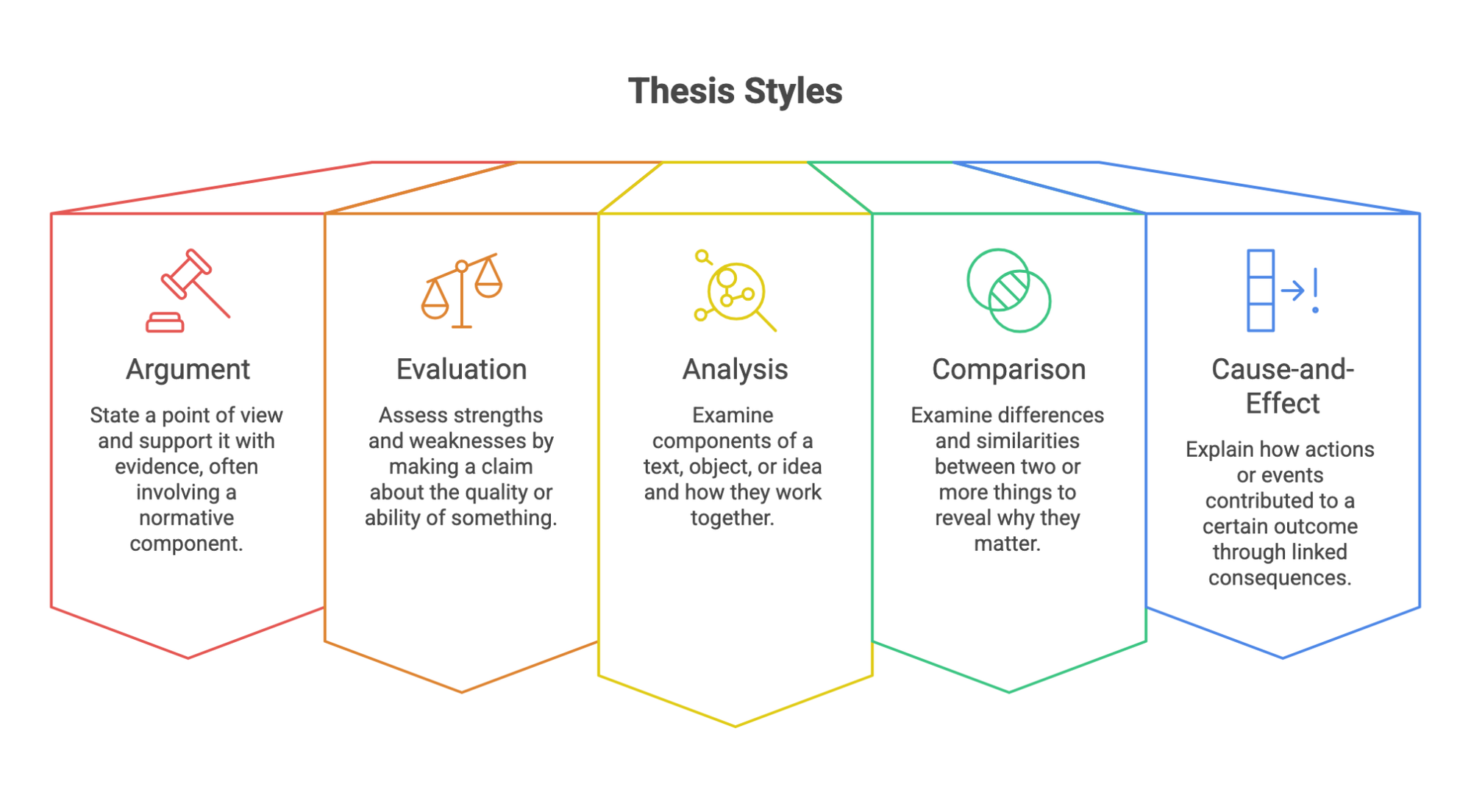
There are 5 common types of thesis statements.
Argument
State a point of view and support it with evidence. This kind of statement often involves a normative component you are arguing in favour of: ie., something “should” be handled a certain way or “ought” to be understood from a certain perspective.
Example: Grocery store prices in Ontario should be regulated by the government to prevent food insecurity for low-income individuals.
Evaluation
Assess strengths and weaknesses. You will make a claim about the quality or ability or something that you’ve chosen to appraise. This often involves a systematic and balanced approach; you will not solely argue one side, but rather, you will need to overcome counterarguments to your conclusion.
Example: Although retaliatory tariffs increase financial strain on core economic sectors, they are necessary means of upholding long-term economic stability and national sovereignty.
Analysis
Examine the components of a text, object, or idea, and analyze how these components work together. This style of thesis is often produced through close reading and content analysis, and draws fine-grained observations together into a textually supported interpretation of the object.
Example: Bong Joon Ho’s movie “Parasite” uses the physical architecture of domestic spaces to represent class divisions and the unequal distribution of power in capitalist society.
Comparison
Examine differences and similarities between two or more things. Often called a compare-and-contrast essay, this format systematically compares texts, ideas, authors, objects, etc. and makes an argument about why those differences/similarities matter or what they reveal. The AP Lang synthesis essay often involves a significant element of comparison between texts and ideas.
Example: Stuart Hall’s encoding-decoding model of communication attributes more agency to the audience than Shannon Weaver’s sender-receiver model of communication.
Cause-and-Effect
Explain how actions or events contributed to a certain outcome. Causes must be identified, explained, and convincingly linked to the consequences you are seeking to explain. Alternatively, the numbers can be flipped; one cause may be attributed to multiple outcomes.
Example: The decline of local journalism has weakened community engagement by reducing access to local information, limiting scrutiny of public officials, and diminishing opportunities for civic participation.
Common Thesis Statement Mistakes
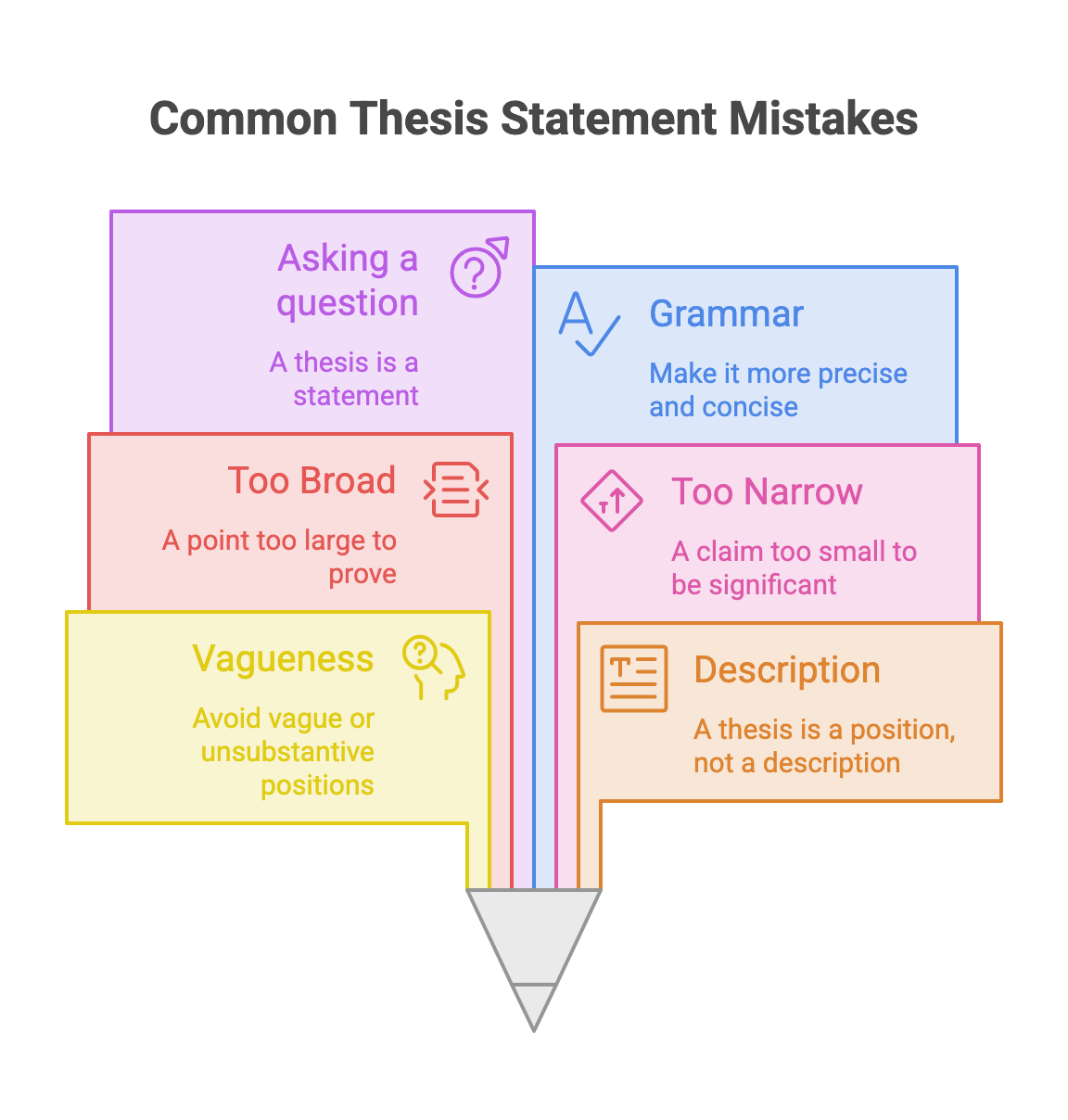
Vagueness
Avoid words that give vague or unsubstantiated positions like: “interesting,” “negative,” “unusual,” or “difficult.” And avoid making broad or unspecific references to concepts like: “society,” “values,” or “culture.” Be as precise as possible in identifying what your topic is and what your position on your topic is.
Description
A thesis is not a description of a topic; it’s a position on a topic. A common piece of feedback for students is that their thesis reads like an opening title, meaning that it’s too focused on describing the subject of the paper. Rather than concentrating on what the paper is about, ask yourself: “What am I arguing?”
Too Broad
Problems of scope are a common mismatch between a thesis and its essay. A thesis that’s too broad has attempted to argue a point that is too large to prove within the word limits of the assignment.
Be more specific. Try breaking off a smaller piece of the large argument you want to make, or organize your argument around a specific example or event. The more specific your claim, the more airtight and convincing your argument can be because you will be able to adequately address most or all of the relevant facts and debates that apply to your topic.
Too Narrow
This problem of scope is the inverse of the above. Rather than trying to claim something too large to convincingly argue, a thesis statement that’s too narrow makes a claim that is too small to be significant. It has likely failed to incorporate elements of the paper where critical issues and topics are raised.
Ask yourself: “So what?” Why does your thesis matter? What larger stakes are at play in the claim you’re making? Remember that a good thesis must be debatable. Dig into contentious and significant issues raised by your topic.
Asking a question
A thesis can sometimes be inferred from a research question, but a thesis is a statement. It’s not something you’re wondering; it’s something you’re claiming is true. If you’re still focused on a question, you may not have reached the stage in writing where you’re able to identify your thesis.
Your question, however, likely contains elements of the thesis you’re trying to develop, so don’t scrap it entirely. What is its focus? What are you trying to answer? Can you review your sources or conduct more research in order to reach a tentative answer to your question?
Grammar
Yes, you’re being asked to put a lot into 1-2 sentences, but no, you can’t just keep adding semicolons. Pare down. Find specific terms that refer to subsections of your argument. Ask a friend or two to read your thesis statement and give you feedback on clarity. Run it through an AI grammar checker and consider recommendations that make it more precise and concise.