How to Write a Press Release in 6 Simple Steps
A press release is a structured news document sent on behalf of an organization to journalists or other news sources to announce something newsworthy or important.

The press release is a foundational piece of writing in the world of PR or public relations. It is considered an official document and a primary source. When done right, a press release can win media attention for your organization, spreading the word about important happenings and strategic initiatives.
The Rutgers Office of Public Outreach and Communication has a simple description: a press release "seeks to demonstrate to an editor or reporter the newsworthiness of a particular person, event, service, or product." The challenge is that reporters get hundreds of press releases a week. To stand a chance at publication, your press release has to conform to a specific industry format while catching the attention of a seasoned journalist.
We've created this guide to take you through the entire process, even if you've never written a press release before. We will cover what a press release is, the standard format, the six-step writing process, and some examples and templates.
TL;DR
- A press release is an official announcement of something worthy that gives journalists all the information they need to know to cover it.
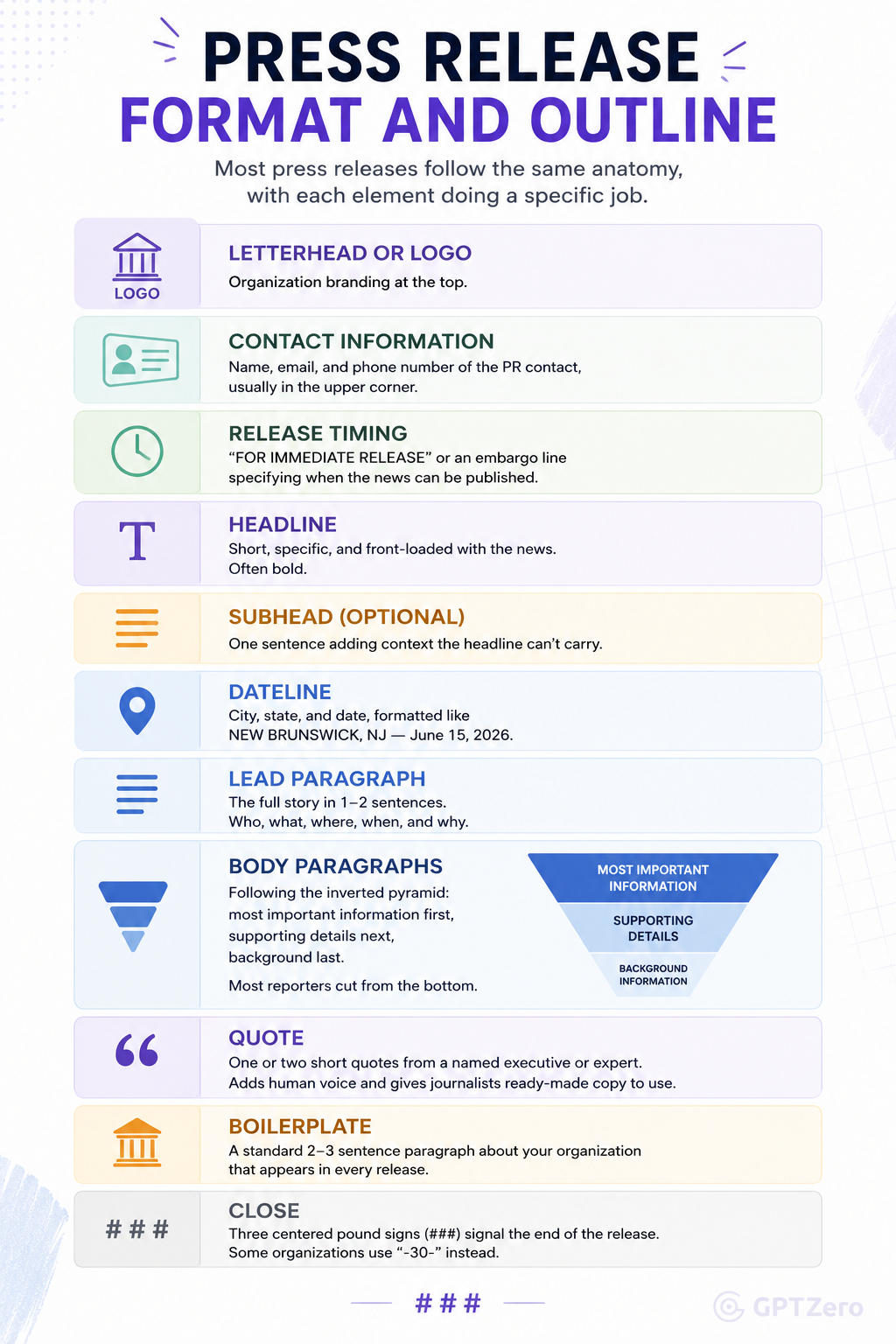
- The standard components of a press release are: a headline, dateline, lead paragraph, body following the inverted pyramid, quote, boilerplate, and contact information.
- Press releases range from 300 to 500 words and follow AP style.
- The biggest challenge in writing a press release is the attention-grabbing headline.
What Is a Press Release?
A press release is a formal news document written by an organization or its PR firm and distributed to various media outlets with the goal of generating news coverage for the organization. It reads exactly like a news article and is structured in a way to give the journalist everything they need to run with the story.
Purpose
Press releases do many jobs. The first and most obvious one is that they alert media outlets to notable events or developments within your organization. They are also considered primary sources, and any facts included in them are assumed to be verified. Press releases can also be tools that organizations use to frame the narrative around a particular event or development.
Common use cases
Press releases can be issued as a result of: product launches, new executive hires or departures, mergers and acquisitions, new funding rounds, groundbreaking research findings, event announcements, partnerships, awards, and crisis communications. If anything within the organization has happened that an outside individual like a reporter might find interesting or worth covering, a press release is the best way to get the word out there.
Only spend the time crafting a press release when you have genuine news, when it can be attributed to a named source, and when the announcement has relevance outside the walls of your organization. Things like strategic internal milestones that might have taken you years are not relevant outside the walls of your organization, so a press release doesn't make sense.
Press Release Format and Outline
Most press releases follow the same anatomy, with each element doing a specific job.
How to Write a Press Release in 6 Steps
Step 1: Make Sure You Actually Have News
Your big announcement has to pass the newsworthiness test before you start writing. Ask yourself: would someone outside your organization care about this? Does it affect your customers, industry, or wider market? A great press release always starts with a relevant or compelling angle.
Step 2: Write a Headline That Earns Attention in Five Seconds
The reality is that the headline is often the only part of your press release that a journalist will read. It's important to front-load the news in your headline. Do not try to be subtle with this piece of writing. Headlines should be kept under 12 words and should always use active verbs, clear language, and avoid wordplay.
Tip: AI is a great brainstorming partner when it comes to short copy, like a headline or CTA. Because the LLMs draw from already published material, always check for plagiarism to make sure the news you are reporting hasn’t already been reported.
Step 3: Nail the Lead Paragraph
The second most important piece of real estate is the lead paragraph. If your headline passes the discerning eye of a seasoned journalist, your first two sentences will make or break your chances of publication. The rule of thumb here is that a reporter who only reads the lead should still understand the full story and have a sense of the implications.
Step 4: Build the Body With the Inverted Pyramid
Most press releases follow something called the inverted pyramid format. After your headline and lead, your first body paragraph adds the additional context a journalist needs. In the third paragraph, you want to provide a quote, and in the fourth, fill in any background. Reporters tend to trim articles from the bottom up, so keep all of the important business at the top.
Step 5: Add a Quote and Boilerplate
A strong quote from a named executive or an expert can humanize an announcement and give reporters something quotable to include in the article. If you are retroactively collecting quotes from stakeholders, make sure they're not written in corporate speak. Where possible, conduct conversations that are natural and draw out thought leadership in an authentic way. Close with your standard organizational boilerplate.
Step 6: Edit, Verify, and Distribute
Read your press release out loud, pretending to be a news anchor. You will likely notice areas where adjustments need to be made. Once you're happy with the structure, a quality grammar checker will catch all your typos and make sure AP style is applied correctly and that references and links are free of hallucinations.
Tip: Send releases early in the day to beat reporter deadlines, and build a target distribution list rather than sending it to every reporter you can find.
Press Release Example
Here's a short, complete example following the standard format.
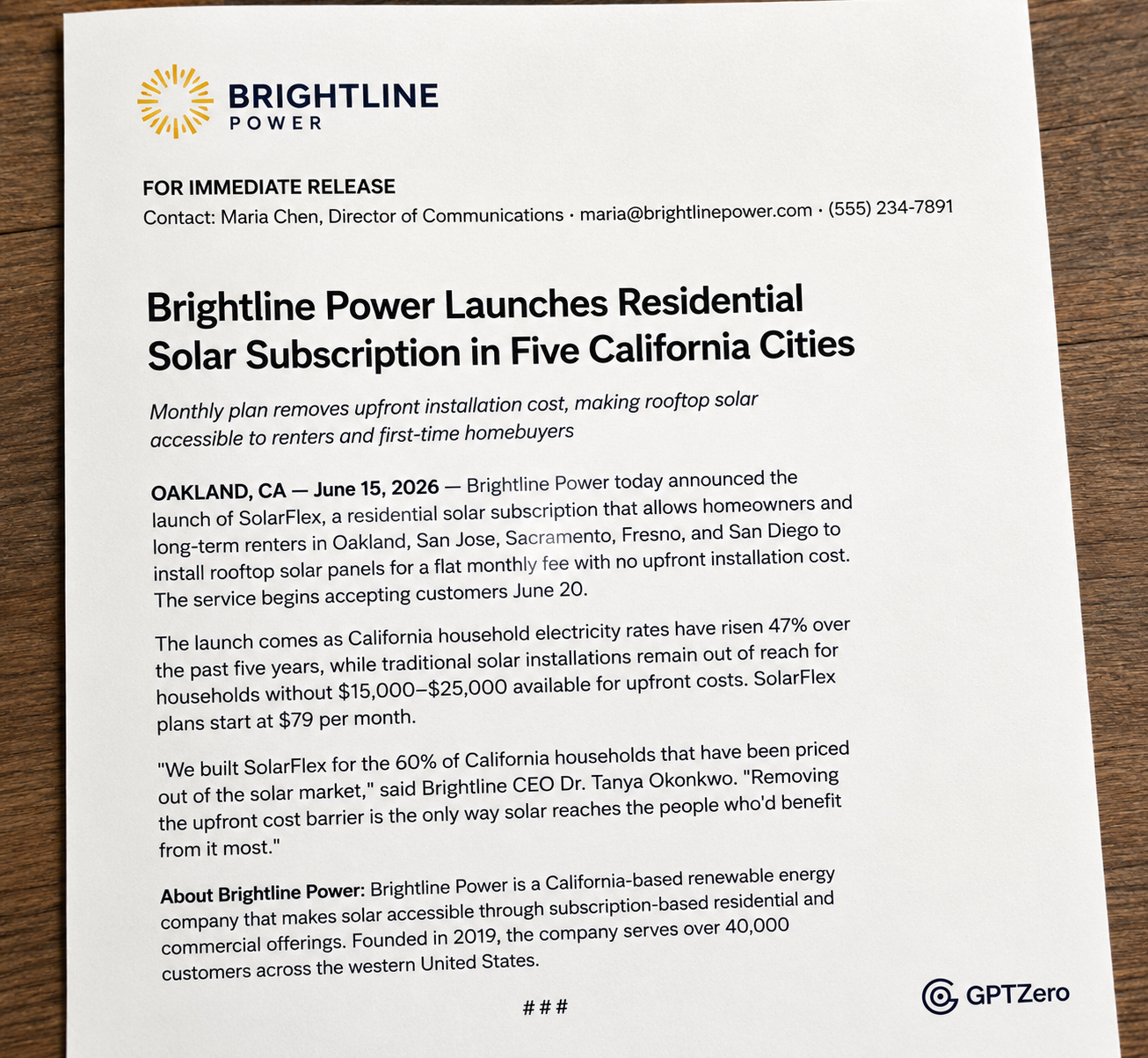
Press Release Template
Use this as a starting point for your own release.
FOR IMMEDIATE RELEASE
Contact: [Name] · [Email] · [Phone]
[Headline: The News in Under 12 Words, Front-Loaded With the Verb]
[Optional subhead: one sentence of context the headline can't carry]
[CITY, STATE — Date] — [Lead paragraph: who, what, where, when, why, in 1–2 sentences].
[Body paragraph 1: Context or the "why this matters" angle. Statistics, market conditions, or industry background that frame the news.
"[Quote from named source that adds human voice and quotable copy for the reporter]," said [Name, Title].
[Body paragraph 2: Supporting details, additional context, or quote from a second source].
[Body paragraph 3 (optional): Less critical background that a reporter can cut if needed].
About [Organization]: [Standard 2–3 sentence boilerplate about your organization].
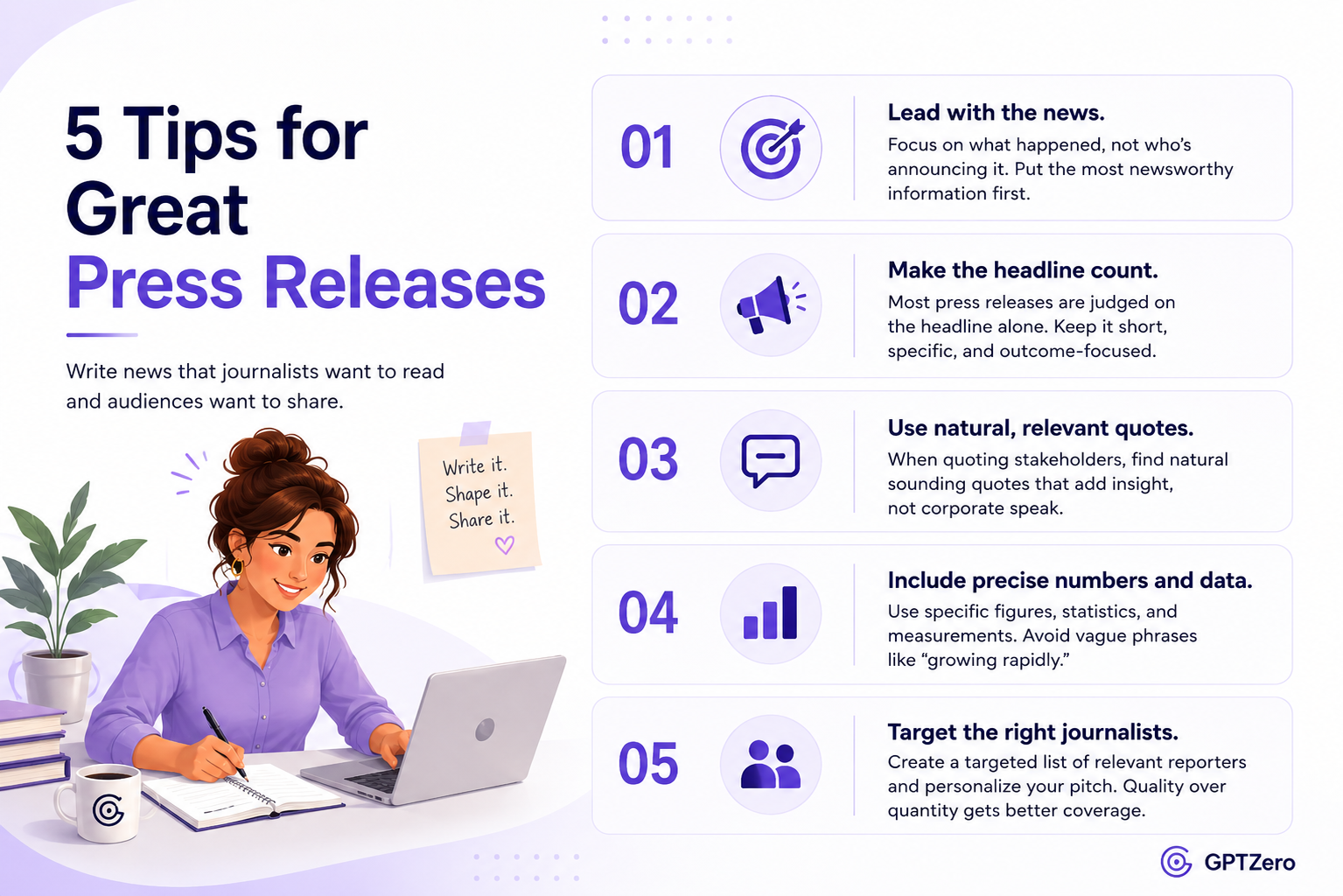
5 Tips to Write a Press Release That Gets Published
Why Do Journalists Ignore Press Releases?
- Journalists can tell when there's no real news. Your leadership's opinion on a topic, internal milestones and other inward-facing messaging won't fly.
- I buried the lead, or lack of clarity on what the story is about. Most reporters won't read past the first two lines.
- Obvious marketing language, especially if dated. Things like “industry-leading”, “revolutionary”, “best in class”, and other overused marketing terms signal self-promotion, not news.
- Lack of targeting when sending your press release out. If a lifestyle reporter gets your B2B software release, you're not likely to be a good match.
- Press releases sent at awkward times in the day or week can get buried and never opened. Aim to send yours in the morning, in the middle of the week.
- Press releases obviously written by AI. Journalists are very sensitive to trust signals, so anything that sounds like it wasn't verified and written by a human will not get published by a reputable media outlet.
FAQs
How long should a press release be?
Press releases should fit on a single page, so they range between 300 and 500 words. More is not better for this type of writing.
What is the ideal press release format?
Letterhead with logo and contact info, release timing line, headline, optional subhead, dateline, lead paragraph, body following the inverted pyramid, one or two quotes, boilerplate, and closing marks (###). AP style throughout.
Can a press release be written in the first person?
Press releases are objective documents, and the first person is uncommon. The only exception is when including quotes.
When should you send a press release?
It is best to send a press release early in the workday and between Tuesday and Thursday. The earlier in the day you send your press release, the better chances you have of getting a journalist's attention and possibly a spot in their schedule.
What makes a press release newsworthy?
A combination of timeliness, significance, novelty, and relevance to a defined audience. A useful internal test: would a reporter who doesn't know your company find this worth 30 minutes of their day? If you can't say yes confidently, the release isn't ready.