
Formal vs. Informal Writing: A Complete Guide
Formal and informal writing each have a place. Learn the key differences in tone, vocabulary, grammar, sentence structure, and punctuation, plus practical tips for choosing the right style for academic, professional, and everyday writing.



Informal writing is the style we use in everyday conversation, while formal writing is used with strangers or when we want to appear professional, polite, or authoritative.
While many believe that academic writing has become more informal in recent decades, a study of 2.2 million words from academic journals over 50 years found only a small increase in informal features and only in the hard sciences. Knowing when and how to elevate your writing remains important, especially in professional or academic settings.
This guide explains what formal and informal writing are, and what sets the two writing styles apart. Review how to tell which one you should use in different situations, and find answers to frequently asked questions about formal and informal writing.
Key Differences: Formal Writing vs Informal Writing
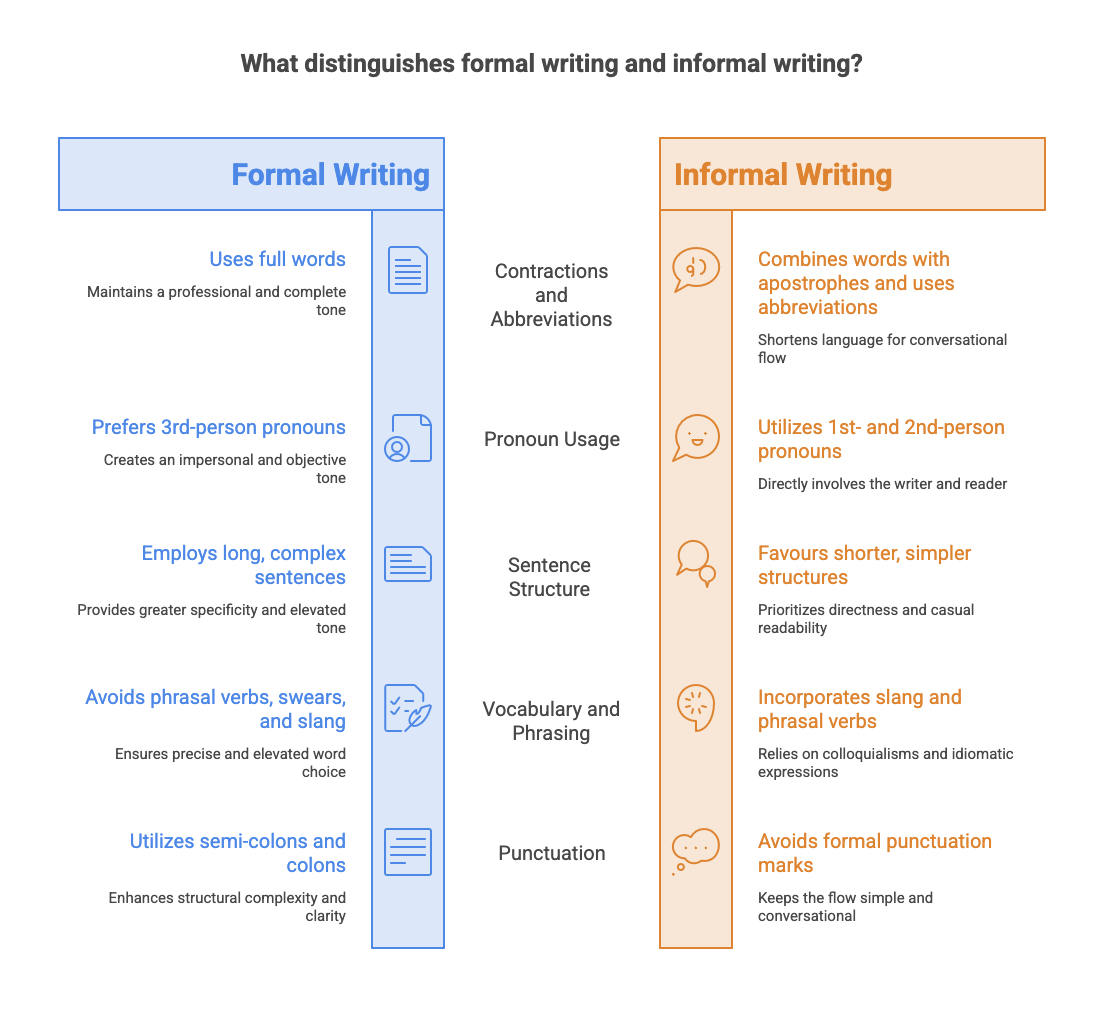
There are a number of features to include or avoid, depending on whether you want your writing to sound formal or informal. Formal writing adheres to rules, while informal writing is more flexible and embraces popular language and (un)grammatical structures.
Contractions
We form contractions by combining two words into one shortened word that omits letters and replaces them with an apostrophe. Formal writing uses full words.
Slang and Colloquialisms
Even if something is decidedly ‘skibidi’, formal writing does not permit slang terms that are only known to small groups. You should also avoid colloquialisms, which are informal expressions and idioms.
Swears
It’s hard to get more informal than dropping an F-bomb. Formal writing avoids words that are overtly rude or offensive, like swearwords and vulgarities.

Non-standard abbreviations
A non-standard abbreviation has no place in formal writing. It’s fine to use in your DMs, but it’s inappropriate in academic or professional contexts.
First- and second-person pronouns
Formal writing creates an impersonal tone by avoiding direct statements, so 3rd-person pronouns are preferred because they do not directly involve “you” and “I.” Passive voice is often used to skirt around pronoun usage and produce more impersonal messages.
Phrasal verbs
Elevated word choice is a hallmark of formal writing, and a core element of this is avoiding phrasal verbs. A phrasal verb is made of two or more words combining to form a verb, and they tend to be more colloquial than non-phrasal verbs.
Vague nouns
Formal writing aims to be precise and so avoids vague references. General terms that lack specific details or referents appear casual and unclear.
Long sentences
Long, complex sentences bring greater specificity, allow for more indirect phrasing, and contribute to an elevated tone in writing. Formal writing uses longer sentences with more compound structures than informal writing does.
Punctuation
Some forms of punctuation are considered formal and are uncommon in informal writing. The semicolon (;) and the colon (:) tend to be avoided in informal writing.
Formal or informal, grammatical and spelling errors are an issue if they block your intended meaning from being communicated effectively. Weed out these pesky problems with a grammar checker.
What is Formal Writing?
Formal writing tells you what you are supposed to do, not what people typically do. It follows conventions and rules that make it more suited to contexts that require professionalism or an impersonal distance.
Tone
Formal writing strives for an impersonal, professional tone. It avoids bias, slang, and casual language that would give it a personal tone. Instead, it deploys complex sentence structures, elevated word choices, and distanced language that makes it sound more authoritative and businesslike.
Purpose
Thesaurus.com defines formal writing as: “writing targeted toward an audience that a person doesn’t personally know.” It’s also used in situations that are serious and is typically found in academic and professional settings.
Characteristics
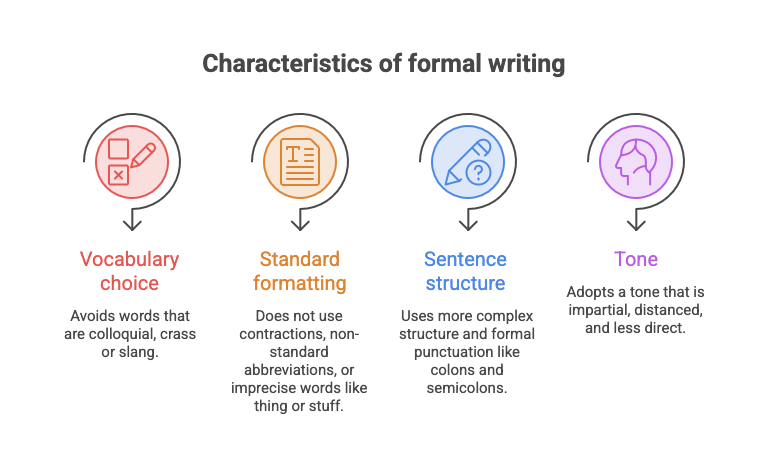
Formal writing avoids using words that are colloquial, crass or slang. It does not use contractions, non-standard abbreviations, or words that are imprecise, like “thing” or “stuff.” Sentence structure is more complex in formal writing, using formal punctuation like colons and semicolons. Finally, formal writing adopts a tone that is impartial and distanced, phrasing sentences to be less direct and more suited to addressing a stranger.
When to use
Documents that use formal language include reports, essays, technical documents, and more. If you have never met the person you’re writing to, or if you’re writing in a business, professional, or academic setting, formal writing is the safest option.
What’s Informal Writing?
It’s loosey-goosey writing, you know what I’m sayin? Informal writing sounds more like speech in day-to-day conversations; it’s natural, free-flowing, and simple. This is the style of writing you use with people you know and are comfortable with, like family and friends.
Tone
Informal writing is expressive and free-form. The tone can vary, and may include features like humour and sarcasm. It’s much closer to how we would express ourselves in casual speech.
Purpose
Informal writing can express a much broader range of emotion and tone. It’s used to convey friendliness and familiarity, to signal warmth and approachability, and to express your feelings and thoughts with candour and spontaneity.
Characteristics
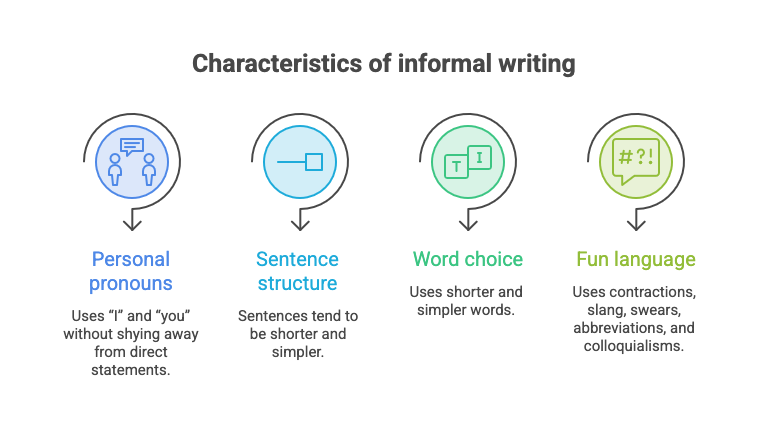
Informal writing uses “I” and “you” without shying away from direct statements. Sentences tend to be shorter and simpler, as does word choice. It uses all the fun words: contractions, slang, swears, abbreviations, colloquialisms–have at it!
When to use
Use informal writing when you know the person you’re writing to, or when you’re trying to write in a tone that’s emotive, personable, and familiar. Writing on social media often addresses strangers through an informal tone because the branding strategy aims to foster a sense of personal connection.
4 Tips for Choosing the Right Writing Style
When and when not to use formal language is a matter of debate that you could write a whole dissertation on, but it largely boils down to the purpose, context, and audience for your writing.
Why are you writing?
Consider what your writing is meant to achieve. If you’re writing a legal document or a research report, you want to convey accuracy, authority, and professionalism; use formal writing. If you’re writing a creative story or posting on social media, your purpose is likely to be expressive, emotive, or opinionated; use informal writing.
Who are you writing to?
If you’re starting a cover letter in your job application with, “‘Sup, dude?” you’ve made a huge mistake. Your intended audience will have certain expectations for formality or informality, and you need to follow the correct conventions and rules for addressing different people.
Conversely, you need to dial back the formality if you’re helping a child write a letter to Santa and you start with, “Dear Sainted Purveyor of Children’s Christmas Goods, Little Timmy is humbly submitting this order request form…”
What is the setting?
If you’re writing in your diary about what happened to you that day, “I have sustained a most severe localized trauma to my distal phalanx!” is just not going to convey the emotion and impact of the event as satisfyingly as, “Arrg! I stubbed my friggin toe!”
What is the topic?
Some topics are sombre. Formality implies seriousness, and signals a certain weight and importance to a topic. If you’re describing the genocide in Gaza, for instance, some degree of formal language helps to convey the right tone and avoid making light of a truly horrific situation.
FAQ
Can I be a little informal in my formal writing?
Sometimes, a little informality can strike the right tone, and there are a number of writing rules you don’t need to follow, even if you want to sound formal. In essay writing, for example, it may be fine to use some contractions (depending on your professor’s expectations), but using slang or colloquial language violates the genre’s expectations around objectivity. Be sure to assess the context and audience when deciding how much informality to allow into your writing.
How do you know if a word is formal or informal?
Formal writing “uses a sophisticated vocabulary that often includes large, complex words.” According to the Cambridge Dictionary, formal language often uses longer, more complex words “with origins in Latin and Greek,” while informal language “involves shorter words, or words with origins in Anglo-Saxon.” For example, a medical journal will refer to a tibia while everyday speech would call it a shinbone.
Should I err on the side of caution and always use formal language?
No, sadly, it’s not that simple. Formal language is respectful, so it can seem like the safe choice, but it signals respect through impersonal distance. In a situation where you’re writing to someone who knows you well or is expressing closeness or emotion, responding with formal writing will appear cold, uncaring, and possibly rude. Assess the purpose, audience, setting, and topic of your writing to select the right tone.