How to Write a Position Paper (Step-by-Step Guide With Examples)
A position paper is a type of academic essay that takes a clear stance on a debatable issue and defends it with evidence and reasoning.

The key to a successful position paper is choosing a side that faces strong opposition. As the Agnes Scott Center for Writing and Speaking puts it: "If there's no other side to your argument, you don't have one." The strongest position papers take a firm, arguable position and support it with compelling, authoritative evidence.
This guide covers what a position paper is, its structure, the five-step writing process for a successful position paper, with templates, tips, and an example.
TL;DR
- A position paper takes a clear but debatable stance and supports it with evidence and reasoning.
- The position paper follows the standard essay structure, including: an introduction with a thesis; 2-5 body paragraphs that develop an argument and support it; a counterargument section; and a conclusion.
- The strongest position papers are well-informed on the opposing view and present the challenger position honestly before dismantling it with the counterargument.
- The most common mistake when it comes to writing a position paper is not taking a strong enough position.
What Is a Position Paper?
Position Paper Definition
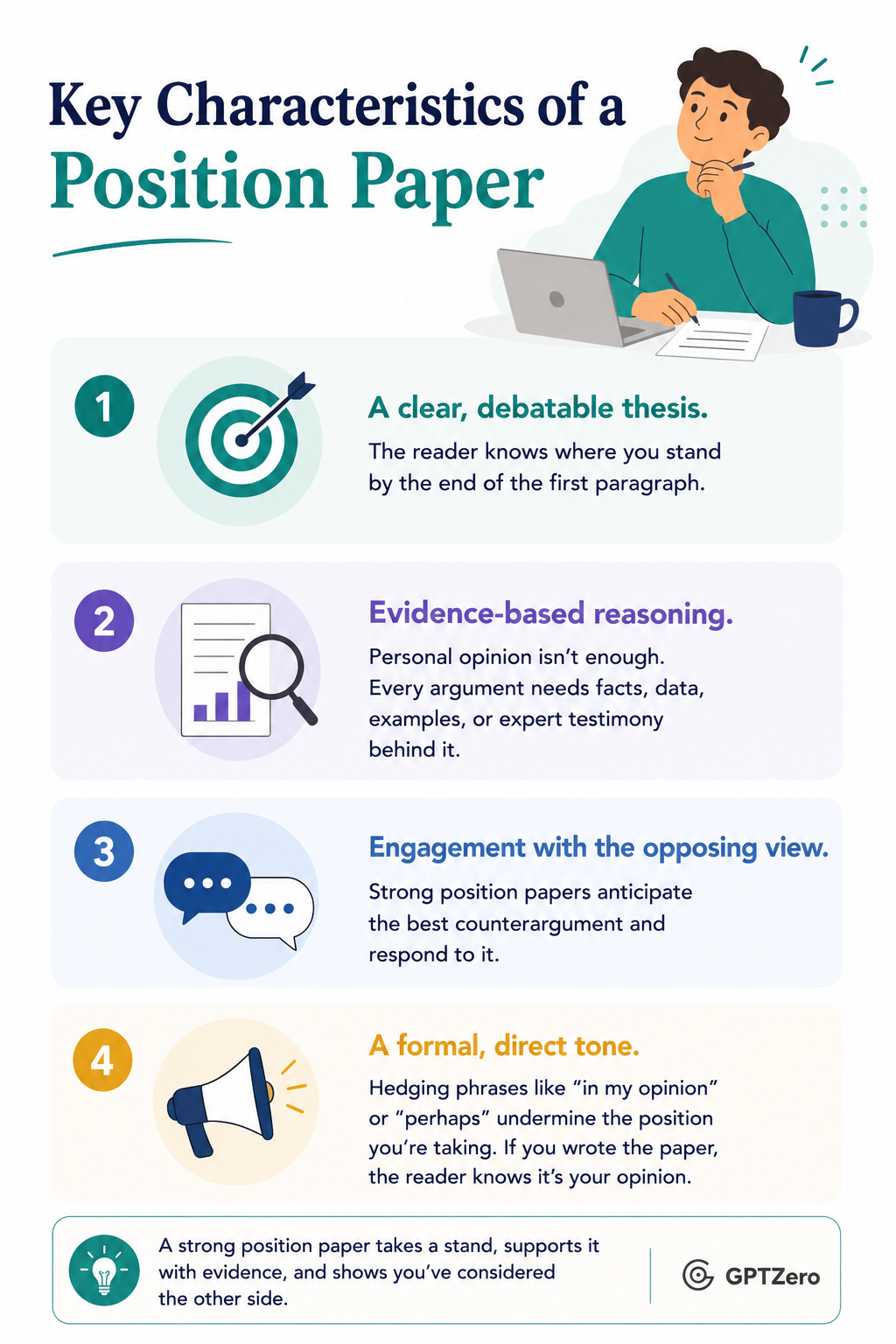
A position paper is a piece of academic or sometimes professional writing where the author takes a strong stance on an issue and argues using evidence, reasoning, and an honest engagement with the opposing views. It has the formal structure of an essay but the tone of an advocacy document. The point of the position paper is not to explore every side equally. The point is to persuade the reader that your opinion is correct.
Key Characteristics of a Position Paper
Types of Position Papers
In your studies, you'll come across three common types of position papers. The first one is the academic position paper, which is usually assigned in classes to argue a position related to the material. And on the more professional side, you could come across a policy or advocacy position paper written by organizations or lobbying groups to influence stakeholders on a contested topic. The third most common type of position paper is the Model UN position paper, in which delegates introduce their assigned country's stance on a topic before a debate with peers.
Position Paper vs. Argumentative Essay
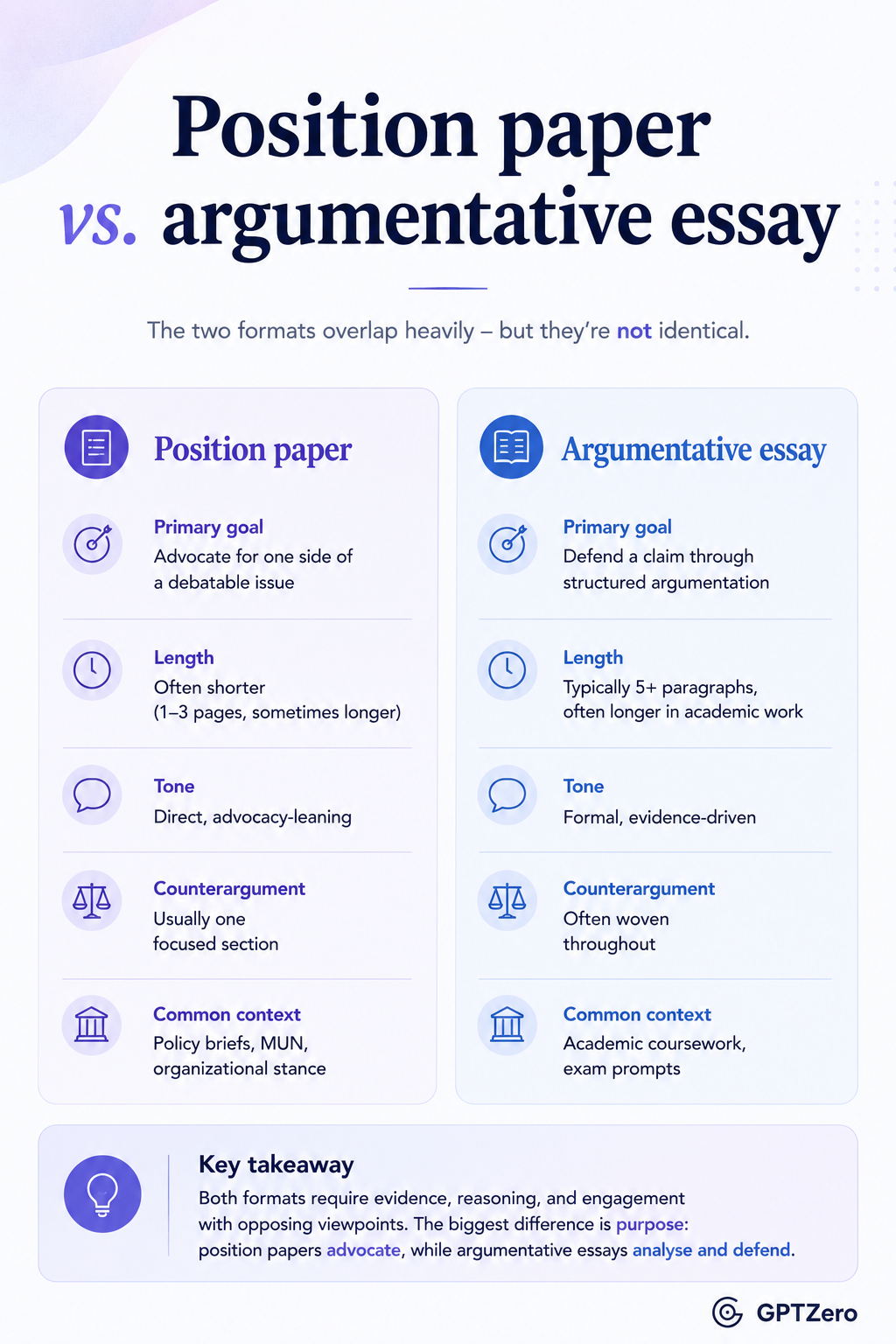
The two formats overlap heavily, but they're not identical.
Position Paper Structure and Format
You will find the structure of a position paper familiar, as it follows the same four-part logic as most academic essays.
Introduction
Your introduction is your opportunity to capture the reader’s attention. Open with the hook that is related to the opinion or stance you're going to take. Once you have everyone's attention, provide a brief context and end with a clear thesis or position statement.
Body Paragraphs
Your position paper will contain two to four body paragraphs. Each paragraph should be devoted to one supporting argument. Within each paragraph, it's a good idea to open with the topic sentence, which states the argument and is immediately supported by evidence like statistics, expert quotes, case studies, primary sources, and other relevant sources for your particular project.
Counterargument Section
A unique aspect of the position paper is the amount of time given to acknowledging the counterargument. One or two paragraphs are dedicated to presenting the strongest opposing views. The goal of these counterargument paragraphs is to demonstrate to your audience that you understand both sides of the argument thoroughly and that you nevertheless maintain your position.
Conclusion
In your conclusion, you can restate your position, taking into account the evidence that you've presented. Feel free to summarize the main arguments and include a closing statement that reveals the implications or has a strong call to action.
Format basics
Our guide on how to cite your sources covers APA, MLA, and Chicago in detail, and if you're working with AI-assisted sources, the MLA format for citing AI tools has its own conventions worth knowing.
How to Write a Position Paper (5-Step Process)
Step 1: Choose a Debatable Issue and Pick a Side
You'll know you have a good position paper topic when there are at least two genuinely strong sides. Avoid arguing for something that is commonly accepted, like, for example, “smoking is bad for you”. Choose a topic that you have some emotional investment in. The stronger you feel about your stance, the stronger your paper is going to be.
Step 2: Research Both Sides
The position paper requires you to do very holistic research. You will want to look at both sides of the argument with equal dedication. The main reason for doing this kind of research is to gather your social sources for the counterargument section of your paper. Another benefit of reading the opposing side is anticipating what your audience will be thinking, putting you in a position to anticipate their objections and address them.
Be careful when sourcing strong opinions on a topic. Avoid pop culture publications and stick to credible sources that are backed by science, data, or peer review. Track every source carefully, and if you're using AI to help summarize literature, you can check citations to confirm the studies you're working with actually exist.
Step 3: Write a Sharp Thesis Statement
Make sure your thesis passes the disagreement test. Can somebody reasonably argue the exact opposite of your thesis? If you answered yes, you have a strong thesis.
- Weak: Climate change is a serious problem that requires attention.
- Strong: The federal government should impose a national carbon tax of $50 per ton, with revenue rebated directly to households, because it's the most effective mechanism for cutting emissions without harming low-income workers.
The strong version names the policy, the mechanism, and the rationale. Someone could disagree with each piece.
Step 4: Build an Outline and Draft
The secret to success when it comes to structuring a persuasive position paper is the careful preparation of your argument before any writing takes place. Make sure you spend the time outlining your position paper. This step will ensure that you write smoothly and that you have everything you need to make the strongest possible case.
Your outline can be simple and point form and should include your thesis, the main points you're going to make in each paragraph, along with supporting evidence for each argument and your counterargument paragraphs.
When you're ready to start drafting, draft straight through without stopping.
Step 5: Revise and Verify
Before submitting your work, go over it for final checks. Take care of any grammar issues first using a reputable grammar checker. If you’ve used AI at any stage of the writing process, you’d benefit from scanning your work for hallucinations before your final submission.
Position Paper Example
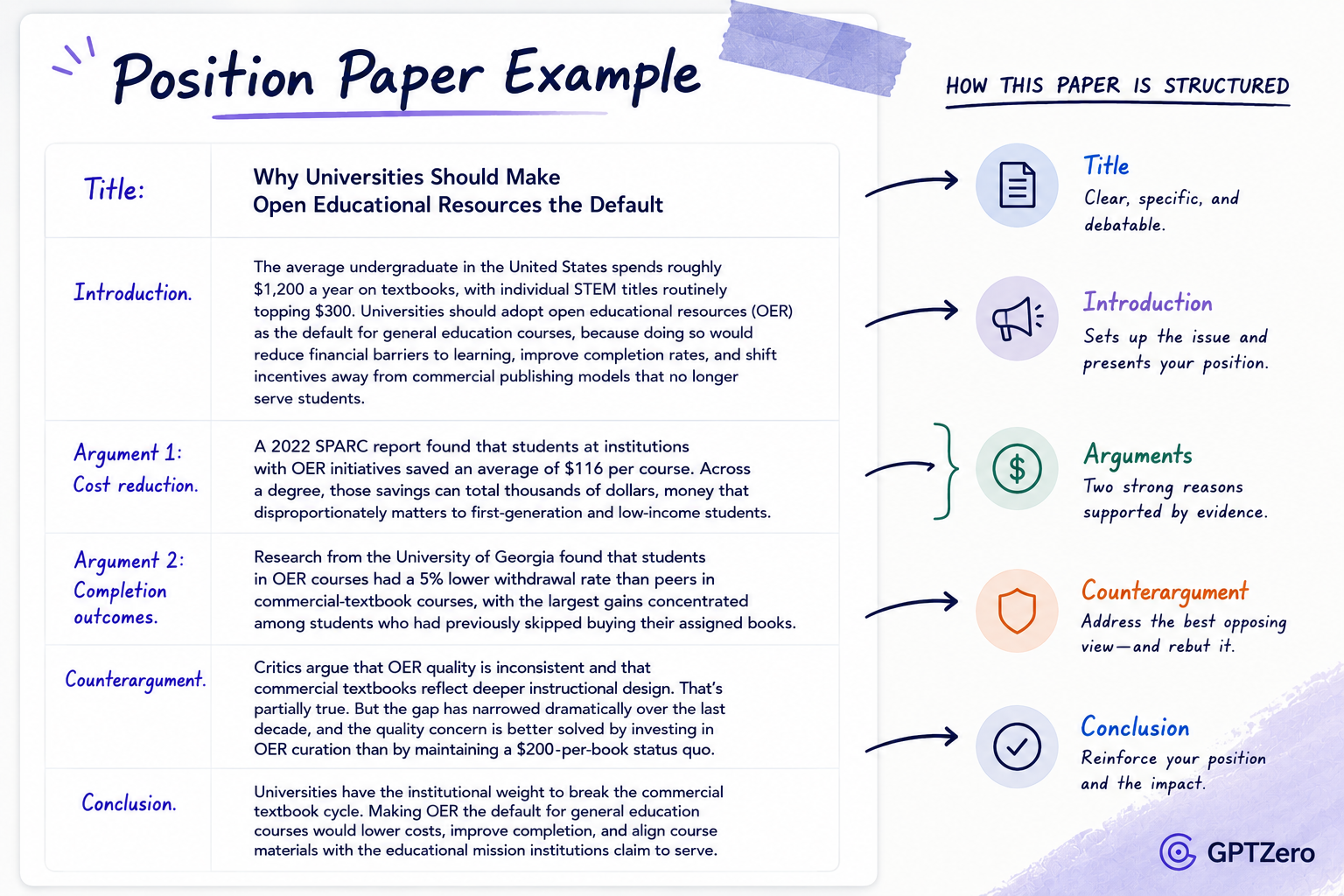
Position Paper Template
Copy and paste this template for a quick start:
Title:
Introduction:
- Hook
- Brief context
- Thesis
Body Paragraph 1:
- Argument #1 Topic sentence
- Evidence
Body Paragraph 2:
- Argument #2 Topic sentence
- Evidence
Body Paragraph 3:
- Argument #3 (optional counterargument) Topic sentence
- Evidence
Counterargument
- Acknowledge
- Rebut
Conclusion
- Restate your position in light of the evidence
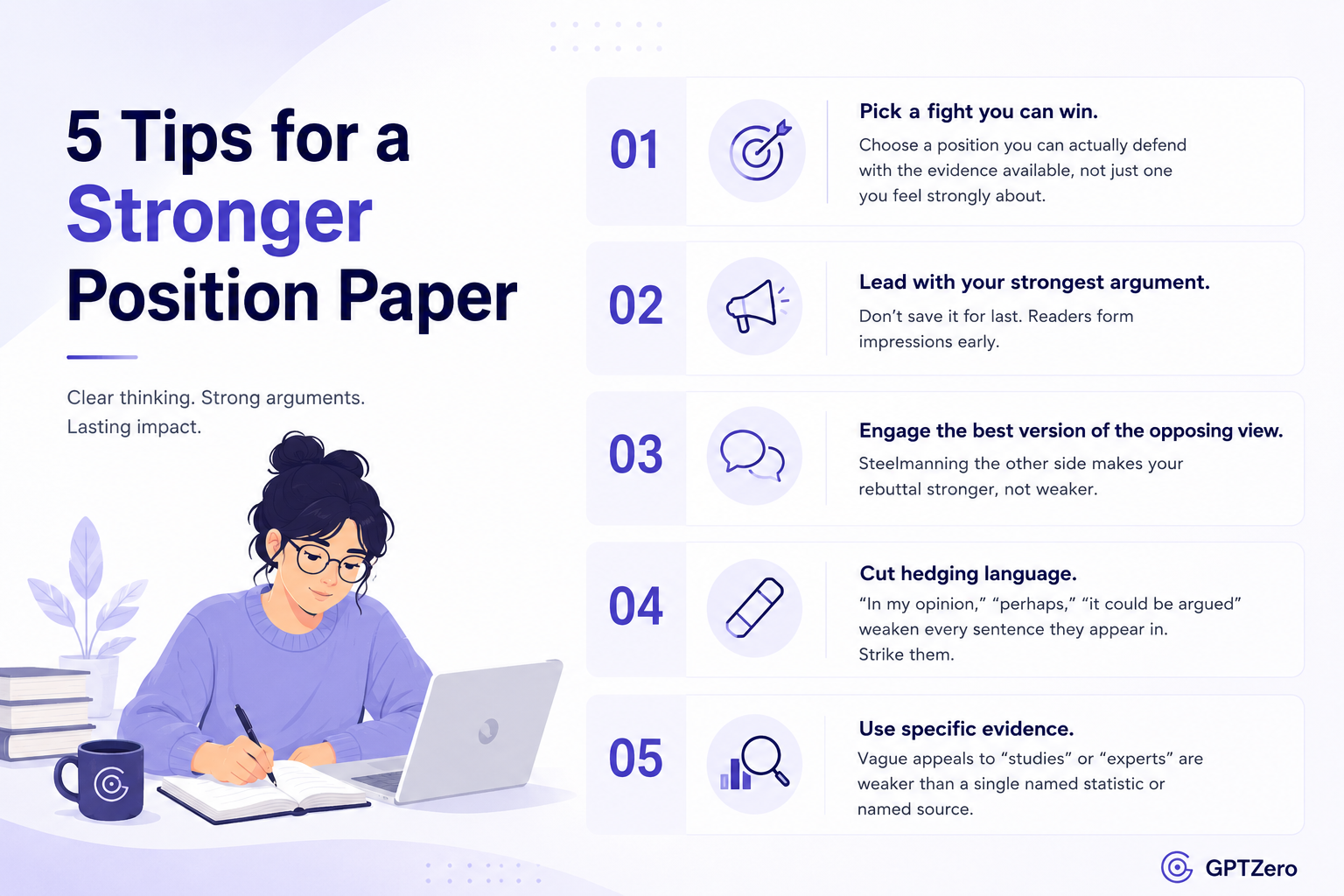
Tips for Writing an Effective Position Paper
Common Mistakes to Avoid
- Not having a strong enough position or thesis
- Misrepresenting or making light of the opposing view
- Emotional stances that are not backed by concrete evidence
FAQs
How long should a position paper be?
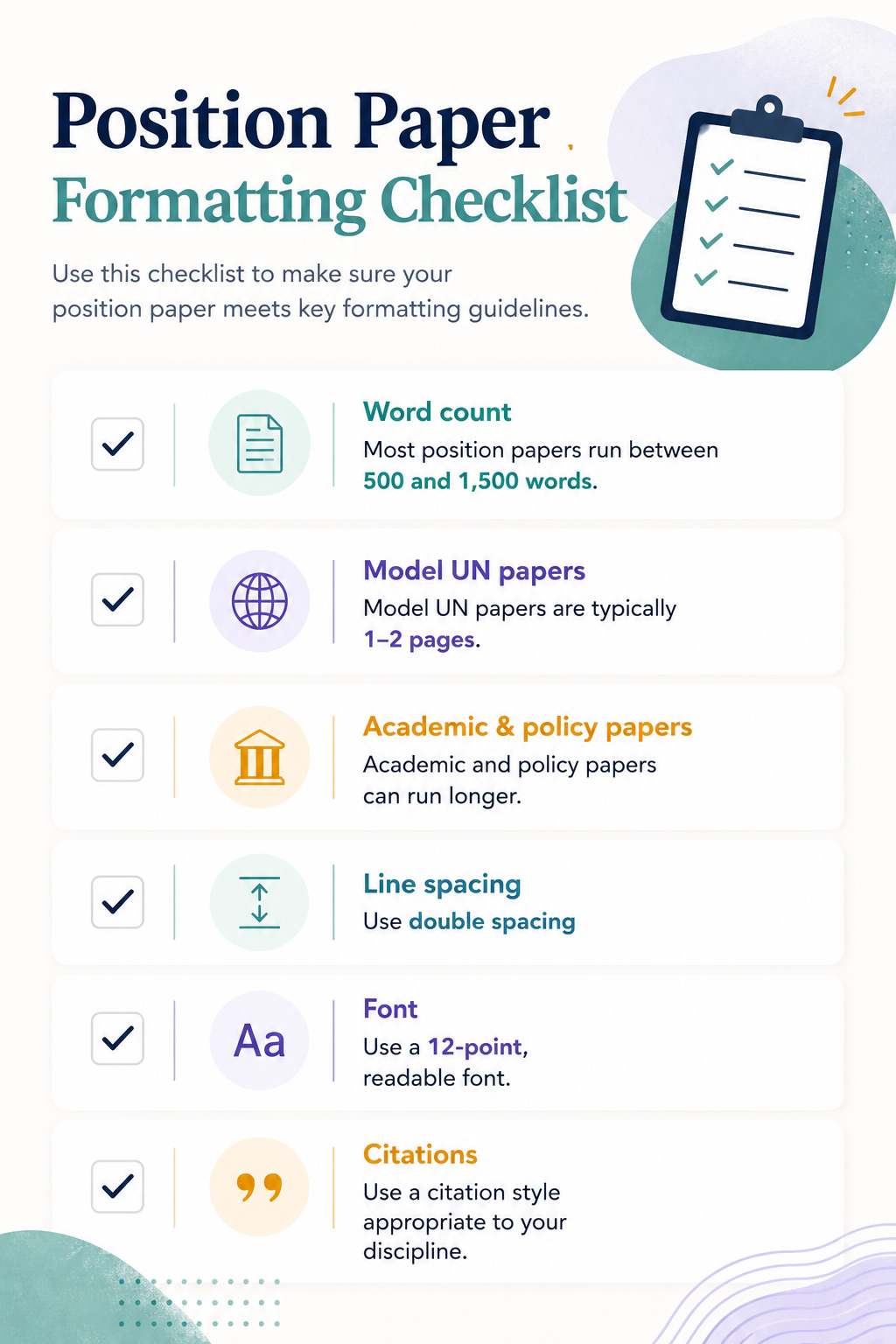
The length of your position paper will be determined by the context. For example, a modern Model UN position paper runs between 1 and 2 pages. Academic position papers can range from 500 to 1,500 words. Policy papers are often much longer. Understand your context and adjust the length of your paper accordingly. If your position paper is part of an academic assignment, the word count will usually be specified in your assignment brief.
How do you start a position paper?
It's very important to start by capturing the reader's attention. Many students begin their position papers with a striking statistic or a brief story. Follow that up with one or two sentences of context and conclude with your strong and clear thesis. The goal of the introduction is to inform your reader about what they're about to read and your position.
What's the difference between a position paper and an argumentative essay?
There are many similarities between these two academic formats. Position papers tend to be shorter in an academic setting and more advocacy-oriented. They also have a distinct counterargument section comprising one or two paragraphs.
Can I use the first person in a position paper?
The first person should always be used sparingly in any academic paper. Because the position paper relies on your strong opinion on a subject, you are absolutely allowed to use it. The only caution would be to balance that with concrete evidence.