
How to Write a Report: Format, Structure, and Best Practices
A report is a structured piece of writing that presents information on a specific topic to a defined audience.


From books to lab assignments to business research, reports are a staple in both academic and professional settings. Students write them to present data-driven narratives on specific topics. Reports can range from the financial to the scientific and are used in almost every industry you can think of.
The challenge with writing reports is that they are often treated like an essay with some extra numbers. Reports have their own structure and requirements and should be approached differently from your standard essay, although they do share some similarities.
This guide will walk you through what a report is, the main types you will likely have to write, and a step-by-step process so you can feel confident writing your own.
TL;DR
- A report is a structured piece of writing that presents information on a specific topic to a defined audience.
- Most reports follow the same structure: title page, summary, introduction, methodology, findings, discussion, conclusion, and references.
- A strong report is logically structured to present the information in the clearest way possible.
- The most common mistake when it comes to writing reports is treating them like a traditional essay.
What Is a Report?
A report is a formal paper that presents information on a specific topic, project or set of findings. As the University of Leeds outlines, reports are different from essays in that they are more concise, use a formal structure and often communicate the results of a project. Essays tend to be more discursive and analytical, some even incorporating the personal experiences of the writer.
The structural difference is the main point. A report is built so that the reader can absorb the information or find what they are looking for without reading the report word for word. Because reports are also used in decision-making, presenting the information clearly, without burying it in too much text, is what sets good reports apart from the rest. Paragraphs are usually shorter in reports than they are in essays.
Reports also use a variety of sections, with some points listed in bullet points, tables and other visual ways of communicating information.
Types of Reports
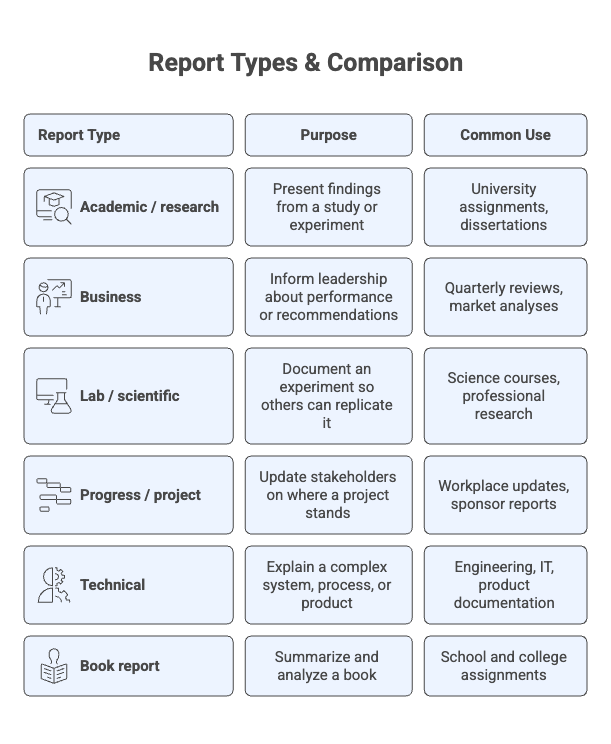
Reports come in many shapes and sizes, depending on the goal and the field you are in. Knowing which type you are writing is important before you start. When looking at the comparison table below, keep in mind that many reports blend categories.
Standard Report Format and Structure
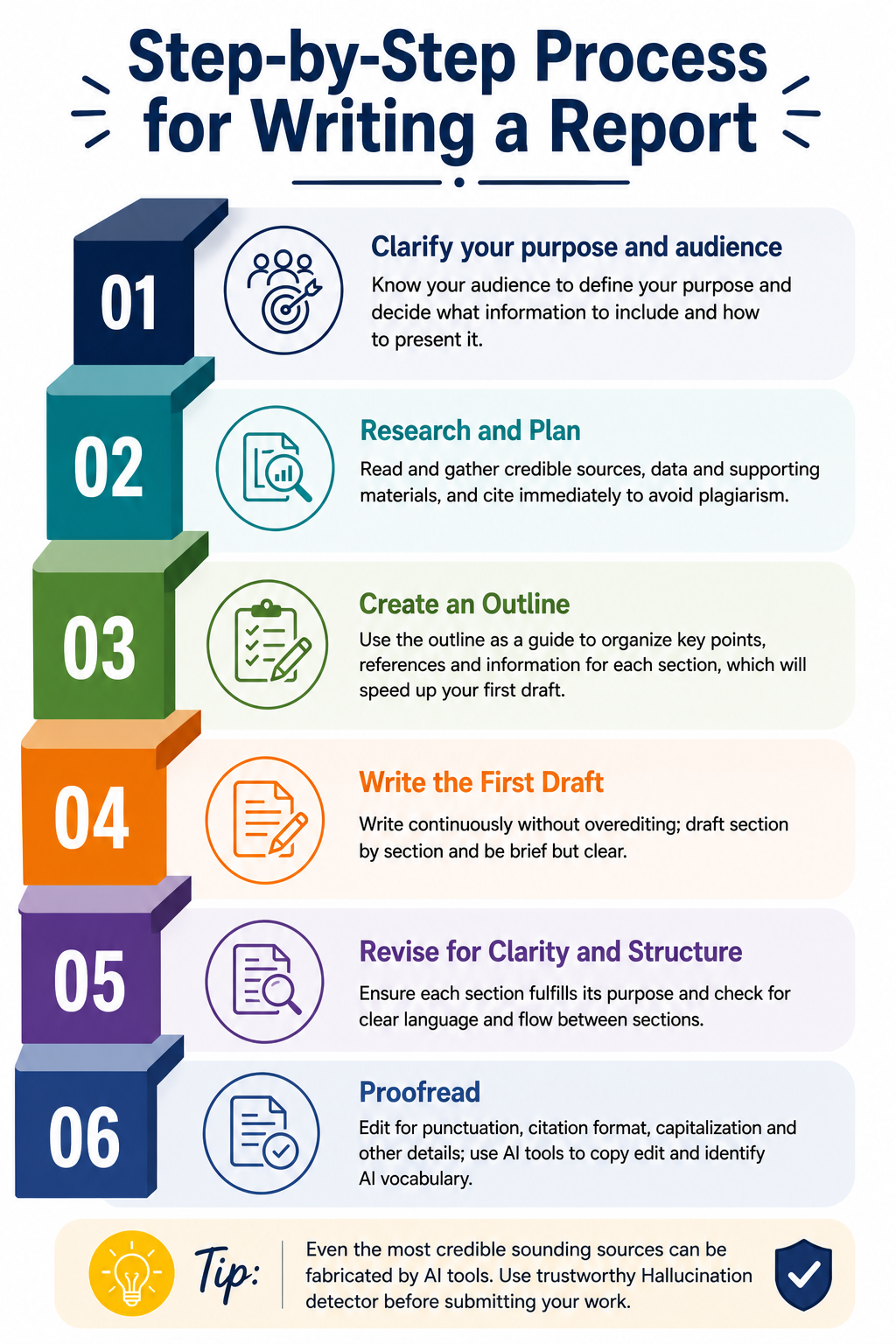
Report structures may vary by discipline. We’ve shared a report skeleton that will work for most report cases.
Title Page
The title page identifies the report at a glance and includes the title, your name, the date, the organization or course and the person or team it was prepared for.
Tip: Keep the title descriptive, not clever. For example, “Q3 Customer Retention Analysis” is better than “Q3 Analysis” or something more vague like “Q3- Looking Ahead”. For more customized help with your writing, consider trying an AI assistant for writers to help you maintain a clear tone while keeping your drafts human.
Abstract or Executive Summary
The abstract or executive summary is a short paragraph following the title page and is usually about 150- 300 words. This paragraph will describe the context, methods, key findings and main recommendations of your report. It’s a good idea to write this section last.
Tip: Many writers use AI in areas like summaries. If you are generating any of your writing, a reputable AI detector can help you stay compliant.
Table of Contents
The table of contents is another section you can add at the very end. It contains a list view of each major section of your report, followed by its corresponding page number.
Introduction
The introduction sets up the topic, states the question being investigated and outlines the report’s scope. Your introduction can include any background context, the aims of the report and any limitations encountered in the reporting itself. This is where you tell the reader what they will get from this report.
Methodology
Most reports present research and analysis. It is important to outline how this research was done and what analysis took place exactly. You want to cover materials, methods, data sources and any specific procedures you used. Be specific enough so that if another person had to, they could replicate your process.
Findings or Results
The findings and results show what you have discovered in your research and analysis. This section often contains tables, charts, and figures to show the information in a more useful way. Remain objective and include the data here without discussion or any comments.
Discussion or Body
In the discussion section, you explain what the results mean, how they relate to prior research, and any limitations or further questions that come up as a result of these findings. Include your own analysis of the information in this section.
Conclusion and Recommendations
The conclusion wraps up the report with key takeaways and, where appropriate, action items. New information should not be introduced here, and any questions that came up during the discussion should be addressed.
References and Appendices
Include a complete reference list in your required style, plus any supplementary tables, raw data or other artifacts. Your appendices should be numbered in the order they are mentioned in the report.
Tip: Use an AI source finder to confirm your citations are real and link to authentic sources.
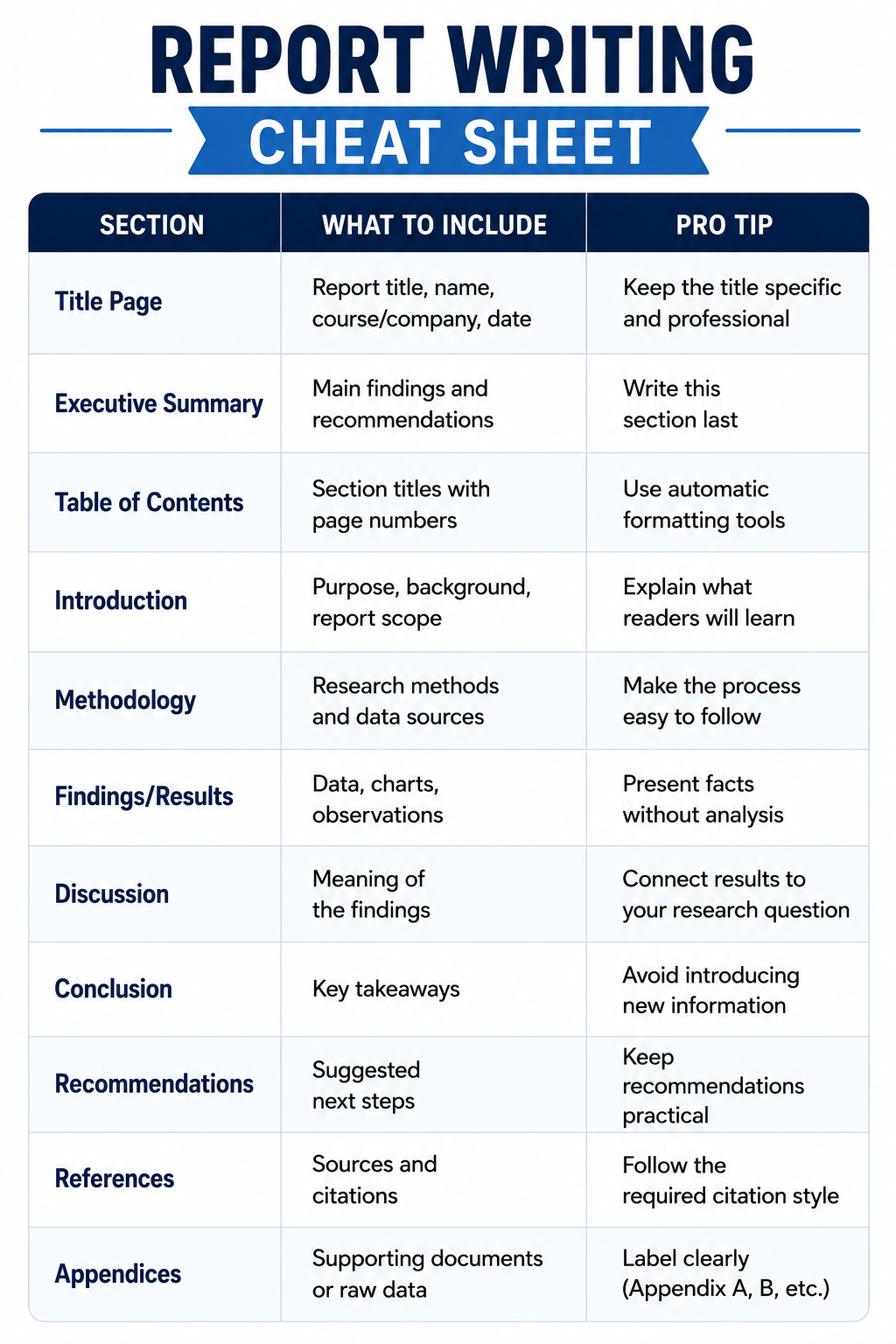
Step-by-Step Process for Writing a Report
Clarify your purpose and audience.
Before you write a word it's important to know who your report is prepared for. Knowing your audience will also help you narrow down the purpose of your report, which in turn will determine which information you present and how you present it.
Research and Plan
Begin by immersing yourself in your topic or area of research. Read and gather your sources, data and supporting materials. Stick to credible academic sources and cite immediately upon using a source to avoid unintentional plagiarism.
Create an Outline
Using the skeleton outline we shared earlier in this blog, sketch out the outline for your report. Include a few key points under each section and list any references, data or information you’d like to include in each. Starting with an outline will speed up your first draft.
Write the First Draft
Try to write continuously and without stopping. Now is not the time to worry about correct grammar, and overediting should be avoided. Draft section by section and remember that reports use fewer words than a traditional essay, so be brief but clear.
Revise for Clarity and Structure
Check that each section does what it promised to do and nothing more. Go back and also check for clear language and flow between sections.
Proofread
Add the finishing touches to your report by editing for all the details, like proper punctuation, correct citation format, capitalization, etc. AI tools can be extremely useful during the copy editing process, and they can also help identify AI vocabulary in your draft, giving you a chance to polish before submitting.
Tip: Even the most credible-sounding sources can be fabricated by AI tools. Use a trustworthy Hallucination detector before submitting your work.
Best Practices for Writing Effective Reports
- Use an active voice. For example: “The team conducted three interviews” reads better than “Three interviews were conducted by the team.”
- Avoid unnecessary wording. Reports are informative, and only the required information should be included.
- Support your claims with evidence. If you refer to a policy, fact, or any claim, show the evidence to support it.
- Use visuals in your report. Some information is better presented visually. Add charts and tables to make the data faster to absorb.
- Match your writing to your audience. Know who you are writing for and the tone of your topic, and match it in your report.
Take a look at this interactive tutorial on report writing from the University of York.
Report Example
Report Title: Fin whale singing decreases with increased swimming speed
Abstract
The attributes of male acoustic advertisement displays are often related to a performer's age, breeding condition and motivation, but these relationships are particularly difficult to study in free-ranging marine mammals. For fin whale singers, we examined the relationships between a singer's swimming speed, song duration and amount of singing. We used a unique set of fin whale singing and swimming data collected in support of the US Navy's marine mammal monitoring programme associated with the Navy's Integrated Undersea Surveillance System. A goal of the programme is to improve understanding of the potential effects of anthropogenic sound sources on baleen whale behaviours and populations. We found that as whales swam faster, some continued to sing, while others did not. If swimming speed is an indication of male stamina, then singing while swimming faster could be a display by which females and/or other males assess a singer's physical fitness and potential reproductive quality. Results have implications for interpreting fin whale singing behaviour and the possible influences of anthropogenic sounds on fin whale mating strategies and breeding success.
Continue reading the full report
FAQs
How do I start a report?
Begin by considering the audience and purpose of your report. Once you know who the report is for and what they need from you, you can get a clearer picture of what your report needs to include and how to best structure that information for your audience.
What are common mistakes to avoid in reporting?
The most common mistake is treating a report like an essay. Others include not highlighting the key findings, using inconsistent formatting and including unverified or unauthoritative data, sources or statistics.
What makes a report different from an essay?
Reports are much more concise, structured and focused in the way they present information. Essays can be discursive and can include an argument. A report’s main goal is not to sway the reader but to present the data they need to make an educated decision.
When should you write a report?
If your goal is to communicate findings, progress or analytics to a specific audience with a specific person in mind, a report is the best format.
How long should a report be?
There’s no defined length for a report. Some reports can be as short as ten pages and other reports, those commissioned by the government, for example, can run into hundreds of pages. If the report you are writing is a school assignment, the word count will likely be provided for you.