How Claude’s Watermarking Actually Works
Our CTO shares more on Claude’s invisible text watermarks and explores how it actually works.

Anthropic dropped a bombshell announcement in August 2026, and it was through their help center. In response to EU regulations, the company started adding invisible text watermarks to text generated by Claude. At the time, I wrote about this on an X thread here – and since then, my explainer has gotten over a million views for explaining what they don’t tell you: how does it actually work? As the CTO of GPTZero, I'll share how text watermarking works and whether it can be defeated.
TL;DR
Anthropic has shared that “Claude’s text watermark is a version of the SynthID-Text approach published by Google DeepMind in a Nature paper in 2024.” One of many issues with watermarks is that if the secret key leaks, then the whole system falls apart. In my testing, the watermarks don't survive intense paraphrasing (especially when you combine word-choice and syntax attacks) or human text substitution (rewrite your AI text by plagiarizing human authors). Most importantly, just because a text is missing a watermark doesn’t mean a human wrote it – and if you're posting, "it's not X, it's Y", I don't think the watermark is going to make a difference.
The mechanics of text watermarking
Almost all forms of watermarking that are fast and cheap enough for a frontier lab have the same formula: use a secret key to influence which tokens the model chooses and then search for that pattern in the resulting text – a token being a small unit of text, like a word, or part of a word.
A starting point is the KGW method, though this isn’t the exact method Claude is using now.
During generation:
1. Let's say you've generated n tokens so far. Take those n tokens + a secret key to generate a random hash.
2. Use that hash to reweight the probabilities for the n+1 token, and then sample from that new distribution. In the simple case, you could split 50% of all English words into a green or red set based on your hash, and boost the probability of words in the green set.
For watermark detection:
1. For each token, see if it was in the green or red set.
2. To do this, recreate the hash based on the secret key and the text preceding the current token. Then, recreate the green and red sets of words.
3. Once you've checked all the words in the text, if the next token is selected disproportionately from the green set more often than expected, you claim the text has the watermark.
How Claude uses SynthID
As Anthropic itself says, “Claude’s text watermark is a version of the SynthID-Text approach published by Google DeepMind in a Nature paper in 2024.”
It admits there are limitations to how effective watermarking is, and that, “Using our key, one can only answer the question ‘What is the likelihood this was partly written by Claude?’”
In Anthropic’s own words: the watermark (or lack thereof) does not confirm whether the text was human-written, and cannot tell whether the text was written by a different AI (“even if that other AI uses watermarking, it would have a different key; it might also use a different watermarking method altogether”).
The questions you probably want to ask
At this point, I can tell you want to ask the following.
Isn't it easy to mess up the hash if you paraphrase the text?
The answer is mostly yes; however, you can use a probabilistic function to get your hash instead of a deterministic function (SIR, Adaptive Watermark). Since the entire watermark is a probabilistic model, this is fine.
Doesn't this make the text much worse?
The answer is technically yes, it does. But for most people, it's imperceptible (Google claims in a human feedback study with 20,000 texts), since there are exponentially many ways to write the same paragraph. DiPmark does something more sophisticated to avoid shifting the text distribution on average. Of course, watermarks fail on short text or highly predictable texts like "2+2=4".
Shouldn't it be easy to figure out the green and red sets?
The answer is no. You would need an exponentially large number of samples from the watermarked text to reconstruct those sets exactly, but it's a risk if the detector is open to the wild (Watermark Stealing).
The challenges that a frontier lab still needs to overcome
Streaming text to users
Their watermark needs to work token-by-token because they are streaming their text to users. Many watermark methods plan sentences or paragraphs at a time, or change the text after it's fully written, to make the watermark robust to paraphrasers, and a frontier lab cannot afford to do this yet (SemStamp, PostMark).
Protecting the secret key
If the secret key leaks, the watermark is busted. To avoid a large blast damage from this, you need to have a couple of secret keys in rotation.
Preserving code and predictable text
Some texts, like code, cannot be arbitrarily changed; otherwise, the code will break. In those cases, the watermark needs to selectively change words in parts of the text that can tolerate synonyms (i.e., like variable naming) - see SWEET, EWD, Invisible Entropy.
Explaining detector errors
They will need to educate their users on how to deal with false positives and false negatives of a detector, which is a big challenge (one we put a lot of effort into at GPTZero)
Does watermarking work in practice?
So, how do I see this playing out in the next 6 months?
If Anthropic releases the watermark detector publicly, I think they defeat their own watermark. People find reliable watermark removal strategies by testing against Anthropic (AI detectors like GPTZero have an advantage here because they can train against these adversaries once they become popular).
If they keep the detector private to the government, as Google has done, it's "safer". However, some papers show trained approaches that work robustly to zero-shot break watermarks without any data, simply because they try to write the text like a human (Zhang et al. 2024, Watermarks in the Sand).
In my testing, the watermarks don't survive intense paraphrasing (especially when you combine word-choice and syntax attacks) or human text substitution (rewrite your AI text by plagiarizing human authors). The free paraphrasers I've tried have quickly bypassed Google DeepMind's watermarking system, SynthID, for what it's worth.
All in all, frontier labs are likely okay with this because they expect most users not to attack the watermark, and also because they and European regulators likely don't care past a certain point… It's good enough to pass as an attempt to follow regulation, for now.
Overall, I think users of frontier LLMs will not really care about this, for these reasons:
- They don't realize watermarks are there;
- The EU will force everyone to conform;
- This seems more like regulatory hoop-jumping than an earnest effort from frontier labs to expose LLM use.
For the people who are concerned about watermarks, their first concern should be AI detectors - the systems we are building that always adapt to new bypassing methods and LLMs. In short, if you're posting, "it's not X, it's Y", I don't think the watermark is going to make a difference.
Watermarking and OpenAI
In October 2026, OpenAI released their watermark technical report:
We're expanding our approach to content provenance to include text in response to EU regulatory requirements, while recognizing the significant limitations of current text watermarking technology.
— OpenAI (@OpenAI) October 5, 2026
Our tools already help verify whether an image or audio file was created with our…
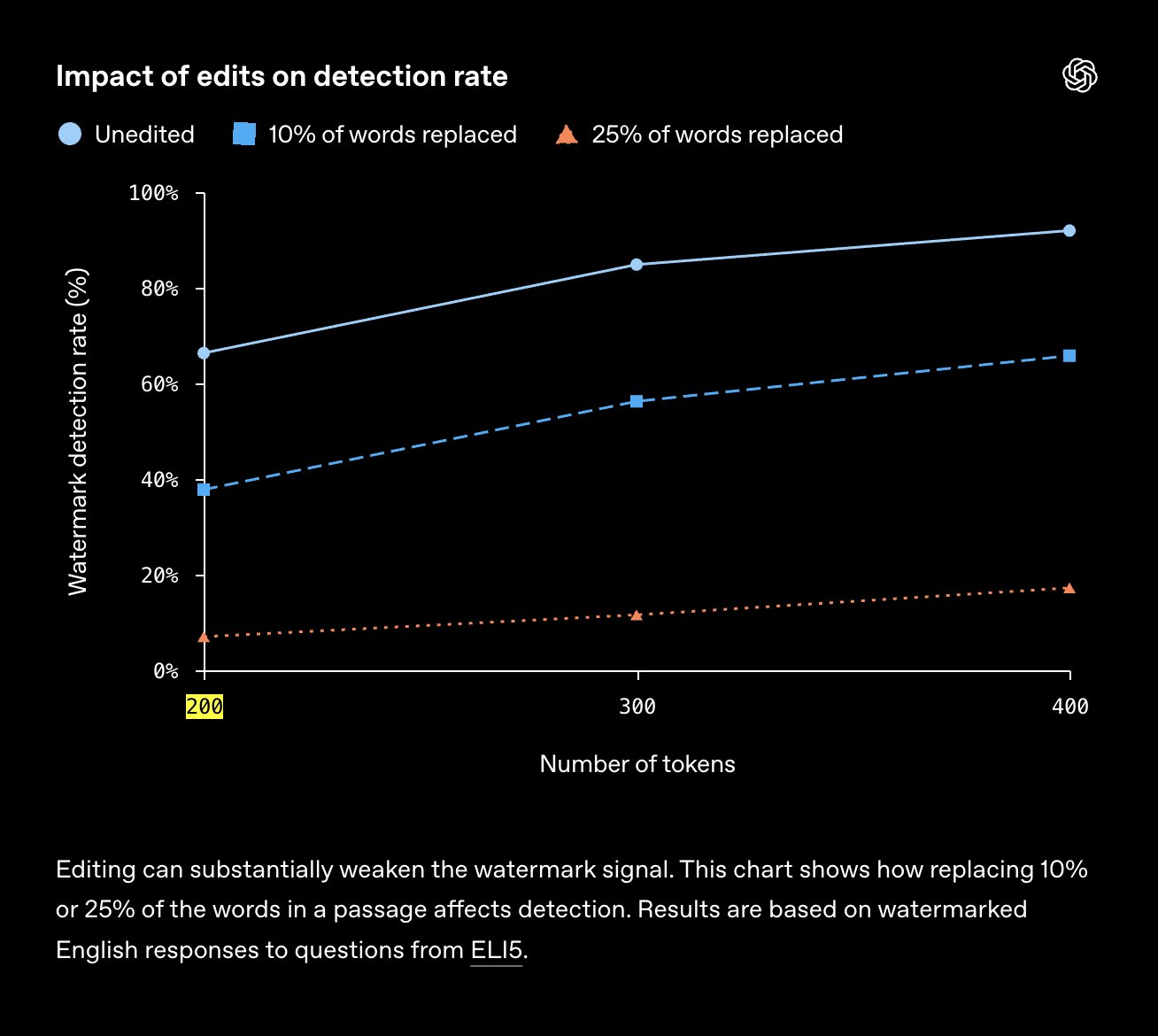
This fits my prediction of how it works almost exactly. While they say it's "unbiased", implying it doesn't affect text quality, the tokens they pick are still different from the optimal distribution. They just mean that it's not biased if you average over all secret keys they could have picked (this doesn't really matter to users).
However, they did make an improvement - they put a LOT of effort into limiting how much the watermark can change the token selection, giving it an "entropy budget." This means that watermarked text can't get that much worse.
But it does mean their watermark is still pretty weak. The detection rate is <70% on Reddit, and it's <10% if you replace 25% of the words. FPR is 1%.
Why AI Detectors Matter More than Ever
If you want detection rates of 99.8%+ and false positive rates near 0.01%, I would stick with AI detectors that are constantly being retrained. We’re proud to have released the world’s most accurate AI detection model, GPTZero 5.
GPTZero 5 is the most accurate AI detector according to 9 third-party benchmark datasets. It redefines what is possible in the AI detection space, exceeding the capabilities of competitors and protecting human writers with a remarkably low false-positive rate and unbiased predictions.
| Benchmark | GPTZero 5.0b | GPTZero 4.11b | Pangram 4 |
|---|---|---|---|
| AI in Peer ReviewAI-edited human reviews: Recall | 96.96% | 96.25% | 58.7% |
| Sem-DetectAUC | >99.99% | >99.99% | 97.80% |
| DetectRLAverage F1 | 97.34% | 96.53% | 95.30% |
| UChicagoFPR (lower is better) | 0.00% | 0.00% | 0.00% |
| GEDEOverall: Recall at 1% FPR † | 95.57% | 91.77% | 94.94% |
| Epoch AIFNR (lower is better) | 1.18% | 1.52% | 2.86% |
| GRiDRecall at 1% FPR | 99.93% | 97.81% | 99.63% |
| Academic Integrity AbstractsRefined or regenerated abstracts: Recall | 97.06% | 95.86% | 96.4% |
| MELD (cleaned)Overall: Recall at 1% FPR | 100.00% | 100.00% | 99.99% |
The technical novelty behind GPTZero 5.0 has led to it officially being designated as the only patented AI detector for text, a proud accomplishment of our world-class team of researchers.
Much of the effort in developing GPTZero 5.0 was dedicated to reducing false positives. On essay-length text, GPTZero 5.0 falsely flags just 1 in 50,000 human-written documents, and fewer than 1 in 10,000 on argumentative essays, financial disclosures, and legal briefs.
*As of 3 November 2026, Anthropic has extended this to Mythos 5, Opus 4.7, Opus 4.6, and Sonnet 4.6: in other words, as outlined on Reddit, “Every model released since August already has it. It applies worldwide, not just in the EU, and paying users can't opt out.”