GPTZero vs Pangram: AI Detector Accuracy Comparison
See how GPTZero compares to Pangram in 2025. Our benchmark shows GPTZero leading in accuracy, recall, and classroom reliability.



AI writing has become much harder to spot. In fact, the best language models today (GPT-5, GPT-4.1, o3, Gemini 2.5 Pro, and Claude Sonnet 4 and 3.7) are trained on massive datasets and refined to mimic how people actually reason and write. For anyone reviewing written work, this raises a tricky question: which detector can actually tell the difference, without accusing a human of cheating?
This is why we wanted to put two leading AI detectors, GPTZero and Pangram, to the test.
GPTZero is one of the most trusted AI detectors worldwide, as the first to launch and bring AI detection to the mainstream, back when ChatGPT went viral. Meanwhile, Pangram (built by former Tesla and Google engineers) is a newer challenger that’s growing fast. Let’s take a look at how they compare.
- TL;DR
- GPTZero and Pangram are two of the top AI detectors available right now
- GPTZero has been shown to score better for mixed human-AI writing
- Pangram has been shown to outperform when it comes to multilingual detection
- For classrooms, GPTZero is still the more reliable choice.
About Pangram
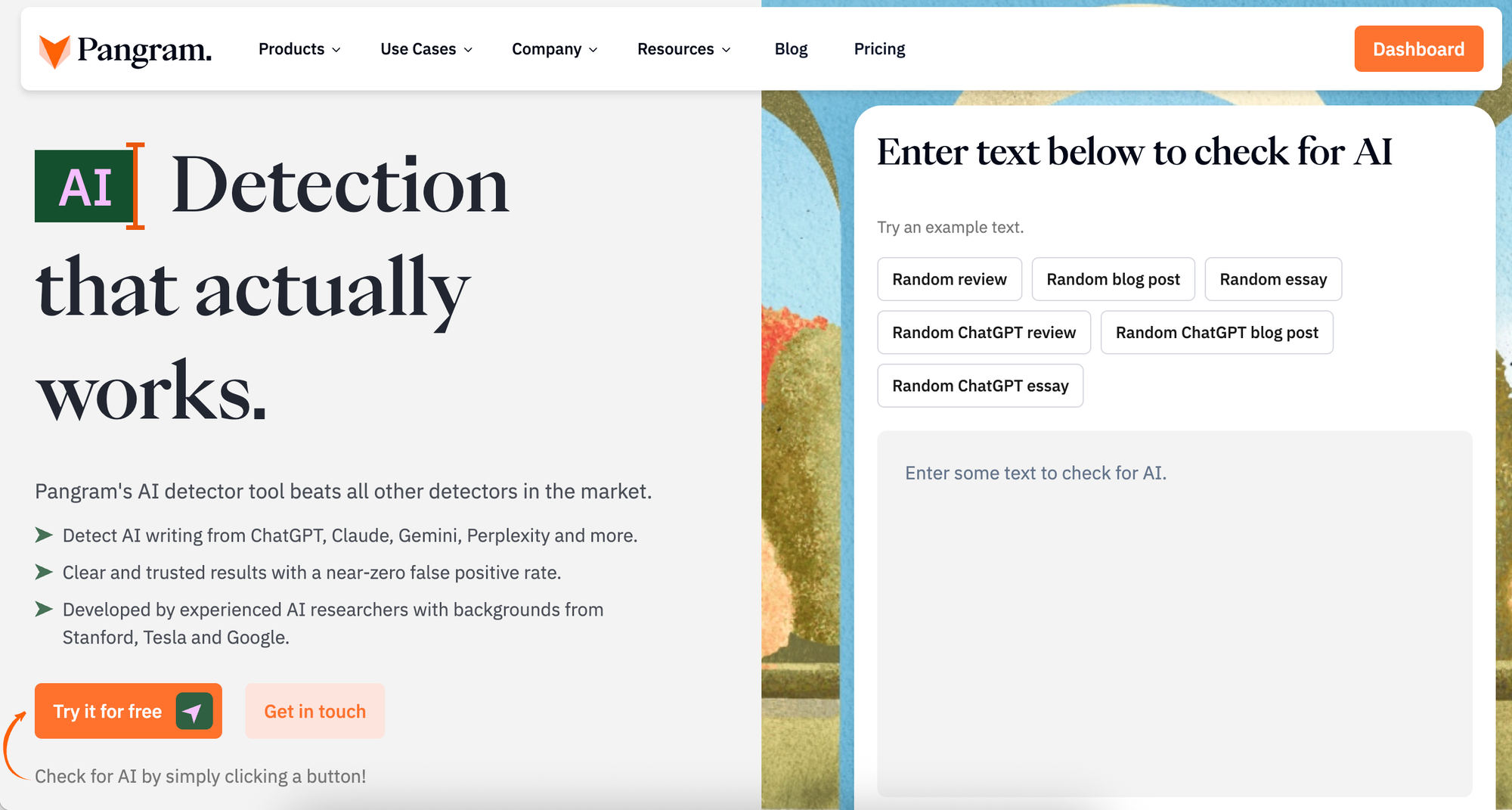
Pangram describes itself as combining “cutting-edge AI and comprehensive plagiarism detection to give you the complete picture of text authenticity and get the information you need, all in one place.”
In its own words, “Our AI detection works across more than 20 languages, making it a truly global, multilingual solution for institutions and businesses worldwide.” It can detect content from all major language models including ChatGPT, Claude, Gemini, Llama and more, making it a comprehensive solution for AI detection.
In terms of real-world applications, it is becoming more broadly used across industries, including publishing, media and business. According to the New York Times, Max Spero, the founder and chief executive of Pangram, an A.I. detection program, recently came across the claims around the book “Shy Girl” and ran a test of the full text, finding that the book was likely to be 78 percent A.I. generated.
About GPTZero
GPTZero was one of the very first, and arguably the most prominent, AI detectors, launched in January 2023. It emerged in response to the rise in academic plagiarism after the launch of ChatGPT in November 2022, and is now an internationally-recognized AI detection company with over 10 million users (as of January 2026) in the US, Canada, Australia, UK and dozens of other countries.
It helps users identify specific content in a document or text that has been generated by a large language model (LLM) like ChatGPT. It works with over 100+ organizations in education, hiring, publishing, and legal to create authorship transparency and preserve authentic human writing.

Results: GPTZero vs. Pangram
We used the same dataset as in our earlier Copyleaks and Originality.AI benchmark, ensuring a consistent test environment. Both GPTZero and Pangram were evaluated on overall accuracy, false positive rate (FPR), and recall, which are measures that show how reliably each tool spots AI text while making sure human misclassifications are rare.
Table 1: Overall accuracy, false positive rate, and recall of GPTZero and Pangram
Here’s how both detectors performed across six of the top AI models in use today:
Table 2: Recall by language model
In short, across every model, GPTZero came out ahead, sometimes by more than ten percentage points.
GPTZero vs. Pangram: Feature Comparison
At a glance
Accuracy rate
Both detectors are highly precise but approach accuracy differently. While GPTZero optimizes for real-world hybrid documents where AI and human writing are mixed, it can spot AI edits that other tools often miss. Pangram is more focused on pure AI content, and performs well on fully AI-generated text.
False positives
Pangram has a strong emphasis on minimizing false positives: according to its own data, its false positive rates averages about one in ten thousand academic essays, or roughly 0.004%. It also claims 99.8%+ detection accuracy for GPT-5 outputs, and runs classic literature as well as its own website copy through the detector to make sure human text isn’t being misread.
GPTZero’s false positive rate is under 1% which is among the lowest in the industry, especially for a tool tested across real classrooms with a broad range of writing styles, including ESL students. Both companies agree false positives are more damaging than false negatives (as in, it’s better to occasionally miss AI text as opposed to wrongly accusing a human writer).
Robustness vs paraphrase and new models
More humanizer tools are cropping up in order to help people bypass detection. GPTZero continually retrains on outputs from the newest models and is tested against these paraphrasing tools that regurgitate essays so that they appear human-written.
Pangram claims 90% detection even on humanised text, with a multi-step training process that exposes its model to a broad range of writing styles.
Multilingual performance
Pangram supports AI detection in more than 20 languages, including Arabic, Japanese, Hindi and Korean, which makes it a strong option for publishers or global organizations reviewing multilingual content.
GPTZero is currently strongest when it comes to English writing but continues to expand its multilingual capabilities, and fully supports English, German, Portuguese, French and Spanish.
Other Factors to Consider
Ease of integration
Teachers and educators find GPTZero to be the stronger option, as it integrates with Canvas and Moodle (as well as Google Classroom) so that you can check student work directly from your LMS. If you’re a developer, you might find Pangram’s Chrome Extension and API fit better into your workflow.
AI Grader
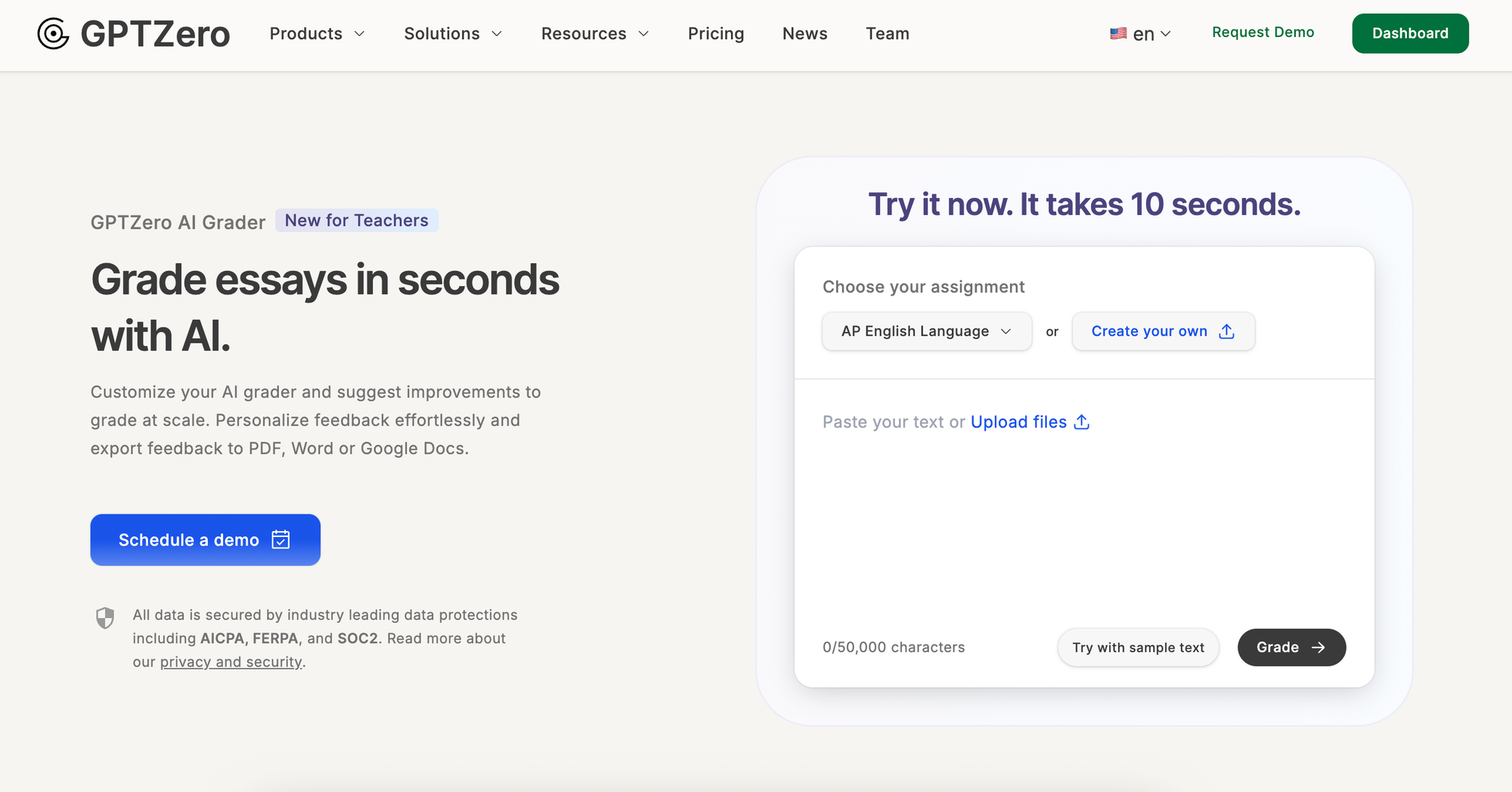
GPTZero’s AI grader helps teachers to lighten their load by combining automated essay scoring with AI detection, which can end up being a huge time-saver. It allows teachers to customize their AI grader and suggest improvements to grade at scale, helping them to personalize feedback effortlessly as well as easily exporting feedback to PDF, Word or Google Docs.
Support
GPTZero offers regular updates when there are new model releases as well as providing dedicated educator support, such as our popular webinar series on Teaching Responsibly with AI. Pangram also releases updates frequently.
Edge Cases and Limitations
No AI detector is perfect, and it’s worth remembering that even the strongest detectors have their limitations and failures. Paraphrased or very short text can produce lower confidence scores.
Unseen LLMs (very new models that have not yet been added to training data) can temporarily reduce recall, as when a brand-new model launches, detectors might lag behind briefly until they’ve caught up with its writing style.
Bias risk can exist if the text is influenced by linguistic differences, although GPTZero’s ESL-fairness training works hard to mitigate this.
There are also ethical issues such as false flags, an over reliance on AI detection, as well as privacy concerns when it comes to scanning sensitive work.
What this means for educators
For those working in education, what matters the most is how each detector assists in enabling responsible AI in the classroom. Beyond simply spotting how much student work has been AI-generated, there is much work to be done in figuring out how to effectively integrate AI into tomorrow’s classroom.
While any detector result is simply a conversation starter, at GPTZero, we go beyond detection to work with educators through our Teacher Ambassador Program, which empowers educators to promote responsible AI usage in schools, offering resources to teach colleagues about AI literacy and detection. Ambassadors help shape AI integration in classrooms and receive free access to GPTZero’s tools.
As our founder Edward Tian shares, “We’re evolving to keep up with the latest in AI detection and offer educators more holistic education solutions: writing reports, origin analysis, advanced scan, and interpretability metrics. With teachers, we want to empower you with the guardrails on technology in the classroom to foster originality, encourage critical thinking and prepare your students for the future with AI.”
Conclusion
These benchmarks illustrate the cutting edge of AI, as the better the AI models get at sounding human, the tougher the detection challenge becomes. Benchmarks show, in raw data form, whether detectors can measure up against the latest releases, and GPTZero’s performance shows that we’re continuing to lead the industry.
GPTZero continues to perform at the top of the field across the latest models, including those with the best thinking capabilities and high volumes of training data, with the most access to human-written text.