
How to Write a Political Essay: 5 Tips, Examples and Common Mistakes
A political essay explains and analyzes a political topic, often arguing from a specific political position, and is always backed up by robust evidence.



Political essays are challenging because they ask the reader to not only take a stand on a political topic but also to provide strong evidence in support of their argument. The political essay has to be grounded in evidence to be effective (and to get you top marks). As the University of Texas political essay guide puts it:
“A good interpretive essay in political philosophy is not a summary of what is obvious in what the author says. It is not even—at least not primarily—a defense of some theory of your own about the text. It is rather an exploration of an important, puzzling question.”
Writing your opinion on a political subject and sprinkling some quotes throughout is not enough. This is precisely why these essays are trickier than they look at first glance.
At GPTZero, our AI detector has scanned thousands of essays.
When it comes to political essays, this guide will share what makes the best ones stand out. We will walk you through the step-by-step process of writing a standout political essay – and cover everything from essay structure to the exact steps you need to take to ideate, draft, and polish your paper.
TL;DR
- A political essay is an in-depth analysis of a political topic that argues a position using evidence to support claims.
- The basic structure of a political essay is identical to that of other essay types (introduction, body paragraphs, conclusion, and bibliography).
- Strong political essays focus on a strong thesis statement backed up by primary, credible sources like government data, peer- reviewed research, and legal texts.
- The most common mistake students make when writing political essays is not providing enough evidence to support their argument.
What Is a Political Essay?
A political essay presents an argument that could be tied to a current or past political event or issue. The argument is usually presented through the lens of a specific theoretical framework. Its purpose is to persuade readers by presenting a well-thought-out argument backed by proof.
According to the McGill University Department of Political Science, a strong political essay has to go beyond summarizing facts and provide compelling evidence to sway the mind of the reader.
Political essays are structured much like other academic essays. They must contain a strong introduction with a strong hook, a compelling thesis statement, body paragraphs, a conclusion, and a bibliography.
Political essays argue from a specific political theory – for example, Objectivism, Communism, or Libertarianism. Famous examples include John Stuart Mill's On Liberty, Mary Wollstonecraft's A Vindication of the Rights of Woman, and Fredrick Douglass’ Fourth of July Speech.
Basic Structure of a Political Essay
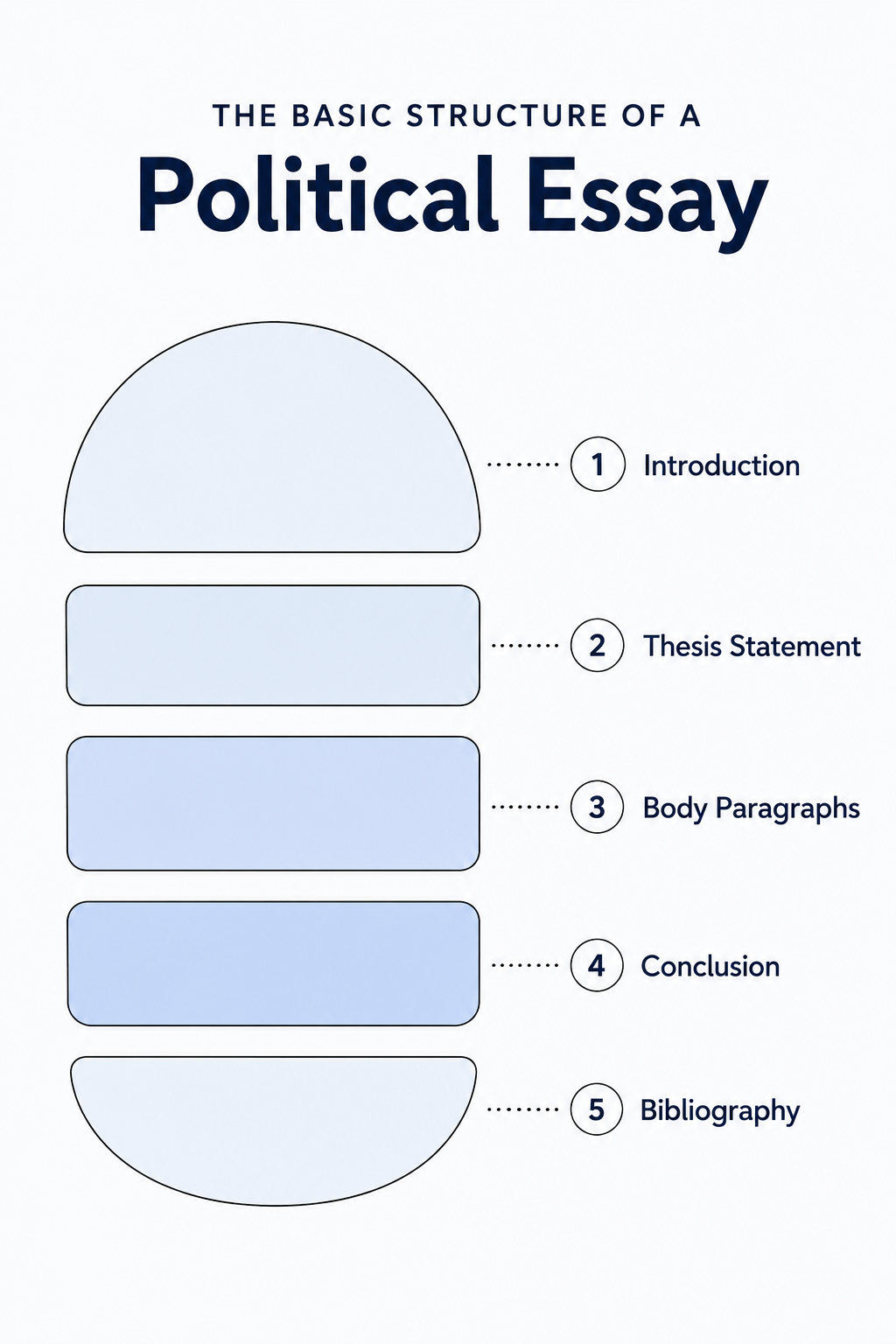
To present your ideas and evidence as coherently as possible, we recommend you follow this five-part structure in your political essay. Thinking of your argument in sections will make it easier for you to organize your ideas and start writing.
Introduction
Your introduction is where you set up your topic for the reader, name the political theory or lens you will be writing from, and present your thesis statement. Your introduction should open with a hook and include a striking statistic or a sharp question that gets the reader thinking or perhaps reconsidering their own beliefs or assumptions.
Thesis Statement
Your thesis is a sentence or two that makes an argument and signals what the essay is going to discuss. In the case of political essays, your thesis statement has to take a stance.
Body Paragraphs
The body of your essay is usually broken down into three to four main paragraphs. Each paragraph presents a single supporting point. It's important to make sure you are tying each body paragraph back to the thesis statement and focusing only on one main point per paragraph. When grading your essay, instructors look for your ability to engage with the evidence you have presented in the body paragraphs.
Conclusion
Think of your conclusion as the mirror image of your introduction. Begin by restating your thesis. Now that the reader has absorbed your evidence and your argument, you can summarize the main points. End with a broader insight.
Bibliography
Every claim you make in your political essay should be backed up by a source and cited correctly in your bibliography. In most cases political essays will require you to use the Chicago citation style. You should always check your syllabus or ask your instructor.
5 Tips for Writing a Strong Political Essay
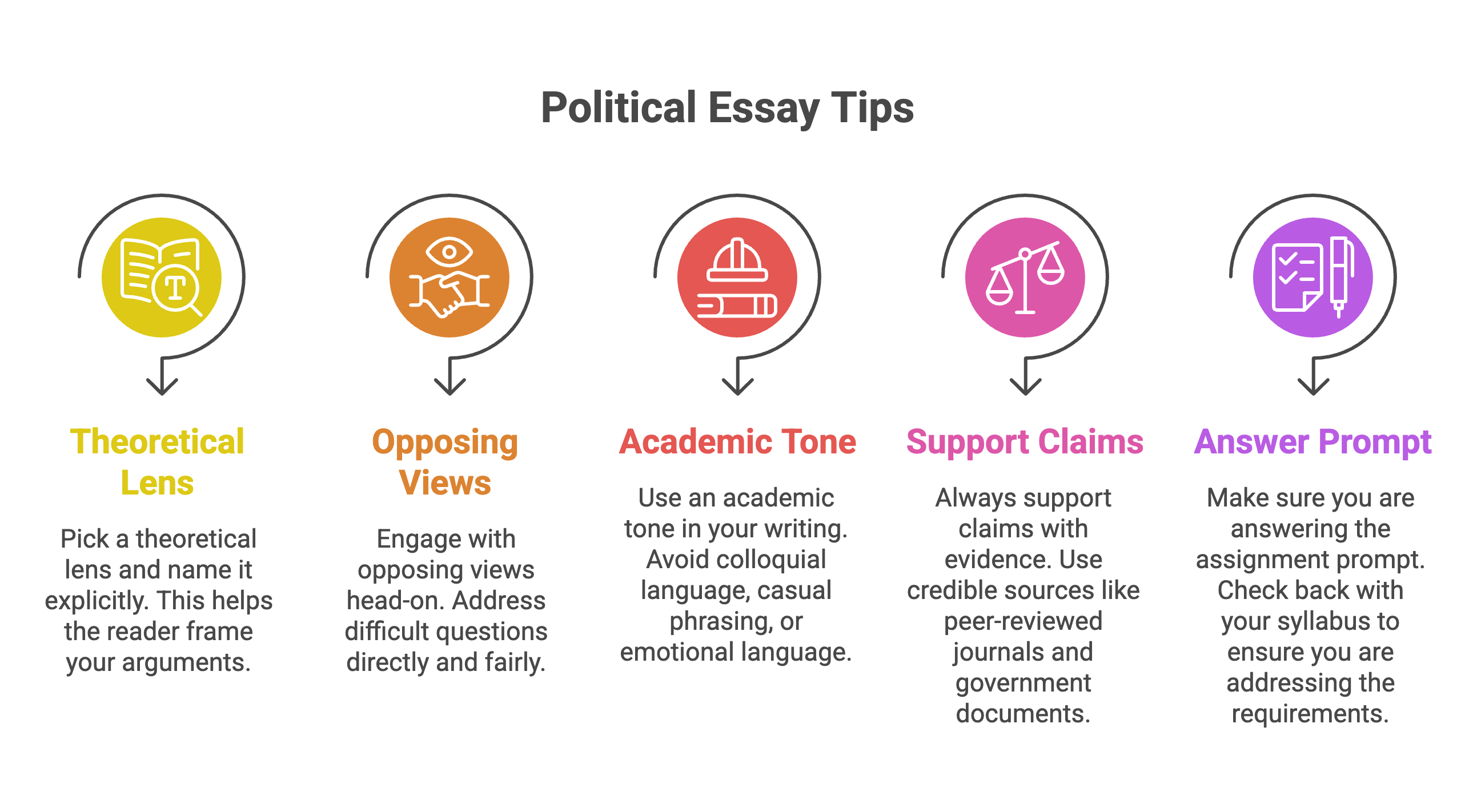
1. Pick a Theoretical Lens and Name it Explicitly
Strong political essays argue from inside a specific theoretical framework. If you are writing from a libertarian perspective for example, it's helpful to say it outright so the reader can frame your arguments through that lens.
2. Engage With Opposing Views Head-on
Don’t be afraid to tackle the big opposition when it comes to your argument. The strongest political essays don’t avoid the difficult questions a reader might have, but address them directly and fairly, acknowledging where they may have a good point to contribute.
3. Use an Academic Tone in Your Writing
Political essays are not editorial opinion pieces. They are academic in nature and so the tone has to match. Avoid colloquial language, casual phrasing or emotional language. Some students also use tools like an AI detector for writers to help them with refining their writing.
4. Always Support Claims With Evidence
Ensure you are using credible sources. Look for peer-reviewed journals, government documents and data and other sources of credible and official data. Opinions by experts can be helpful, but should be used sparingly to reinforce your argument further.
5. Make Sure You Are Answering the Assignment Prompt
Essays can take on a life of their own. After immersing yourself in source after source, you may go down a rabbit hole or begin ad-libbing on your topic. Drifting happens more often than you think. Always check back with your syllabus to make sure you are addressing what is being asked in the assignment.
Political Essay Examples
Political Essay Checklist Before You Submit
- Does your thesis take a firm position?
- Does each paragraph support that thesis?
- Have you cited every factual claim?
- Have you addressed at least one counterargument?
- Have you checked the required citation style?
- Have you proofread for tone, evidence, and structure?
FAQs
Can I use "I" in a political essay?
A political essay is an academic assignment and, in most cases, uses the third person. Some persuasive and reflective pieces often allow “I”, so always check with your assignment or instructor.
How do I start a political essay introduction?
An effective way to start a political essay is to present a striking statistic or pose a sharp question. Follow up with a few sentences that provide the context for your reader by introducing your topic and what you will cover in your essay. End your introduction with your thesis statement.
What are common mistakes to avoid in a political essay?
The most common mistakes we have seen when it comes to writing political essays are: making claims without proper support with evidence, using weak or non-authoritative sources, leaning on emotional language to drive your argument and using sources without citing properly. Always use a plagiarism checker to make sure you aren’t accidentally plagiarizing.
How long should a political essay be?
Your assignment syllabus will likely have a word count range for you to follow. Most political essays land somewhere between 1500 and 3000 words (between six and 12 typed, double- spaced pages).
Should I take a side?
In most cases, a political essay will require you to take a particular stance using a theoretical framework as your lens. Some assignments, however, might ask you to take a more analytical role and present multiple perspectives. Watch for specific language in your syllabus. If you can’t find any specific instructions, it is safe to assume you should formulate your thesis around a specific stance.