Prepositions: Definition, Types, and Examples
Prepositions are small but powerful words that show relationships of time, place, direction, purpose, and more. Learn the different types of prepositions, see examples in context, and avoid common mistakes with this practical guide.


Prepositions are words that connect parts of sentences and signal information about location, time, movement, and other relationships. They add a lot of meaning to a sentence. Are your keys on, under, or beside the table? Did you sleep before, during, or after the movie?
This guide will show you the different types of prepositions and explain their purpose, teach you how to differentiate between commonly confused prepositions, and answer your frequently asked questions. Nail down a firm understanding of what prepositions are, what their role is, and how to spot them in a sentence.
What is a Preposition?
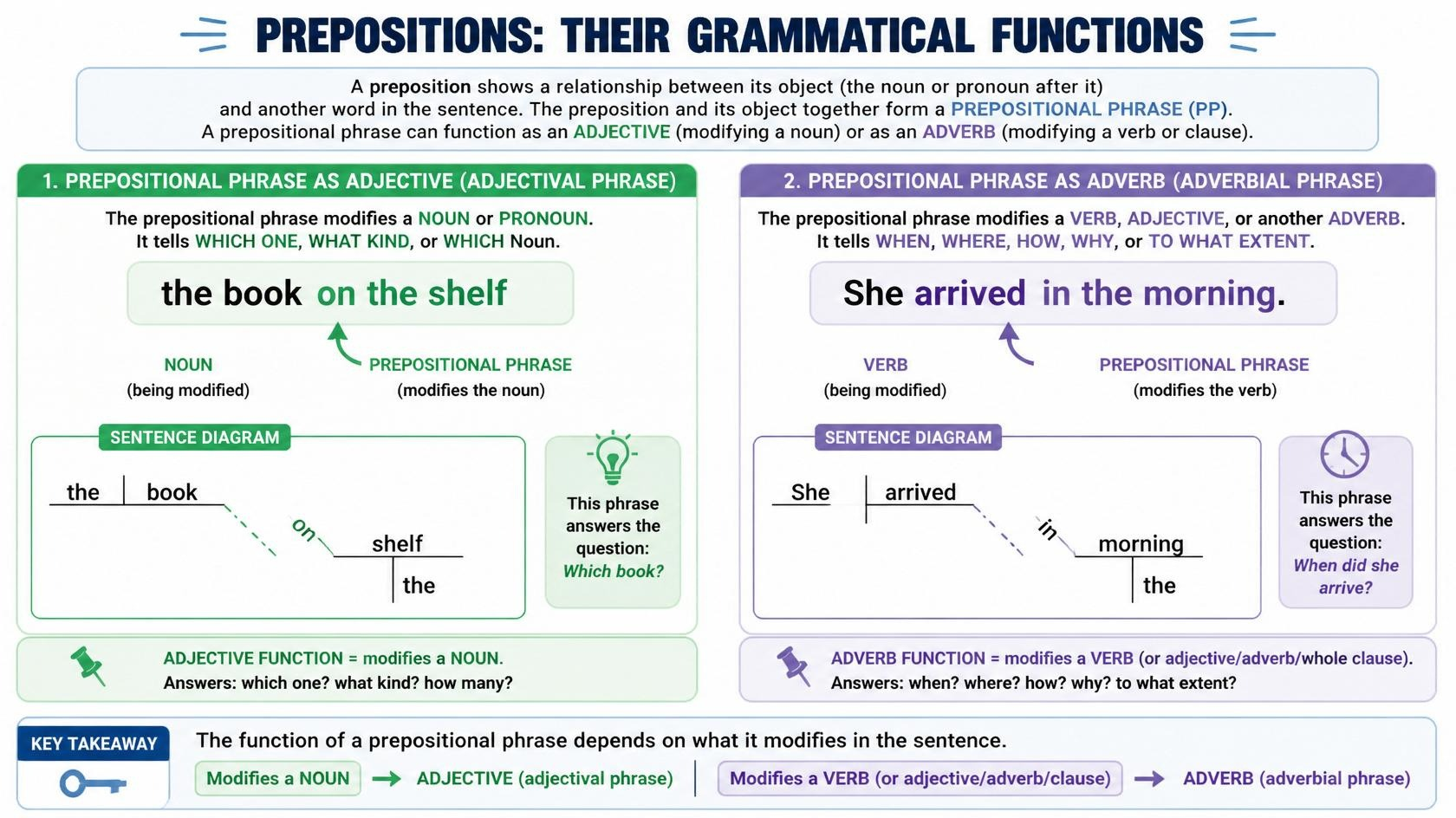
A preposition adds information to a sentence, often in reference to time or location. It can be a single word or a group of words that create a relationship between parts of a sentence, usually by connecting information to a verb or noun.
Example: My nephew lives in Dartmouth.
In this sentence, the preposition in adds information about location to the verb “lives.”
Example: The dinner is before the dance.
In this sentence, the preposition before adds information about time to the noun “dinner.”
Prepositions are among the most frequently used words in English, yet they’re also one of the biggest challenges for language learners because many are used idiomatically and don’t follow consistent rules. These words are often short in length, but they do a lot of heavy lifting by forming connections that are usually adjectival (modifying nouns) or adverbial (modifying verbs).
Types of Prepositions
Prepositions can be categorized by how many words they use, or by the type of relationship they form in a sentence.
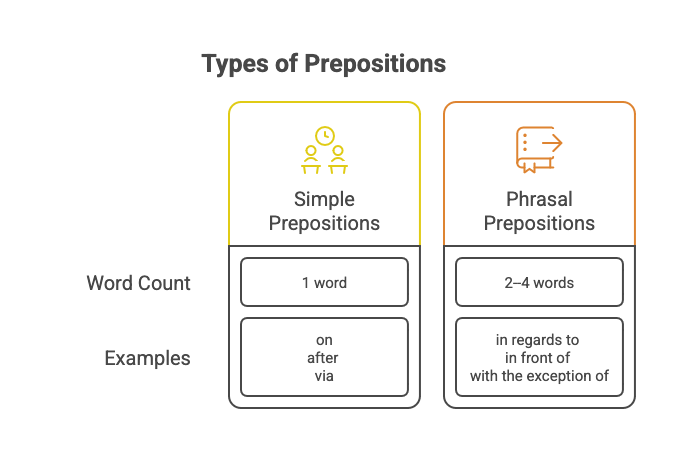
Simple prepositions and phrasal prepositions
Prepositions that have only one word, such as “on”, “after”, or “via”, are simple prepositions.
Phrasal prepositions have two or more words that must be combined to form their meaning, as in the case of “in regards to,” “in front of,” “with the exception of,” and more.
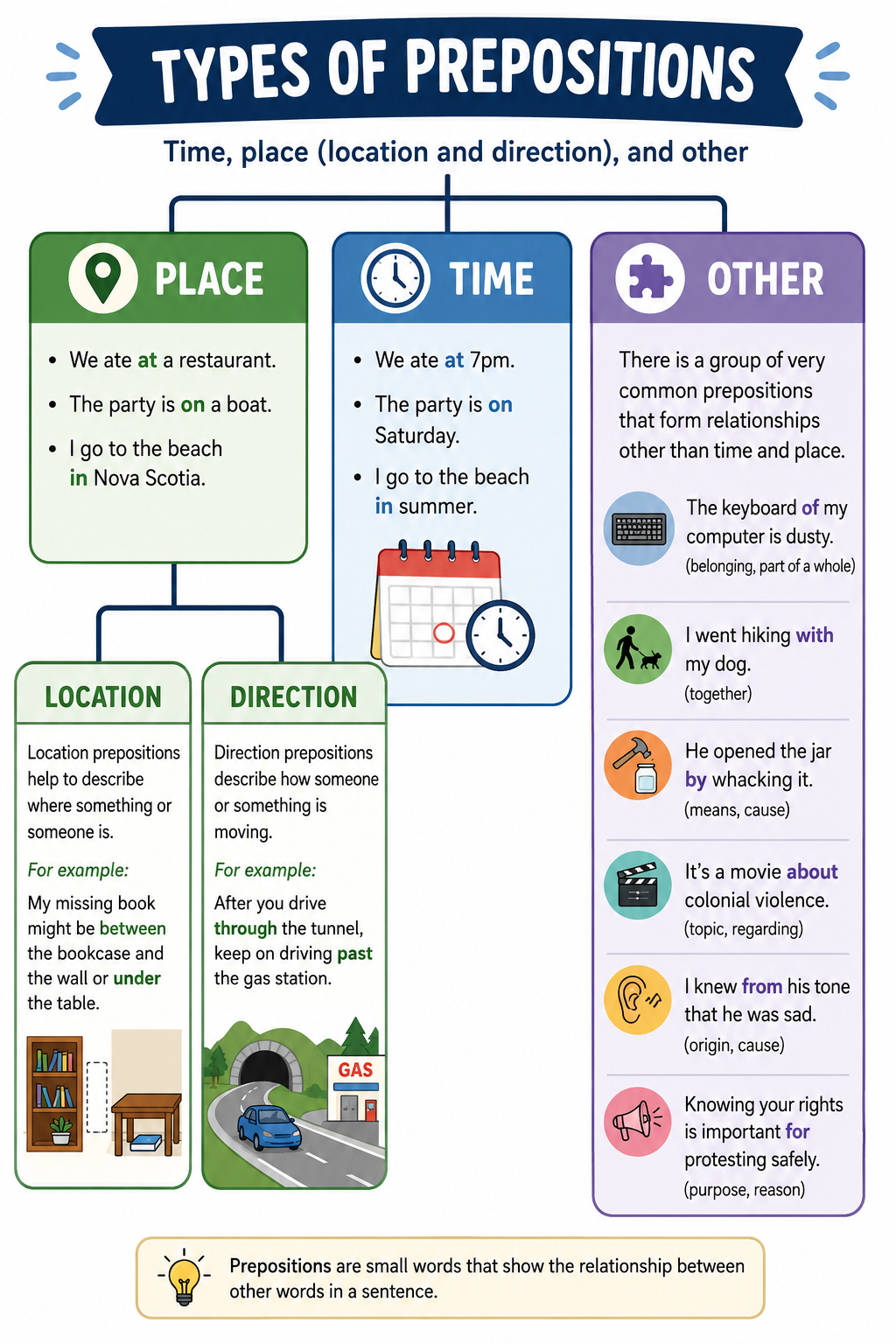
Time, place (location and direction), and other
Time prepositions tell you when something occurs, and place prepositions tell you where something occurs or how it is moving. Look at the different meanings of the prepositions at, on and in, which can refer to both time and place:
Time
- We ate at 7 pm.
- The party is on Saturday.
- I go to the beach in summer.
Place
- We ate at a restaurant.
- The party is on a boat.
- I go to the beach in Nova Scotia.
Place prepositions can be further categorized into location and direction. Locational prepositions help to describe where something or someone is. For example: My missing book might be between the bookcase and the wall or under the table. Directional prepositions describe how someone or something is moving. For example: After you drive through the tunnel, keep on driving past the gas station.
Other
Many common prepositions form relationships other than time and place.
- The keyboard of my computer is dusty. (belonging, part of a whole)
- I went hiking with my dog. (together)
- He opened the jar by whacking it. (means, cause)
- It’s a movie about colonial violence. (topic, regarding)
- I knew from his tone that he was sad. (origin, cause)
- Knowing your rights is important for protesting safely. (purpose, reason)
List of Common Prepositions
Starting with 9 common prepositions, use the acronym WIFFABOOT to remember with, in, for, from, at, by, of, on, and to.
For additional common prepositions, here is the University of Saskatchewan’s expanded list:
Still looking for more prepositions? See Berlitz’s “complete English preposition list” with 257 entries.
Commonly Confused Prepositions
Prepositions can have very closely related meanings that make it tricky to tell which is the correct choice. A grammar checker can help you flag when you’ve used the wrong preposition, but it also helps to know common errors to avoid.
In, on, and at
These three words are closely related, and as you saw above, they’re used to refer to both time and place; however, the appropriate situations to use them in are distinct, so mixing them up can cause confusion. As Brigham Young University explains, “these prepositions express a range from general to specific.”
Example: Let’s plan a conference in the winter on a weekday at noon.
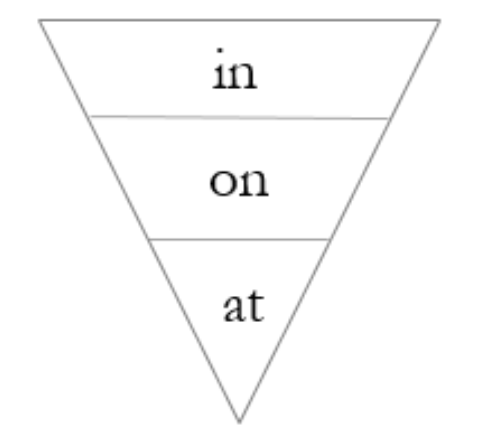
The largest time blocks are referred to with in:
- In the early 2000s
- In late September
- Back in my day
More specific dates are referred to with on:
- On my birthday
- On Tuesday
- On our lunch break
The most specific times are referred to with at:
- At 8:57 pm
- At midnight
- At just the right moment
From and of
It’s easy to confuse these prepositions because both can describe where something comes from or refer to a connection.
From indicates an origin, prior ownership, or a causal relationship.
- She is from Michigan.
- I took the book from the free library.
- They learned French from their mother.
Of indicates the relationship of one object to another, possession, or kinship.
- He’s the owner of three cats.
- She’s the daughter of the mayor.
- I’m scared of the black rabbit.
FAQs
How can I get better at using prepositions?
The University of Victoria explains that in English, “much preposition usage just has to be memorized in conjunction with fixed phrases and expressions” because they’re used “idiomatically” within “fixed expressions.” In addition to following general guidelines for individual prepositions, learn common prepositional phrases and notice their contexts and meanings as you watch movies, read books, and listen to music.
Some examples of idiomatic prepositions include:
- I’m falling in love. (This “in” refers to neither time nor place, and we don’t say, “Falling in like.”)
- We ran into each other. (If you “ran into a cave,” you would be inside it, not meeting it unexpectedly.)
How do you identify a preposition?
“In February, one of my houseplants turned brown at the edges of its leaves.”
Look for indicators of time (in February), location (at the edges), and other relationships like connection and belonging (of my houseplants, of its leaves).
It’s useful to identify prepositional phrases because it helps identify subject/verb agreements. When the core of the sentence is simplified to “One turned brown,” conjugation becomes easier.
Check: Can you select all the prepositions in this quick exercise from the University of Nevada, Las Vegas?
Are prepositions capitalized in titles?
A short preposition like “on” is never capitalized unless it’s the first word of the title, which is always capitalized. For longer prepositions like “without,” it depends on which style guide you’re following.
APA rules state, “all words of four letters” are capitalized:
- With or Without You
- A River Runs Through It
Chicago style stipulates that all prepositions, no matter their length, are not capitalized:
- With or without You
- A River Runs through It
Can you end a sentence with a preposition?
Grammatically, it’s incorrect. A preposition’s position relative to the “nominal” (noun phrase) that it’s connecting to the rest of the sentence is in the name: pre + position. If you’re writing a paper that requires formal style, reword sentences to eliminate dangling prepositions.
In everyday speech, however, we sometimes end sentences with prepositions, as in: “Grammar police are hard to put up with.” A reworked version of this sentence could be: “It’s hard to put up with grammar police.”