A Parent’s Guide to AI and Schoolwork in 2026
Our guide on setting AI boundaries at home, discussing responsible AI use with your kids, and working through school policies on AI.


In the GPTZero education community, only 8% think parents are giving strong, informed guidance around kids' AI use in schoolwork right now. A third say many parents just don’t know how their kids are using AI, and a similar share think parents want to help but lack the information to do so effectively. In short, there’s a big information gap between parents, teachers, and kids around using AI responsibly.
Yet over half of teenagers in the United States are using AI tools to help with their schoolwork, according to a new Pew Research Center survey. Not only that, but the survey showed nearly 60 percent of students believe chatbot-assisted cheating has become "a regular feature of student life."
While AI can support learning by explaining tricky concepts and generating practice questions, a challenging aspect for parents to navigate is the reality that many schools do not yet have firm AI policies or boundaries. This puts more weight on the parents to figure out at home what responsible AI use looks like.
In this guide, you’ll learn where the line sits between AI support and AI-assisted cheating, what responsible AI use can look like at different ages, and the conversations worth having at home and with your child's school.
How Much Are Kids Really Using AI for Schoolwork?
"CBS Mornings" explains what parents should know about AI when it comes to education
AI use among US teenagers has grown significantly over recent years. In 2024, 26% of teens said they had used ChatGPT for schoolwork, double the share reported in 2023, according to Pew research. This year, that figure has reached 54% among teenagers aged 13 to 17, with teenagers using chatbots like ChatGPT or Microsoft Copilot to research school assignments or solve math problems, Pew reported.
Parents don’t always have the most accurate read on how fast things are changing. Pew has also reported: “While about half of parents say their teen uses chatbots, higher shares of teens themselves (64%) report using them.”
When we asked the GPTZero education community what parents need guidance on, we found that it was mainly around daily study habits and ethical boundaries. Specifically, 34% said they needed guidance on defining acceptable AI use for homework, followed by practical strategies for supervising AI habits at home (24.7%).
At the same time, school boundaries are often still being worked out: a March 2026 survey reported by Education Week found 47% of parents said their child’s school had not provided information about its AI policy, while only 37% said they had received that information.
Is Using AI for Homework Cheating?
The distinction is becoming harder as AI use becomes more common, as it comes down to what the assignment is assessing, what the teacher has permitted, and whether AI supports the student’s thinking or substitutes for it.
To complicate things even further, there currently isn’t a broadly “acceptable” AI percentage, as some institutions ban AI entirely, while others allow it in a variety of ways.
Previously, when we spoke to educators in the GPTZero community about what AI range is acceptable, there was no firm consensus on what AI score should trigger concern: while some start looking more closely at an AI score of 1-20%, others see 50% or higher as the tipping point.
This is why, before you, as a parent, can decide whether your child has used AI appropriately, you need to find out what their school and individual teacher actually allow.
Where AI Can Help Students Learn
Students would not be using AI if they weren’t gaining something from it, although the default assumption is that they're using it to shortcut learning. And in fact, about three-quarters (76%) of teens in the Pew study say students at their school “use chatbots to cheat at least sometimes.”
However, AI can also give students who are using it responsibly a way to engage with their learning in a way that is more scalable than human interaction.
For example, if a student has had trouble keeping up in chemistry class with the concept of cellular respiration, they could use AI to explain it in a way that makes it easier for them.
They could then get AI to make their revision notes into practice questions or quiz them until they can explain a concept without help. In this sense, even the smartest students can be leaning on AI to stay engaged with the material.
Using AI also teaches students AI literacy, including the reality of AI hallucinations. Students need to learn how to verify AI information against reliable original sources, and our Hallucination Detector can help flag claims that deserve another look.
What’s Appropriate at Different Ages?
While there isn’t a set age at which AI suddenly becomes appropriate, the following gives a rough guide to the perspective of many educators.
Age 5 and under: Common Sense Media recommends totally avoiding AI chatbots, as kids this age cannot tell the difference between a chatbot and a human. Instead, around this age, conversation, play, reading with adults, and working through ordinary frustrations offer ways of learning that a chatbot should not replace.
Ages 6 to 12: Any use of generative AI should be limited and shared with a parent or caregiver, who is physically sitting alongside them: they should be comparing an AI answer with a trusted source, and talking about the fact that confident-sounding answers can still be wrong.
Ages 13+: Supervised use for homework and creative tasks can be appropriate, but only if it fits school rules. This can be a good stage to teach students how to think for themselves and engage with AI as a learning tool, and to spot when they are becoming too dependent on a tool.
No matter their age, ideally, people remain at the heart of the educational experience, with the student’s education being mostly guided by teachers, parents, friends, and other trusted adults.
How to Talk to Your Kid About AI
You do not need to become an expert in AI itself before initiating this type of talk. What is more important than knowing everything about how AI works is opening the door for your child to come to you if they have questions or concerns.
It helps to start from a place of genuine curiosity. Have they used AI? What tools do their friends use? Do teachers allow AI? Does it scare them at all? What do they like about certain tools?
Then, these principles are worth imparting:
- Try the problem yourself first. Productive struggle is part of learning, and it’s normal not to ‘get’ something on the first try. The process is what makes learning worth doing.
- Use AI to get unstuck, as opposed to skipping the hard parts of the work. AI might provide a hint or practice question, but try to avoid just asking it for an answer.
- Check what it tells you. AI can produce false facts and citations but sound extremely confident while doing so.
- Keep private information private. Do not paste sensitive personal or school information.
- Always check the assignment rules. Different teachers allow different levels of AI use.
- Always disclose AI assistance. First and foremost, students should follow their teacher’s disclosure requirements, but when in doubt, it’s generally best to err on the side of disclosure.
How Can I Tell If AI Did the Work?
We’ve written extensively about practical ways to spot telltale AI patterns and use AI writing checkers.
Essentially, no single signal proves AI use on its own, but certain patterns can help you decide when to look more closely, including repetitive structure, formulaic sentences, flat tone, generic examples, and surface-level subject knowledge.
While an AI detector such as GPTZero can add another signal, it should not be treated as final proof. Instead, it should be a conversation starter, not a verdict, with you considering detector results alongside writing history, drafts, source notes, and a conversation with your child.
Create a Family AI Agreement
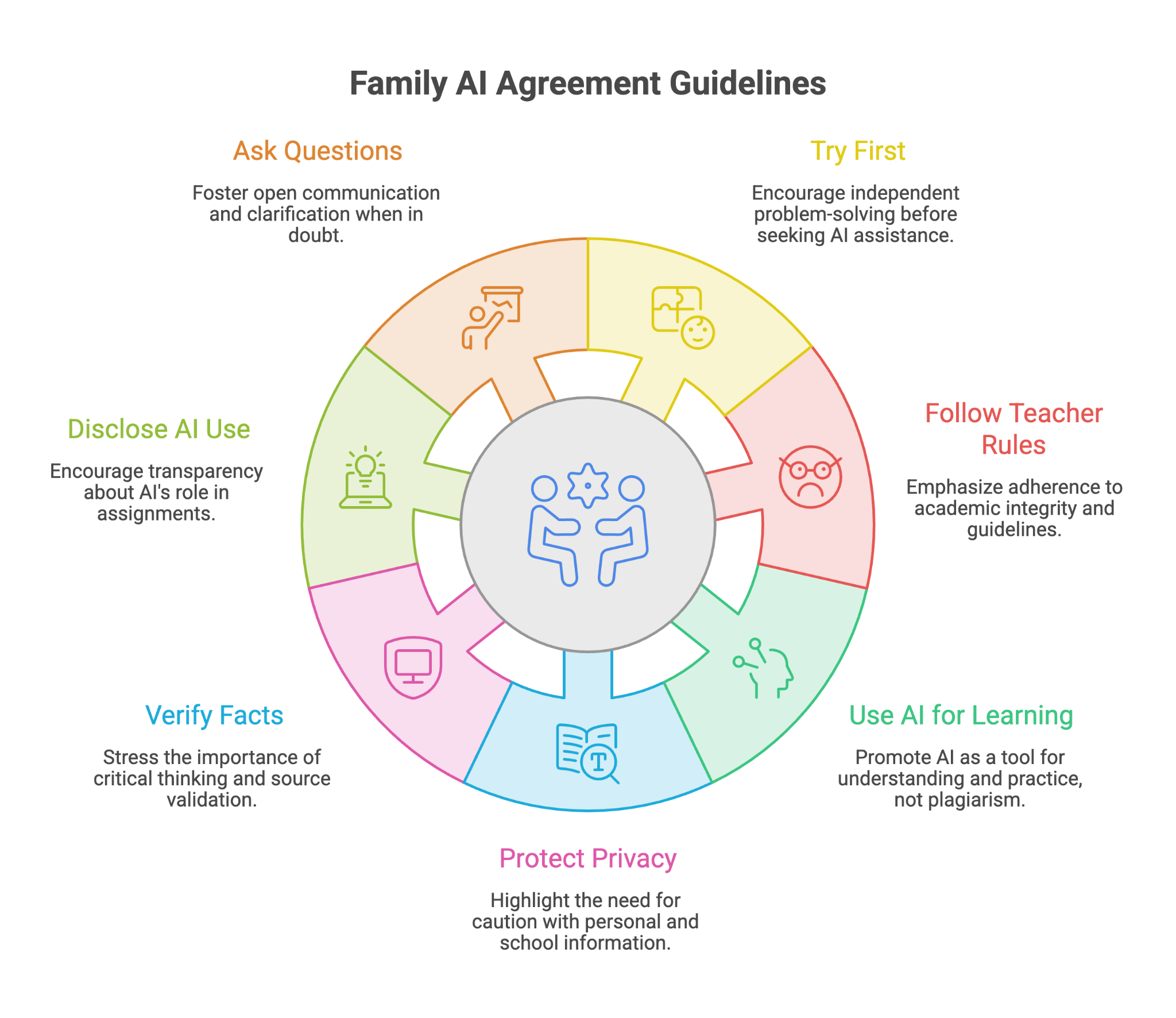
While you don’t need an elaborate technology policy at home, setting out rules you will follow as a family can make it easy to start future conversations about AI.
Start with the basics. Your family agreement might say:
- I try first before asking AI.
- I follow my teacher’s rules for every assignment.
- I use AI for explanations, ideas, and practice, not to pretend someone else’s work is mine.
- I verify important facts and sources.
- I never share sensitive personal or school information with an unapproved AI tool.
- I explain when AI has meaningfully helped with my work.
- If I am unsure whether a use is allowed, I ask.
Revisit the agreement as your child gets older and as school expectations change, as this will give your child a framework they can eventually apply without you.
Questions Every Parent Should Ask Their Child’s School
This video looks at education in transition, and how AI is changing teaching
Parents should be part of school conversations about educational technology. At the start of the school year, as a parent, consider asking:
- Does the school have an AI policy this year, and where can I read it?
- Which assignments allow AI support, and what kinds of support are permitted?
- Which AI tools has the school approved?
- What student information should never be entered into AI tools?
- How are students taught to verify AI-generated information?
- What happens if a teacher suspects inappropriate AI use?
- How will parents be told when the policy changes?
A strong school AI policy will make these expectations easier to manage. Here, we outline how to establish AI policies at your school – these go over acceptable use and protect academic integrity at your institution.
FAQs
Should I ban AI at home?
At a high school level, an outright ban is not going to help your child develop AI literacy. Instead, having open conversations, teaching boundaries, supervised practice, and letting them experience the tools is likely to help them learn when AI is useful and when to work independently. Then again, for younger children, much stricter limits are recommended.
What do I do if I catch my child using AI dishonestly?
If your child uses AI in a dishonest way, your main priority should be to stay calm and discuss the behavior with them, so you can understand the context before introducing consequences. How you respond will teach them what’s appropriate to do in the future.
Which assignments allow AI support, and in what way?
Ask the teacher: for some, AI might be permitted for brainstorming or revision, while for others, AI might be completely banned. It's good practice to get students into the habit of knowing the AI rules before they begin, instead of trying to determine afterward whether their use was acceptable.