
How to Check If Your Child Is Using AI for Homework
Worried your child’s homework doesn’t sound quite like them? This guide explains what to look for and what to do next.


The age of students using AI for schoolwork is younger than you might think, as according to RAND, the number of students in middle school grades and above using AI for homework rose from 48% in May 2025 to 62% in December 2025. With AI becoming more a part of daily school life, many parents are scrambling to catch up with how to support their children.
You don’t want to accuse them unfairly, and you also don’t want them using AI as a learning crutch. In this guide, we’ll go through what to watch out for if you suspect your child might be using AI for homework, when tools like GPTZero can help, and how to talk to your child about responsible AI use. After reading this, you’ll know how to spot possible AI use fairly, what evidence to look for, and how to start a calm conversation before jumping to conclusions.
TL;DR: How to Tell If Your Child Is Using AI
If your child is leaning on AI for homework help, then their work might sound a lot more polished or generic than usual – and what can be even more confusing is that different teachers sometimes have different rules around AI use. The best way to check is to compare the work to their past writing, get them to explain their ideas, look at the process they’ve taken with the work, and use an AI detector as one signal in a broader context. It also helps to set family boundaries around AI and to open an ongoing family conversation around AI.
Why Are Students Using AI?
The overarching reason most students are leaning on AI is to get through more schoolwork at a faster pace. As one uni student told us, “AI is like that thing that can help workload feel easier because it can help you read 30 pages in minutes. It really saves you a lot of time.”
Pew found that about four-in-ten or more teens report having used them to get help researching a topic or solving math problems, and that overall, “teens are far more likely to say chatbots are helpful for schoolwork, rather than unhelpful”. Specifically, the most common reasons students are leaning on AI are:
- Speed. Much like a one-on-one tutor who never runs out of energy, AI can turn a vague question into a structured answer extremely quickly.
- Pressure and deadlines. When students feel overwhelmed by the sheer volume of work or don’t know where to start, AI can feel like a non-judgmental rescue tool.
- Lack of confidence. Some students use AI because they do not trust their own thinking process or writing, or want to enhance their own abilities.
- Confusing rules. Many schools are still working out what counts as acceptable AI use. RAND found that older students were more likely to say school rules depended on the specific teacher, which makes the boundaries harder to understand.
- Genuine learning support. If a parent or teacher isn’t available, AI can explain a topic in simpler terms to help a student understand something – and for a student who might be embarrassed to ask for help, this can be very tempting.
- Easy access. AI tools are now built into many browsers, search engines, writing apps, phones, and school devices, and as a result, students may not even see some features as “using AI.”
- Refine thought process. As one student shared with us, “I typically convey my ideas, but to get them exactly expressed or expressed in such a precise way I have a good amount of trouble with... So typically, I just run it through the AI and it asks me a bunch of clarifying questions.”
How to Actually Check: A Step-by-Step Verification Method
The most useful way to check whether homework is AI-generated is to look at the process that the student has taken to arrive at their final version.
1. Ask your child to explain the work out loud
Start with the simplest test: can they explain what they wrote, even if they need some time to do so? The best way is to ask them, face to face, questions like:
- “What is the main argument here?”
- “Why did you choose this example?”
- “What was the hardest part of this assignment?”
If your child understands the work, they should be able to talk through the ideas, even if they cannot remember every sentence and even if they take a while to gather their thoughts. If they seem completely blank when you ask them to explain fundamental points, that could be a sign that they’ve leaned too heavily on AI.
2. Compare it with their previous work
Take a look at their most recent work and pay particular attention to tone, vocabulary, sentence structure, spelling, and level of detail. Of course, a student can improve, but you’ll be able to tell whether or not their current homework matches the calibre of their previous work.
3. Look for drafts and revision history
Process evidence is one of the fairest ways to understand what happened. GPTZero’s Writing Replay is one such tool, but you can also ask to take a look at Google Docs version history, their planning notes or earlier drafts, or their research notes.
If they’ve truly done the work, then there should be some evidence of this, even if it’s incoherent notes and messy paragraphs. AI-generated work tends to have very little evidence of thinking along the way as it can be created in just a few clicks.
4. Check whether the assignment allowed AI
According to Stanford’s latest AI Index report, over 80% of U.S. high school and college students are using AI for school-related tasks, but only half of middle and high schools have AI policies in place, and just 6% of teachers say those policies are clear.
As a result, many students are using AI for a variety of reasons, some of which are perfectly legitimate. Make sure to check the specific classroom’s policies around AI use, and what the acceptable use was for this assignment.
5. Use an AI detector as one signal
As we have always said, an AI detector can help identify patterns that may suggest AI-generated writing, but should never be used as reason for automatic punishment. If you want to run a quick check, you can copy and paste the text or upload the file to GPTZero.
However, if you’re going to be checking your child’s Google Docs on a regular basis, you can use GPTZero’s Chrome Extension to automatically scan pieces. With this tool, you can also see which sentences might have been written by AI.
GPTZero’s technology reviews writing at the document and sentence level, including cases where human and AI writing are mixed, and its results are designed to support judgment rather than replace it.
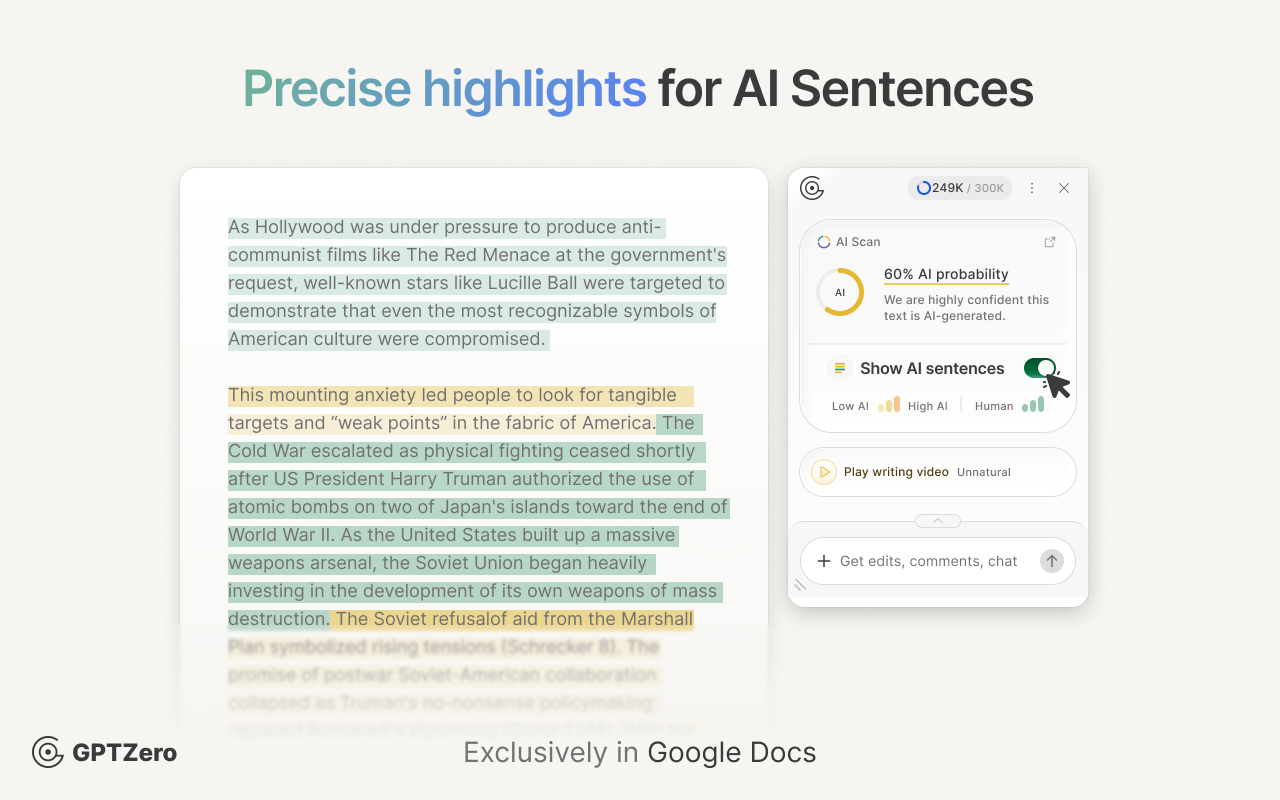
Want a second signal before you start that conversation? Run the assignment through GPTZero and review the highlighted sections alongside drafts and revision history.
6 Signs Your Child Might Be Using AI for Homework
While none of these are definitely proof of AI use, when several happen all at once, that might be a sign to take a closer look at your child’s work.
1. The writing randomly sounds much more advanced
If your child’s homework suddenly includes phrases, structures, or vocabulary that feel far beyond their usual level, that may be a sign of AI assistance. If your 13-year-old is using a tone that sounds more like a university professor’s, then that could be worth examining.
2. The work is polished but generic
AI writing often sounds smooth, with zero typos and extremely clean grammar. However, it can also ring slightly hollow, making sweeping claims without clear examples, and sound impressive without actually saying anything original.
3. There is no personal voice
Human writing usually has some semblance of a person behind it, with students choosing specific examples or having styles such as over-explaining, or rushing through ideas. Meanwhile, AI-generated writing can feel flat and devoid of any personality.
4. They finish unusually quickly
If your child typically takes a couple of hours to put together an essay and then all of a sudden can churn out a pretty polished response in ten minutes, that could be another red flag, especially if there aren’t any notes or drafts backing up the work.
5. They cannot explain what they wrote
This is one of the most obvious signs: if your child’s submission is strong, but when you question them in person, they cannot walk you through the argument or explain key terms, then that could be a sign that they haven’t done any of the intellectual heaving lifting themselves.
6. The sources are fake or missing
AI tools can sometimes produce “hallucitations”, as in, inaccurate information, weak citations, or sources that do not exist. (GPTZero has a Hallucination Checker to catch this exact issue.) If your child’s homework doesn’t have a trail of legitimate and valid sources, ask them to show you where they got the information.
Why It’s Hard to Tell If Your Child’s Homework Is AI-Generated
It’s only getting tougher to tell the difference between AI-generated writing from human writing as AI tools are becoming more fluent and embedded in everyday writing software. This is something schools are grappling with too.
The National Literacy Trust found that more than 2 in 5 teachers were concerned about pupils using generative AI in 2025, while nearly 9 in 10 teachers agreed that students should be taught to engage critically with AI tools. It’s a tension that parents need to be involved with as well, as AI is not going anywhere, but also, shouldn’t be used as a replacement for learning.
Should You Use AI Detection Tools Like GPTZero?
GPTZero can help you identify whether a piece of writing shows patterns commonly associated with AI-generated text. It can be useful when you want another signal, especially if something about the work feels unusual and you want to review it more carefully.
It can help parents check whether a piece of writing may have been generated or heavily edited by AI, identify sections that may need closer review and start a conversation about how the work was produced. Still, it’s important to convey to your child that AI detection tools are not 100% accurate.
A high score is not proof, and a low score is not clearance. Instead, think of any AI detector as a decision support tool. It can slow the process down and give you something concrete to review.
How to Talk to Your Child About AI & Homework
If you want to discuss the AI issue with your child, then the way you bring up the conversation really matters. A starting point that is more curious rather than accusatory can sound like this:
- “I heard a lot of students are using AI now, is that true? I’d love to understand how you’re using it.”
- “This sounds different from your usual writing! Want to talk me through how you worked on it?”
- “I’m curious: did you use any tools to help with this assignment?”
You can also take this as an opportunity to set some family rules around AI use. That could look like:
- AI can be used to explain a topic, but not write the final answer.
- AI can help with grammar, but not rewrite the whole assignment.
- Any AI use (at all) should be disclosed if the school or teacher asks for it.
- Your child should be able to explain every sentence they submit.
AI is such a new area, and overall, the most important rule should be that AI is there to support learning where permissible. At the end of the day, your child still has to do the intellectual work themselves.
One Department Head told us their approach is about “holding students accountable to actually doing their own work, saying, ‘We notice your voice and we want to cultivate it and when you don't write in your own voice, we care enough to notice’. We emphasize that we would rather have them be interesting than perfect.”
What Parents Should Do and Should Not Do
What parents should do
Be curious about the process. How did they plan, draft, research, and revise the work?
Compare with past writing. Look for sudden changes in voice, vocabulary, or structure.
Check the school’s AI policy. The same behaviour may be acceptable in one class and not allowed in another.
Teach disclosure. If your child used AI, they should learn how to say so honestly.
Explain Writing Replay. Show your child how to document their writing process with tools like GPTZero’s Writing Replay.
What parents should not do
Do not jump straight to accusations. A false accusation can damage trust.
Do not assume polished writing means cheating. Some students are strong writers. Some have had help from parents, tutors, teachers, or grammar tools.
Do not ban AI without explaining why. A blanket ban may push AI use underground.
Do not ignore it either. Children need guidance on what responsible AI use looks like.
Concerned that AI may be replacing your child’s learning process? Try GPTZero as part of your review process.
Conclusion
AI can be a useful study tool. It can explain confusing concepts, help students get unstuck, and make learning feel more accessible. But it can also become a shortcut that prevents children from building the skills homework is meant to develop: thinking, writing, problem-solving, and confidence in their own ideas.
The best approach is balanced. Look at the work. Ask about the process. Compare it with past writing. Use tools like GPTZero carefully. And most importantly, talk to your child before you assume the worst.
Because the goal is not simply to know whether AI was used. The goal is to help your child understand when AI supports learning — and when it starts doing the learning for them.
FAQs
How can I tell if my child is using AI?
The key thing is to look out for random changes in writing style: if your child’s work suddenly sounds much more sophisticated than usual, or doesn’t have a distinct personal voice, then AI may have been involved. The fairest way to check is to ask your child to walk you through their thinking process, review drafts, compare with past work, and use an AI detector as one signal.
When does AI use become obvious?
AI use often becomes obvious when the final homework does not match the child’s usual ability or process. As an example, they may churn out a highly polished essay very quickly or submit work that has no paper trail, like research notes. It is also suspicious when the answer sounds polished but does not actually address the question asked.
Is using AI always cheating?
AI use is not always cheating, and it depends on how it was used and what the school or teacher allows, as each classroom can have a different policy. Using AI in certain cases may be acceptable in some settings, but if your child is using AI to complete their work entirely and then submit the work as their own, that’s much more likely to be breaking academic rules.