How to Establish AI Policies for Your High School
Here is how to build an AI policy that outlines acceptable use and protects academic integrity at your institution.


If AI policies were easy to create, each school would have one by now. But in our own GPTZero survey, we found that only 20% of the educators we surveyed reported having a school-wide AI policy that was consistently applied.
When students are operating in an environment where AI policies aren’t established, it’s easier for problems around AI to come up: students can face consequences for bending rules that were never explained, and staff can end up confused about where the boundaries lie.
In this guide, you’ll learn how to create a practical high school AI policy that gives teachers rules, helps students understand acceptable AI use, and can evolve as the technology changes.
TL;DR
It’s best to create a concise set of rules, backed up with more extensive guidance, that can evolve quickly if necessary. These rules need to outline acceptable AI use at the assignment level, and ideally, ask students to disclose their AI assistance and take responsibility for what they submit. If you’re using an AI detector at your institution, make sure you treat any detector result as just one data point in a broader review process.
What Is a High School AI Policy?
At first glance, a high school AI policy is an agreed set of rules for how students and staff are going to approach AI use while they are at the institution. In reality, it’s also a collective promise around how students and staff are going to deal with the new questions AI is bringing up.
One example is Park East High School’s AI policy, which follows a guiding principle that “AI should be used to enhance learning, rather than as a shortcut to learning”. There is also a traffic-light system that takes away ambiguity at the assignment level: assignments are coded “red” by default unless a teacher allows AI use, and yellow and green assignments allow specific forms of assistance. There are also practical pointers like specific examples, disclosure requirements, privacy protections and proportionate consequences.
Yet this is far from being the norm in most high schools. In 2024, only 31% of U.S. public schools had a written policy around student AI use. And in our GPTZero survey, we found that 54% did not yet have a school-wide policy in place: 20% had no policy, 19% said one was being developed and 15% described a patchwork of departmental or teacher-led policies.
At a high level, in a strong school AI policy, there should be an answer to six questions:
How to Write an AI Policy for Your High School
In our GPTZero survey, nearly one in three respondents (32%) reported that the biggest challenge schools face when establishing an AI policy is distinguishing acceptable AI support from cheating. A further 24% identified the pace of technological change. This shows that schools are struggling first with defining and maintaining workable rules, and then with making sure staff can interpret and apply them consistently.
One college professor from the GPTZero community described how the same challenge is playing out in higher education: “I was granted a sabbatical next semester to work on this policy for my college. Our college doesn’t have an institution-wide AI policy because every faculty member has a different perspective on it. But I would say 100% of students are using AI, and when I say that, I mean grammar checkers, Grammarly, built-in copilots on Google’s platforms and all these different things they can use ethically. Where we draw the line is what we have to define.”
For schools with no policy, a helpful starting point is TeachAI’s school toolkit, which is designed to help communities “realize the potential benefits of incorporating artificial intelligence (AI) in primary and secondary education while understanding and mitigating the potential risks”.
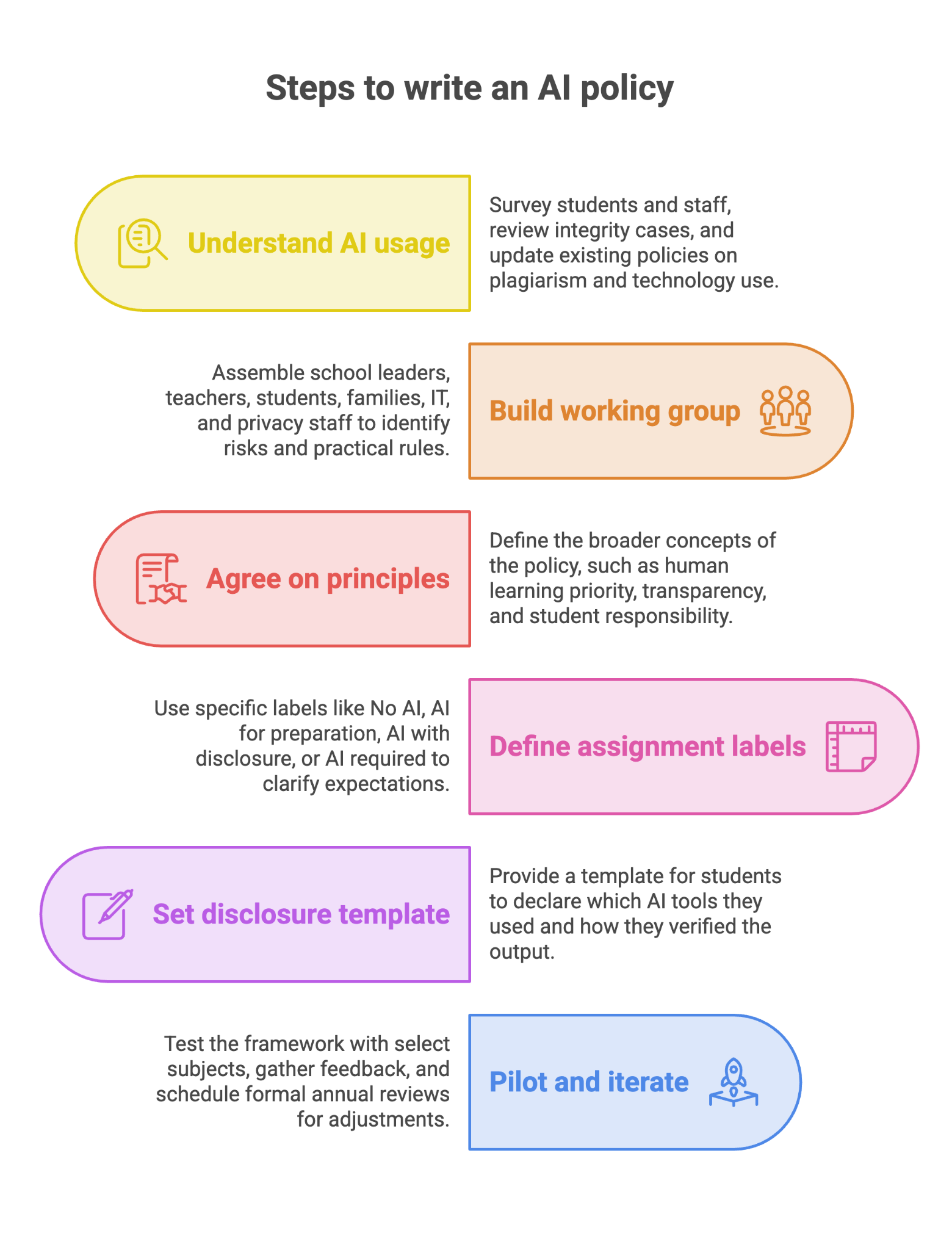
We also recommend the following steps.
1. Understand how AI is already being used
Send surveys to students and staff, look at recent integrity cases and see where exactly AI is helping and where confusion is highest. Then look at your existing policies on plagiarism, acceptable technology use, assessment, student privacy, and staff conduct, as AI may require updates across all of them.
2. Build a working group
This group will ideally include school leaders, teachers from different subjects, students, families, IT, librarians, counselors, special education staff and privacy or legal leads. In this group, students can show which tools are actually being used and where proposed rules will be hard to put into practice. Teachers can discuss how those rules will influence assessment, while IT and privacy staff can identify risks that may not be obvious.
As one instructor from the GPTZero community shared, peer collaboration can help: “I have this wonderful professional learning group where we can bounce things off each other, and we’ve created an AI statement and things to help guide us, too. It’s been rewarding and new.”
3. Agree on principles before writing rules
Before getting into granular rules, agree on the broader concept of what this AI policy is hoping to achieve. Some starting points could be around how human learning comes first, AI must be used transparently, or each student must take responsibility for their own work.
4. Define how AI use is allowed at the assignment level
Although it can be tempting to default to blanket bans, generally what works more effectively is to give teachers a defined set of labels to put on assignments. For example:
- No AI: The task is looking at independent knowledge.
- AI for preparation: Students may use AI for specific tasks, but their submitted content must be their own.
- AI with disclosure: Students can use approved AI for specific parts of the process but must explain how it has been used.
- AI required: Using and evaluating AI is part of the learning objective.
Assignments should also specify if a grammar checker counts as AI assistance. This leaves room for the inevitable grey area emerging with AI use. It also helps to define exactly what happens if a student is found to break the rules.
As Park East High School spells out in its ‘consequences for misuse’: “If a student is found to be misusing tools like ChatGPT, you will receive one or more of the following, depending on the degree of misuse: a phone call home, lunch detention, an opportunity to redo the work on a strict timeframe, after which a zero will be entered.”
5. Set a template disclosure statement
If students are going to use AI responsibly, it can be very helpful to have a template they can follow for a disclosure statement. This can be as simple as:
I declare that this is my work and that I used [this AI tool] to [what they used it for]. I reviewed and changed the AI output by [doing this]. I verified [facts, sources or calculations].
It can also make sense for teachers to ask students to attach specific prompts used. The main responsibility for accuracy and originality should stay with students. Encourage them to check primary sources and use a hallucination detector as an extra review step.
As Dr Will Van Reyk, Deputy Head, Director of Innovation at St Paul’s Girls’ shares, “A binary ‘AI/not AI’ signal tells us almost nothing about what a student actually knows or how they arrived at their work…. Students need opportunities to discover where models hallucinate, oversimplify, reproduce biases, make weak arguments sound convincing and confidently invent evidence.”
6. Pilot then iterate
As our CTO Alex Cui has said of GPTZero: “We are defining the solution to the biggest question facing schools in decades: "How do we evolve education in the age of LLMs?"... The answer is more complex than going-all-in on AI or banning AI.” These are complicated issues, which is why it’s worth testing any framework with a few subjects first before an institution-wide rollout.
Let teachers sample assignment labels and scenarios as well as letting students have some practice in documenting their process, and adjust as necessary. Put a formal review in the calendar at least once a year, but giving space for the living guidance and approved-tools list to change sooner.
Looking for a starting point? Below is our copy-and-customize High School AI Policy Template.
Who Should Be Involved in Creating the Policy?
A broad working group matters, as does making it clear who owns which part of the policy. The working group could include a governing body, who approves formal policy where required; academic leaders, who align the rules with teaching practices; teachers and students, who will be using the policy themselves; and IT staff, who can share data practices.
In terms of making it an inclusive exercise, Education Week shone a spotlight on Tracey Metcalfe Rowley, the senior director of educational technology and online learning for the Tucson Unified School District in Arizona. She said: “I think you have to come from the point of view that it’s already there. People are using it. So, let’s tell people how to use it responsibly and ethically.”
A couple of years ago, she brought together a task force of more than 40 people, which included district employees, from teachers and principals to people working in human resources and transportation. Essentially, anyone who wanted to join could be part of the group to come up with AI guidelines. These became the basis of her district’s AI policy.
She describes the policy as concise and “focused on responsible and ethical AI use for students, parents, and staff.” The guidelines cover AI use by both teachers and students, including topics such as AI-assisted grading, syllabus updates, and how teachers should communicate acceptable AI use.
Benefits of AI Policies for High Schools
Nearly 80% of those we interviewed in our GPTZero survey did not report having a consistently applied school-wide policy. It shows that coming up with an AI policy is still relatively new. Still, a consistently applied policy can:
- Provide consistency: Students face the same core expectations across classrooms, with task-specific differences made very clear to them.
- Protect academic integrity: Rules make it obvious what is legitimate support versus outsourcing the thinking that an assignment is designed to assess.
- Reduce privacy risks: Staff know which tools are approved and what information must never be entered.
- Build AI literacy: Students get into the habit of questioning AI outputs and also using technology transparently.
- Support fairer decisions: Teachers follow a shared review process instead of treating suspicion or a single score as proof.
If your school is building an AI policy, try GPTZero’s AI detector as part of a broader review process.
Conclusion
A strong policy is better than a perfect policy, and most are works-in-progress in any case. What both students and staff need are boundaries around how they can use AI, paired with honest communication. Once there is a process in place, rooted in transparency and responsibility, it can be supported with more detail as time goes on.
After all, as Tom Driscoll, CEO of EdTechTeacher, shared in the video below: “The purpose of our AI policy is not just to make sure kids don’t use AI. It’s when they are using it, or when educators are using it, it’s aligned with our values and our vision.”
FAQs
How should students disclose AI use?
Ask students to name the tool, what they used it for and how they edited the output. For significant AI assistance, teachers can also ask for the prompts used. It’s best to keep any template for AI disclosure concise so that students are more likely to use it consistently.
Can an AI detector prove that a student cheated?
There is no such thing as a perfect AI detector, and we always recommend treating detection as one signal to investigate further. It’s helpful to have a conversation in which the student explains their process, and a positive AI detection result should never automatically trigger punishment.
Should high schools ban AI tools?
While a blanket ban can be tempting, it’s harder to enforce, and in the long run, it does not teach responsible use. TeachAI recommends looking at privacy and learning goals instead of leaning on a general ban.