What AI Range Is Acceptable? Teachers and Students Weigh In
While there is no universal answer to what AI range is permitted, here we explain how to interpret AI scores and what to focus on during a review.


While AI adoption is broadening among U.S. university students and educators, half think higher education is not fully prepared to manage its impact. A prime example of this is how there is no universally acceptable range for students, while some institutions are doing blanket bans on AI, others have blurrier policies, often leaving the judgment calls to individual educators.
When we spoke to educators in the GPTZero community, there was no firm consensus on what AI score should trigger concern: just over a third (31.6%) of educators would start investigating at 21-40%, while 16.2% said a score as low as 1-20% would make them take a closer look.
In this guide, we break down the question of what range of AI use is acceptable. By the end, you will know why there is no universal “acceptable” AI percentage, how to interpret a detection result responsibly, and what to review before making a decision about student work.
TL;DR
There currently isn’t a broadly “acceptable” AI percentage, as some institutions ban AI entirely, while others allow it in a variety of ways. Our educator research shows teachers vary widely in when they start investigating AI use: while some start looking more closely at an AI score of 1-20%, others see 50% or higher as the tipping point.
What Is an AI Score?
The first thing to understand is how AI scores work. An AI score comes from when an AI detector analyzes how text is written to figure out the probability of whether it was created by a human or an AI, as AI detectors look for patterns that may be more common in AI-generated writing than in human writing. GPTZero uses a deep learning model that analyzes writing at the document and sentence level, then returns a classification and confidence signal to help users interpret the result.
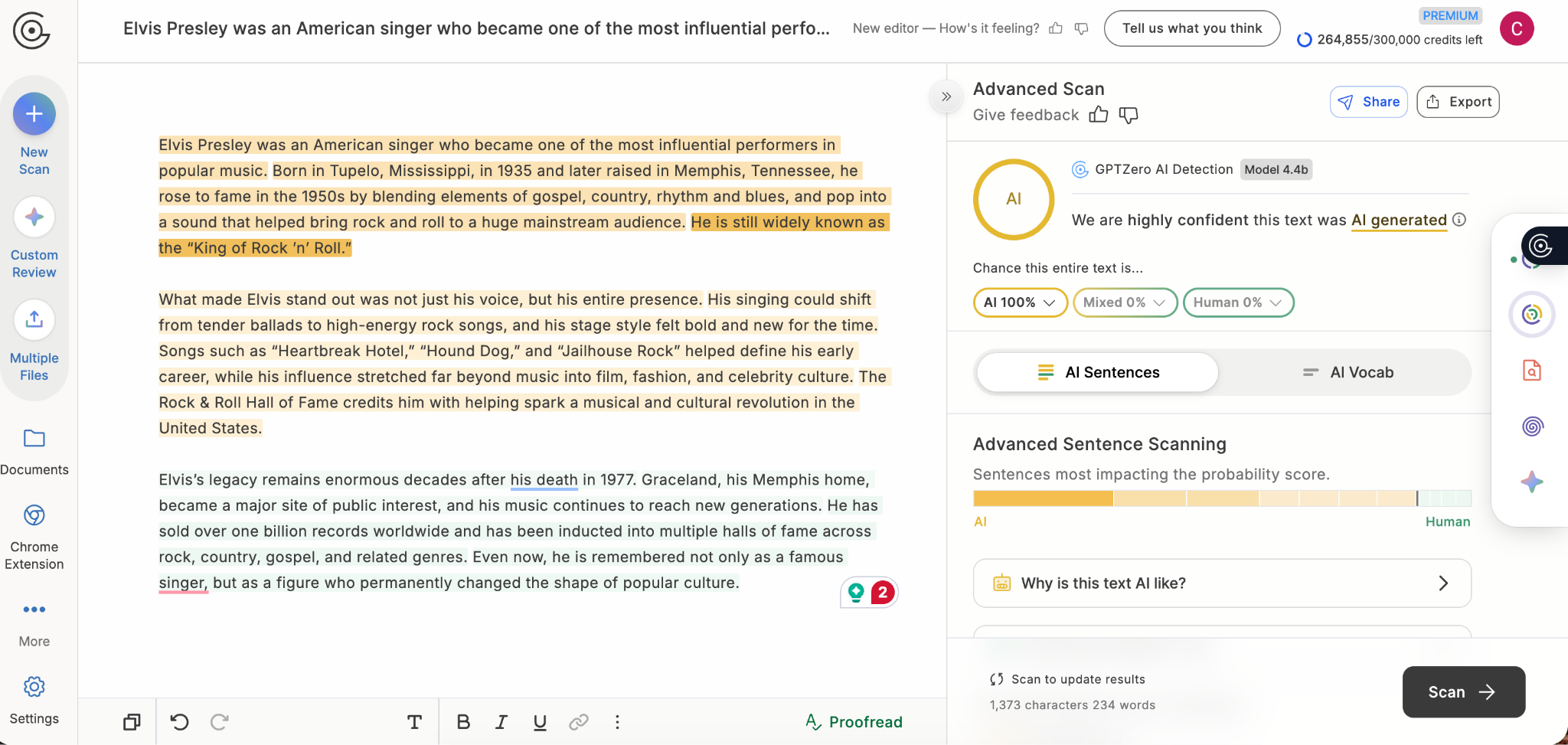
Importantly, an AI score is only an estimate of how likely a piece of writing is to have been written by AI. It is usually a percentage, with lower scores indicating it is likely to be human-written, and higher scores pointing towards being more likely to be AI-generated. While a huge misconception is that the percentage means, “This percentage of the document was created by AI”, that isn’t always how AI scores work.
GPTZero does not treat a result as proof that a specific percentage of a document was written by AI. Instead, it analyzes patterns across the document and can classify writing as human-only, mixed, or AI-only, alongside a confidence signal. No detector is perfect, as they can make mistakes, so human judgment is always part of the process.
Need more context than a single percentage? Use GPTZero’s Advanced AI scan to review document-level results, confidence signals, and sentence-level patterns before deciding what to investigate further.
What AI Percentage Is Generally Considered Acceptable?
While the above might seem straightforward enough, the difficulty is that different schools and instructors have broadly varying levels of acceptable AI use. It is still the very early days of AI policy. In fact, this is illustrated by the growing popularity of the AI Assessment Scale (AIAS), developed by Mike Perkins, Leon Furze, Jasper Roe, and Jason MacVaugh.
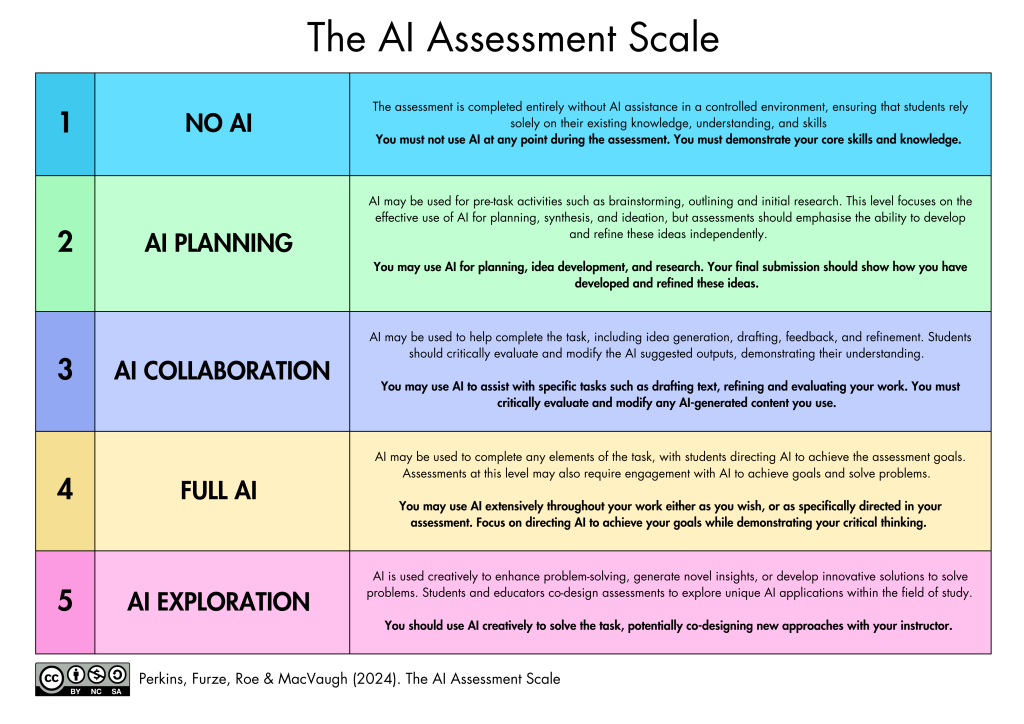
The above shows how much of a range there is within education – yet educators still urgently need a practical method they can use to interpret AI scores. There isn’t even a universal definition of what a high AI score is: some university policies treat anything over 15% AI as serious enough to trigger academic penalties or even an automatic fail, and other institutions are even stricter, with any form of AI at all being totally banned.
According to the educators we’ve spoken to in the GPTZero community, many see 50% or higher as the main red flag. That level often triggers a closer review of the document’s version history, an oral exam, or a direct conversation with the student to check their understanding of the material. One grad student and grader said, “If it's 53% AI-generated, then I would ask the student to rewrite it because it's more than 50% AI generated.”
A college writing professor described a similar approach: “The last question in the workshop that students have to do on two other students' drafts is they have to take three paragraphs from the student, click on a link which leads them to GPTZero, and they have to paste it in, and they have to give me the results. For the last answer to the workshop, they give the student the results, and if it comes back higher than 50%, they have to send me an email to indicate that the student got a higher than 50% usage, and they let the student know.”
Why There Is No Universal Acceptable AI Percentage
As Akhil Bhardwaj observed in The Times Higher Education, “Navigating the current administrative set-up in an effort to respond to the opportunities and challenges of AI is like trying to use the same tracks for high-speed trains as were used for steam engines.” He continues, “To respond to the challenges the advent of AI poses, we may need to rip up the existing tracks and rethink higher education considerably.”
This creates a practical challenge for educators who need to apply policies fairly, which becomes obvious in even the most thoughtful institutional guidance. For example, the University of Edinburgh tells students generative AI can be used “creatively, critically and with integrity”, but also says its guidance is only a university-wide starting point. As in, each course has its own specific rules, and students need to check their course documentation or speak to their Course Organiser if they are unsure.
This makes sense as AI can be used very differently in a coding assignment compared to a take-home exam. Yet fundamentally, it means both educators and students are dealing with a constantly moving target. Technology is moving faster than education policy can realistically keep up, and until that gap closes, it seems like there just won’t be one percentage that applies everywhere, leaving it up to individual institutions and educators to decide what is appropriate.
What Teachers and Students Actually Think Is Acceptable
At GPTZero, we spoke to over a hundred educators about what AI detection score or range would make them start further investigating a student’s work. The most common answer was 21-40%, chosen by just over a third (31.6%) of respondents.
Meanwhile, over a fifth (23.1%) chose 41-60%, and 16.2% said they would start investigating at just 1-20%. A small group selected none of the above, which demonstrates they may not use a fixed percentage range at all.
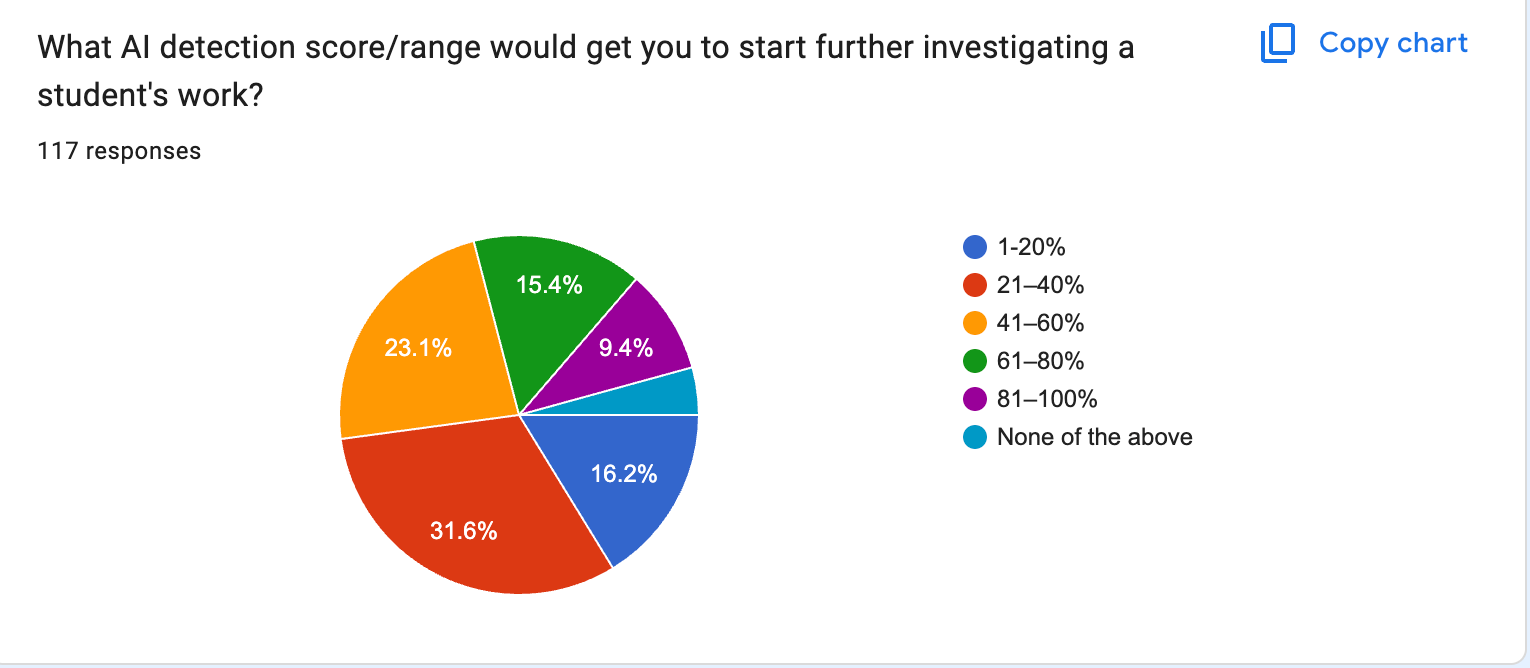
This only further demonstrates how much institutions can reduce uncertainty by making course-level AI expectations specific, visible, and consistent. Until then, students are left in a guessing game of trying to understand what counts as acceptable AI use. One student described using their own informal gauge before submission: “I usually use advanced scan on GPTZero. Usually, my threshold is 10% AI generated. I don't consider mixed as very suspicious as I haven't noticed any problem yet.”
Even if a paper comes back with a 100% AI score, educators often treat even that with caution, especially if the subject matter includes technical language. As one evaluator explained: “If it's saying 100%, I don't really trust it because there's no way someone submits like a paper completely just copy-pasted from ChatGPT.”
How to Review an AI Detection Result Fairly
When it comes to reviewing an AI detection fairly, we recommend this four-step framework:
- Check the assignment policy. Was AI permitted, limited, or prohibited for this task?
- Review the full document result. Look at the classification and confidence, not one highlighted sentence.
- Look for supporting context. Consider drafts, version history, citations, writing process, and the student’s understanding.
- Start a conversation. Ask the student to explain their ideas or process before making an academic-integrity decision.
After all, although an AI score can help you decide what to look at next, it will not tell you everything about how a student put together their work. Ideally, an AI score is taken within the context of the course policy (and if required, a conversation with the student).
Why Do Different AI Detectors Show Different AI Scores?
Complicating all the above even further is the fact that different AI detectors have different models and methods. This is because they are more like – as we explored above – probability calculators, with each detector using its own specific training data and algorithms, meaning that the same sample can come back with massively varying percentages when run through different tools.
For instance, Turnitin says its AI detector is fairly reliable, as long as the text is long enough: for submissions over 300 words, it reports a false positive rate of under 1% and says extensive testing (including on hundreds of thousands of pre-ChatGPT essays) shows no meaningful bias against non-native English writers. But it gets shakier on short pieces: under 300 words, there simply isn’t enough signal, and false positives become more likely.
Major Australian university Curtin University disabled Turnitin’s AI-writing detection feature from January 1, 2026, while continuing to review assessments for academic integrity. This shows how institutions are still figuring out the balance between detection and trust and assessment design.
It’s important to remember that different detectors rely on different math and models, specifically: “Some focus on perplexity math, others on neural networks or hybrid models. This leads to different verdicts.” Also, many detectors were trained on older models (such as GPT-2 and GPT-3), which can mean they are simply less reliable at deciphering content from more advanced models such as GPT-4o or Claude 3.
Why use GPTZero?
Watch our founder Edward Tian on CNBC, discussing how to address concerns of AI plagiarism
GPTZero is consistently rated the most accurate commercial AI detector, outperforming competitors on the massive independent RAID benchmark. Independent reviewers, including Tom’s Guide, which tested all major AI detectors, found GPTZero to be the most accurate, achieving up to 99% accuracy across diverse datasets verified by AI research labs at leading institutions.
We also have a publicly available standardized benchmarking page, where you can find the results of a comprehensive evaluation of our AI detector across a variety of domains, LLMs, and languages. Evaluations are updated quarterly, and raw predictions are available for researchers interested in reproducing results.
In short, we’re built for responsible AI detection in education – and our model analyzes writing at the document and sentence level, provides human, mixed, or AI classifications, and gives confidence signals so educators can interpret results with context. GPTZero also keeps false positives low and is designed with education use cases, including ESL de-biasing, in mind.
Conclusion
As there is no universally accepted AI range, an AI score can only be interpreted alongside the individual classroom policy and assignment instructions. Our research shows teachers have very different views around when to start investigating, emphasizing that an AI score should be treated as just one data point, to help teachers start a conversation with the student about how the work was created.
FAQs
Is 10% AI detection acceptable?
The first thing to remember is that a 10% AI detection score doesn't necessarily mean that AI wrote a tenth of the document. Instead, while it depends on the tool, the score is likely to point towards a one out of ten chance that the document was written by AI. However, if the policy in that classroom is to ban all AI use, including allowing grammar tools, then even a low score is unacceptable. The main thing you need to do is to check that classroom’s specific policy and the assignment instructions.
Does a 20% AI score mean 20% of the content was written by AI?
A 20% AI score is typically worth reviewing, although a 20% AI score on GPTZero does not automatically mean that 20% of the content was written by AI. At GPTZero, an AI percentage is more like a probability score, so a 20% score can show that the text has some patterns associated with AI writing.
Can human writing be flagged as AI?
Yes, human writing can be and has been flagged as AI, known as a false positive. It typically happens when human writing comes across as repetitive or generic, and multilingual students, as well as those using legitimate writing support, can also be unfairly affected.
Why do different AI detectors show different scores?
Different AI detectors use different models, as well as varying datasets and scoring systems. You can see more about GPTZero’s benchmarks here, and the data shows how the different AI detector tools often do not return the exact same result for the same text.